EU AI Act
What does EU AI Act Article 4 require for AI literacy training?
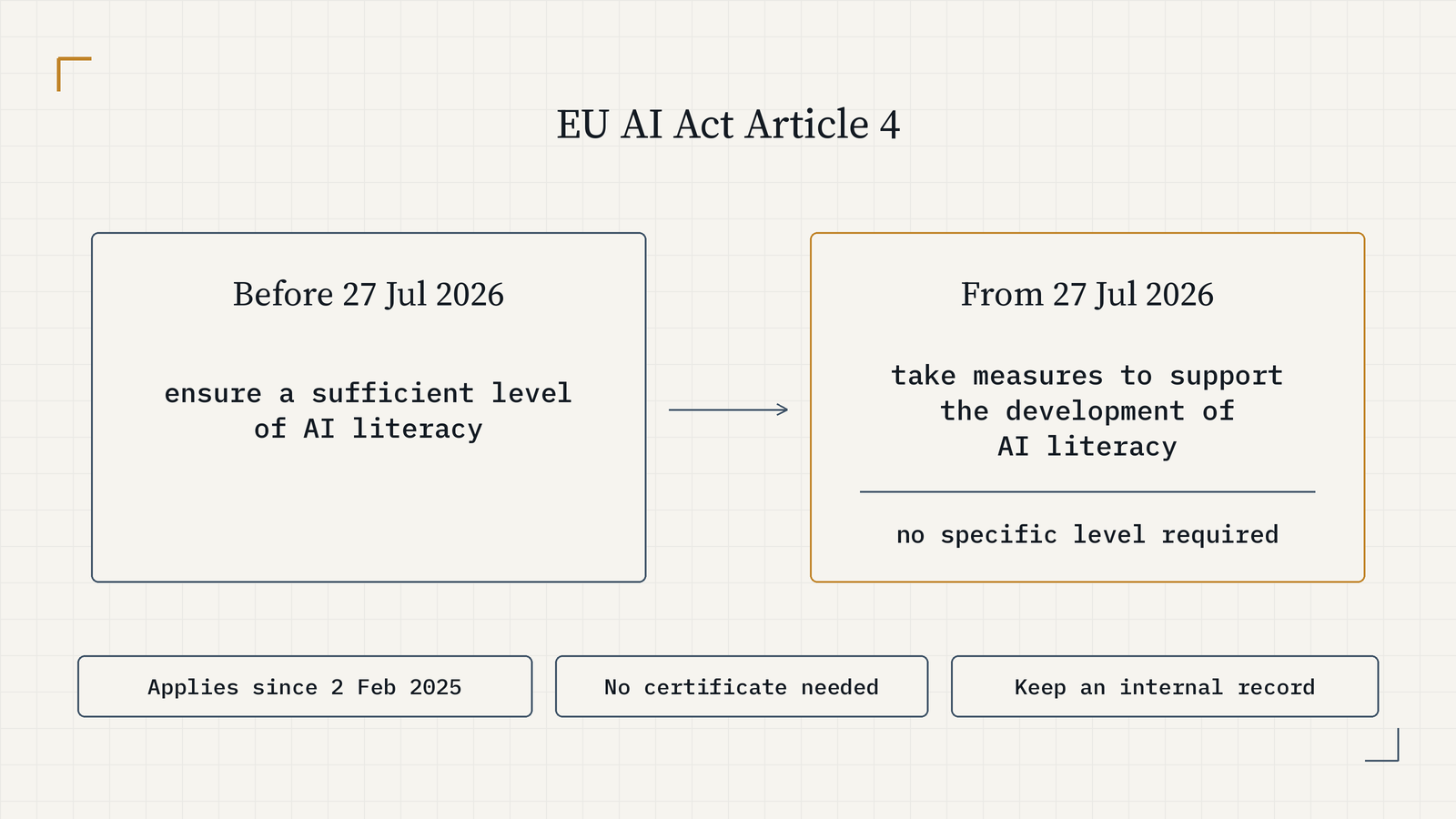
Article 4 of the EU AI Act has applied since 2 February 2025. It requires every provider and deployer of an AI system to act on the AI literacy of its staff. In July 2026 the EU rewrote it: the duty to act stayed, but the old "sufficient level" standard went. This page sets out what the amended Article says, what the European Commission says about training and certificates, and what a learning and development team can do this quarter.
Every quotation below is from Regulation (EU) 2024/1689, the amending Regulation (EU) 2026/1744, or the Commission's AI literacy questions and answers, all read on 2 October 2026. This is not legal advice.
What does Article 4 say now?
Regulation (EU) 2026/1744, the Digital Omnibus on AI, replaced Article 4 in full. Paragraph 1 now reads:
Providers and deployers of AI systems shall take measures to support the development of AI literacy of their staff and other persons dealing with the operation and use of AI systems on their behalf, taking into account their technical knowledge, experience, education and training and the context the AI systems are to be used in, and considering the persons or groups of persons on whom the AI systems are to be used. This obligation does not require providers or deployers to guarantee any specific level of AI literacy of any individual.
Paragraph 2 tells the Commission and the Member States to support organizations, in particular SMEs, and requires the Commission to publish practical examples of how to comply. Paragraph 3 asks the European Artificial Intelligence Board to adopt recommendations, taking into account European competence frameworks, including common objectives.
What changed in July 2026?
The wording of the duty. The original Article 4 said providers and deployers "shall take measures to ensure, to their best extent, a sufficient level of AI literacy". The amended text says they "shall take measures to support the development of AI literacy", and adds that this does not require any specific level of AI literacy of any individual.
The duty itself survived. The Commission's proposal of 19 November 2025 would have turned Article 4 into a duty on the Commission and the Member States to encourage organizations. The adopted text kept the obligation on providers and deployers. Recital 8 of the amending Regulation explains why: stakeholders said a solution "imposing stringent obligations to ensure a sufficient level of AI literacy would not be suitable for all types of providers and deployers". The amendment was signed on 8 July 2026, published in the Official Journal on 24 July 2026, and entered into force on 27 July 2026. Our Digital Omnibus guide covers its other changes.
Who has to act on AI literacy?
Providers and deployers of AI systems. A deployer is "a natural or legal person, public authority, agency or other body using an AI system under its authority except where the AI system is used in the course of a personal non-professional activity". That reaches most employers whose staff use AI at work, and the Article covers "other persons" dealing with AI systems on the organization's behalf, such as contractors, as well as staff.
The Commission's Q&A gives an everyday example. Asked whether a company whose employees use ChatGPT to write advertisement text or translate must comply, it answers: "Yes, they should be informed about the specific risks, for example hallucination." Our guide to provider and deployer roles helps if you are unsure which role you hold for a given system.
What counts as AI literacy?
Article 3(56) defines it, and the 2026 amendment left the definition unchanged:
'AI literacy' means skills, knowledge and understanding that allow providers, deployers and affected persons, taking into account their respective rights and obligations in the context of this Regulation, to make an informed deployment of AI systems, as well as to gain awareness about the opportunities and risks of AI and possible harm it can cause;
Read with Article 4, that gives a training brief with four inputs: the person's technical knowledge, experience, education and training; the context the AI system is used in; the people it is used on; and both the opportunities and the risks, including possible harm.
Do staff need a course or a certificate?
Neither is required. On certificates the Commission's Q&A is direct: "There is no need for a certificate." It adds that organizations can keep an internal record of trainings and other guidance. On format it says there is no one-size-fits-all approach and "no strict requirements or mandatory trainings are imposed".
That does not mean a reading list is enough. The same Q&A warns that "in many cases, simply relying on the AI systems' instructions for use or asking the staff to read them might be ineffective". It also says no specific governance structure, such as an AI officer or a governance board, is mandated for Article 4.
The Commission's Q&A, last updated 27 July 2026, is not legal text, and parts of it lag the amendment: one answer gives enforcement from 2 August 2026 and another from 3 August 2026, and one says the amendment entered into force in mid-July. The Official Journal gives 27 July 2026. Where they differ, rely on the Regulation.
AI literacy training record
Person or role,Team,AI systems used,Our role for each system (provider or deployer),What the person uses it for,Main risks for this use,Training or guidance given,Format,Date completed,Covers opportunities and risks (yes or no),Covers possible harm to people (yes or no),Evidence kept (where),Next review date,Notes
Example: marketing executive,Marketing,General-purpose chatbot,Deployer,Drafting advertisement text and translations,"Hallucination; confidential data pasted into prompts",Internal guidance note and 30-minute briefing,Live session,2026-10-15,yes,yes,LMS completion record,2027-04-15,"The Commission's AI literacy Q&A gives this use case: staff should be informed about specific risks, for example hallucination."
,,,,,,,,,,,,,
,,,,,,,,,,,,,
,,,,,,,,,,,,,
"Article 4 of the EU AI Act, as amended by Regulation (EU) 2026/1744: providers and deployers shall take measures to support the development of AI literacy of their staff and other persons dealing with AI systems on their behalf. No certificate is needed; the Commission's Q&A says an internal record of trainings and other guiding initiatives can be kept. Template from credentialpress.com/guides/eu-ai-act-article-4-ai-literacy. Not legal advice.",,,,,,,,,,,,,
Who enforces Article 4, and what are the penalties?
The Commission's Q&A places enforcement with national market surveillance authorities. Penalties come from national rules that each Member State lays down under Article 99(1). Article 99 fixes fine ceilings for the Article 5 prohibitions and for a listed set of other obligations, and Article 4 is not on that list, so the amount depends on national law. Our guide to EU AI Act dates and fine tiers sets out the ceilings that do exist.
Is there a separate training duty for high-risk AI?
Yes, and it is stricter. Article 26(2) requires deployers of high-risk AI systems to "assign human oversight to natural persons who have the necessary competence, training and authority, as well as the necessary support." After the 2026 amendment, that duty applies from 2 December 2027 for systems that are high risk under Annex III, such as AI used in recruitment, and from 2 August 2028 for those under Annex I. The guide to the Annex III high-risk areas helps you check whether any of your systems qualify.
What should a learning and development team do now?
Our suggestion, built from the Article's own factors:
- List the AI systems in use, who uses each one, and whether you are the provider or the deployer.
- Group people by role and by risk, because the Article ties the measures to each person's knowledge and to the context of use.
- Give each group guidance or training that covers what the system is for, its known risks, and possible harm to the people it is used on.
- Keep an internal record of what each person received and when, and set a review date.
- Watch for the Commission's practical examples under Article 4(2) and the Board's recommendations under Article 4(3), and adjust.
The training record above has a column for each of those steps.
Where do certifications fit?
Article 4 does not require anyone to hold a certification. They suit the people who design and run an AI governance program, rather than every user. The IAPP's AIGP covers AI governance across laws and frameworks, and our AIGP exam study guide follows the IAPP's 2026 blueprint. For the management system side, the ISO/IEC 42001 Lead Implementer book follows PECB's exam. For the Act itself, the AI governance framework handbook traces each obligation to its Article; it was written to the 2024 text, so read it alongside the July 2026 amendments. The teams page lists every book by role.
What should you do this week?
Download the training record, list the AI systems your organization uses, and fill in the first three columns. That inventory is the base for everything Article 4 asks.
Frequently asked questions
Is AI literacy training mandatory under the EU AI Act?
Article 4 requires providers and deployers of AI systems to take measures to support the development of AI literacy of their staff and others who operate or use AI systems on their behalf. Since the July 2026 amendment it does not require any specific level of AI literacy, and the Commission's Q&A says no strict requirements or mandatory trainings are imposed. Some measure is required; a set course is not.
What changed in Article 4 in 2026?
Regulation (EU) 2026/1744, in force since 27 July 2026, replaced Article 4. The old text required measures to ensure, to the organization's best extent, a sufficient level of AI literacy. The new text requires measures to support the development of AI literacy, and says the duty does not require any specific level of AI literacy of any individual.
Do employees need an AI literacy certificate?
No. The European Commission's AI literacy Q&A says there is no need for a certificate, and that organizations can keep an internal record of trainings and other guiding initiatives.
Does Article 4 apply if staff only use ChatGPT?
Yes, according to the Commission's Q&A. For a company whose employees use ChatGPT to write advertisement text or translate, it says staff should be informed about the specific risks, for example hallucination.
Who enforces Article 4?
National market surveillance authorities, under penalty rules each Member State lays down, according to the Commission's Q&A. Article 99 sets no specific fine ceiling for Article 4: its ceilings name Article 5 and a list of other provisions.
When did Article 4 start to apply?
On 2 February 2025, with the rest of Chapters I and II of the AI Act. The July 2026 amendment changed the wording, not the date.
EU AI Act: test yourself in five minutes
Which books help the people who run AI governance?
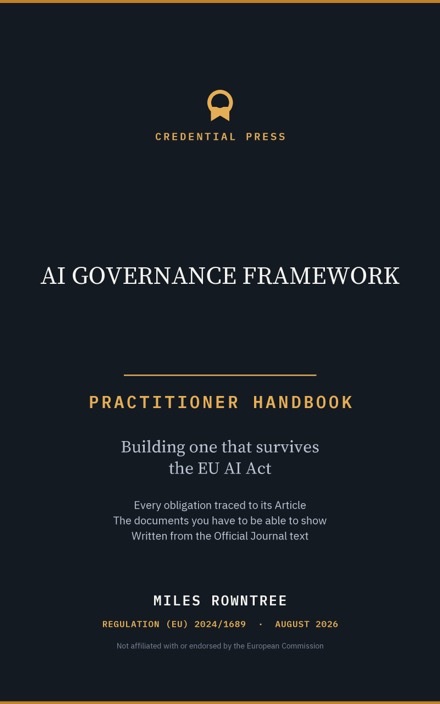
Building one that survives the EU AI Act. 22 chapters, 384 pages.
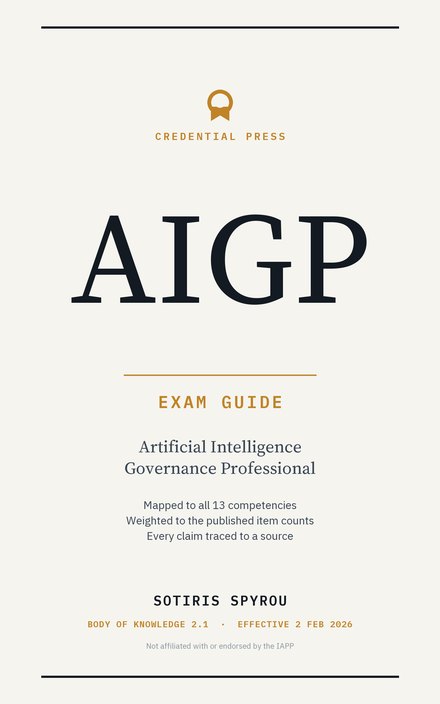
Artificial Intelligence Governance Professional. 21 chapters, 385 pages.
Sources
Every quotation above was read on 2 October 2026.
- Regulation (EU) 2024/1689, the AI Act, Official Journal L, 12 July 2024, Articles 3, 4, 26, 99 and 113
- Regulation (EU) 2026/1744 (Digital Omnibus on AI), Official Journal L, 24 July 2026, recital 8 and Article 1, point (5)
- Regulation (EU) 2024/1689, consolidated text dated 27 July 2026 (a documentation tool with no legal effect)
- European Commission, AI Literacy: Questions and Answers, last updated 27 July 2026
Credential Press is independent of the European Commission, the IAPP and PECB. This is not legal advice.