EU AI Act
What does EU AI Act Article 50 require for chatbots, AI-generated content and deepfakes?
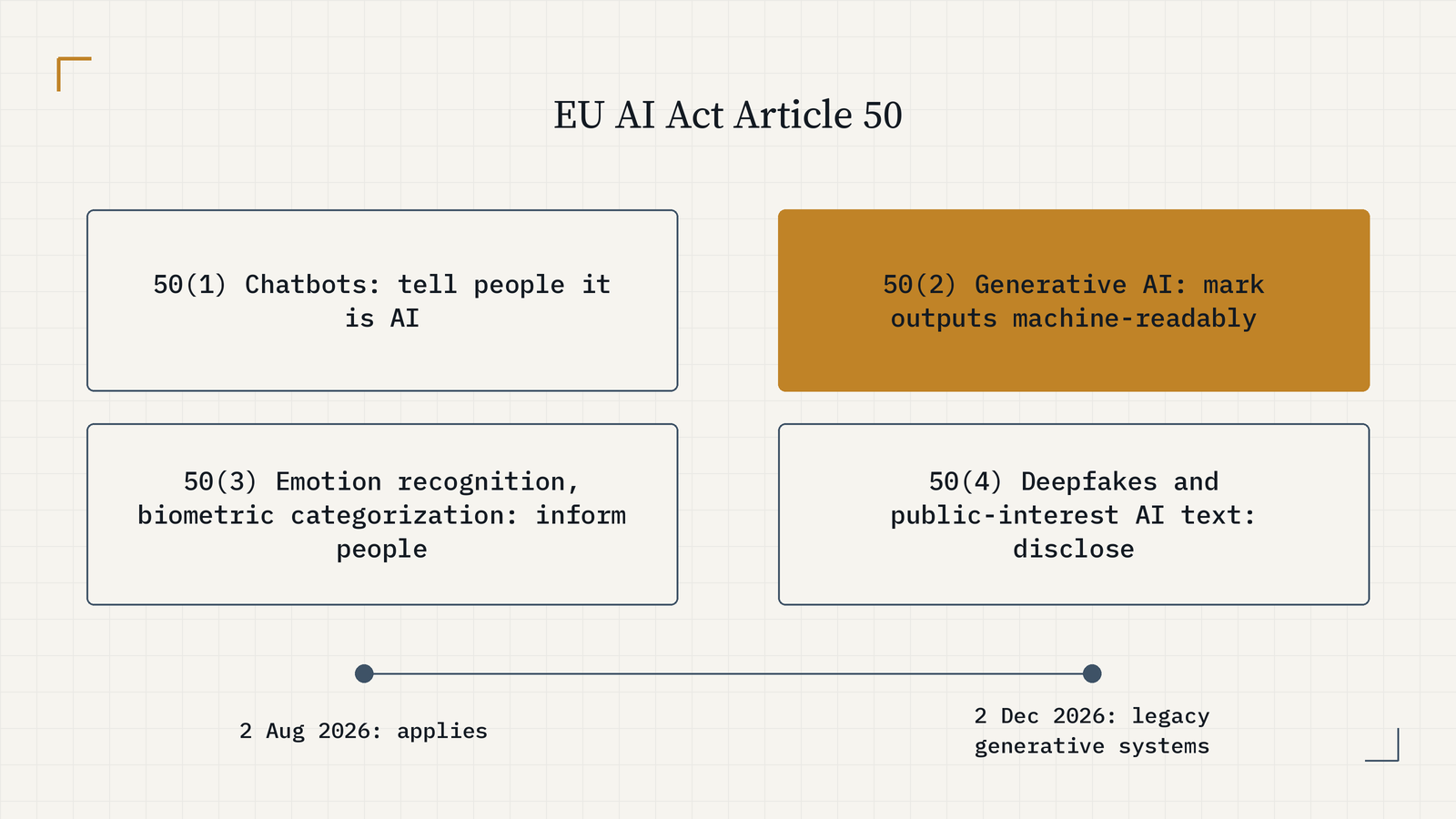
Article 50 is the part of the EU AI Act most organizations will meet first, because it reaches ordinary chatbots and generative AI, not just high-risk systems. It has four duties: tell people they are talking to an AI, mark AI-generated output, tell people about emotion recognition or biometric categorization, and disclose deepfakes and AI-written public-interest text. It applies from 2 August 2026, and the July 2026 amendment left that date alone.
Quotations are from Regulation (EU) 2024/1689 as amended by Regulation (EU) 2026/1744, read in the consolidated text of 27 July 2026 on 2 October 2026. This is not legal advice.
What are the four Article 50 duties?
| Paragraph | Who | Duty |
|---|---|---|
| 50(1) | Providers of AI systems that interact directly with people | Design them so people are informed they are interacting with an AI system, unless that is obvious |
| 50(2) | Providers of systems generating synthetic audio, image, video or text, including general-purpose AI systems | Mark outputs in a machine-readable format, detectable as artificially generated or manipulated |
| 50(3) | Deployers of emotion recognition or biometric categorization systems | Inform the people exposed to the system |
| 50(4) | Deployers of systems that create deepfakes, or AI text published to inform the public on matters of public interest | Disclose that the content is artificially generated or manipulated |
Under Article 50(5), the information must reach people "in a clear and distinguishable manner at the latest at the time of the first interaction or exposure", and must meet accessibility requirements. Article 50(6) says these duties sit alongside, and do not replace, the high-risk rules and any other transparency law.
When must a chatbot say it is AI?
Whenever it interacts directly with people, unless it is "obvious from the point of view of a natural person who is reasonably well-informed, observant and circumspect, taking into account the circumstances and the context of use". The duty sits with the provider, the organization that builds the system or has it built and puts it on the market under its name. A company that buys a chatbot from a vendor and deploys it under its own brand should check its role; our guide to provider and deployer roles explains when a deployer becomes a provider.
What must generative AI providers mark?
Outputs. Article 50(2) requires providers of systems "generating synthetic audio, image, video or text content" to ensure outputs are "marked in a machine-readable format and detectable as artificially generated or manipulated". The technical solutions must be effective, interoperable and reliable as far as technically feasible, taking into account the type of content, the cost and the state of the art. The duty does not apply where the system only performs "an assistive function for standard editing", or does not substantially alter the input data or its meaning.
The July 2026 amendment added a transition: under new Article 111(4), providers of generative systems placed on the market before 2 August 2026 must comply with Article 50(2) by 2 December 2026. It also rewrote Article 50(7): the Commission will assess whether codes of practice on detecting, marking and labeling AI content are adequate, and may adopt common rules by implementing act if they are not.
Article 50 transparency checklist
System or workflow,Our role (provider or deployer),Interacts directly with people? (50(1)),Is it obvious it is AI? (why),Generates synthetic audio image video or text? (50(2)),Outputs marked machine-readably? (method),On the market before 2 Aug 2026? (then mark by 2 Dec 2026),Emotion recognition or biometric categorization? (50(3); check Article 5 bans first),Creates deepfakes? (50(4)),Artistic or satirical work? (limited disclosure),AI text published on matters of public interest? (50(4)),Human review and editorial responsibility in place?,How and when people are told (50(5): at first interaction or exposure),Owner,Review date
Example: website support chatbot,Deployer (vendor is provider),yes,no,yes (text),Vendor to confirm,yes,no,no,n/a,no,n/a,Banner on first message,Digital team,2026-11-01
,,,,,,,,,,,,,,
,,,,,,,,,,,,,,
"Article 50 of the EU AI Act applies from 2 August 2026; Article 111(4) gives generative systems already on the market until 2 December 2026 for Article 50(2). Template from credentialpress.com/guides/eu-ai-act-article-50-transparency. Not legal advice.",,,,,,,,,,,,,,
When must a deepfake be disclosed?
Article 3(60) defines a deep fake as "AI-generated or manipulated image, audio or video content that resembles existing persons, objects, places, entities or events and would falsely appear to a person to be authentic or truthful". A deployer that generates or manipulates such content must disclose that it is artificially generated or manipulated. For "evidently artistic, creative, satirical, fictional or analogous" work, the duty shrinks to disclosing that such content exists, "in an appropriate manner that does not hamper the display or enjoyment of the work".
AI-generated text has a narrower rule. A deployer must disclose it only where the text "is published with the purpose of informing the public on matters of public interest", and not where the content "has undergone a process of human review or editorial control" and a person holds editorial responsibility for the publication. A newsroom that edits AI drafts and stands behind them is outside it; an unedited AI news feed is inside.
What about emotion recognition and biometric categorization?
Article 50(3) requires deployers of these systems to inform the people exposed to them, and to process personal data under the GDPR. This is the transparency rule for uses that are allowed. Some uses are banned outright: Article 5 prohibits inferring emotions in the workplace and in education, except for medical or safety reasons, and biometric categorization that deduces race, political opinions, trade union membership, religious or philosophical beliefs, sex life or sexual orientation. Our guide to the Article 5 prohibitions lists them.
What is the fine for breaching Article 50?
Article 99(4)(g) puts the transparency obligations for providers and deployers under Article 50 in the middle tier: up to EUR 15,000,000 or 3% of total worldwide annual turnover, whichever is higher. SMEs face the lower of the two, and since July 2026 so do small mid-cap enterprises under Article 99(6a). Our guide to AI Act dates and fines has every tier.
What should you do this week?
List every chatbot, generative feature and synthetic media workflow you build or use. For each, mark whether you are the provider or the deployer, then which of the four duties applies. If you supply a generative system that was on the market before 2 August 2026, plan the marking work for 2 December 2026. Our guide to the July 2026 amendments has the other changes. Credential Press is independent of the EU institutions.
Frequently asked questions
Do chatbots have to say they are AI under the EU AI Act?
Yes. Article 50(1) requires providers to design AI systems that interact directly with people so that the people are informed they are interacting with an AI system, unless that is obvious to a reasonably well-informed, observant and circumspect person in the circumstances.
Does AI-generated content have to be labeled in the EU?
Two duties apply. Providers of systems that generate synthetic audio, image, video or text must mark the outputs in a machine-readable format so they are detectable as AI-generated. Deployers must disclose deepfakes, and AI-generated text published to inform the public on matters of public interest, unless the text has had human review and someone holds editorial responsibility.
When does Article 50 apply?
From 2 August 2026, the AI Act's general application date, which the July 2026 amendment did not move. Providers of generative systems already on the market before 2 August 2026 have until 2 December 2026 to comply with the marking duty in Article 50(2).
What counts as a deepfake under the AI Act?
Article 3(60) defines a deep fake as AI-generated or manipulated image, audio or video content that resembles existing persons, objects, places, entities or events and would falsely appear to a person to be authentic or truthful.
Are artistic or satirical deepfakes exempt?
Not fully. Where the content is part of an evidently artistic, creative, satirical or fictional work, the duty is limited to disclosing that generated or manipulated content exists, in a way that does not hamper the display or enjoyment of the work.
What is the fine for breaching Article 50?
Article 99(4) puts the Article 50 transparency obligations in the middle tier: up to EUR 15 million or 3% of total worldwide annual turnover, whichever is higher, with lower caps for SMEs and small mid-caps.
EU AI Act: test yourself in five minutes
Which books go deeper on the EU AI Act?
Building one that survives the EU AI Act. 22 chapters, 384 pages.
AI Governance Worked Scenarios
24 worked situations under the EU AI Act, decided against the Articles. 81 pages.
Sources
Every quotation above was read on 2 October 2026 through the EU Publications Office.
- Regulation (EU) 2024/1689 (AI Act), Articles 3(60), 5, 50, 99 and 113
- Regulation (EU) 2026/1744 (Digital Omnibus on AI), Articles 50(7) and 111(4) as amended
- Regulation (EU) 2024/1689, consolidated text dated 27 July 2026 (no legal effect)
Credential Press is independent of the European Commission. This is not legal advice.