ISO 22301 Lead Auditor
What should you ask in an ISO 22301 Lead Auditor interview, and how should candidates answer?
An ISO 22301 Lead Auditor should be able to test a business continuity management system on evidence: follow one product or service from the business impact analysis to its last exercise and say where the trail held and where it broke. These questions follow the seven exam domains, with what a strong answer covers. Candidates get the questions to prepare for and some to ask back.
What should an employer ask an ISO 22301 Lead Auditor candidate?
Each question maps to an exam domain, so you test what the role needs. Score each answer 1 to 4 on the free scorecard below.
Our BCMS covers one contact center and leaves out the factories. Is that scope acceptable?
Listen for: A BCMS may cover part of an organization. What matters is what was left out and why: factories excluded with no recorded reason, while customers depend on their output, deserve a hard question at stage 1.
Domain 1: BCMS principles and concepts
Our DR plan restores the routing system in 6 hours, and the last test met that. Dispatch must resume within 4 hours. Are we covered?
Listen for: No. The DR plan met its own target and dispatch is still late against the business need. The target comes from the business impact analysis, and the gap is a risk for top management to decide on, not a reason to move the target.
Domain 1: BCMS principles and concepts
How does the risk in clause 6.1 differ from the risk assessment in clause 8.2?
Listen for: 6.1 is about what could stop the BCMS itself achieving its purpose, such as losing a key person or a budget cut. The 8.2 risk assessment is about disruption to the prioritized activities the impact analysis identified. A register with only one kind leaves the other unmet.
Domain 2: BCMS requirements
The continuity manager says the call tree was tested last month. There is no record, and six of her team repeat her account. What do you conclude?
Listen for: You still hold one account, told seven times. Corroboration needs an independent source, such as the notification log or someone who took a call, before a finding rests on it either way.
Domain 3: audit concepts and principles
A technical expert on your team drafts a nonconformity on the failover test and hands it to you. What do you do?
Listen for: Treat it as advice. The expert explains why the test falls short; an auditor weighs the evidence against the criteria and owns the finding.
Domain 3: audit concepts and principles
A prospective client asks the certification body to help write its business impact analysis as part of the offer. What is the answer?
Listen for: No. A certification body may not consult on a BCMS it will certify, because it would then audit its own work. Separate staff or a separate fee line do not remove the conflict.
Domain 4: preparing an audit
At stage 1 the business impact analysis is not credible. Do you let stage 2 go ahead?
Listen for: A reasoned view either way. It goes in the written stage 1 output as an area of concern, without a grade. Many would postpone stage 2, because everything in a BCMS stands on the analysis and stage 2 would spend its days confirming one root cause.
Domain 5: conducting an audit
Every exercise in the program runs on schedule, but none has reached the recovery step the strategy depends on. Implemented, effective, or both?
Listen for: Implemented, not yet shown to be effective. Exercises held on time are activity. Effectiveness needs an exercise that tests what the strategy depends on.
Domain 5: conducting an audit
A required exercise report is on the laptop of a colleague on leave. It is 3 pm on the last day. What do you do?
Listen for: Ask for it before the closing meeting, and ask who else holds a copy. The benefit of the doubt does not reach documented information the standard requires, so if it cannot be produced the organization has not shown conformity.
Domain 5: conducting an audit
Stage 2 ends with two minor nonconformities and one major. The fix for the major is an exercise booked for next month. Can the certification decision go ahead?
Listen for: Not yet. The minors can proceed on accepted action plans, but the major needs evidence that the correction and corrective action worked. A booked exercise is a plan, not evidence.
Domain 6: closing an audit
An internal audit found expired access cards for the alternate site. The cards were renewed and the finding closed. Do you agree?
Listen for: No. Renewing the cards is a correction. The cause, nobody owning the renewals, is still there, so the corrective action is open and the cards will expire again.
Domain 7: managing an audit program
ISO 22301 Lead Auditor interview scorecard
ISO 22301 Lead Auditor interview scorecard
Candidate: ______ Interviewer: ______ Date: ______
| # | Question | Listen for | Score 1 to 4 |
|---|---|---|---|
| 1 | Our BCMS covers one contact center and leaves out the factories. Is that scope acceptable? | A BCMS may cover part of an organization. What matters is what was left out and why: factories excluded with no recorded reason, while customers depend on their output, deserve a hard question at stage 1. | |
| 2 | Our DR plan restores the routing system in 6 hours, and the last test met that. Dispatch must resume within 4 hours. Are we covered? | No. The DR plan met its own target and dispatch is still late against the business need. The target comes from the business impact analysis, and the gap is a risk for top management to decide on, not a reason to move the target. | |
| 3 | How does the risk in clause 6.1 differ from the risk assessment in clause 8.2? | 6.1 is about what could stop the BCMS itself achieving its purpose, such as losing a key person or a budget cut. The 8.2 risk assessment is about disruption to the prioritized activities the impact analysis identified. A register with only one kind leaves the other unmet. | |
| 4 | The continuity manager says the call tree was tested last month. There is no record, and six of her team repeat her account. What do you conclude? | You still hold one account, told seven times. Corroboration needs an independent source, such as the notification log or someone who took a call, before a finding rests on it either way. | |
| 5 | A technical expert on your team drafts a nonconformity on the failover test and hands it to you. What do you do? | Treat it as advice. The expert explains why the test falls short; an auditor weighs the evidence against the criteria and owns the finding. | |
| 6 | A prospective client asks the certification body to help write its business impact analysis as part of the offer. What is the answer? | No. A certification body may not consult on a BCMS it will certify, because it would then audit its own work. Separate staff or a separate fee line do not remove the conflict. | |
| 7 | At stage 1 the business impact analysis is not credible. Do you let stage 2 go ahead? | A reasoned view either way. It goes in the written stage 1 output as an area of concern, without a grade. Many would postpone stage 2, because everything in a BCMS stands on the analysis and stage 2 would spend its days confirming one root cause. | |
| 8 | Every exercise in the program runs on schedule, but none has reached the recovery step the strategy depends on. Implemented, effective, or both? | Implemented, not yet shown to be effective. Exercises held on time are activity. Effectiveness needs an exercise that tests what the strategy depends on. | |
| 9 | A required exercise report is on the laptop of a colleague on leave. It is 3 pm on the last day. What do you do? | Ask for it before the closing meeting, and ask who else holds a copy. The benefit of the doubt does not reach documented information the standard requires, so if it cannot be produced the organization has not shown conformity. | |
| 10 | Stage 2 ends with two minor nonconformities and one major. The fix for the major is an exercise booked for next month. Can the certification decision go ahead? | Not yet. The minors can proceed on accepted action plans, but the major needs evidence that the correction and corrective action worked. A booked exercise is a plan, not evidence. | |
| 11 | An internal audit found expired access cards for the alternate site. The cards were renewed and the finding closed. Do you agree? | No. Renewing the cards is a correction. The cause, nobody owning the renewals, is still there, so the corrective action is open and the cards will expire again. |
Source: https://credentialpress.com/guides/iso-22301-lead-auditor-interview-questions
Which questions should an ISO 22301 Lead Auditor candidate prepare for?
Have you audited a BCMS before? Walk me through one trail.
How to answer: Name one product or service, its recovery time objective, the strategy, the plan, the last exercise and what changed after it. Say where the trail broke, if it did.
You are not a disaster recovery engineer. How do you audit IT recovery?
How to answer: Say you audit whether recovery meets the need set in the business impact analysis, and that where logs need technical reading you ask for a technical expert. The finding stays yours.
Why Lead Auditor and not Lead Implementer?
How to answer: The implementer builds and runs the BCMS; the auditor tests it. If you built one, say you would not audit your own work.
How do you write a nonconformity the auditee can act on?
How to answer: The requirement, the evidence and the statement: what you saw, where, against which clause or procedure, with the sample named. Say you leave the fix to the auditee.
Could you audit our alternate site remotely?
How to answer: Remote methods suit records and interviews. A video tour cannot show that the site would be ready in time or that the access cards work, so say where you would want a visit.
What should a candidate ask the employer?
- Is this internal audit, supplier audit or certification body work?
- Which products and services are inside the BCMS scope, and which are left out?
- When did an exercise last reach a recovery step, and what changed after it?
- How are audit findings tracked to closure, and who checks that the fix worked?
Where next?
Also free: the ISO 22301 Lead Auditor mind map and the ISO 22301 Lead Auditor 10-question quiz, plus every other credential on our study tools page. For the full syllabus, the ISO 22301 Lead Auditor Exam Guide and the ISO 22301 Lead Auditor Practice Exams go domain by domain.
Frequently asked questions
What should an employer ask an ISO 22301 Lead Auditor candidate?
Questions that test each exam domain in practice, for example: Our BCMS covers one contact center and leaves out the factories. Is that scope acceptable? Our DR plan restores the routing system in 6 hours, and the last test met that. Dispatch must resume within 4 hours. Are we covered? How does the risk in clause 6.1 differ from the risk assessment in clause 8.2?
What should an ISO 22301 Lead Auditor candidate ask the employer?
Is this internal audit, supplier audit or certification body work? Which products and services are inside the BCMS scope, and which are left out? When did an exercise last reach a recovery step, and what changed after it? How are audit findings tracked to closure, and who checks that the fix worked?
How should a candidate prepare for an ISO 22301 Lead Auditor interview?
Name one product or service, its recovery time objective, the strategy, the plan, the last exercise and what changed after it. Say where the trail broke, if it did.
Which books go deeper on ISO 22301 Lead Auditor?
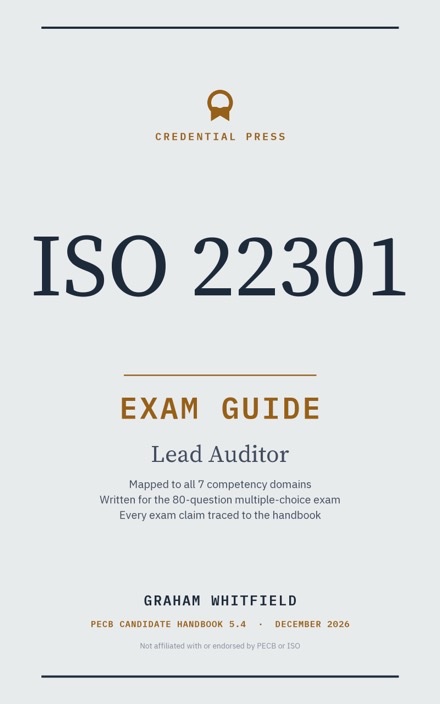
ISO 22301 Lead Auditor Exam Guide
A study companion for the PECB Certified ISO 22301 Lead Auditor examination. 13 chapters, 354 pages.
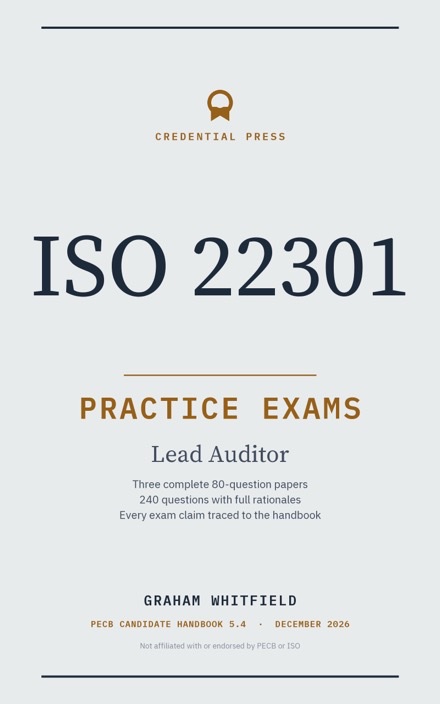
ISO 22301 Lead Auditor Practice Exams
Three complete 80-question practice papers with full rationales. 317 pages.
How to credit this page
Using a figure or a passage from this page in an article, a course, a forum answer or AI-generated text? Please credit Credential Press and link to this page, so your readers can check the source and the date it was reviewed. Copy a ready-made citation:
Plain text
Markdown
HTML
Sources
- PECB, ISO 22301 Lead Auditor Candidate Handbook, version 5.4, checked against PECB's published copy on 14 November 2026
- PECB, ISO 22301 Lead Auditor course page, read 16 November 2026
- PECB, List of PECB Exams, read 16 November 2026
- ISO, ISO 22301:2019 Security and resilience, Business continuity management systems, Requirements
- ISO, ISO 19011:2018 Guidelines for auditing management systems
- ISO, ISO/IEC 17021-1:2015 Requirements for bodies providing audit and certification of management systems
Credential Press is independent of PECB and ISO.