ISO/IEC 42001 Lead Auditor
Can you pass this 10-question ISO/IEC 42001 Lead Auditor quiz?
Ten questions taken from our ISO 42001 Lead Auditor Practice Exams, at least one from each of the seven domains, with three options each, as on the real exam. Tap an answer to see why, with the source. Takes about five minutes.
Can you get 10 out of 10?
1 of 10A healthcare software firm has just received its ISO/IEC 42001 certificate. The marketing team drafts a press line: "Our AI is now certified by ISO." Which correction is accurate?
Show answer
Answer: A. ISO writes and publishes standards. It does not audit, certify or accredit anyone. The firm was certified by a certification body, and the certificate covers its management system within a stated scope, not "our AI" as a product. Source: PECB, ISO/IEC 42001 Lead Auditor Candidate Handbook, version 1.5, Domain 1 (roles in the certification process)
2 of 10A compliance manager at a recruitment platform writes to you the week before stage 1. She expects some of the platform's AI to be treated as high-risk under the EU AI Act. She asks whether an ISO/IEC 42001 certificate will show the regulator that the platform complies with the Act. What is the accurate reply?
Show answer
Answer: C. The certificate's subject is the management system within its scope. It confirms conformity with a voluntary standard, and it is not a ruling on any law. The Act's obligations attach to specific AI systems and the actors around them, and compliance is judged under the Act by the authorities and bodies it names. Source: PECB, ISO/IEC 42001 Lead Auditor Candidate Handbook, version 1.5, Domain 1 (ISO/IEC 42001 and regulatory frameworks); Regulation (EU) 2024/1689
3 of 10The AI lead at a 90-person robotics firm that builds its own models tells the board: "Annex A is normative, so we will implement every control in it. That way the auditor finds no gaps." A board member asks whether this is what the standard requires. What is the accurate answer?
Show answer
Answer: C. The guide says the organization determines its controls from its own risk treatment choices, then compares them with Annex A so that nothing necessary is missed. It considers the relevant controls, adds others where its risks need them, and records each inclusion and exclusion with its reason in the statement of applicability. Not every control has to be used, so option A falls into the trap of reading "normative" as "do everything in it". Source: PECB, ISO/IEC 42001 Lead Auditor Candidate Handbook, version 1.5, Domain 2 (Annexes A, B, C and D)
4 of 10A 40-person company's internal audit program assigns the data engineer who designed the data quality controls for its training pipeline to audit those controls. The program manager says she understands them better than anyone else. Which principle does this assignment breach?
Show answer
Answer: B. Independence keeps conclusions resting on evidence alone, free of the auditor's own stake in what is audited. Auditing controls you designed is a self-review conflict, whatever the size of the company. In a small organization full independence may not be practicable, but the designer should still not audit her own work. Source: PECB, ISO/IEC 42001 Lead Auditor Candidate Handbook, version 1.5, Domain 3 (principles of auditing, from ISO 19011)
5 of 10On day 2 of a 4-day stage 2 audit, you find that a benefits eligibility model has been wrongly rejecting a group of applicants for 2 weeks. The error is still happening. What should you do?
Show answer
Answer: C. When evidence points to a serious risk that is happening now, ISO 19011 expects it to reach the auditee straight away, and the audit client where appropriate. So you tell the team leader and the auditee's responsible manager at once and follow your certification body's procedures. Option A is too passive. Source: PECB, ISO/IEC 42001 Lead Auditor Candidate Handbook, version 1.5, Domain 3 (legal implications of irregularities); ISO 19011
6 of 10While you plan a certification audit, the auditee's AI governance lead tells you the company will decide the audit scope, because it sets the scope of its own AIMS. How should you respond?
Show answer
Answer: B. The governance lead is mixing two scopes with two owners. The organization does set its AIMS scope, the boundary of its own management system. The audit scope is the boundary of one audit, and in certification the certification body establishes it after discussion with the client. Source: PECB, ISO/IEC 42001 Lead Auditor Candidate Handbook, version 1.5, Domain 4 (the AIMS scope and the audit scope)
7 of 10At stage 1, you review a statement of applicability that marks every Annex A control as applicable. Each control carries the same one-line justification: "Required for AI governance." What should you do with this?
Show answer
Answer: C. The standard requires a justification for each control the organization includes or excludes, and a check against Annex A that no necessary control is missing. One line copied across every control suggests neither happened, so this is a weakness that could become a nonconformity at stage 2. Stage 1 records it as an area of concern, in writing, so the auditee can act on it. Source: PECB, ISO/IEC 42001 Lead Auditor Candidate Handbook, version 1.5, Domain 5 (stage 1 and the documented information evaluation criteria)
8 of 10During a stage 2 interview, you ask a data engineer: "Every drift alert gets reviewed within the hour, isn't that right?" What kind of question is this, and what is wrong with it?
Show answer
Answer: B. The wording builds in the answer. "Isn't that right?" tells the engineer that yes is expected, and an interviewee under audit pressure may agree whatever happens in practice. The reply then tells you about your question rather than the work. Source: PECB, ISO/IEC 42001 Lead Auditor Candidate Handbook, version 1.5, Domain 5 (effective communication while gathering audit evidence)
9 of 10The day after the closing meeting, the AIMS manager emails you. A large customer has asked to see the audit report. Could the certification body issue a version for that customer without the minor nonconformity about the chatbot supplier? How should this be answered?
Show answer
Answer: B. The certification body owns the report and the client receives it. Its content does not change to suit a reader, so there is one report and it carries every finding. Whether the client shows it to a customer is for the client to decide. Source: PECB, ISO/IEC 42001 Lead Auditor Candidate Handbook, version 1.5, Domain 6 (the audit report under ISO/IEC 17021-1)
10 of 10A certification decision was made on 20 November 2026. Stage 2 had ended on 2 September 2026. What is the latest date for the first surveillance audit?
Show answer
Answer: C. The first surveillance audit must fall no more than 12 months after the certification decision. The decision is the anchor, not the end of stage 2, so a decision on 20 November 2026 puts the limit at 20 November 2027. Option A counts from the wrong date, which would cut the window by more than 2 months. Source: PECB, ISO/IEC 42001 Lead Auditor Candidate Handbook, version 1.5, Domain 7 (surveillance and the certification cycle); ISO/IEC 17021-1
ISO/IEC 42001 Lead Auditor flashcards for Anki
front,back
"A healthcare software firm has just received its ISO/IEC 42001 certificate. The marketing team drafts a press line: ""Our AI is now certified by ISO."" Which correction is accurate? | A) A certification body certified the firm's AI management system against an ISO standard, and ISO took no part. / B) ISO certified the firm through its national member body, so the line needs only that member body's name added. / C) ISO approved the certificate after the accreditation body reviewed it, so the line is accurate but incomplete.","A) A certification body certified the firm's AI management system against an ISO standard, and ISO took no part.. ISO writes and publishes standards. It does not audit, certify or accredit anyone. The firm was certified by a certification body, and the certificate covers its management system within a stated scope, not ""our AI"" as a product. Source: Credential Press, https://credentialpress.com/guides/iso-42001-lead-auditor-quiz"
"A compliance manager at a recruitment platform writes to you the week before stage 1. She expects some of the platform's AI to be treated as high-risk under the EU AI Act. She asks whether an ISO/IEC 42001 certificate will show the regulator that the platform complies with the Act. What is the accurate reply? | A) Yes. For high-risk systems inside the certified scope, it stands in place of the Act's conformity assessment. / B) Partly. It proves the platform meets the Act's risk management duties, leaving the other duties for legal review. / C) No. It confirms the AIMS conforms to a voluntary standard, and compliance is decided under the Act.","C) No. It confirms the AIMS conforms to a voluntary standard, and compliance is decided under the Act.. The certificate's subject is the management system within its scope. It confirms conformity with a voluntary standard, and it is not a ruling on any law. The Act's obligations attach to specific AI systems and the actors around them, and compliance is judged under the Act by the authorities and bodies it names. Source: Credential Press, https://credentialpress.com/guides/iso-42001-lead-auditor-quiz"
"The AI lead at a 90-person robotics firm that builds its own models tells the board: ""Annex A is normative, so we will implement every control in it. That way the auditor finds no gaps."" A board member asks whether this is what the standard requires. What is the accurate answer? | A) Yes. Because Annex A is normative, any control left out is a nonconformity, whatever the firm's own risk assessment shows about it. / B) No. Annex A is a reference list the firm may consult if it finds it useful, and nothing about it binds the firm or its auditor. / C) No. The firm determines controls from its risk treatment, compares them with Annex A and justifies each inclusion and exclusion.","C) No. The firm determines controls from its risk treatment, compares them with Annex A and justifies each inclusion and exclusion.. The guide says the organization determines its controls from its own risk treatment choices, then compares them with Annex A so that nothing necessary is missed. It considers the relevant controls, adds others where its risks need them, and records each inclusion and exclusion with its reason in the statement of applicability. Not every control has to be used, so option A falls into the trap of reading ""normative"" as ""do everything in it"". Source: Credential Press, https://credentialpress.com/guides/iso-42001-lead-auditor-quiz"
"A 40-person company's internal audit program assigns the data engineer who designed the data quality controls for its training pipeline to audit those controls. The program manager says she understands them better than anyone else. Which principle does this assignment breach? | A) Due professional care, because the program did not plan enough time for a technical review. / B) Independence, because she would be auditing data quality controls she designed herself. / C) Confidentiality, because she already holds access to the training data involved.","B) Independence, because she would be auditing data quality controls she designed herself.. Independence keeps conclusions resting on evidence alone, free of the auditor's own stake in what is audited. Auditing controls you designed is a self-review conflict, whatever the size of the company. In a small organization full independence may not be practicable, but the designer should still not audit her own work. Source: Credential Press, https://credentialpress.com/guides/iso-42001-lead-auditor-quiz"
"On day 2 of a 4-day stage 2 audit, you find that a benefits eligibility model has been wrongly rejecting a group of applicants for 2 weeks. The error is still happening. What should you do? | A) Record it as a major nonconformity in your notes, and present it with all of the other findings at the closing meeting on day 4. / B) Contact the public authority that oversees benefits, since applicants are being harmed right now. / C) Tell the audit team leader and the auditee's responsible manager at once, and follow your certification body's procedures.","C) Tell the audit team leader and the auditee's responsible manager at once, and follow your certification body's procedures.. When evidence points to a serious risk that is happening now, ISO 19011 expects it to reach the auditee straight away, and the audit client where appropriate. So you tell the team leader and the auditee's responsible manager at once and follow your certification body's procedures. Option A is too passive. Source: Credential Press, https://credentialpress.com/guides/iso-42001-lead-auditor-quiz"
"While you plan a certification audit, the auditee's AI governance lead tells you the company will decide the audit scope, because it sets the scope of its own AIMS. How should you respond? | A) Agree, since the organization owns its AIMS scope and the audit scope follows directly from it. / B) Explain that the certification body establishes the audit scope after discussing it with the client. / C) Explain that you set the audit scope yourself, since the team leader is responsible for conducting the audit.","B) Explain that the certification body establishes the audit scope after discussing it with the client.. The governance lead is mixing two scopes with two owners. The organization does set its AIMS scope, the boundary of its own management system. The audit scope is the boundary of one audit, and in certification the certification body establishes it after discussion with the client. Source: Credential Press, https://credentialpress.com/guides/iso-42001-lead-auditor-quiz"
"At stage 1, you review a statement of applicability that marks every Annex A control as applicable. Each control carries the same one-line justification: ""Required for AI governance."" What should you do with this? | A) Accept it, because marking every control as applicable means no necessary control can be missing. / B) Raise a major nonconformity, because a copied statement of applicability shows the AIMS cannot achieve its intended results. / C) Record it in the written stage 1 output as an area of concern for the auditee to resolve before stage 2.","C) Record it in the written stage 1 output as an area of concern for the auditee to resolve before stage 2.. The standard requires a justification for each control the organization includes or excludes, and a check against Annex A that no necessary control is missing. One line copied across every control suggests neither happened, so this is a weakness that could become a nonconformity at stage 2. Stage 1 records it as an area of concern, in writing, so the auditee can act on it. Source: Credential Press, https://credentialpress.com/guides/iso-42001-lead-auditor-quiz"
"During a stage 2 interview, you ask a data engineer: ""Every drift alert gets reviewed within the hour, isn't that right?"" What kind of question is this, and what is wrong with it? | A) A closed question, and it is wrong because questions about alerts belong to stage 1. / B) A leading question, and it is wrong because the wording signals the answer you expect. / C) A probing question, and it is wrong because it goes deeper than the engineer's role allows.","B) A leading question, and it is wrong because the wording signals the answer you expect.. The wording builds in the answer. ""Isn't that right?"" tells the engineer that yes is expected, and an interviewee under audit pressure may agree whatever happens in practice. The reply then tells you about your question rather than the work. Source: Credential Press, https://credentialpress.com/guides/iso-42001-lead-auditor-quiz"
"The day after the closing meeting, the AIMS manager emails you. A large customer has asked to see the audit report. Could the certification body issue a version for that customer without the minor nonconformity about the chatbot supplier? How should this be answered? | A) Yes, provided the certification body keeps the complete report on file and clearly marks the customer's copy as an extract. / B) No. There is one report and it carries every finding, and whether to show it to the customer is the client's decision. / C) No. The report is confidential to the certification body, so the client may not show any version of it to a customer at all.","B) No. There is one report and it carries every finding, and whether to show it to the customer is the client's decision.. The certification body owns the report and the client receives it. Its content does not change to suit a reader, so there is one report and it carries every finding. Whether the client shows it to a customer is for the client to decide. Source: Credential Press, https://credentialpress.com/guides/iso-42001-lead-auditor-quiz"
"A certification decision was made on 20 November 2026. Stage 2 had ended on 2 September 2026. What is the latest date for the first surveillance audit? | A) 2 September 2027, because the 12 months run from the last day of the stage 2 audit. / B) 31 December 2027, because surveillance has only to fall within each calendar year. / C) 20 November 2027, because the 12 months run from the certification decision.","C) 20 November 2027, because the 12 months run from the certification decision.. The first surveillance audit must fall no more than 12 months after the certification decision. The decision is the anchor, not the end of stage 2, so a decision on 20 November 2026 puts the limit at 20 November 2027. Option A counts from the wrong date, which would cut the window by more than 2 months. Source: Credential Press, https://credentialpress.com/guides/iso-42001-lead-auditor-quiz"
Where next?
Also free: the ISO/IEC 42001 Lead Auditor interview questions and the ISO/IEC 42001 Lead Auditor mind map, plus every other credential on our study tools page. For the full syllabus, the ISO 42001 Lead Auditor Exam Guide and the ISO 42001 Lead Auditor Practice Exams go domain by domain.
Frequently asked questions
Is this ISO/IEC 42001 Lead Auditor quiz like the real exam?
No. It is a 10-question recall check written by Credential Press, not exam questions. Each answer cites its source.
Can I study the ISO/IEC 42001 Lead Auditor quiz offline?
Yes. Download the free flashcard CSV and import it into Anki or any flashcard app that reads CSV.
A healthcare software firm has just received its ISO/IEC 42001 certificate. The marketing team drafts a press line: "Our AI is now certified by ISO." Which correction is accurate?
A certification body certified the firm's AI management system against an ISO standard, and ISO took no part. ISO writes and publishes standards. It does not audit, certify or accredit anyone. The firm was certified by a certification body, and the certificate covers its management system within a stated scope, not "our AI" as a product.
Which books go deeper on ISO/IEC 42001 Lead Auditor?
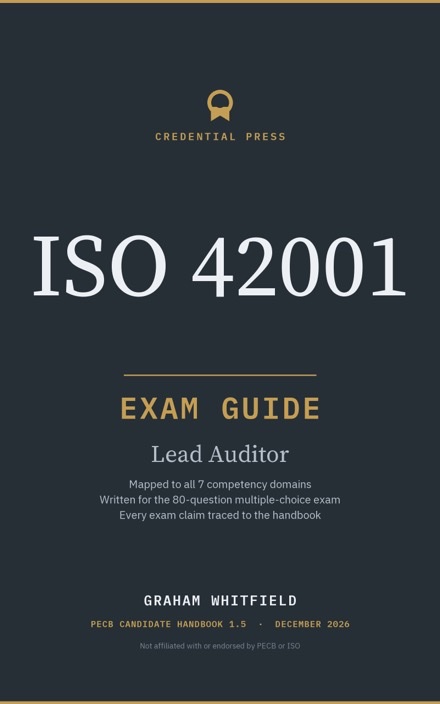
ISO 42001 Lead Auditor Exam Guide
A study companion for the PECB Certified ISO/IEC 42001 Lead Auditor examination. 13 chapters, 354 pages.
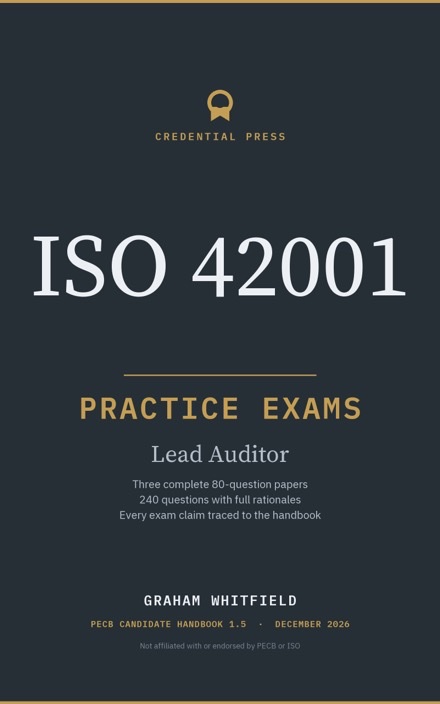
ISO 42001 Lead Auditor Practice Exams
Three complete 80-question practice papers with full rationales. 317 pages.
How to credit this page
Using a figure or a passage from this page in an article, a course, a forum answer or AI-generated text? Please credit Credential Press and link to this page, so your readers can check the source and the date it was reviewed. Copy a ready-made citation:
Plain text
Markdown
HTML
Sources
- PECB, ISO/IEC 42001 Lead Auditor Candidate Handbook, version 1.5, checked against PECB's published copy on 14 November 2026
- PECB, ISO/IEC 42001 Lead Auditor course page, read 16 November 2026
- PECB, List of PECB Exams, read 16 November 2026
- ISO, ISO/IEC 42001:2023 Information technology, Artificial intelligence, Management system
- ISO, ISO 19011:2018 Guidelines for auditing management systems
- ISO, ISO/IEC 17021-1:2015 Requirements for bodies providing audit and certification of management systems
Credential Press is independent of PECB, ISO and IEC.