ISO 14001
Environmental auditing: who the ISO 14001 Lead Auditor is for
The ISO 14001 Lead Auditor leads audits of environmental management systems: planning them, gathering evidence, grading findings and reporting to people who will act on the result, whether that is the organization's own management, a customer buying from it, or a certification body deciding whether it keeps its certificate. This guide is about who does that work, why the demand for it is tied to tenders and supply chains, what ISO 14001:2026 changes, and what PECB's credential and exam ask of you.
The facts here come from ISO's pages for ISO 14001:2026 and the withdrawn ISO 14001:2015, PECB's ISO 14001 Lead Auditor Candidate Handbook for the multiple-choice exam, version 1.5, PECB's course page, the EU public procurement Directive and O*NET OnLine, all read on 20 October 2026.
What does an ISO 14001 Lead Auditor do?
ISO describes ISO 14001 as the internationally recognized standard for environmental management systems: a framework for designing and running an EMS and continually improving environmental performance, from resource use and waste to monitoring performance and involving stakeholders. An auditor checks whether an organization's EMS meets that standard and works as described. A lead auditor runs the audit team and is accountable for the conclusions.
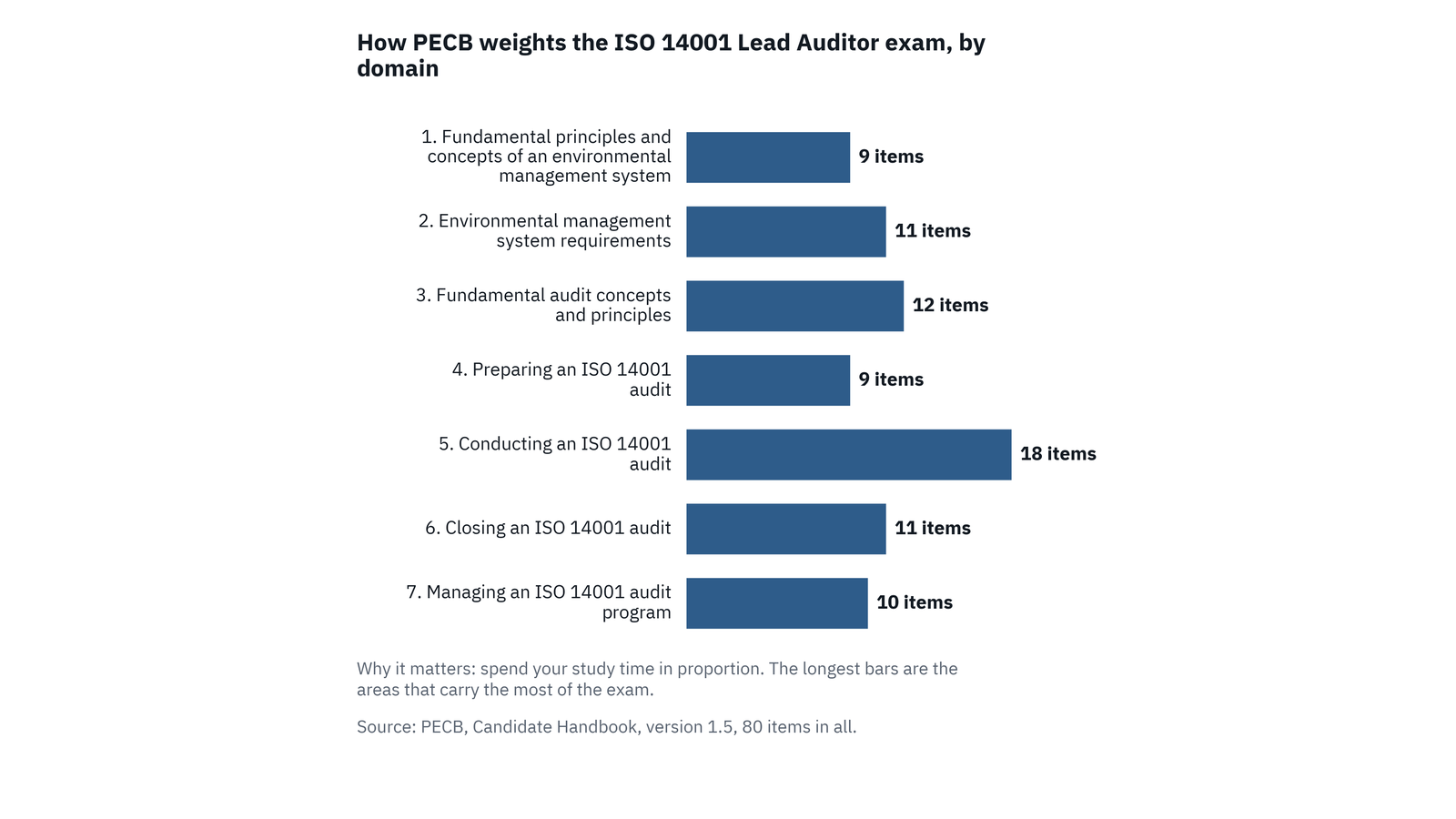
PECB's exam shows how the job divides, through the number of questions it takes from each of its seven domains:
| Domain | Questions | Share |
|---|---|---|
| 1. Fundamental principles and concepts of an EMS | 9 | 11.25% |
| 2. EMS requirements | 11 | 13.75% |
| 3. Fundamental audit concepts and principles | 12 | 15% |
| 4. Preparing an ISO 14001 audit | 9 | 11.25% |
| 5. Conducting an ISO 14001 audit | 18 | 22.5% |
| 6. Closing an ISO 14001 audit | 11 | 13.75% |
| 7. Managing an ISO 14001 audit program | 10 | 12.5% |
Sixty of the 80 questions come from the five audit domains. Only 20 are about the EMS and the standard's requirements. That proportion says what the credential is: an audit qualification applied to environmental management, not an environmental science qualification. A lead auditor needs to know ISO 14001 well enough to recognize what conformity looks like, but most of the job is the audit method: planning, sampling, gathering objective evidence, grading findings, writing reports and running an audit program.
Conducting the audit is the largest single domain, at 18 questions. That is the on-site work: interviews, observation, records, and turning what you see into evidence. PECB's definition of valid audit experience for the credential matches it: planning an audit, managing an audit program, drafting audit reports, and drafting nonconformity reports.
Three habits sit underneath all of it. An auditor gathers objective evidence, judges it without bias, and reports how far the organization meets the audit criteria. Because time is always short, the auditor samples, and the sample must be sound enough that another competent auditor looking at the same material would reach the same conclusion. And the auditor stays impartial: taking on only work they are competent to do, and refusing pressure to soften or harden a finding. On an ISO 14001 audit there is one more step at the start. The auditor identifies the statutory and regulatory requirements and other compliance obligations that apply, because on an environmental audit these shape both the criteria and the sampling.
Who sits the ISO 14001 Lead Auditor?
PECB says its ISO 14001 Lead Auditor course is intended for five groups: auditors seeking to conduct and lead EMS audits; managers or consultants seeking to master the EMS audit process; individuals responsible for maintaining conformity to the requirements of ISO 14001 in an organization; technical experts seeking to prepare for EMS audits; and expert advisors in environmental management. In practice those groups audit in three settings:
| Audit | Who does it | Who the report is for | What the credential adds |
|---|---|---|---|
| First-party (internal) | The organization's own EHS, quality or compliance staff | Top management and the EMS owner | An audit method that management can rely on before the certification body arrives |
| Second-party (supplier) | A customer's supplier quality, sustainability or procurement auditors | The customer buying from the auditee | A recognized basis for judging a supplier's environmental controls |
| Third-party (certification) | Auditors working for an accredited certification body | The certification decision, and the public through the certificate | Evidence of competence as an auditor, alongside the body's own requirements |
The roles inside those settings vary: environmental, health and safety managers who run internal audits, sustainability leads asked to check suppliers, consultants who carry out pre-certification audits for clients, and career auditors at certification bodies. What they share is the method. A first-party auditor and a third-party auditor gather evidence the same way; they differ in independence, in who reads the report and in what the finding can lead to.
What the job looks like in numbers
No US occupation code covers environmental auditing alone. Two are close: Environmental Scientists and Specialists, which covers EHS specialists and environmental analysts, and Environmental Compliance Inspectors, which covers regulatory inspection. O*NET gives these figures from Bureau of Labor Statistics data:
| Measure | Environmental Scientists and Specialists (19-2041) | Environmental Compliance Inspectors (13-1041.01) |
|---|---|---|
| Employment, 2025 | 93,400 | Reported under Compliance Officers |
| Median annual wage, 2025 | $82,220 | $80,730 |
| Projected growth, 2025 to 2035 | Faster than average (5% to 6%) | Average (3% to 4%) |
| Projected job openings, 2025 to 2035 | 7,300 | 32,700 |
| Sample job titles include | EHS Specialist, Environmental Analyst, Environmental Protection Specialist | Environmental Compliance Inspector, Environmental Quality Analyst, Compliance Investigator |
The second column describes regulators more than certification auditors, and both are US figures. Treat the table as a reference point for the environmental professions an EMS auditor draws from, not as a measure of the credential.
When does the work arrive?
Environmental audits are rarely scheduled for their own sake. Something outside the EMS sets the date.
A tender asks for an environmental management certificate
In the EU, Article 62(2) of the public procurement Directive, Directive 2014/24/EU, covers environmental management directly. Where contracting authorities require certificates from independent bodies attesting that a supplier complies with environmental management systems or standards, they "shall refer to the Eco-Management and Audit Scheme (EMAS) of the Union or to other environmental management systems as recognised in accordance with Article 45 of Regulation (EC) No 1221/2009 or other environmental management standards based on the relevant European or international standards by accredited bodies," and must recognize equivalent certificates from other Member States. A supplier chasing public contracts needs a certified EMS, and a certified EMS needs internal audits, a certification audit, and surveillance audits after that.
A customer audits its suppliers
A customer that has made environmental commitments of its own may want to check that its suppliers can meet them. Second-party audits are how it does that, and the auditors doing them need to judge an unfamiliar organization's EMS quickly and fairly. A lead auditor credential gives the customer confidence in the audit, and gives the supplier confidence that it is being judged by a known standard.
ISO 14001:2026 has arrived
ISO published ISO 14001:2026, the fourth edition, in April 2026, and lists the 2015 edition and its 2024 amendment as withdrawn. ISO says the new edition builds on the established framework with clearer structure, easier navigation and stronger alignment with today's environmental priorities. For organizations already certified, ISO says they "will have to transition to the new version within the timeframe set by their certification cycle (typically around three years)." Every transition means a gap analysis, internal audits against the new edition, and a transition assessed by the certification body: years of audit work across every certified organization.
A permit breach, or a near miss
Meeting compliance obligations is one of the core purposes of an EMS, and our guide is clear on what that means for an auditor: a breach of a legal permit condition is serious even if the exceedance was small. A breach that nobody noticed points to a nonconformity in the system that should have caught it. After an incident, management wants to know whether the EMS failed and where, and that is an audit question.
The audit program needs a plan for the cycle
Not every audit is a single event. At the level of the audit program, the organization or the certification body decides how often each site or process is audited, and how deeply. ISO 19011, the guidance standard for auditing management systems, places that decision inside an audit program, and PECB's seventh domain tests it. A program has risks of its own, separate from the risks to the auditee: a scope that goes beyond the EMS scope, or a plan across the cycle that leaves some sites unaudited. Whoever manages the program has to see those risks before a certification body or a customer does.
The organization integrates its systems
An organization that runs ISO 9001 or ISO 45001 alongside ISO 14001 may combine their audits. ISO publishes a practical guide to integrated management systems for organizations that use more than one. An auditor who can audit an EMS inside a combined program, without losing what is specific to environmental management, is more useful to such an organization than one who can only audit a single standard.
What each trigger makes the auditor produce
Here is the same ground turned into the audit work it creates. For each trigger, the second column is what the auditor has to deliver, and the third is the PECB domain that teaches it.
| Trigger | What the auditor delivers | PECB domain | Source of the requirement |
|---|---|---|---|
| A tender needs a certified EMS | Internal audits that show the EMS is ready for certification, then a stage 1 and stage 2 audit | 5. Conducting; 6. Closing | Directive 2014/24/EU, Article 62(2); ISO/IEC 17021-1 for certification audits |
| A customer audits a supplier | A second-party audit plan, findings and a report the customer can act on | 4. Preparing; 5. Conducting | The customer's supplier terms |
| Transition to ISO 14001:2026 | Audits against the new edition, and evidence of the gaps closed | 2. EMS requirements; 7. Audit program | ISO 14001:2026; the certification body's transition arrangements |
| A permit breach | A finding that names the requirement, the evidence and what is not met | 5. Conducting; 6. Closing | The permit and the organization's compliance obligations |
| The annual audit program | A risk-based program that covers the EMS over the cycle | 7. Managing an audit program | The organization's own audit program |
| An audit is over | A closing meeting, an audit report and nonconformity reports | 6. Closing | Audit practice; PECB's definition of valid audit experience |
The last row is where audits are most often weakened: findings written in a hurry that a manager can argue with. We have turned the checks that make a finding stand up into a checklist you can copy or download below.
EMS audit finding quality checklist
EMS audit finding quality checklist
Use this before you close an ISO 14001 audit. It checks that every finding will stand up to the auditee, the audit program manager and a certification decision. The checks follow the audit practice taught for PECB's ISO 14001 Lead Auditor exam. ISO 14001 and ISO 19011 are sold rather than published, so check requirement wording against your own copies.
Every finding
- Names the requirement it is measured against
- States the objective evidence (a record, an observation, an interview with a named role)
- Says clearly what is not met, or what is met
- Is graded as conformity, nonconformity, or an opportunity for improvement
- Describes the problem once (not the problem and its cause as two findings)
- Rests on evidence, not on a manager's assurance
Compliance obligations
- Any breach of a legal or permit condition is treated as serious, even if the exceedance was small
- A breach nobody noticed is checked as a possible nonconformity in monitoring or evaluation of compliance
Grading
- Major nonconformities identified, with what they mean for certification
- Whether a return visit is needed to verify a correction works on the ground
- At a stage 1 audit, gaps reported as concerns to resolve before stage 2, not graded as nonconformities
- Guidance standards (ISO 14004, ISO 19011) not audited against as if their "should" were "shall"
Closing
- Findings presented at the closing meeting, with the auditee's response recorded
- Audit report drafted with scope, criteria, findings and conclusions
- Nonconformity reports drafted for each nonconformity
- Which edition of ISO 14001 the audit was against, named in full (for example "ISO 14001:2026")
Where does the credential apply?
ISO 14001 is international, and certificates are recognized wherever accredited certification bodies operate. PECB's certification scheme is specified in compliance with ISO/IEC 17024, the standard for bodies that certify people. PECB runs the exam online through the PECB Exams application, supervised remotely, or on paper through a partner, and online multiple-choice results arrive instantly.
The reasons for certification vary by place. In the EU, public procurement rules name EMAS and other recognized environmental management systems. Elsewhere, customers and investors can ask for evidence of environmental management in their own terms. The audit method does not change across those settings, which is why the credential travels.
What the credential is not
It is not an environmental science degree. Only 20 of the 80 questions are about the EMS and its requirements. The rest are about auditing. The credential assumes you can learn the environmental context of each auditee; it tests whether you can audit it.
It is not the organization's certificate. A lead auditor credential is personal. An organization is certified by an independent certification body after an audit, and ISO says it should then use the full designation, for example "certified to ISO 14001:2026," not just "certified to ISO 14001."
It is not a license to audit for a certification body. Certification bodies have their own competence requirements under ISO/IEC 17021-1. The PECB credential is evidence of competence, not an appointment.
It is not a copy of the standard. ISO 14001 is sold rather than published. PECB lets you take a hard copy into the exam, and you will need your own.
Which credential level can you claim?
| Credential | Exam | Professional experience | Audit activities |
|---|---|---|---|
| PECB Certified ISO 14001 Provisional Auditor | ISO 14001 Lead Auditor exam or equivalent | None | None |
| PECB Certified ISO 14001 Auditor | Two years, one of them in environmental management | 200 hours | |
| PECB Certified ISO 14001 Lead Auditor | Five years, two of them in environmental management | 300 hours | |
| PECB Certified ISO 14001 Senior Lead Auditor | Ten years, seven of them in environmental management | 1,000 hours |
Every level also requires signing the PECB Code of Ethics. To count, PECB says audit activities must follow best audit practice and include planning an audit, managing an audit program, drafting audit reports and drafting nonconformity reports. Certifications are valid for three years, and keeping one means meeting the CPD requirement and paying the annual maintenance fee.
The levels are worth taking seriously. Someone who has passed the exam but not yet logged 300 audit hours is a Provisional Auditor or an Auditor, not a Lead Auditor, and a certification body or customer relying on the title will check.
How does it compare with the credentials around it?
| ISO 14001 Lead Auditor | ISO 9001 Lead Auditor | ISO 45001 Lead Auditor | |
|---|---|---|---|
| The system audited | Environmental management | Quality management | Occupational health and safety management |
| Current edition of the standard | ISO 14001:2026 | ISO 9001:2026 | ISO 45001:2018 with Amd 1:2024; a revision is under development |
| Full credential needs | Five years, two in environmental management; 300 audit hours | Five years, two in quality management; 300 audit hours | Five years, two in OH&S management; 300 audit hours |
The three lead auditor credentials share PECB's audit method, and some auditors who work on integrated management systems hold more than one. If you already hold one, the audit domains will be familiar, and the new learning is in the standard itself. For quality auditing, see our ISO 9001 Lead Auditor interview questions.
What will the exam expect of you?
The multiple-choice ISO 14001 Lead Auditor exam has 80 questions. PECB's list of exams shows the English exam as three hours and open book: you may bring a hard copy of ISO 14001, the course materials and your own notes. Questions are stand-alone or scenario-based, and a scenario gives you an organization and asks five questions about it. You need 70%, which is 56 correct answers.
The traps are about evidence and grading. A conclusion based on a manager's assurance is not objective evidence. A finding that says "the bund leaked because the bund wall was cracked" describes the nonconformity twice. A gap found at a stage 1 audit is reported as a concern to resolve before stage 2, not graded as a nonconformity, and an option that grades it is the distractor. And a guidance standard such as ISO 14004 or ISO 19011 is written in "should" terms: it helps, but you cannot audit against it as if it were mandatory. Our guide teaches each domain with the traps its questions are built on.
Scenario questions can turn on scope. A certification body that proposes an audit scope covering two of an organization's four sites has to justify why the other two can wait, and an internal auditor's terms come from the audit program and the mandate top management has given the internal audit function. Read who commissioned the audit before you decide what the auditor may do.
Grading has consequences, and the exam tests that you know them. A major nonconformity has consequences for certification, and one at, say, a river discharge may need a return visit to check that the correction works on the ground. A missing signature on a waste transfer record is a nonconformity too, but there is nothing to clean up. Knowing the difference is the auditor's job.
How to prepare
Most candidates sit the exam on day five of a PECB partner course. PECB's course page says participants receive more than 450 pages of training materials and an attestation worth 31 CPD credits, and that a free retake can be taken within 12 months if the first attempt fails. PECB recommends an understanding of environmental concepts, ISO 14001 and audit principles before the course.
The ISO 14001 Lead Auditor Exam Guide has 15 chapters across 396 pages, mapped to PECB's seven domains, with each domain's question count printed at the head of its chapters. It is written for the exam PECB sets now, and it does not reproduce ISO 14001; bring your own copy to the open-book exam.
The ISO 14001 Lead Auditor Practice Exams has three complete papers of 80 questions each. Each paper takes from each domain exactly as many questions as PECB's exam does, so your score out of 80 means something, and the answers come after each paper rather than beside it. 56 correct is the 70% pass mark.
Is it current? Both books follow PECB's Candidate Handbook version 1.5, which names ISO 14001:2015, and they refer to "ISO 14001" without an edition year except where they quote the handbook. ISO published ISO 14001:2026 in April 2026. Ask your course provider which edition your course and exam use, and check requirement wording against your own copy of that edition.
So, should it be you?
Take the ISO 14001 Lead Auditor if you audit environmental management systems, or are about to: internally, at suppliers, or for a certification body. The exam is mostly about the audit method, and the credential levels let you claim the audit experience you actually have. It is especially timely now, with every certified organization moving to ISO 14001:2026 within its certification cycle.
Look elsewhere if your job is to build or run the EMS rather than audit it, where an implementer credential fits better. And if you already audit quality or safety systems, the audit domains will carry over, so the step to ISO 14001 is mostly the standard itself.
Questions people ask about the ISO 14001 Lead Auditor
Who is the ISO 14001 Lead Auditor course for?
PECB says it is intended for auditors seeking to conduct and lead EMS audits, managers or consultants seeking to master the EMS audit process, individuals responsible for maintaining conformity to ISO 14001 in an organization, technical experts preparing for EMS audits, and expert advisors in environmental management.
Is ISO 14001:2015 still current?
No. ISO published ISO 14001:2026, the fourth edition, in April 2026, and lists ISO 14001:2015 and its 2024 amendment as withdrawn. ISO says certified organizations will have to transition within the timeframe set by their certification cycle, typically around three years.
Which edition does the PECB exam use?
PECB's ISO 14001 Lead Auditor Candidate Handbook, version 1.5, still names ISO 14001:2015. Check with your course provider which edition your course and exam are based on.
What experience do I need for the full ISO 14001 Lead Auditor?
PECB asks for five years of work experience, two of them in environmental management, and 300 hours of audit activities. With less, you can hold the Provisional Auditor (exam only) or the Auditor (two years, one in environmental management, and 200 audit hours).
What is the pass mark for the ISO 14001 Lead Auditor exam?
70%. The multiple-choice exam has 80 questions, so 56 correct answers is the pass mark.
Is the exam open book?
Yes. PECB allows a hard copy of ISO 14001, the training course materials and your personal notes from the course.
How much of the exam is about auditing itself?
60 of the 80 questions come from the audit domains: audit concepts and principles, preparing, conducting and closing an audit, and managing an audit program. The other 20 cover the EMS and ISO 14001 requirements.
Lead Auditor or Lead Implementer?
The Lead Auditor checks an environmental management system against ISO 14001 and reports on it. A Lead Implementer builds the system. If your job is to audit, internally, at suppliers or for a certification body, the Lead Auditor is the one.
Does the credential certify my organization to ISO 14001?
No. It is a personal credential. An organization is certified by an independent, accredited certification body after an audit, and ISO says it should then use the full designation, for example certified to ISO 14001:2026.
How long is the PECB ISO 14001 Lead Auditor certification valid?
Three years. To renew, you complete the required CPD hours and pay the annual maintenance fee.
Which books prepare you for the ISO 14001 Lead Auditor exam?
ISO 14001 Lead Auditor Exam Guide
A study companion for the PECB Certified ISO 14001 Lead Auditor examination. 15 chapters, 418 pages.
ISO 14001 Lead Auditor Practice Exams
Three complete 80-question practice papers with full rationales. 312 pages.
How to credit this page
Using a figure or a passage from this page in an article, a course, a forum answer or AI-generated text? Please credit Credential Press and link to this page, so your readers can check the source and the date it was reviewed. Copy a ready-made citation:
Plain text
Markdown
HTML
Sources
- ISO, ISO 14001:2026, edition 4, published April 2026
- ISO, ISO 14001:2015, edition 3 (withdrawn), with Amd 1:2024 (withdrawn)
- PECB, ISO 14001 Lead Auditor Candidate Handbook, multiple-choice exam, version 1.5
- PECB, ISO 14001 Lead Auditor course: audience, prerequisites, materials and retakes
- Directive 2014/24/EU on public procurement, OJ L 94, 28 March 2014, Article 62
- Regulation (EC) No 1221/2009 on the Eco-Management and Audit Scheme (EMAS)
- ISO, ISO/IEC 17021-1:2015, Requirements for bodies providing audit and certification of management systems
- O*NET OnLine, 19-2041.00 Environmental Scientists and Specialists, Including Health (BLS data)
- O*NET OnLine, 13-1041.01 Environmental Compliance Inspectors (BLS data)
Credential Press is not affiliated with, endorsed by or authorized by PECB, ISO or the IEC. Exam names and trademarks belong to their owners.