SSCP
Who runs the controls? Inside the SSCP and the hands-on security job it proves
The SSCP is ISC2's credential for the person who runs security day to day: the one who configures the firewall, reads the alerts and runs the restore. It asks for one year of experience, tests seven domains and takes up to two hours. It fits the systems or network administrator whose job has turned into security work, and the analyst who wants proof of hands-on breadth. It does not fit someone whose job is to design or run a security program. That is the CISSP, and this guide shows where the line falls.
The exam facts here come from ISC2's SSCP Certification Exam Outline, effective 1 October 2025 and checked against ISC2's published copy on 14 November 2026. The rules come from ISC2's SSCP, experience requirements, adaptive testing and member policies pages, all read on 16 November 2026. Labor figures come from O*NET OnLine, which publishes US Bureau of Labor Statistics data, and the scenes come from our own fact-checked guide. Where this page and ISC2 differ, ISC2 wins.
What does an SSCP holder actually do?
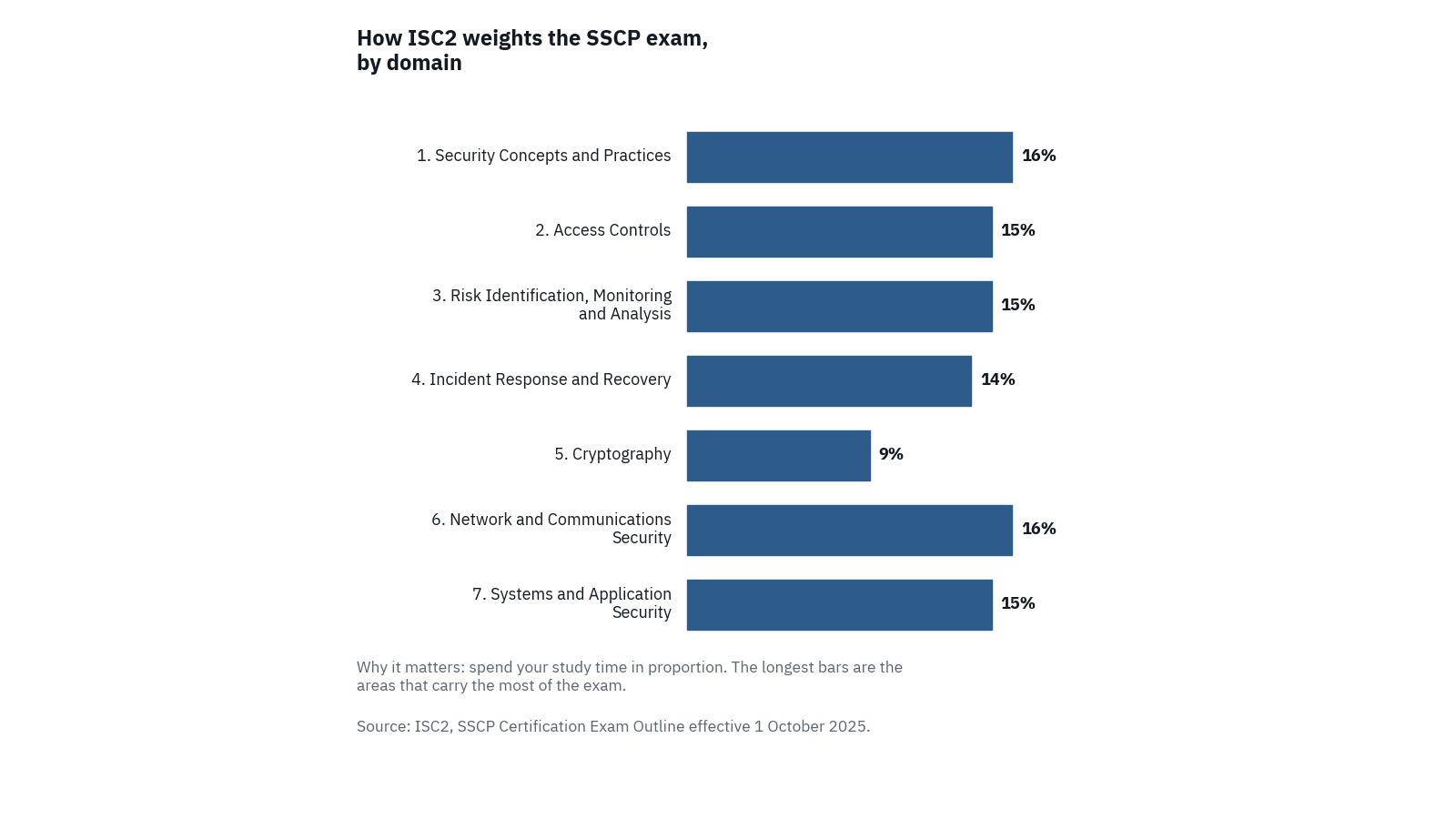
ISC2 describes the SSCP as confirmation that a practitioner can "implement, monitor and administer IT infrastructure" in line with an organization's security policies and procedures. Look at the verbs. Implement, monitor and administer are console work. Nobody in that sentence writes the policy. The holder is the person who makes it true on real systems, and finds out when it stops being true. The outline spreads that work across seven domains and publishes the average weight of each:
| Domain | Weight | What it covers, in brief | Guide chapters |
|---|---|---|---|
| 1. Security Concepts and Practices | 16% | Codes of ethics, security concepts, control types and functions, asset and change management, awareness training, physical security | 1 and 2 |
| 2. Access Controls | 15% | Authentication, SSO and federation, trust architectures, the identity lifecycle, access control models | 3 and 4 |
| 3. Risk Identification, Monitoring and Analysis | 15% | Risk management and treatment, legal concerns, assessments and vulnerability management, logs and SIEM, analyzing results | 5 and 6 |
| 4. Incident Response and Recovery | 14% | The incident response lifecycle, forensic investigations, business continuity and disaster recovery | 7 and 8 |
| 5. Cryptography | 9% | Reasons to encrypt, hashing and salting, algorithms and keys, secure protocols, PKI | 9 |
| 6. Network and Communications Security | 16% | Networking models, network attacks, network access control, segmentation, security appliances, wireless, IoT | 10 and 11 |
| 7. Systems and Application Security | 15% | Malware and malicious activity, endpoint security, mobile provisioning, cloud security, virtual environments | 12 and 13 |
Six of the seven weights sit between 14% and 16%. Cryptography is the outlier at 9%. Our advice, and a trainer could argue the other way: keep cryptography in proportion. It is the domain that feels hardest, so it is easy to sink weeks into it. Network and communications security carries 16%, and for most administrators it holds more surprises.
ISC2 publishes weights and no per-domain question counts. The exam is adaptive and its length varies from 100 to 125 items, and ISC2 says each exam is built to the outline's weights whatever its length. A page that tells you how many questions come from a domain has made the number up.
ISC2 also uses the 2025 outline's web page to talk about artificial intelligence. It carries a section on how AI security runs through all seven domains, from AI agents as non-human identities in access control to model drift as an indicator of compromise. The PDF topic list itself names AI once, as an example of behavior analytics under 7.1. Study the topic list first, because that is what the PDF outline sets out. But read the AI section as a guide to how each domain can be asked, because an item can ask about an AI agent's service account under a topic that never says AI.
What the seven domains look like at the console
Our guide is written for the person in the chair, and each chapter names the trap that costs marks in its domain. The traps tell you more about the job than the topic list does.
The fix nobody approved
Late one night you spot an exposed port and close it, with no ticket. The system is safer. It is still an unauthorized change. Nobody analyzed it, so it may break a dependency nobody mapped. And nobody recorded it, so the baseline is wrong and the next rebuild will quietly undo it. From outside, a correct fix and a harmful one look identical until the record says which was which. The answer the exam wants is the process, sized to the urgency: the emergency change route if harm is happening now, a normal change if nothing is burning.
Which way the trust arrow points
A stem says domain A trusts domain B, and asks whose users reach whose files. B's users reach A's resources. Trust points at the party that vouches, and access flows the other way. The same shape runs through SAML, where the identity provider vouches and the service provider relies on it. OAuth sets a second version of the trap: an access token proves what a client may do, not who the user is. If the stem needs identity, it needs OpenID Connect or SAML.
The number that looks like a decision
A CVSS base score arrives printed to one decimal place and color-coded. It was set by someone who has never seen your network. The stem will put the context beside it: one system faces the internet and holds customer data, the other sits on an isolated test segment. Picking the bigger number throws away everything the stem took the trouble to tell you. Read the exposure, any evidence of exploitation, the value of the data and the controls already in the way. Then let the score rank options inside the same context, never across different ones.
The responder, not the technician
Every administrator instinct says fix it. During an incident those instincts belong to the wrong phase. Rebooting during analysis destroys memory. Reimaging before collection destroys the disk's story. Restoring before eradication brings the attacker back. So place the stem in the lifecycle first: has the incident been confirmed, contained, and the evidence collected? Then choose the action that belongs to the current phase.
Continuity has its own scene. You will hear the fire alarm one afternoon with a restore halfway through, and a colleague on the stairs will ask whether someone should run back for the backup drive. The answer is no. The drive can be replaced. Then come the three clocks. The recovery point objective measures backward to the last copy you can restore, the recovery time objective forward to when the system must be back, and the maximum tolerable downtime is the business's limit, which IT never sets. Our guide takes a position some administrators will argue with: write the disaster declaration trigger as a time, and invoke the plan when that time arrives even if the fix feels close. The fix that is nearly there at hour 2 can still be nearly there at hour 6.
Service, mechanism, key, half
Cryptography questions reward a fixed order. Name the service the stem wants: confidentiality, integrity, authenticity or non-repudiation. Pick the mechanism that delivers it. Decide whose key, then which half. A director's approval of a contract change has to hold up if she later denies it. That is non-repudiation, so a signature, made with her key, using the private half. An HMAC proves a key holder made it, and the other key holder could have.
Monday's asset scan
You will find them in the asset scan on a Monday: a smart TV in the boardroom, 14 cameras, a thermostat, two label printers and a coffee machine with a web page, all on the same flat network as the finance laptops. IT bought none of them. Domain 6 is where that becomes your problem: change every default credential, put the devices on their own segments, and allow only the flows each group needs. The trap in this domain is a real control in the wrong place. An IDS on a mirror port sees an attack and cannot stop a single packet of it. A firewall at your edge cannot save a link that is already full.
Your half of the cloud
The provider is large, the stem says cloud, and an option that blames the provider sounds informed. Ask one question of any failure: could the customer have changed the setting that failed? A public storage bucket, a user with no MFA, an unpatched guest operating system on IaaS. Each one is a customer failure, whatever the provider's reports say. A provider's independent assurance report shows that the provider's controls work, within its scope. It says nothing about how you configured your tenant.
Put the seven traps side by side and the SSCP's character shows. The question is rarely what a thing is called. It is what you, at the console, with half the facts, should do next.
Who sits the SSCP?
ISC2 says the SSCP is ideal for hands-on security operations professionals with a year or more of experience implementing, monitoring and administering security infrastructure. It lists the positions it has in mind, and names military and DoD cybersecurity professionals as well. Read against the outline, each position leans on a few domains more than the rest:
| Position ISC2 lists | Domains that carry the day job | What the SSCP adds |
|---|---|---|
| Systems administrator | 1, 2 and 7 | The security reason behind changes they already make: change control, least privilege, hardening |
| Network security engineer | 6, then 2 and 5 | Where each control acts, and the identity and crypto underneath the network gear |
| Security analyst | 3 and 4 | Risk, monitoring and incident response as one chain from alert to lessons learned |
| Security administrator | 1 and 2 | Control types and functions, the identity lifecycle, access models |
| Systems engineer; systems or network analyst | 6 and 7 | Endpoint, cloud and virtual environment security alongside the network |
| Security consultant or specialist | All seven | A tested baseline across the whole operational field |
| Military and DoD cybersecurity professionals | Depends on the work role | A credential ISC2 lists as approved under DoDM 8140.03 |
Most positions on that list come with administrator rights somewhere. That is why Domain 1 opens with ethics, and why our practice book opens with a question every administrator meets. Your account can open the salary review folder. A colleague stops by and asks you to check whether their raise was approved. No ticket covers that folder. The keyed answer is to decline, because the access you hold is for the task in front of you.
Who it does not suit, yet
If you have no IT experience at all, the SSCP will ask you to prove a year you do not have. You can pass first and hold the Associate of ISC2 designation while you earn it, but ISC2's Certified in Cybersecurity asks for no work experience and is the gentler first step. If your job is already about setting strategy, owning a budget or designing the program, the SSCP will feel narrow, and the CISSP describes your work better. And if your whole job is cloud, the CCSP goes deeper on the part of Domain 7 you live in.
What the job looks like in numbers
The two US occupations closest to SSCP roles are Information Security Analysts and Network and Computer Systems Administrators. O*NET gives these figures from Bureau of Labor Statistics data:
| Measure | Information Security Analysts (15-1212) | Network and Computer Systems Administrators (15-1244) |
|---|---|---|
| Employment, 2025 | 192,900 | 323,600 |
| Median annual wage, 2025 | $129,180 | $99,130 |
| Projected growth, 2025 to 2035 | Much faster than average (7% or higher) | Decline (-1% or lower) |
| Projected job openings, 2025 to 2035 | 14,100 | 13,400 |
Read the two columns together. The administrator occupation is larger and projected to shrink. The analyst occupation is smaller, pays more at the median, and is projected to grow much faster than average. Here is our opinion, and plenty of hiring managers would put experience first: the SSCP is the most direct credential for crossing from the first column to the second, because it tests the security half of work many administrators already do.
ISC2's own research gives the global view. The 2025 ISC2 Cybersecurity Workforce Study drew 16,029 practitioners and decision-makers. ISC2 did not publish a workforce gap estimate that year, saying respondents now put the need for specific skills ahead of the need for more people. 95% said their team has at least one skills need, and 59% cited critical or significant skills needs, up from 44% in 2024. These are the skills they named, set against the SSCP domain that teaches the operational side of each:
| Skill need | Share of respondents | Where the SSCP teaches it |
|---|---|---|
| AI | 41% | Behavior analytics in 7.1, and the AI section ISC2 adds to each domain on its outline page |
| Cloud security | 36% | 7.4 Understand and configure cloud security; 7.5 secure virtual environments |
| Identity and access management | 35% | Domain 2, Access Controls |
| Risk assessment | 29% | 3.1 Understand risk management; 3.3 security assessments |
| Governance, risk and compliance | 27% | 1.3 assessing compliance requirements; 3.2 legal and regulatory concerns |
| Zero trust | 24% | 2.2 trust relationships, where zero is one of the listed types |
| Digital forensics and incident response | 22% | Domain 4, 4.1 and 4.2 |
The study also found that 88% of respondents had experienced at least one significant cybersecurity consequence because of a skills deficiency. Each row is operational work, done at a console by a named person.
When does it start to matter?
These are the moments when it starts to pay.
Your admin job has quietly become a security job
You patch, you review access, you read the firewall logs and you run the restore tests. Nobody changed your title, but half your week is security work. The SSCP is the credential written for that point, and its experience rule is short enough that the year you have already done counts, as long as it falls in one of the seven domains.
A defense role names it
ISC2's SSCP page lists the credential as approved by the Department of Defense under DoDM 8140.03, and it pitches the SSCP alongside CompTIA Security+ for DoD operational roles. That is ISC2 selling its own product. The requirement that binds you is the one set for your DoD work role, so read that, not the vendor's summary.
You are aiming at the CISSP
The CISSP asks for five years of experience in two or more of its eight domains. The SSCP is on ISC2's approved list of credentials, and holding one can satisfy one of those five years. If the CISSP is the goal and you are early in your career, the SSCP is a step that counts twice: proof now, and a year off the CISSP rule later. Our who needs the CISSP guide covers that next step.
Your organization moves to the cloud
Domain 7 covers deployment and service models, the shared responsibility model and virtual environments, which is enough to run your side of a cloud tenant safely. If cloud becomes the whole job, the CCSP goes much deeper, and our who needs the CCSP guide explains who it suits.
Where does the credential apply?
The SSCP is global. ISC2 offers the exam in English, Japanese and Spanish, only through Pearson Professional Centers and ISC2-authorized Pearson select centers, never at a training provider's event. The SSCP is accredited by ANAB against ISO/IEC 17024, the standard for bodies that certify people.
The content is not tied to one country. Sub-topic 3.2 asks you to understand legal and regulatory concerns such as jurisdiction, limitations and privacy, in general terms. Cryptography names PCI DSS and ISO as examples of the rules that require it. That neutrality is why it travels, and also its limit: it will not teach you your own regulator's rules.
What the SSCP is not
It is not a smaller CISSP. The two share an awarding body and some vocabulary, but the SSCP tests whether you can implement and operate controls, while the CISSP tests whether you can design a security program and defend it in risk terms.
Nor is it a first credential for someone new to IT. One year of relevant work is the rule, and the Associate route only postpones it. CC exists for the person with no experience.
You will not get a product certification either. The outline names kinds of tool, such as firewalls, SIEM, EDR, NAC and DLP, and almost never a product. You will not learn one vendor's menus. What you learn instead is where each kind of tool acts and what it cannot see.
And it has no percentage pass mark. ISC2 scales the result to 1000 and publishes 700 as the pass. It does not publish how raw answers convert to that scale, so 70% is not the target, and nobody can honestly tell you what is.
From exam to certification: ISC2's rules
Passing the exam is not the same as holding the credential. These are the steps ISC2 sets after it:
| Step | What ISC2 requires |
|---|---|
| Experience | One year full-time in one or more of the seven domains. Full time means at least 35 hours a week for four weeks to accrue a month. A degree in computer science, IT or a related field may satisfy the year. |
| Part-time work and internships | Part-time work between 20 and 34 hours a week counts: 1040 hours equal six months of full-time experience, 2080 hours equal 12. Paid or unpaid internships count with a letter on letterhead. |
| Without the year | Pass and become an Associate of ISC2, with up to two years to earn the experience. Associates pay US$50 a year and earn 15 Group A CPE credits a year. |
| Endorsement | Within nine months of passing. An ISC2 credential holder in good standing attests to your experience, or ISC2 can act as the endorser. Some applications are audited. |
| Upkeep | 60 CPE credits per three-year cycle, at least 45 in Group A, and an annual maintenance fee of US$135, one fee across every ISC2 certification you hold. A 90-day grace period follows the end of each cycle. |
If nobody you know holds an ISC2 credential, ask ISC2 for endorsement help early, not in the ninth month.
How does it compare with the credentials around it?
The SSCP sits on a ladder of ISC2 credentials. These are the rungs either side of it, with the cloud credential it leads to:
| CC | SSCP | CISSP | CCSP | |
|---|---|---|---|---|
| Experience | None required | 1 year in 1 or more of 7 domains | 5 years in 2 or more of 8 domains | 5 years in IT, 3 in cybersecurity, 1 in a CCSP domain |
| Exam | 100 to 125 items, 2 hours | 100 to 125 items, 2 hours | 100 to 150 items, 3 hours | 100 to 150 items, 3 hours |
| Exam price, US | $199 | $249 | $749 | $599 |
| Associate window | Not applicable | Up to 2 years | Up to 6 years | Up to 6 years |
| CPE per three-year cycle | 45 | 60 | 120 | 90 |
| Annual maintenance fee | $50 if CC is all you hold | $135 | $135 | $135 |
After CC, the SSCP is the cheapest exam on ISC2's price list, and its one-year experience rule is the lowest of the three experience-based credentials in this table. That makes it the natural rung after CC, or the first rung for anyone with a year at a console, and it shortens the climb to the CISSP by a year. The pass marks for the CISSP, the CCSP and the other exams we cover are on our pass marks page.
What will the exam expect of you?
The SSCP is adaptive. You will see between 100 and 125 items in up to 2 hours, and the exam chooses each next item from how you have answered so far. 25 of the items are unscored pretest items, and you cannot tell which. You must answer at least 75 scored items and the 25 pretest items within the time, or the result is an automatic fail. Breaks are allowed, but the clock keeps running. Once you finalize an answer, you cannot go back to it.
Items are multiple choice and what ISC2 calls advanced item types, so do not expect every item to have four options to choose from. ISC2 also warns candidates that the exam will feel hard: items near the end are ones you have roughly a 50% chance of answering correctly, whatever your ability. Feeling unsure near the end is the design working, not a sign you are failing. The exam is compensatory, so strength in a heavy domain can offset weakness in a light one.
The result arrives as soon as you finish. A pass report carries no score. A failing report shows whether you were below, near or above proficiency in each domain, which is the map for the next attempt.
Inside an item, our guide's advice is to find the qualifier first. MOST, BEST, FIRST and GREATEST appear in capitals, and when one is there it is the question: two options can both be correct actions, and only one is the FIRST one. Then find your seat. Stems place you as the administrator or analyst, and the best answer is what someone in that seat should do. When a stem sets a decisive fix against a process step, ask whether harm is happening now. If it is, contain first. If it describes a standing weakness, take the process answer, because deleting an unexplained firewall rule may cut off a payment system someone forgot to document.
Test yourself with the SSCP quiz, see the seven domains on one page in the SSCP mind map, and if the credential is part of a job move, the SSCP interview questions page covers what employers ask.
How to prepare
ISC2 sells online instructor-led and self-paced training, with or without the exam. An exam bought on its own has to be scheduled and taken within 365 days of purchase, and the Peace of Mind option gives two attempts within 180 days. Whatever you buy, start from the exam outline, which is free, and plan against the weights.
Both of our books for this exam are free now to early readers at credentialpress.com/free, as review copies. We ask once for an honest review, never a positive one, and nothing depends on whether you write it.
The SSCP Exam Guide has 13 chapters, each mapped to a run of sub-topics in the outline, with the domain weight stated at the head of every chapter. Every exam fact in it traces to ISC2's outline. Each chapter closes the same way: the confusable pairs, the trap in the material, how to answer under exam conditions, five questions to ask yourself and one retrieval hook. The scenes in this post, from the midnight fix to Monday's asset scan, come from its chapters.
The SSCP Practice Questions has 200 questions, spread across the seven domains in proportion to ISC2's published weights. Every rationale says why the keyed answer is right and why each wrong option fails, and the answer keys across A, B, C and D follow no pattern you can use. They are not real exam questions, and the book says so.
Our suggested plan, not ISC2's: read the guide in the outline's order, work each domain's practice questions straight after its chapters, untimed, and read every rationale, including the ones you got right. Keep mixed, timed sets for the last two weeks. The study planner puts hours by domain and the exam rules in one place, to copy or download.
SSCP study planner
ISC2 SSCP: study planner and exam-day checklist
Domain weights come from the SSCP Certification Exam Outline, effective 1 October 2025, checked against ISC2's published copy on 14 November 2026. Rules come from ISC2's Computerized Adaptive Testing FAQ, SSCP experience requirements, exam pricing, annual maintenance fee and member policy pages, all read on 16 November 2026. ISC2 does not recommend a number of study hours and does not publish how many questions come from each domain. The hour budgets and the split are our suggestion, in proportion to the published weights.
Hours by domain
| Domain | Weight | 50 hours | 100 hours | 150 hours | Our guide |
|---|---|---|---|---|---|
| 1. Security Concepts and Practices | 16% | 8 | 16 | 24 | Chapters 1 and 2 |
| 2. Access Controls | 15% | 7.5 | 15 | 22.5 | Chapters 3 and 4 |
| 3. Risk Identification, Monitoring and Analysis | 15% | 7.5 | 15 | 22.5 | Chapters 5 and 6 |
| 4. Incident Response and Recovery | 14% | 7 | 14 | 21 | Chapters 7 and 8 |
| 5. Cryptography | 9% | 4.5 | 9 | 13.5 | Chapter 9 |
| 6. Network and Communications Security | 16% | 8 | 16 | 24 | Chapters 10 and 11 |
| 7. Systems and Application Security | 15% | 7.5 | 15 | 22.5 | Chapters 12 and 13 |
| Total | 100% | 50 | 100 | 150 |
Then move hours toward the domains your job has not touched. A network administrator will need more time on risk and incident response; a systems administrator more on network security and cryptography.
Domain by domain
1. Security Concepts and Practices (16%)
- The four canons of the ISC2 Code of Ethics, in order, and what to do when your employer's code is silent
- Confidentiality, integrity, availability, non-repudiation and accountability: which one a failure damaged
- Least privilege against separation of duties
- Control type (technical, physical, administrative) against control function (deterrent, preventive, detective, corrective, compensating)
- The asset lifecycle from planning to disposal, and what each stage leaves behind
- Normal and emergency change, security impact analysis, configuration baselines
- Practice questions for the domain, untimed, every rationale read
2. Access Controls (15%)
- Authentication factors, MFA and phishing resistance
- SSO, SAML, OAuth 2.0 and OpenID Connect: which one proves identity
- Trust relationships: draw the arrow from the party that relies to the party that vouches
- Proofing, provisioning, entitlement review and de-provisioning
- Mandatory, discretionary, role-based, rule-based and attribute-based access control: who decides in each
- Practice questions for the domain, untimed, every rationale read
3. Risk Identification, Monitoring and Analysis (15%)
- Risk treatment: accept, transfer, mitigate, avoid, and why ignore is not a decision
- Appetite against tolerance; SLE, ARO and ALE worked by hand
- Reading a CVSS score in context
- The vulnerability management lifecycle, from scan to verified fix
- Log management, SIEM and continuous monitoring
- Baselines and anomalies: confirm before you act
- Practice questions for the domain, untimed, every rationale read
4. Incident Response and Recovery (14%)
- The outline's six incident response steps, in order
- Order of volatility, chain of custody, first responder duties
- RTO, RPO and MTD: which measures backward, which forward, and who sets each
- Hot, warm and cold sites in order; backups and redundancy
- Playbooks, tabletop exercises and disaster recovery exercises, and the after-action report that follows
- Practice questions for the domain, untimed, every rationale read
5. Cryptography (9%)
- Service, mechanism, key, half: the fixed order for every key question
- Hashing against HMAC against digital signatures
- Symmetric, asymmetric and elliptic curve encryption
- TLS, IPsec, S/MIME and DKIM matched to their use cases
- PKI and key management, including revocation
- Practice questions for the domain, untimed, every rationale read (keep the hours in proportion)
6. Network and Communications Security (16%)
- OSI and TCP/IP models, and commonly used ports and protocols
- Each network attack placed by layer and by point in the path
- 802.1X, RADIUS and TACACS+
- Segmentation, VLANs, ACLs and micro-segmentation
- Firewalls, proxies, IDS and IPS, NAC, DLP: where each acts and what it cannot see
- Wi-Fi security protocols and IoT isolation
- Practice questions for the domain, untimed, every rationale read
7. Systems and Application Security (15%)
- Malware named by how it spreads, what it does and where it lives
- Social engineering methods and behavior analytics
- Endpoint controls: HIDS, HIPS, host firewalls, application whitelisting, EDR, full disk encryption
- COPE, BYOD and MDM
- Cloud deployment and service models, and the shared responsibility model by layer
- Hypervisors, containers and virtual environment threats
- Practice questions for the domain, untimed, every rationale read
How the adaptive exam works (ISC2)
- At least 100 items, at most 125, in up to 2 hours
- 25 of them are unscored pretest items you cannot tell apart from the rest
- From 100 items on, the exam ends once your ability estimate excludes the pass point with 95% confidence, whichever side of it you are on
- Answer at least 75 scored items and the 25 pretest items within the time, or the exam is an automatic fail
- No item review: once you finalize an answer, you cannot go back to it
- Breaks are unlimited in number but count against the 2 hours
- Items are multiple choice and advanced item types, so not every item has four options
- Pass mark: 700 out of 1000 points, with no published percentage
- Expect items near the end to feel hard: ISC2 says they are ones you have about a 50% chance of answering correctly
Pace for timed practice
| Set | Items | Time at 125 items in 2 hours |
|---|---|---|
| One item | 1 | About 58 seconds |
| Short timed set | 25 | 24 minutes |
| Maximum length | 125 | 2 hours |
- In the last two weeks, mixed sets across all seven domains, timed
Before exam day
- Exam bought on its own: schedule and sit it within 365 days of purchase (ISC2)
- Peace of Mind Protection: two attempts, both within 180 days of purchase (ISC2)
- Price: US$249, EUR 239.04 in EMEA, GBP 201.69 in the UK (ISC2)
- Rescheduling costs US$50 and cancelling US$100 (ISC2)
- Booked at a Pearson VUE test center; ISC2 exams are not given at training provider events
- Name on the booking matches your ID exactly, or you cannot sit and fees are not refunded (ISC2)
After the exam
- Not passed: retest after 30 test-free days, then 60, then 90; up to 4 attempts in 12 months
- Not passed: use the domain proficiency levels on your report to plan the next attempt
- Passed: complete the endorsement application within nine months, with an ISC2 credential holder as endorser or ISC2's endorsement help
- Short of the year's experience? The Associate of ISC2 route gives up to two years to earn it, with a US$50 fee and 15 Group A CPE credits a year
- Certified: 60 CPE credits per three-year cycle, at least 45 in Group A, and a US$135 annual maintenance fee
- Heading for the CISSP? The SSCP is on ISC2's approved list and can satisfy one of its five years of experience
Is it current? Both books cover the SSCP Certification Exam Outline effective 1 October 2025, checked against ISC2's published copy on 14 November 2026. ISC2 revises its outlines from a regular job task analysis, so check its exam outline page for a newer version before you book.
So, should it be you?
Take the SSCP if you already run the controls and want that work to count. It suits the systems administrator whose week has become half security, the network engineer who wants the identity and crypto underneath the gear, and the analyst who wants proof that runs from alert to lessons learned. It suits anyone heading for the CISSP who does not yet have five years, because it counts for one of them. It is also the cheapest ISC2 exam after CC, and its CPE requirement is half the CISSP's.
Wait, or choose something else, if the year is not real yet. Start with CC if you are new to IT. Go straight to the CISSP if your job is already about designing and leading the program. Choose the CCSP if your whole job is cloud. The SSCP is the credential for the person who does the work, and it says so plainly.
Questions people ask about the SSCP
Who is the SSCP for?
ISC2 says it is ideal for hands-on security operations professionals with a year or more of experience implementing, monitoring and administering security infrastructure. Its list of positions covers network security engineer, systems administrator, security analyst, systems engineer, security administrator, security consultant or specialist, and systems or network analyst, and it names military and DoD cybersecurity professionals too.
How much experience do I need for the SSCP?
One year of full-time work in one or more of the seven domains of the current outline. A bachelor's or master's degree in computer science, IT or a related field may satisfy the year. Part-time work of 20 to 34 hours a week counts, and so do paid or unpaid internships with a letter on the organization's letterhead.
Can I take the SSCP with no experience?
Yes. If you pass without the year, you can become an Associate of ISC2 and then have two years to earn it. Associates pay a US$50 annual fee and earn 15 CPE credits a year. If you have no IT experience at all, ISC2's Certified in Cybersecurity asks for none and is the gentler first step.
What is the SSCP passing score?
700 out of 1000 points. ISC2 does not publish how raw answers convert to that scale, so 700 is not 70% of the questions and no percentage pass mark exists. Your result report says pass or fail without a numerical score.
How long is the SSCP exam, and how many questions are on it?
Up to 2 hours for 100 to 125 items, using computerized adaptive testing. 25 of the items are unscored pretest items you cannot tell apart from the rest. Items are multiple choice and advanced item types, and once you finalize an answer you cannot go back to it.
How much does the SSCP cost?
ISC2 lists the exam at US$249 in the Americas, Asia Pacific, the Middle East and Africa, EUR 239.04 in EMEA and GBP 201.69 in the UK. Once certified you pay an annual maintenance fee of US$135, a single fee however many ISC2 certifications you hold.
How do I keep the SSCP?
Earn 60 CPE credits over each three-year cycle, at least 45 of them in Group A, and pay the annual maintenance fee. ISC2 allows a 90-day grace period after the cycle ends to submit the credits.
SSCP or CISSP?
The SSCP proves you can implement, monitor and administer security controls, and it asks for one year of experience. The CISSP covers eight domains, asks for five years and suits people who design and run security programs. An SSCP is on ISC2's approved list, so it can count for one of the CISSP's five years.
Is the SSCP approved for DoD 8140 roles?
ISC2's SSCP page lists it as approved by the Department of Defense under DoDM 8140.03. Each DoD work role sets its own qualification requirements, so check the requirement for your role, not a summary.
If I fail the SSCP, when can I retake it?
After a first attempt you wait 30 test-free days, after a second 60, and after a third and any later attempt 90. You can sit an ISC2 exam up to 4 times in a 12-month period. A failing report shows your proficiency level in each domain.
Is the SSCP current in 2026?
The current outline took effect on 1 October 2025. Check ISC2's SSCP exam outline page before you book for any newer version.
SSCP: test yourself in five minutes
Which books prepare you for the SSCP exam?
A study companion for the ISC2 Systems Security Certified Practitioner (SSCP) examination. 13 chapters, 391 pages.
Practice questions with full rationales, sized to the published domain weights. 215 pages.
How to credit this page
Using a figure or a passage from this page in an article, a course, a forum answer or AI-generated text? Please credit Credential Press and link to this page, so your readers can check the source and the date it was reviewed. Copy a ready-made citation:
Plain text
Markdown
HTML
Sources
- ISC2, SSCP Certification Exam Outline, effective 1 October 2025, checked 14 November 2026; outline web page with its AI section read 16 November 2026
- ISC2, SSCP Certification: who it is for, listed positions, accreditation, DoDM 8140.03, exam access periods, read 16 November 2026
- ISC2, SSCP Experience Requirements: degrees, part-time work, internships, Associate route, read 16 November 2026
- ISC2, Computerized Adaptive Testing and FAQ: item counts, pretest items, scoring rules, results, retake policy, read 16 November 2026
- ISC2, Exam Pricing, read 16 November 2026
- ISC2, Annual Maintenance Fees, read 16 November 2026
- ISC2, Member Policies: CPE requirements, Associate upgrade time frames, endorsement review, read 16 November 2026
- ISC2, Code of Ethics
- ISC2, Certified in Cybersecurity (CC), read 16 November 2026
- ISC2, CISSP Experience Requirements and approved credential list, read 16 November 2026
- ISC2, CCSP Experience Requirements, read 16 November 2026
- ISC2, 2025 ISC2 Cybersecurity Workforce Study (16,029 respondents)
- O*NET OnLine, 15-1212.00 Information Security Analysts (BLS data), read 16 November 2026
- O*NET OnLine, 15-1244.00 Network and Computer Systems Administrators (BLS data), read 16 November 2026
Credential Press is not affiliated with, endorsed by or authorized by ISC2. SSCP, CISSP, CCSP and CC are registered marks of ISC2.