FRM Part II
After Part I: who sits FRM Part II, and how the six areas map to real risk jobs
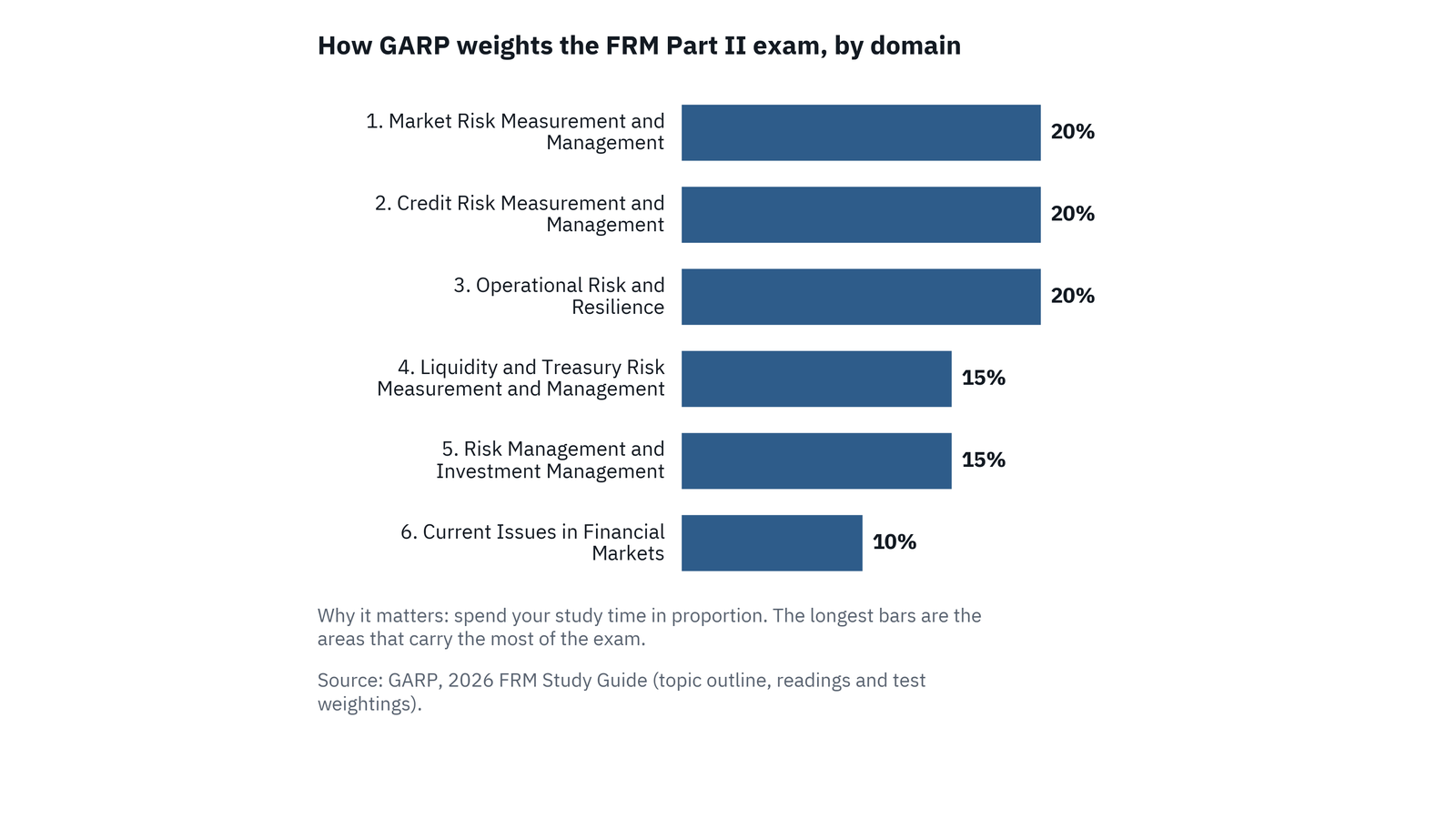
FRM Part II is the second of GARP's two Financial Risk Manager exams, and the one that stands between a Part I pass and the FRM certification. GARP says its material applies in jobs from risk analysis and model validation to trading, portfolio management, treasury, audit and consulting. This guide is about those people: what each of the six Part II areas does for them at work, how long GARP gives them, and what still stands between a Part II pass and the FRM certification.
The exam facts here come from GARP's 2026 FRM Study Guide, its Program and Exams page, its Exam Policies, its Fees and Payments page and its FAQ, read on 20 October 2026. The labor-market figures come from O*NET OnLine, which publishes US Bureau of Labor Statistics data. For the dates, fees and weights, GARP's own pages win wherever this page and GARP differ.
What does Part II test that Part I did not?
Part I teaches the tools. GARP's FAQ says Part II "focuses on the application of the tools acquired in the FRM Exam Part I." Read the topic list and the shift is clear: less about what a model is, more about what a risk manager does with it on a bad day: whether a reported VaR number was honest, whether a counterparty line is priced for the loss it could cause, whether a bank survives 30 days of outflows, whether a portfolio's risk budget is being spent where the manager thinks it is.
Part I covers Foundations of Risk Management, Quantitative Analysis, Financial Markets and Products, and Valuation and Risk Models. Part II covers six areas, and GARP publishes the weight of each one in the Study Guide:
| Area | Weight | Topics GARP lists, in brief |
|---|---|---|
| 1. Market Risk Measurement and Management | 20% | VaR estimation, mapping and backtesting; expected shortfall; extreme value theory; correlations and copulas; term structure models; volatility smiles; FRTB |
| 2. Credit Risk Measurement and Management | 20% | Credit analysis; default risk; expected and unexpected loss; credit VaR; counterparty risk; credit derivatives; securitization |
| 3. Operational Risk and Resilience | 20% | Operational risk frameworks; cyber and operational resilience; financial crime and fraud; third-party risk; model risk and validation; stress testing; RAROC; economic capital; the Basel Accords |
| 4. Liquidity and Treasury Risk Measurement and Management | 15% | Liquidity metrics; liquidity portfolios; cash-flow modeling and stress testing; contingency funding plans; funding models; funds transfer pricing; cross-currency funding; balance sheet management |
| 5. Risk Management and Investment Management | 15% | Factor theory; portfolio construction; portfolio risk measures; risk budgeting; performance measurement; hedge funds and private markets; due diligence; asset liquidity |
| 6. Current Issues in Financial Markets | 10% | For 2026: artificial intelligence, private credit, geopolitical risk, rising government debt, crypto and digital assets, digital resilience |
Two of those areas, liquidity and treasury risk and investment management, have no counterpart among the Part I areas. Together they are 30% of the paper. If neither treasury nor investment management is your day job, these two areas are likely to be the newest reading for you. The FRM Part II exam guide page has the full outline, the readings and the dates.
Who sits Part II?
GARP does not publish a list of job titles for Part II. It does say what counts as relevant experience for the certification: full-time work "where the identification, measurement, monitoring, or management of risk is a meaningful part of the job's responsibility." It then names the jobs where the exam's material applies: risk analysis, model validation, trading, portfolio management, treasury, audit and consulting. That list is the closest thing GARP publishes to a description of who the exam is for.
Read against the six areas, each of those jobs leans on different parts of the paper:
| Job | Areas that carry the day job | What Part II adds to it |
|---|---|---|
| Risk analyst, market or credit | 1 and 2 | Estimating VaR and expected shortfall, backtesting them, measuring credit VaR and counterparty exposure |
| Model validator | 3, then 1 | Model risk and model validation as GARP frames them, plus backtesting, the first test any market risk model faces |
| Trader or desk risk manager | 1 and 2 | FRTB's trading book rules, volatility smiles, credit derivatives |
| Portfolio manager or buy-side risk | 5 | Factor theory, risk budgeting, performance measurement, hedge fund and private market due diligence |
| Treasury and balance sheet management | 4 | Liquidity metrics and stress tests, contingency funding plans, funds transfer pricing, cross-currency funding |
| Internal auditor | 3 | Operational risk framework governance, and whether model risk management is designed and operating as it should |
| Risk consultant | 6, plus the client's area | The issues GARP names for the year, which are often the ones clients are asking about |
No job uses all six areas every week, which is why the exam can feel uneven. A treasury analyst may find area 4 easy and area 1 hard; a quant on a trading desk may find the reverse. The weights do not care which job you have, so the plan has to.
What the job looks like in numbers
The closest US occupation is Financial Risk Specialists, code 13-2054 in the federal classification. O*NET, the US Department of Labor's occupational database, gives these figures from Bureau of Labor Statistics data:
| Measure | Figure |
|---|---|
| Employment, 2025 | 66,000 |
| Median annual wage, 2025 | $117,330 ($56.41 an hour) |
| Projected growth, 2025 to 2035 | Much faster than average (7% or higher) |
| Projected job openings, 2025 to 2035 | 4,800 (openings from growth and replacement, as O*NET reports them) |
| Sample job titles | Risk Analyst, Risk Manager, Risk Specialist, Analyst, Equity Research Analyst, Securities Analyst |
Those figures cover one US occupation code. People in the other jobs GARP names, such as trading, treasury, audit and portfolio management, are counted under other codes, and the figures leave out everyone outside the US. The table tells you the core risk job is well paid and growing in the US. It does not tell you what an FRM is worth to any single career, and we found no credible published figure for that.
When does Part II start to matter?
Most people do not decide to sit Part II in the abstract. Something puts a date on it.
You passed Part I, and the clock started
GARP's certification policy says you must pass Part II "by December 31 of the 4th year of passing the FRM Exam Part I." Its Program and Exams page puts the same rule more loosely, as four years from the date you pass Part I. Your GARP account shows the date that applies to you. Plan backward from it, because the four years include the months you spend waiting for results.
GARP offers Part II in May, August and November. For 2027 it lists Part II on May 15 to 17, in the afternoon sessions of August 13 to 14, and on November 20 to 22. Early registration is USD 600 and standard registration USD 800, before taxes, and GARP says all fees are subject to change.
You want to sit both parts at once
You can sit Part I and Part II on the same day only in August. In May and November you can sit both in the same exam window, on different days. The catch is the same either way: if you fail or do not show up for Part I in that window, GARP does not grade your Part II. If you register for the two parts in different windows and then fail Part I, GARP converts your Part II registration to Part I. GARP's policy says you cannot sit Part II in a later window before you have taken and passed Part I.
Sitting both in one window saves time on the four-year clock. It also doubles the reading in the run-up, and a Part I failure costs you the Part II attempt as well.
Your firm is putting a new rule in place
Some of the Part II areas exist because regulators wrote them into bank practice. The Fundamental Review of the Trading Book, published by the Basel Committee as its minimum capital requirements for market risk, sits in area 1. The liquidity coverage ratio and the net stable funding ratio sit in area 4. The Basel Committee's principles for operational resilience, and in the EU the Digital Operational Resilience Act, sit behind area 3 and the digital resilience reading in area 6. When a firm implements one of these, somebody has to explain the rule, model it and defend the numbers to a supervisor. Knowing the Part II reading is a head start on that work.
You are moving across the firm
A move from a trading desk to treasury, or from a bank to an asset manager, changes which areas you use every day. Part II can serve as a structured way into the new side of the house: area 4 for treasury, area 5 for the buy side.
What each area lets you do at work
Here is the same material turned around. For each area, the first column says the decision at work it prepares you for. The second gives the matching task from O*NET's list, shortened, for Financial Risk Specialists, so you can see the area in the language of a job description. The last column points to the chapters in our guide.
| Area (weight) | The decision it prepares you for | Matching O*NET task, in brief | Exam Guide chapters |
|---|---|---|---|
| 1. Market risk (20%) | Is the reported VaR or expected shortfall honest, and how much capital does the trading book need? | Scenario analysis of possible severe market events; talking to traders about the risks of their positions | 1 and 2 |
| 2. Credit risk (20%) | What could this borrower or counterparty cost us, expected and unexpected? | Analyze areas of potential risk to the assets, earning capacity or success of the organization | 3 and 4 |
| 3. Operational risk and resilience (20%) | Will critical services keep running through a disruption, and are our models and third parties under control? | Develop contingency plans for emergencies; develop or implement risk-assessment models | 5 and 6 |
| 4. Liquidity and treasury (15%) | How long do we survive a funding stress, and what should each business pay for its funding? | Statistical analysis to quantify risk | 7 and 8 |
| 5. Investment management (15%) | Is the portfolio's risk budget spent where the manager thinks it is, and is this fund what it says it is? | Statistical analysis to quantify risk, with statistical software or econometric models | 9 and 10 |
| 6. Current issues (10%) | What will the board, the supervisor or the client ask about this year? | Analyze new legislation for its impact on risk exposure; keep up with the latest models in the financial literature | 11 |
We have turned the dates and rules from this section into a checklist you can copy or download below.
FRM Part II deadline and readiness checklist
FRM Part II: deadline and readiness checklist
Use this when you have passed, or are about to sit, FRM Part I. Every rule below is GARP's, from its FRM Exam Policies, Program and Exams, Fees and Payments and FAQ pages, read on 20 October 2026. Check your own GARP account before you rely on any date.
Your clock
- Date you passed Part I: ____________
- Your Part II deadline as your GARP account shows it (the rule: pass Part II by December 31 of the
4th year of passing Part I): ____________
- The exam window you are aiming for (May, August or November): ____________
- Early registration opening date for that window, from GARP's Fees and Payments page: ____________
- If you plan to sit both parts in one window: only August allows both on the same day, and if you
fail or miss Part I, your Part II is not graded
Your study plan, sized to the weights
- Market Risk Measurement and Management (20%): hours planned ______
- Credit Risk Measurement and Management (20%): hours planned ______
- Operational Risk and Resilience (20%): hours planned ______
- Liquidity and Treasury Risk Measurement and Management (15%): hours planned ______
- Risk Management and Investment Management (15%): hours planned ______
- Current Issues in Financial Markets (10%): this year's readings downloaded from GARP (online only)
Exam day
- An authorized calculator: HP 12C (including the Platinum and Prestige editions), HP 10B II, HP 10BII+,
HP 20B, or Texas Instruments BA II Plus (including the Professional)
- Phone fully off and stored (airplane mode is not enough)
- Pace: 80 questions in 4 hours is 3 minutes a question on average
After you pass
- Two years of full-time work where identifying, measuring, monitoring or managing risk is a
meaningful part of the job (internships, part-time jobs and work done during school do not count)
- A description of your role in managing financial risk, at least 4 to 5 sentences, ready to submit
in your GARP account
- Do not use "FRM" after your name until GARP has certified you
- Once certified: 40 CPD credits every two years, which GARP encourages
Where does it apply?
The FRM is a global certification. GARP runs both exams by computer-based testing, mainly in English, and offers candidates in Mainland China the option of sitting in Simplified Chinese. The content is not written for one country's rulebook. Instead it teaches the international standards that national rules are built from:
| Framework | Issued by | Where it applies | Part II area |
|---|---|---|---|
| Minimum capital requirements for market risk (FRTB) | Basel Committee on Banking Supervision | Bank trading books, once a jurisdiction writes the standard into its own rules | 1 |
| Liquidity Coverage Ratio | Basel Committee on Banking Supervision | Banks, as adopted locally; a 30-day stress test of liquid assets against outflows | 4 |
| Net Stable Funding Ratio | Basel Committee on Banking Supervision | Banks, as adopted locally; a one-year test of stable funding against the assets it funds | 4 |
| Principles for operational resilience | Basel Committee on Banking Supervision | Banks, as supervisory principles | 3 |
| Digital Operational Resilience Act, Regulation (EU) 2022/2554 | European Union | EU financial entities, from 17 January 2025 | 3 and 6 |
Basel Committee standards have no legal force of their own. They bite when a supervisor adopts them, and the timing differs by country. That is why Part II teaches the standard rather than any one country's version, and why your own regulator's rulebook is still required reading for the job.
What Part II is not
It is not the certification. Passing Part II completes the exams. The FRM itself also needs two years of full-time relevant work, submitted as a description of at least 4 to 5 sentences of your role in managing financial risk and approved by GARP. GARP's policy is plain: candidates "cannot use the FRM designation after their name in any manner until they have been certified."
It is not a score. Both FRM exams are pass or fail. You also get quartile results comparing your performance with other candidates, but GARP publishes no pass mark, so a number quoted in a forum or a prep course is not GARP's.
It is not a license. GARP is a not-for-profit membership association, and the FRM is a professional certification. It is issued by GARP, not by a regulator, and it does not authorize anyone to do regulated work.
It is not frozen. GARP says its FRM Committee reviews and revises the curriculum every year, and the Current Issues area changes most. A guide written to one year's outline should say which year, and so should your notes.
From Part I to certification: the GARP timeline
| Step | GARP's rule |
|---|---|
| Enroll and pass Part I | A one-time USD 400 enrollment fee is paid when you first register for Part I |
| Pass Part II | By December 31 of the 4th year of passing Part I |
| Results | Pass or fail, with quartile results, on the GARP candidate portal within eight weeks of the exam window closing |
| Submit work experience | Two years full-time, built before or after the exams; experience gained while at school, including internships and part-time jobs, does not count |
| Deadline for the experience | Within 10 years of sitting Part II under GARP's Exam Policies; miss it and you re-enroll and retake both exams |
| Certificate | Sent the month after GARP approves your work experience |
| After certification | 40 CPD credits every two years, which GARP encourages |
One line in GARP's FAQ gives five years, rather than 10, to submit work experience after passing Part II. GARP's Exam Policies and its Program and Exams page both say 10. If your plans depend on the difference, ask GARP and keep the answer in writing.
How does Part II compare with the GARP exams around it?
Most Part II candidates are weighing it against Part I behind them, or against one of GARP's shorter certificates. All four exams use the same format family:
| FRM Part I | FRM Part II | Risk and AI (RAI) | Sustainability and Climate Risk (SCR) | |
|---|---|---|---|---|
| Questions | 100, equally weighted | 80, equally weighted | 80, equally weighted | 80, equally weighted, including one multi-part case study |
| Time | 4 hours | 4 hours | 4 hours | 4 hours |
| Study time GARP quotes | About 240 hours on average, from a survey of May 2015 candidates, not split by part | 100 to 130 hours | 100 to 150 hours | |
| Results | Within eight weeks of the window closing | Within four to six weeks | Within four to six weeks | |
| Leads to | Part II | The FRM, after two years of work experience | The RAI Certificate | The SCR Certificate |
The certificates are narrower and quicker. RAI suits someone whose risk work is mostly about AI and machine learning models, and SCR suits someone whose work is mostly climate and sustainability risk. AI appears inside FRM Part II too, as one of the 2026 Current Issues readings, but as one topic in a much larger paper. If you have passed Part I, Part II is the exam that completes what you started.
What will the exam expect of you?
Part II has 80 multiple-choice questions, each with four options and one best answer, in four hours. That is 3 minutes a question on average, which sounds generous until a stem asks you to rebuild a liquidity coverage ratio from a balance sheet. You sit it by computer at a testing site, with an authorized calculator: the HP 12C (including the Platinum and Prestige editions), the HP 10B II, HP 10BII+ or HP 20B, or the Texas Instruments BA II Plus (including the Professional). GARP is strict about the rest of the room. If your phone makes any noise during the exam, even from a locker, your session ends and the exam is not graded.
One trap runs through Part II items: a true statement that does not answer the question. On an FRTB item, two options can both describe real features of the rules, and only one fixes the problem the stem describes. A stem about a firm whose deposits are stable but whose mortgage book is funded overnight is about the NSFR, even if the word liquidity appears four times and the LCR is the ratio you know better. Calculation items have their own pattern: on an LCR question, expect wrong options built by leaving out the Level 2 cap, leaving out the inflow cap, or applying a cap to the wrong side. Every chapter of our guide names the traps its area's items are built on. For scoring, dates and what to do this week, see the FRM Part II exam page.
How to prepare
GARP publishes its own FRM Exam Books and practice exams, and lists approved third-party exam preparation providers. Whatever you use, the assigned readings in the Study Guide are the syllabus, and this year's Current Issues readings are published online only. Download them from GARP rather than relying on anyone's summary.
Size your plan to the weights, not to your comfort. If you take GARP's average of about 240 hours as a budget, the published weights split it into 48 hours each for market risk, credit risk and operational risk, 36 hours each for liquidity and treasury risk and for investment management, and 24 hours for Current Issues. Your own split should move hours toward the areas your job does not touch, since those are where the reading is newest. The checklist above has a line for each area so you can write the hours down before you start.
The FRM Part II Exam Guide (Wikidata) has 11 chapters, two for each of the first five areas and one for Current Issues, across 419 pages. Every chapter opens with its area's published weight and GARP's topic list, works through the calculations with hypothetical numbers where the area has them, and has a mind map of its topics. It was written from GARP's 2026 FRM Study Guide, checked against GARP's published copy on 15 September 2026, and every source is named at the back with the date it was read. It does not quote GARP's own material or any real exam item.
The FRM Part II Practice Questions (Wikidata) has 200 questions split by the published weights, so the practice matches the paper rather than the subjects that are easiest to write questions on. Every question has a full rationale explaining why the right answer is right and why each wrong one is wrong.
Is it current? Both books follow the 2026 FRM Study Guide. GARP revises the curriculum every year, and Current Issues is the part that dates first, so check the readings list for your own exam year against the books before you start. If you are still on Part I, start with the FRM Part I Exam Guide, the FRM Part I exam page and the Part I mind map, then test yourself with the Part I quiz. Practicing interview answers? The FRM interview questions page covers the Part I material.
So, should you sit Part II now?
Sit it now if you have passed Part I and your work already touches two or three of the six areas. The four-year rule makes a long delay costly, and the material is easier to learn while you are using some of it every day. Sit it now too if your firm is putting FRTB, the liquidity ratios or an operational resilience program in place, because the reading is the same reading the project needs.
Wait a window if one of the 15% areas is entirely new to you and your next exam date is close. Liquidity and investment management together are 30% of the paper, and a weak start there is hard to make up in the last month. And if your interest is narrow, mainly AI risk or mainly climate risk, look at GARP's RAI or SCR certificates first: they are shorter, and they say exactly what you do.
Whichever you choose, decide early. For the 2027 windows GARP lists Part II at USD 600 at early registration and USD 800 at standard registration, so the decision itself is worth USD 200.
Questions people ask about FRM Part II
Who should sit FRM Part II?
Anyone who has passed FRM Part I and wants the FRM certification, since certification needs both exams and two years of relevant work. GARP says the exam's application can be found in many jobs, including risk analysis, model validation, trading, portfolio management, treasury, audit and consulting.
How long do I have to pass FRM Part II after Part I?
GARP's certification policy says you must pass Part II by December 31 of the 4th year of passing Part I. GARP's Program and Exams page puts it as four years from the date you pass Part I. Check the exact date in your GARP account.
Can I take FRM Part I and Part II on the same day?
Only in August. In May and November you cannot sit both on the same day, but you can sit both in the same exam window. If you fail or do not show up for Part I in that window, GARP does not grade your Part II.
How many questions are on FRM Part II, and how long is it?
80 equally weighted multiple-choice questions, each with four options, in four hours, by computer-based testing. That is 3 minutes a question on average.
What is the pass mark for FRM Part II?
GARP does not publish one. Both FRM exams are scored pass or fail, and candidates also receive quartile results comparing their performance with other candidates. Any pass mark you see quoted is unofficial.
What does FRM Part II cover?
Six areas in the 2026 Study Guide: market risk (20%), credit risk (20%), operational risk and resilience (20%), liquidity and treasury risk (15%), risk management and investment management (15%) and current issues in financial markets (10%).
Am I FRM certified once I pass Part II?
No. You also need two years of full-time work in which identifying, measuring, monitoring or managing risk is a meaningful part of the job, submitted and approved through your GARP account. GARP says you cannot use the FRM designation after your name until you are certified.
Does work experience before the exams count toward the FRM?
Yes. GARP says the experience can be built before or after you pass the exams. Experience gained while at school, including internships and part-time jobs, does not count.
How much does FRM Part II cost?
For the 2027 windows GARP lists USD 600 at early registration and USD 800 at standard registration, before taxes such as VAT or GST. The one-time USD 400 enrollment fee is paid with Part I, not Part II. GARP says all fees are subject to change.
Which calculators are allowed in the FRM exam?
GARP authorizes the HP 12C (including the Platinum and Prestige editions), the HP 10B II, HP 10BII+ and HP 20B, and the Texas Instruments BA II Plus (including the Professional). A candidate using any other calculator will not have the exam graded.
Do FRM holders have to do CPD?
GARP's CPD program asks for 40 credits, about 40 hours, every two years. GARP's own answer on whether it is mandatory is that FRM-certified professionals are encouraged to take part.
FRM Part I: test yourself in five minutes
Which books prepare you for FRM Part II?
A study companion for the GARP Financial Risk Manager Exam Part II. 11 chapters, 419 pages.
FRM Part II Practice Questions
Practice questions with full rationales, sized to the published domain weights. 216 pages.
How to credit this page
Using a figure or a passage from this page in an article, a course, a forum answer or AI-generated text? Please credit Credential Press and link to this page, so your readers can check the source and the date it was reviewed. Copy a ready-made citation:
Plain text
Markdown
HTML
Sources
- GARP, 2026 FRM Study Guide (topic outline, readings and test weightings)
- GARP, FRM Program and Exams: format, windows, study time, results, the four-year rule
- GARP, FRM Exam Policies: certification requirements, calculators, phones
- GARP, FRM Fees and Payments: 2027 dates and fees, enrollment fee
- GARP, FRM Frequently Asked Questions: relevant experience, same-day rules, CPD
- GARP, Risk and AI (RAI) Certificate, Program and Exam
- GARP, Sustainability and Climate Risk (SCR) Certificate, Program and Exam
- O*NET OnLine, 13-2054.00 Financial Risk Specialists (2025 wage data and 2025 to 2035 projections from the Bureau of Labor Statistics)
- Basel Committee on Banking Supervision, Minimum capital requirements for market risk
- Basel Committee on Banking Supervision, Basel III: The Liquidity Coverage Ratio and liquidity risk monitoring tools
- Basel Committee on Banking Supervision, Basel III: the net stable funding ratio
- Basel Committee on Banking Supervision, Principles for operational resilience
- Regulation (EU) 2022/2554 (DORA), OJ L 333, 27 December 2022
Credential Press is not affiliated with, endorsed by or authorized by GARP. FRM and Financial Risk Manager are trademarks of the Global Association of Risk Professionals.