CAPM
Can you pass this 10-question CAPM quiz?
Ten questions taken word for word from our CAPM Practice Questions, at least two from each of PMI's four domains, each with four options and one keyed answer. The real exam also uses drag-and-drop, animation or comic strip and hot spot items, which a page cannot show. Tap an answer to see why, with the source. Takes about five minutes.
Can you get 10 out of 10?
1 of 10A regional bank's change director puts three pieces of work under one manager: a branch refurbishment, an upgrade to the fraud detection software and a staff wellbeing survey. None of the three depends on another, and they share no common benefit, but they draw on the same budget line and compete in the same funding round. The director calls the group "the transformation program." How should you classify the grouping?
Show answer
Answer: B. A program is defined by related components that deliver a shared benefit, and the stem rules out both: nothing depends on anything else, and no benefit is shared. Unrelated work grouped for funding and priority is a portfolio, whatever the organization calls it. One manager overseeing the work describes a reporting line, not a relationship between the parts, so calling it a program fails. Source: PMI, CAPM Examination Content Outline, 2023 Exam Update, Domain 1, Task 1 (distinguish between a project, program, and a portfolio)
2 of 10On a predictive project, a team member raises a new risk that a key supplier may raise its prices before the main order is placed. What should happen next?
Show answer
Answer: D. The risk register is a project document, updated as the work goes on without a change request for each entry. A new risk is recorded, analyzed for probability and impact, given an owner and given a planned response. Sending it to a change control board treats a working document as if it were part of the approved plan. Source: PMI, CAPM Examination Content Outline, 2023 Exam Update, Domain 1, Task 2 (use a risk register in a given situation)
3 of 10You are a developer on a Scrum team building a self-service portal for an energy supplier. The sponsor, who funds the project, stops by your desk and asks you to add a usage comparison chart before the next review. The chart is not in the current iteration's work. What should you do?
Show answer
Answer: D. The chart is a change to scope, however small. The sponsor has every right to ask, but asking is not approving. On a Scrum team, a new request goes to the product owner, who is accountable for the product's value and decides the order of the backlog. Source: PMI, CAPM Examination Content Outline, 2023 Exam Update, Domain 1, Task 3 (roles and responsibilities of the project team and the project sponsor)
4 of 10Activity G on your predictive project has 3 days of total float and 0 days of free float. A supplier problem delays G by 5 days. Nothing else changes. What happens to the project?
Show answer
Answer: D. Total float is how far G can slip without delaying the project finish. A 5-day slip uses all 3 days of float and pushes the finish out by the rest: 5 - 3 = 2 days. G has no free float, so any slip delays its successor's early start at once, and G's path becomes the critical path. Source: PMI, CAPM Examination Content Outline, 2023 Exam Update, Domain 2, Task 2 (apply critical path methods)
5 of 10On a hypothetical predictive project, planned value is $80,000, earned value is $100,000 and actual cost is $125,000. Which reading of the performance indexes is correct?
Show answer
Answer: C. Write each formula with EV first. SPI = EV / PV = $100,000 / $80,000 = 1.25, so work is getting done at 125% of the planned rate, ahead of schedule. CPI = EV / AC = $100,000 / $125,000 = 0.80, so each dollar spent buys 80 cents of planned work, over budget. Source: PMI, CAPM Examination Content Outline, 2023 Exam Update, Domain 2, Task 3 (calculate cost and schedule variances)
6 of 10A team has converted its project plan into four sprints: sprint 1 for requirements, sprint 2 for design, sprint 3 for build and sprint 4 for testing. The team calls the project adaptive. Which change would make the plan adaptive in practice?
Show answer
Answer: B. The plan has the words of adaptive delivery and the shape of predictive delivery. The test is whether each iteration ends with a working, tested increment that a user could try, and sprint 2 here ends with designs and nothing that runs. Re-cutting the work into vertical slices restores a short feedback loop. Source: PMI, CAPM Examination Content Outline, 2023 Exam Update, Domain 3, Task 2 (distinguish the logical units of iterations; translate this WBS to an adaptive iteration)
7 of 10A newly appointed Scrum master starts each Monday by assigning the week's tasks to named Developers and telling the product owner which items to put first. What should the Scrum master do instead?
Show answer
Answer: C. Scrum splits authority on purpose. The Developers are self-managing and decide who does what, when and how. The product owner decides the order of the product backlog. Source: PMI, CAPM Examination Content Outline, 2023 Exam Update, Domain 3, Task 4 (components of different adaptive methodologies); The Scrum Guide
8 of 10You are the business analyst on a project to change how a distributor handles customer returns. Dana runs the returns team every day and knows every exception. Marcus answers to the executive team for how well the returns process performs across sales, the warehouse and finance. Dana proposes removing one approval step. Who should approve the change?
Show answer
Answer: C. Marcus is the process owner. He is accountable for the design and performance of the returns process across every department it passes through, and he has the authority to approve changes to how it works. Dana is the process manager. Source: PMI, CAPM Examination Content Outline, 2023 Exam Update, Domain 4, Task 1 (distinguish between stakeholder roles, e.g., process owner, process manager)
9 of 10You need the sponsor to choose between two scope options by Thursday. Each option has different costs and risks. The sponsor reads email on her phone between meetings, and the steering group next meets in 3 weeks. Which approach fits this situation?
Show answer
Answer: A. A message that needs a decision needs interactive communication, so the sponsor can ask questions and decide on the spot, and the outcome then needs a written record. A short meeting with a one-page summary does both. A detailed email is push communication: it confirms nothing, and a reader on a phone between meetings may reply "let's discuss" while the deadline passes. Source: PMI, CAPM Examination Content Outline, 2023 Exam Update, Domain 4, Task 2 (recommend the most appropriate communication channel/tool)
10 of 10On a predictive project, every test linked in the traceability matrix for a clinic's new booking system has run and passed. The clinic manager, who owns the requirements, has not yet reviewed the system against its acceptance criteria. The project manager says the product is validated and ready. Which statement is accurate?
Show answer
Answer: D. Verification checks that a deliverable meets its specification, and a matrix full of passed tests shows it. Validation checks that the deliverable meets the stakeholder's need, and it ends when the owner reviews the result against the acceptance criteria and accepts it, recorded as sign-off. Here the owner has reviewed nothing, so validation is incomplete. Source: PMI, CAPM Examination Content Outline, 2023 Exam Update, Domain 4, Task 6 (determine if a project/product is ready for delivery based on a requirements traceability matrix)
CAPM flashcards for Anki
front,back
"A regional bank's change director puts three pieces of work under one manager: a branch refurbishment, an upgrade to the fraud detection software and a staff wellbeing survey. None of the three depends on another, and they share no common benefit, but they draw on the same budget line and compete in the same funding round. The director calls the group ""the transformation program."" How should you classify the grouping? | A) As a program, because one manager oversees all three pieces of work and reports on them together. / B) As a portfolio, or part of one, because unrelated work is grouped for funding and priority. / C) As a single large project, because the three pieces of work draw on one budget line. / D) As operations, because the work is funded from a standing budget line instead of a charter.","B) As a portfolio, or part of one, because unrelated work is grouped for funding and priority.. A program is defined by related components that deliver a shared benefit, and the stem rules out both: nothing depends on anything else, and no benefit is shared. Unrelated work grouped for funding and priority is a portfolio, whatever the organization calls it. One manager overseeing the work describes a reporting line, not a relationship between the parts, so calling it a program fails. Source: Credential Press, https://credentialpress.com/guides/capm-quiz"
"On a predictive project, a team member raises a new risk that a key supplier may raise its prices before the main order is placed. What should happen next? | A) Submit a change request so that the change control board can approve adding the new risk to the register. / B) Wait for the next phase gate, where the sponsor reviews and approves additions to the register. / C) Add the risk to the risk management plan, which holds the list of the project's risks. / D) Record it in the risk register, rate its probability and impact, assign an owner and plan a response.","D) Record it in the risk register, rate its probability and impact, assign an owner and plan a response.. The risk register is a project document, updated as the work goes on without a change request for each entry. A new risk is recorded, analyzed for probability and impact, given an owner and given a planned response. Sending it to a change control board treats a working document as if it were part of the approved plan. Source: Credential Press, https://credentialpress.com/guides/capm-quiz"
"You are a developer on a Scrum team building a self-service portal for an energy supplier. The sponsor, who funds the project, stops by your desk and asks you to add a usage comparison chart before the next review. The chart is not in the current iteration's work. What should you do? | A) Build the chart now, because the sponsor funds the whole project and the change will take less than a day. / B) Raise a change request for the change control board to assess against the scope baseline. / C) Ask the Scrum team to vote on whether the chart is worth adding to the current iteration. / D) Thank the sponsor and take the request to the product owner, who will rank it in the backlog.","D) Thank the sponsor and take the request to the product owner, who will rank it in the backlog.. The chart is a change to scope, however small. The sponsor has every right to ask, but asking is not approving. On a Scrum team, a new request goes to the product owner, who is accountable for the product's value and decides the order of the backlog. Source: Credential Press, https://credentialpress.com/guides/capm-quiz"
"Activity G on your predictive project has 3 days of total float and 0 days of free float. A supplier problem delays G by 5 days. Nothing else changes. What happens to the project? | A) The finish date holds, because G is not on the critical path. / B) The finish date moves 5 days later, the full length of the delay. / C) The finish date moves 3 days later, by the amount of G's total float. / D) The finish date moves 2 days later, and G's successor starts later too.","D) The finish date moves 2 days later, and G's successor starts later too.. Total float is how far G can slip without delaying the project finish. A 5-day slip uses all 3 days of float and pushes the finish out by the rest: 5 - 3 = 2 days. G has no free float, so any slip delays its successor's early start at once, and G's path becomes the critical path. Source: Credential Press, https://credentialpress.com/guides/capm-quiz"
"On a hypothetical predictive project, planned value is $80,000, earned value is $100,000 and actual cost is $125,000. Which reading of the performance indexes is correct? | A) SPI of 0.80 and CPI of 1.25: behind schedule and under budget. / B) SPI of 1.25 and CPI of 0.80: ahead of schedule and under budget. / C) SPI of 1.25 and CPI of 0.80: ahead of schedule and over budget. / D) SPI of 1.25 and CPI of 1.25: ahead of schedule and under budget.","C) SPI of 1.25 and CPI of 0.80: ahead of schedule and over budget.. Write each formula with EV first. SPI = EV / PV = $100,000 / $80,000 = 1.25, so work is getting done at 125% of the planned rate, ahead of schedule. CPI = EV / AC = $100,000 / $125,000 = 0.80, so each dollar spent buys 80 cents of planned work, over budget. Source: Credential Press, https://credentialpress.com/guides/capm-quiz"
"A team has converted its project plan into four sprints: sprint 1 for requirements, sprint 2 for design, sprint 3 for build and sprint 4 for testing. The team calls the project adaptive. Which change would make the plan adaptive in practice? | A) Shorten each sprint from 4 weeks to 2 weeks so that the phases finish sooner and stakeholders get more reviews. / B) Re-cut the work into vertical slices so that every sprint ends with a working, tested increment users could try. / C) Add a retrospective after sprint 4 so that the team can capture lessons before the next project starts. / D) Hold a sprint review at the end of each phase so that stakeholders approve its documents before the next one begins.","B) Re-cut the work into vertical slices so that every sprint ends with a working, tested increment users could try.. The plan has the words of adaptive delivery and the shape of predictive delivery. The test is whether each iteration ends with a working, tested increment that a user could try, and sprint 2 here ends with designs and nothing that runs. Re-cutting the work into vertical slices restores a short feedback loop. Source: Credential Press, https://credentialpress.com/guides/capm-quiz"
"A newly appointed Scrum master starts each Monday by assigning the week's tasks to named Developers and telling the product owner which items to put first. What should the Scrum master do instead? | A) Keep assigning tasks but leave the backlog order to the product owner, since task assignment is part of facilitation. / B) Hand task assignment to the product owner, who is accountable for maximizing the value of the product. / C) Coach the team and get impediments removed, leaving task choices to the Developers and order to the product owner. / D) Hold a weekly vote of the whole Scrum team on both the task assignments and the order of the product backlog.","C) Coach the team and get impediments removed, leaving task choices to the Developers and order to the product owner.. Scrum splits authority on purpose. The Developers are self-managing and decide who does what, when and how. The product owner decides the order of the product backlog. Source: Credential Press, https://credentialpress.com/guides/capm-quiz"
"You are the business analyst on a project to change how a distributor handles customer returns. Dana runs the returns team every day and knows every exception. Marcus answers to the executive team for how well the returns process performs across sales, the warehouse and finance. Dana proposes removing one approval step. Who should approve the change? | A) Dana, because as the person who runs the process daily she understands its exceptions better than anyone else in the organization. / B) The project sponsor, because any change to how a business process works sits above the business analyst's authority. / C) Marcus, because he is accountable for the process across its whole length, including its design and any change to how it works. / D) You, because the business analyst defines the future process and owns the requirements that describe it.","C) Marcus, because he is accountable for the process across its whole length, including its design and any change to how it works.. Marcus is the process owner. He is accountable for the design and performance of the returns process across every department it passes through, and he has the authority to approve changes to how it works. Dana is the process manager. Source: Credential Press, https://credentialpress.com/guides/capm-quiz"
"You need the sponsor to choose between two scope options by Thursday. Each option has different costs and risks. The sponsor reads email on her phone between meetings, and the steering group next meets in 3 weeks. Which approach fits this situation? | A) A short meeting with the sponsor, backed by a one-page summary of both options, then the decision confirmed in writing. / B) A detailed email setting out both options, their costs and their risks, so the sponsor has a full record to decide from. / C) An entry on the project's shared site where the sponsor can read both options whenever she has time before Thursday. / D) A formal presentation to the full steering group at its next monthly review, followed by a written status report.","A) A short meeting with the sponsor, backed by a one-page summary of both options, then the decision confirmed in writing.. A message that needs a decision needs interactive communication, so the sponsor can ask questions and decide on the spot, and the outcome then needs a written record. A short meeting with a one-page summary does both. A detailed email is push communication: it confirms nothing, and a reader on a phone between meetings may reply ""let's discuss"" while the deadline passes. Source: Credential Press, https://credentialpress.com/guides/capm-quiz"
"On a predictive project, every test linked in the traceability matrix for a clinic's new booking system has run and passed. The clinic manager, who owns the requirements, has not yet reviewed the system against its acceptance criteria. The project manager says the product is validated and ready. Which statement is accurate? | A) The product is validated, because a matrix with every test passed shows the right thing was built and accepted. / B) The product is validated, provided the team's quality function has signed the test results as complete. / C) The product is not verified, because verification needs the clinic manager to review it against the criteria. / D) The product is verified but not validated, because the owner's review and recorded sign-off are still missing.","D) The product is verified but not validated, because the owner's review and recorded sign-off are still missing.. Verification checks that a deliverable meets its specification, and a matrix full of passed tests shows it. Validation checks that the deliverable meets the stakeholder's need, and it ends when the owner reviews the result against the acceptance criteria and accepts it, recorded as sign-off. Here the owner has reviewed nothing, so validation is incomplete. Source: Credential Press, https://credentialpress.com/guides/capm-quiz"
Where next?
Also free: the CAPM interview questions and the CAPM mind map, plus every other credential on our study tools page. For the full syllabus, the CAPM Exam Guide and the CAPM Practice Questions go domain by domain.
Frequently asked questions
Is this CAPM quiz like the real exam?
No. It is a 10-question recall check written by Credential Press, not exam questions. Each answer cites its source.
Can I study the CAPM quiz offline?
Yes. Download the free flashcard CSV and import it into Anki or any flashcard app that reads CSV.
A regional bank's change director puts three pieces of work under one manager: a branch refurbishment, an upgrade to the fraud detection software and a staff wellbeing survey. None of the three depends on another, and they share no common benefit, but they draw on the same budget line and compete in the same funding round. The director calls the group "the transformation program." How should you classify the grouping?
As a portfolio, or part of one, because unrelated work is grouped for funding and priority. A program is defined by related components that deliver a shared benefit, and the stem rules out both: nothing depends on anything else, and no benefit is shared. Unrelated work grouped for funding and priority is a portfolio, whatever the organization calls it. One manager overseeing the work describes a reporting line, not a relationship between the parts, so calling it a program fails.
Which books go deeper on CAPM?
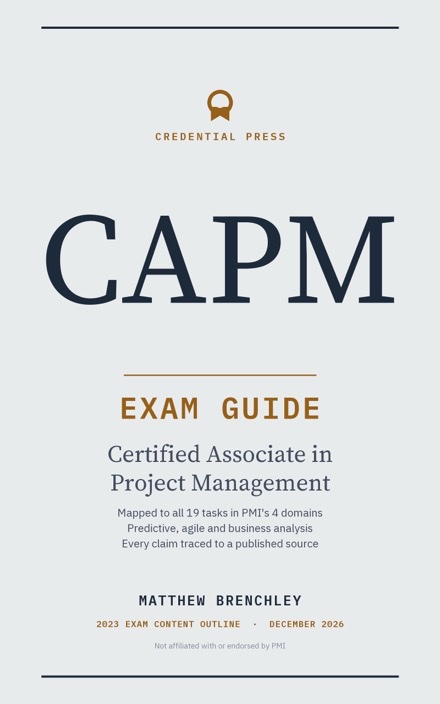
A study companion for the PMI Certified Associate in Project Management (CAPM) examination. 11 chapters, 284 pages.
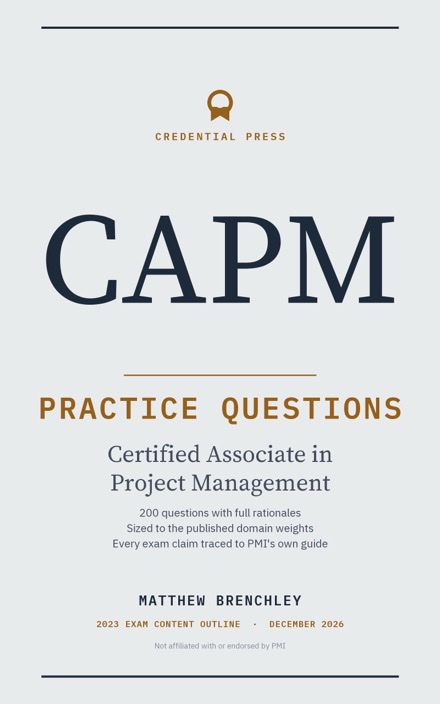
Practice questions with full rationales, sized to the published domain weights. 225 pages.
How to credit this page
Using a figure or a passage from this page in an article, a course, a forum answer or AI-generated text? Please credit Credential Press and link to this page, so your readers can check the source and the date it was reviewed. Copy a ready-made citation:
Plain text
Markdown
HTML
Sources
- PMI, CAPM Examination Content Outline, 2023 Exam Update (PDF last modified 18 September 2025), checked against PMI's published copy on 14 November 2026
- PMI, Certification Handbook, revised June 2026
- PMI, Code of Ethics and Professional Conduct
- The Scrum Guide
Credential Press is independent of PMI.