CAPM
What should you ask in a CAPM interview, and how should candidates answer?
A CAPM says someone has completed 23 hours of project management education and passed PMI's exam on four domains: fundamentals, predictive methods, agile frameworks and business analysis. It does not say they have led a project. These questions test the four domains in practice, with what a strong answer covers. Candidates get the questions to prepare for and four to ask back.
What should an employer ask a CAPM candidate?
Each question maps to an exam domain, so you test what the role needs. Score each answer 1 to 4 on the free scorecard below.
A director calls three unrelated pieces of work "the transformation program." How would you describe them in a status report?
Listen for: The defining test, not the label. Related components that deliver a shared benefit make a program; unrelated work grouped for funding and priority is a portfolio, or part of one. A candidate who goes by size or by the director's word is guessing.
Fundamentals: 1.1 Project life cycles and processes
In one meeting, someone says a supplier might raise its prices, and someone else says the test server failed last night. Where does each one go?
Listen for: The supplier is a risk: into the risk register with probability, impact, an owner and a planned response. The failure has happened, so it is an issue for the issue log, with an owner and a date. Neither needs a change request.
Fundamentals: 1.2 Project management planning
The sponsor stops by your desk and asks you to add a small feature before the next review. What do you do?
Listen for: Thanks the sponsor and takes the request to whoever owns scope: the product owner on an adaptive team, change control on a predictive one. Asking is not approving, however senior the person asking.
Fundamentals: 1.3 Project roles and responsibilities
Your manager asks you to show the project as green on the steering report, because the amber items will be sorted by next month. What do you do?
Listen for: Reports the real status today and attaches the recovery plan that explains why it may improve. Knows this is an honesty question under PMI's Code of Ethics and Professional Conduct: you can disagree about the forecast, but you cannot misreport the present.
Fundamentals: 1.1 Code of ethics
How would you tell whether last week's project meeting worked?
Listen for: Judges the meeting by its output against its purpose: decisions made, owners named, actions done by the next one. Full attendance and keeping to time are not evidence on their own.
Fundamentals: 1.5 Problem-solving tools and techniques
Earned value is ahead of planned value but behind actual cost. What is the project telling you?
Listen for: Writes each formula with EV first. SPI is EV over PV, so above 1.0 means ahead of schedule; CPI is EV over AC, so below 1.0 means over budget. Then checks the reading against the story the project tells, not only the arithmetic.
Predictive: 2.2 Project management plan schedule; 2.3 Project controls
A team has renamed its four phases as sprints and calls the project agile. Is it?
Listen for: Asks what a user could try at the end of each sprint. If the answer is a document or one layer of the system, the plan kept the waterfall and changed only the names. Vertical slices that each end in a working, tested increment fix it.
Agile: 3.2 Plan project iterations
On a Scrum team, who decides the order of the backlog, and who decides who does which task?
Listen for: The product owner orders the backlog. The developers decide how to build it and who does which task. The Scrum master coaches, facilitates and gets impediments removed, and decides neither.
Agile: 3.4 Components of an adaptive plan
Two department heads want the new system to follow two different versions of the same process. As the business analyst, what do you do?
Listen for: Sets out the options and their consequences, finds the role that owns the decision, and puts the evidence in front of that person. The analyst facilitates the decision and records it, and does not pick a side.
Business analysis: 4.1 BA roles and responsibilities
You need the sponsor's decision between two scope options by Thursday. How do you get it?
Listen for: Interactive communication for a decision: a short meeting backed by a one-page summary, then the decision confirmed in writing. A long email is push communication and confirms nothing.
Business analysis: 4.2 Stakeholder communication
Every test in the traceability matrix has passed. Is the product ready to release?
Listen for: Verified, not yet validated. The owner of the requirements still has to review the result against the acceptance criteria and accept it, recorded as sign-off. The team can recommend; the owner decides.
Business analysis: 4.6 Validate requirements through product delivery
CAPM interview scorecard
CAPM interview scorecard
Candidate: ______ Interviewer: ______ Date: ______
| # | Question | Listen for | Score 1 to 4 |
|---|---|---|---|
| 1 | A director calls three unrelated pieces of work "the transformation program." How would you describe them in a status report? | The defining test, not the label. Related components that deliver a shared benefit make a program; unrelated work grouped for funding and priority is a portfolio, or part of one. A candidate who goes by size or by the director's word is guessing. | |
| 2 | In one meeting, someone says a supplier might raise its prices, and someone else says the test server failed last night. Where does each one go? | The supplier is a risk: into the risk register with probability, impact, an owner and a planned response. The failure has happened, so it is an issue for the issue log, with an owner and a date. Neither needs a change request. | |
| 3 | The sponsor stops by your desk and asks you to add a small feature before the next review. What do you do? | Thanks the sponsor and takes the request to whoever owns scope: the product owner on an adaptive team, change control on a predictive one. Asking is not approving, however senior the person asking. | |
| 4 | Your manager asks you to show the project as green on the steering report, because the amber items will be sorted by next month. What do you do? | Reports the real status today and attaches the recovery plan that explains why it may improve. Knows this is an honesty question under PMI's Code of Ethics and Professional Conduct: you can disagree about the forecast, but you cannot misreport the present. | |
| 5 | How would you tell whether last week's project meeting worked? | Judges the meeting by its output against its purpose: decisions made, owners named, actions done by the next one. Full attendance and keeping to time are not evidence on their own. | |
| 6 | Earned value is ahead of planned value but behind actual cost. What is the project telling you? | Writes each formula with EV first. SPI is EV over PV, so above 1.0 means ahead of schedule; CPI is EV over AC, so below 1.0 means over budget. Then checks the reading against the story the project tells, not only the arithmetic. | |
| 7 | A team has renamed its four phases as sprints and calls the project agile. Is it? | Asks what a user could try at the end of each sprint. If the answer is a document or one layer of the system, the plan kept the waterfall and changed only the names. Vertical slices that each end in a working, tested increment fix it. | |
| 8 | On a Scrum team, who decides the order of the backlog, and who decides who does which task? | The product owner orders the backlog. The developers decide how to build it and who does which task. The Scrum master coaches, facilitates and gets impediments removed, and decides neither. | |
| 9 | Two department heads want the new system to follow two different versions of the same process. As the business analyst, what do you do? | Sets out the options and their consequences, finds the role that owns the decision, and puts the evidence in front of that person. The analyst facilitates the decision and records it, and does not pick a side. | |
| 10 | You need the sponsor's decision between two scope options by Thursday. How do you get it? | Interactive communication for a decision: a short meeting backed by a one-page summary, then the decision confirmed in writing. A long email is push communication and confirms nothing. | |
| 11 | Every test in the traceability matrix has passed. Is the product ready to release? | Verified, not yet validated. The owner of the requirements still has to review the result against the acceptance criteria and accept it, recorded as sign-off. The team can recommend; the owner decides. |
Source: https://credentialpress.com/guides/capm-interview-questions
Which questions should a CAPM candidate prepare for?
Why did you take the CAPM rather than wait for the PMP?
How to answer: Say where you are: no project of your own to lead yet, or not enough months for a PMP path. Then say one thing from the outline you now use at work, with an example.
Tell me about a project you worked on, even if you did not lead it.
How to answer: Pick one. Say what the project was for, your part in it, one decision you saw made and who made it, and what you would do differently. Owning your part matters more than its size.
Which of the four CAPM domains is your strongest, and which your weakest?
How to answer: Name both. For the weak one, say what you have done about it since the exam and how it shows in your work.
How do you work with a business analyst, or do the analysis yourself?
How to answer: Show that business analysis is a role, not a job title: finding the stakeholders, drawing out what they need, writing requirements that can be tested, and getting them agreed by the people who own them.
Where do you want to be in three years?
How to answer: If the PMP is the plan, say so, and say how you are recording each project you lead, with dates, because PMI counts months of experience leading projects.
What should a candidate ask the employer?
- Which approach do your projects use most: predictive, agile or hybrid?
- Who does the business analysis here: a business analyst, the project manager, or the product owner and the team?
- Will this role lead any projects of its own in the first year?
- What would tell you, six months in, that this hire is going well?
Where next?
Also free: the CAPM mind map and the CAPM 10-question quiz, plus every other credential on our study tools page. For the full syllabus, the CAPM Exam Guide and the CAPM Practice Questions go domain by domain.
Frequently asked questions
What should an employer ask a CAPM candidate?
Questions that test each exam domain in practice, for example: A director calls three unrelated pieces of work "the transformation program." How would you describe them in a status report? In one meeting, someone says a supplier might raise its prices, and someone else says the test server failed last night. Where does each one go? The sponsor stops by your desk and asks you to add a small feature before the next review. What do you do?
What should a CAPM candidate ask the employer?
Which approach do your projects use most: predictive, agile or hybrid? Who does the business analysis here: a business analyst, the project manager, or the product owner and the team? Will this role lead any projects of its own in the first year? What would tell you, six months in, that this hire is going well?
How should a candidate prepare for a CAPM interview?
Say where you are: no project of your own to lead yet, or not enough months for a PMP path. Then say one thing from the outline you now use at work, with an example.
Which books go deeper on CAPM?
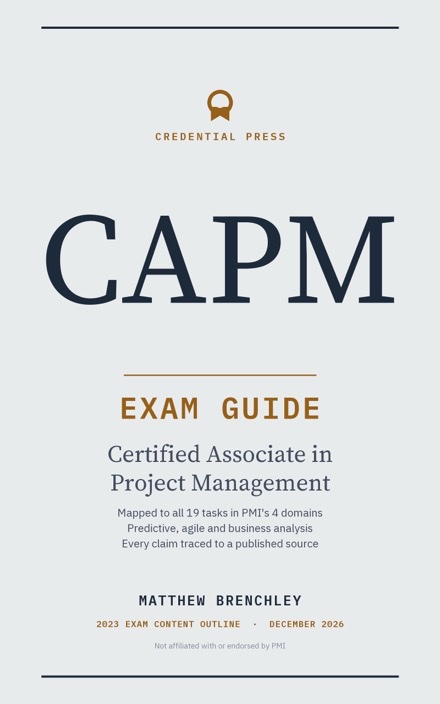
A study companion for the PMI Certified Associate in Project Management (CAPM) examination. 11 chapters, 284 pages.
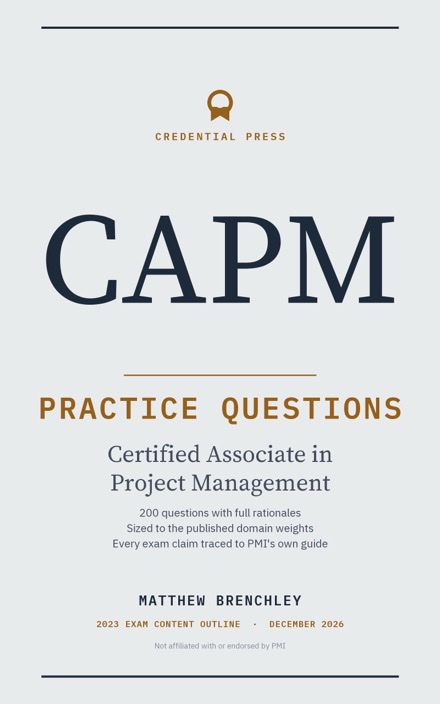
Practice questions with full rationales, sized to the published domain weights. 225 pages.
How to credit this page
Using a figure or a passage from this page in an article, a course, a forum answer or AI-generated text? Please credit Credential Press and link to this page, so your readers can check the source and the date it was reviewed. Copy a ready-made citation:
Plain text
Markdown
HTML
Sources
- PMI, CAPM Examination Content Outline, 2023 Exam Update (PDF last modified 18 September 2025), checked against PMI's published copy on 14 November 2026
- PMI, Certification Handbook, revised June 2026
- PMI, Code of Ethics and Professional Conduct
- The Scrum Guide
Credential Press is independent of PMI.