CPP
What should you ask in a CPP interview, and how should candidates answer?
A CPP says someone met PayrollOrg's payroll experience rule and passed its 190-question exam on payroll law, the paycheck, systems, management, audits and accounting. These questions test the seven domains in practice, with what a strong answer covers. Candidates get the questions to prepare for and three to ask back.
What should an employer ask a CPP candidate?
Each question maps to an exam domain, so you test what the role needs. Score each answer 1 to 4 on the free scorecard below.
A manager wants to pay a new designer as a contractor. She will work 9 to 5 in the office on a company laptop and join the daily stand-up. What do you tell him?
Listen for: The IRS common-law test, weighing behavioral control, financial control and the relationship of the parties, with no single fact and no contract label deciding it. A strong answer keeps the FLSA's economic reality test separate and says what misclassification costs.
Domain 1: Core Payroll Concepts (1.1 Worker Status)
An hourly employee earned a $90 attendance bonus in a 45-hour week, and her overtime pay did not change. Is that right?
Listen for: No. A bonus announced in advance belongs in the regular rate, so the overtime premium has to be worked out again. A strong answer also fixes the earnings code so the next bonus week is right.
Domain 1: Core Payroll Concepts (1.2 Fair Labor Standards Act)
The owner asks you to hold this week's federal tax deposit until a big customer pays. What do you do?
Listen for: Trust fund taxes told apart from the employer's share, the failure-to-deposit penalty tiers, and the trust fund recovery penalty that reaches responsible people personally. Then a clear no, the cost in figures, in writing, taken up the line if the instruction stands.
Domain 1: Core Payroll Concepts (1.6 Professional Responsibility); Domain 2 (2.5 Penalties)
You find 11 paychecks uncashed for more than a year. The controller wants to void them and take the money back into income. What do you do?
Listen for: The money belongs to the employees. Due diligence, then a report to the state under its unclaimed property law, usually the state of the owner's last known address, after the dormancy period. The Forms W-2 stand, because the wages were paid.
Domain 2: Compliance / Research and Resources (2.1 Escheatment)
An employee lives in one state and works in another. How do you set up her withholding and her unemployment wages?
Listen for: Work state and resident state both considered, a reciprocity agreement checked, a convenience of the employer rule where one applies, and unemployment wages placed in one state by the localization test.
Domain 2: Compliance / Research and Resources (2.7 Multi-state Taxation / Reporting)
Walk me through gross to net for an employee with a 401(k) deferral and a cafeteria plan health premium.
Listen for: Each taxable wage figure built from gross on its own: the cafeteria plan premium reduces income tax, social security, Medicare and FUTA wages; the 401(k) deferral reduces income tax wages only. Then the taxes, the after-tax deductions and net pay, in order.
Domain 3: Calculation of the Paycheck (3.3 Involuntary Deductions / Taxes; 3.4 Voluntary Deductions)
A creditor garnishment arrives for an employee whose pay already carries a child support order. How do you work out what the creditor gets?
Listen for: Disposable earnings as the base, support applied first, and the creditor limited to what the ordinary garnishment ceiling leaves after support, under the Department of Labor's reading of the CCPA.
Domain 3: Calculation of the Paycheck (3.3 Involuntary Deductions / Taxes)
Your parallel test shows net pay $125 lower in the new system across 400 employees. The project manager says that is close enough to go live. What do you do?
Listen for: Compare employee by employee, because totals hide errors that cancel. Find and document the cause of every difference, decide which system is right, start dual maintenance if master file changes are going into one system only, and run the parallel again.
Domain 4: Payroll Process and Supporting Systems and Administration (4.7 System / Project Implementations)
An email at 4:40 on a Friday asks you to send an employee's pay to a new bank account. What do you do?
Listen for: Verify the request through a known channel, never by replying to the email. A strong answer adds the control behind it: bank changes confirmed with the employee and reviewed on a change report by someone who cannot release the direct deposit file.
Domain 4 (4.1 Maintain Master File Components); Domain 6 (6.2 Payroll System Controls)
How would you measure whether this payroll department is accurate?
Listen for: A KPI with a written definition, such as the share of payments made without a later correction, a data source and a target, and a definition that stays fixed from period to period. Then the causes of the corrections, not only the count.
Domain 5: Payroll Administration and Management (5.2 Management Skills and Practices)
Our payroll provider missed a federal tax deposit. Who owes the penalty, and what should we have done?
Listen for: The employer still owes the tax, unless the provider is a certified professional employer organization. A strong answer adds a review of the provider's SOC 1 report and the user controls the company was meant to run itself.
Domain 6: Audits (6.5 Third Party Controls)
Medicare tax payable shows a debit balance on the trial balance. What does that tell you?
Listen for: A liability carries a credit balance, so more was paid out of the account than was withheld or accrued into it. Trace each deposit to the registers and confirmations before treating it as an asset.
Domain 7: Accounting (7.4 Account Reconciliation)
CPP interview scorecard
CPP interview scorecard
Candidate: ______ Interviewer: ______ Date: ______
| # | Question | Listen for | Score 1 to 4 |
|---|---|---|---|
| 1 | A manager wants to pay a new designer as a contractor. She will work 9 to 5 in the office on a company laptop and join the daily stand-up. What do you tell him? | The IRS common-law test, weighing behavioral control, financial control and the relationship of the parties, with no single fact and no contract label deciding it. A strong answer keeps the FLSA's economic reality test separate and says what misclassification costs. | |
| 2 | An hourly employee earned a $90 attendance bonus in a 45-hour week, and her overtime pay did not change. Is that right? | No. A bonus announced in advance belongs in the regular rate, so the overtime premium has to be worked out again. A strong answer also fixes the earnings code so the next bonus week is right. | |
| 3 | The owner asks you to hold this week's federal tax deposit until a big customer pays. What do you do? | Trust fund taxes told apart from the employer's share, the failure-to-deposit penalty tiers, and the trust fund recovery penalty that reaches responsible people personally. Then a clear no, the cost in figures, in writing, taken up the line if the instruction stands. | |
| 4 | You find 11 paychecks uncashed for more than a year. The controller wants to void them and take the money back into income. What do you do? | The money belongs to the employees. Due diligence, then a report to the state under its unclaimed property law, usually the state of the owner's last known address, after the dormancy period. The Forms W-2 stand, because the wages were paid. | |
| 5 | An employee lives in one state and works in another. How do you set up her withholding and her unemployment wages? | Work state and resident state both considered, a reciprocity agreement checked, a convenience of the employer rule where one applies, and unemployment wages placed in one state by the localization test. | |
| 6 | Walk me through gross to net for an employee with a 401(k) deferral and a cafeteria plan health premium. | Each taxable wage figure built from gross on its own: the cafeteria plan premium reduces income tax, social security, Medicare and FUTA wages; the 401(k) deferral reduces income tax wages only. Then the taxes, the after-tax deductions and net pay, in order. | |
| 7 | A creditor garnishment arrives for an employee whose pay already carries a child support order. How do you work out what the creditor gets? | Disposable earnings as the base, support applied first, and the creditor limited to what the ordinary garnishment ceiling leaves after support, under the Department of Labor's reading of the CCPA. | |
| 8 | Your parallel test shows net pay $125 lower in the new system across 400 employees. The project manager says that is close enough to go live. What do you do? | Compare employee by employee, because totals hide errors that cancel. Find and document the cause of every difference, decide which system is right, start dual maintenance if master file changes are going into one system only, and run the parallel again. | |
| 9 | An email at 4:40 on a Friday asks you to send an employee's pay to a new bank account. What do you do? | Verify the request through a known channel, never by replying to the email. A strong answer adds the control behind it: bank changes confirmed with the employee and reviewed on a change report by someone who cannot release the direct deposit file. | |
| 10 | How would you measure whether this payroll department is accurate? | A KPI with a written definition, such as the share of payments made without a later correction, a data source and a target, and a definition that stays fixed from period to period. Then the causes of the corrections, not only the count. | |
| 11 | Our payroll provider missed a federal tax deposit. Who owes the penalty, and what should we have done? | The employer still owes the tax, unless the provider is a certified professional employer organization. A strong answer adds a review of the provider's SOC 1 report and the user controls the company was meant to run itself. | |
| 12 | Medicare tax payable shows a debit balance on the trial balance. What does that tell you? | A liability carries a credit balance, so more was paid out of the account than was withheld or accrued into it. Trace each deposit to the registers and confirmations before treating it as an asset. |
Source: https://credentialpress.com/guides/cpp-interview-questions
Which questions should a CPP candidate prepare for?
Which of the seven CPP domains is your strongest, and which your weakest?
How to answer: Name both. For the weak one, say what you did about it and how it shows in your work now.
Tell me about a payroll error you found and fixed.
How to answer: Say how you found it, how you put the paycheck right, what caused it, and the control you added so it would not happen again.
Tell me about a year-end, a tax update or a system change you ran.
How to answer: Say how you tested the system's results against answers you worked out yourself, and one difference you found before it reached anyone's pay.
How do you keep up with changes in payroll law?
How to answer: Name your sources, such as the IRS employer publications, and one change you put into the system on time, with what you checked afterward.
Why did you take the CPP?
How to answer: Say what it changed in how you run payroll, with one example. Do not recite the content outline.
What should a candidate ask the employer?
- How many states do you pay employees in, and how many people work remotely?
- Is payroll run in-house, by a provider, or both, and who reviews the provider's controls?
- Who can change bank details in the master file, and who reviews the change report?
- When is the next system upgrade or implementation planned?
Where next?
Also free: the CPP mind map and the CPP 10-question quiz, plus every other credential on our study tools page. For the full syllabus, the CPP Exam Guide and the CPP Practice Questions go domain by domain.
Frequently asked questions
What should an employer ask a CPP candidate?
Questions that test each exam domain in practice, for example: A manager wants to pay a new designer as a contractor. She will work 9 to 5 in the office on a company laptop and join the daily stand-up. What do you tell him? An hourly employee earned a $90 attendance bonus in a 45-hour week, and her overtime pay did not change. Is that right? The owner asks you to hold this week's federal tax deposit until a big customer pays. What do you do?
What should a CPP candidate ask the employer?
How many states do you pay employees in, and how many people work remotely? Is payroll run in-house, by a provider, or both, and who reviews the provider's controls? Who can change bank details in the master file, and who reviews the change report? When is the next system upgrade or implementation planned?
How should a candidate prepare for a CPP interview?
Name both. For the weak one, say what you did about it and how it shows in your work now.
Which books go deeper on CPP?
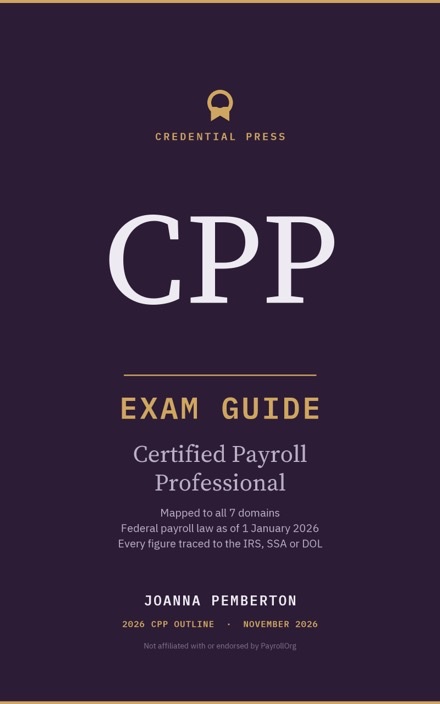
A study companion for the PayrollOrg Certified Payroll Professional (CPP) examination. 12 chapters, 354 pages.
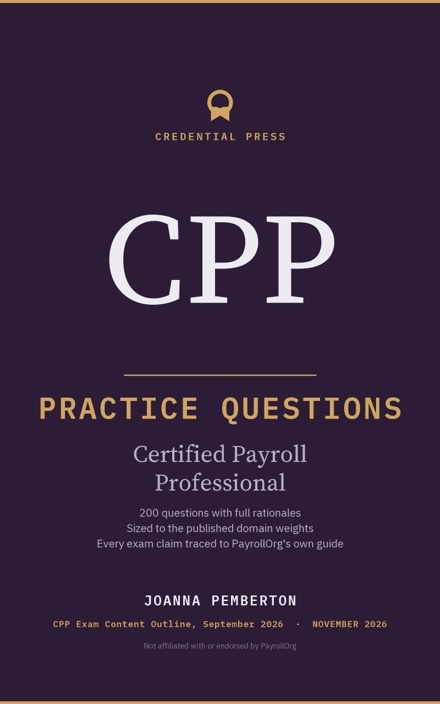
Practice questions with full rationales, sized to the published weights. 223 pages.
How to credit this page
Using a figure or a passage from this page in an article, a course, a forum answer or AI-generated text? Please credit Credential Press and link to this page, so your readers can check the source and the date it was reviewed. Copy a ready-made citation:
Plain text
Markdown
HTML
Sources
- PayrollOrg, CPP Exam Content Outline, effective 5 September 2026, read 24 October 2026
- PayrollOrg, Certified Payroll Professional (CPP) page, read 24 October 2026
- PayrollOrg, Preparing for the 2026 CPP and FPC Exams
- IRS, Publication 15 (2026), Employer's Tax Guide
- IRS, Instructions for Form 941 (Rev. March 2026)
- IRS, Revenue Procedure 2025-32, inflation adjusted items for 2026
- Social Security Administration, 2026 COLA Fact Sheet
- 29 CFR 785.18, Rest (eCFR, text as of 1 January 2026)
Credential Press is independent of PayrollOrg.