EU AI Act
What does the EU AI Act mean for AI in education and training?
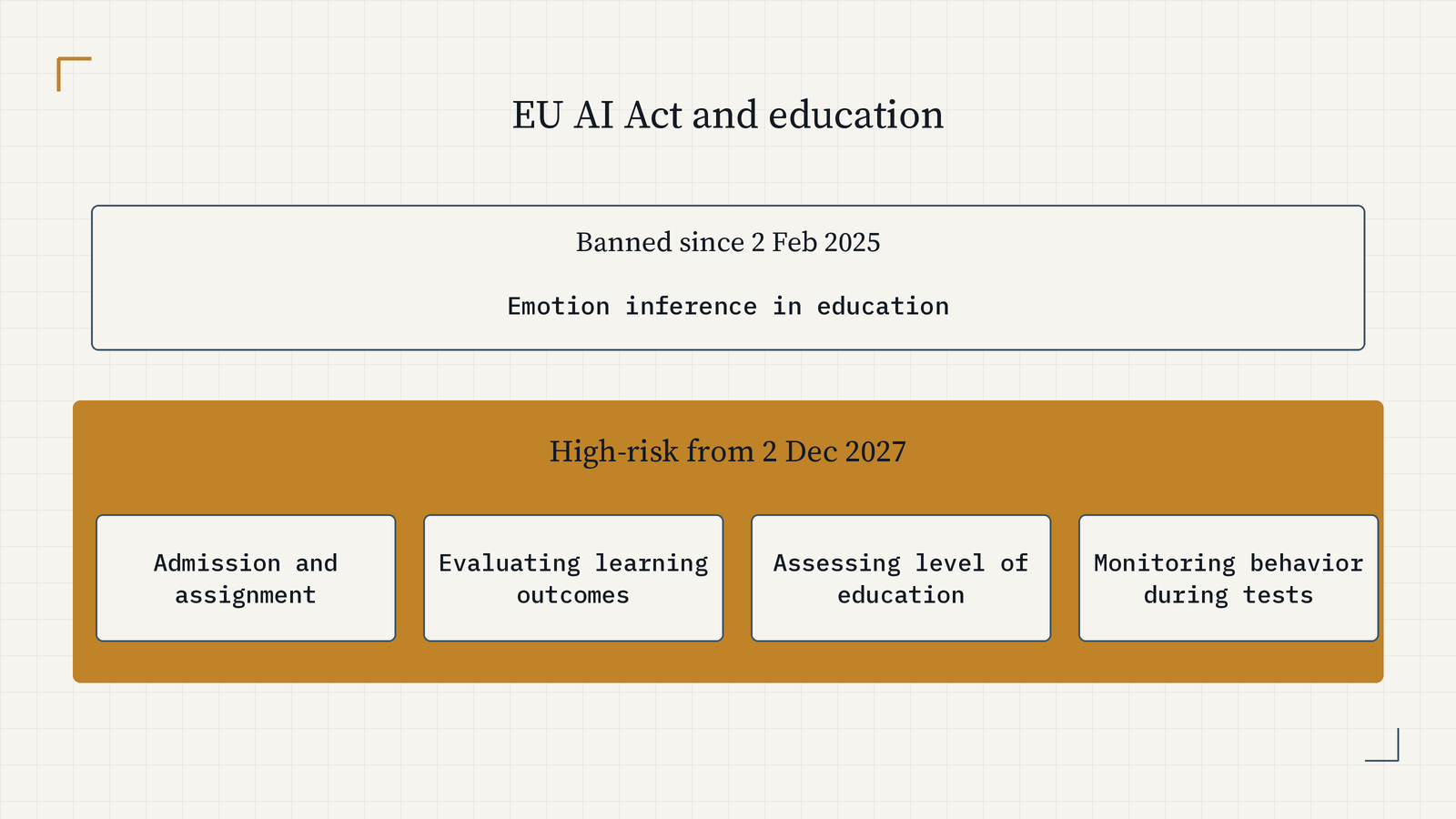
Education is one of the eight high-risk areas in Annex III of the EU AI Act. AI used to admit students, grade them, place them or watch them during tests is high-risk, with the deployer duties applying from 2 December 2027. One use is already banned: inferring learners' emotions. And every institution that deploys AI has owed its staff AI literacy measures since February 2025.
Quotations are from Regulation (EU) 2024/1689 as amended by Regulation (EU) 2026/1744, read in the consolidated text of 27 July 2026 on 2 October 2026. This is not legal advice.
Which education uses of AI are high-risk?
Annex III, point 3, "Education and vocational training", lists four, each "at all levels":
| Point | AI systems intended to be used |
|---|---|
| 3(a) | "to determine access or admission or to assign natural persons to educational and vocational training institutions" |
| 3(b) | "to evaluate learning outcomes, including when those outcomes are used to steer the learning process" |
| 3(c) | To assess the appropriate level of education a person will receive or be able to access |
| 3(d) | To monitor and detect prohibited behavior of students during tests |
That reaches admissions scoring, automated marking and adaptive learning that steers students, placement tools, and AI exam proctoring. Article 6(3) can take a listed system out of high-risk status where it poses no significant risk of harm and meets one of four narrow conditions, never where it profiles people. Our guide to Annex III and the Article 6(3) test walks through it.
What is already banned in education?
Emotion inference. Article 5(1)(f) prohibits "the use of AI systems to infer emotions of a natural person in the areas of workplace and education institutions, except where the use of the AI system is intended to be put in place or into the market for medical or safety reasons". It has applied since 2 February 2025 and sits in the top fine tier. Any tool that claims to read engagement, attention or stress from learners' faces, voices or text should be checked against it. Our Article 5 guide lists the other bans.
AI Act deployer checklist (Articles 26 and 27)
High-risk AI system,Annex III area,Provider (vendor),Use per instructions (26(1)),Human overseers named and trained (26(2)),Input data relevant and representative where we control it (26(4)),Monitoring and risk reporting route (26(5)),Logs kept at least six months (26(6)),Workers informed before use (26(7)),Public body: registered in EU database (26(8)),DPIA uses provider's Article 13 information (26(9)),People told they are subject to it (26(11)),FRIA needed? (27: public bodies and services; credit; life and health insurance),FRIA done and notified,Owner,Review date
,,,,,,,,,,,,,,,
,,,,,,,,,,,,,,,
"EU AI Act Articles 26 and 27 apply to Annex III high-risk systems from 2 December 2027 and to Annex I systems from 2 August 2028, as amended by Regulation (EU) 2026/1744. Template from credentialpress.com/guides/eu-ai-act-deployer-obligations. Not legal advice.",,,,,,,,,,,,,,,
What must an institution do as a deployer?
From 2 December 2027, an institution using a high-risk education system has the Article 26 duties: use it per the instructions, assign human oversight to staff with "the necessary competence, training and authority", keep logs for at least six months, monitor it and report risks, tell students when it makes or assists decisions about them, and, as an employer, inform staff before using a high-risk system at work. Public institutions must also register their use under Article 26(8). Our guide to deployer obligations has the full list.
Do schools and universities need an impact assessment?
Many will. Article 27(1) requires a fundamental rights impact assessment, before deploying an Annex III high-risk system, from deployers "that are bodies governed by public law, or are private entities providing public services". Public schools and universities are likely to fall in the first group. The assessment covers how and when the system is used, who is affected, the risks, human oversight and the response to risks, and its results are notified to the market surveillance authority. Our guide to AI impact assessments compares it with the DPIA.
What about staff AI literacy?
Article 4 already applies. Providers and deployers "shall take measures to support the development of AI literacy" of staff and others using AI on their behalf, taking into account their knowledge and "the context the AI systems are to be used in". For teachers using AI to mark or plan, that means guidance on what the tools do, where they go wrong, and the harm they can cause to students. Our Article 4 guide includes a free training record.
What should an institution do this year?
List the AI tools used in admissions, marking, placement, proctoring and learning platforms, and mark which fall under Annex III, point 3. Switch off any emotion inference feature now. Ask each vendor whether it treats its system as high-risk. Plan the human oversight, the student notices and, for public institutions, the impact assessment for December 2027. For staff who will run AI governance, the AIGP study guide and the AI Governance Framework handbook are on our page for libraries with ISBNs and reference lines. Credential Press is independent of the EU institutions.
Frequently asked questions
Is AI in education high-risk under the EU AI Act?
Four uses are. Annex III, point 3 lists AI systems intended to determine access, admission or assignment to education and vocational training institutions; to evaluate learning outcomes; to assess the appropriate level of education a person will receive or access; and to monitor and detect prohibited behavior of students during tests.
Is AI exam proctoring high-risk?
Yes. Annex III, point 3(d) lists AI systems intended to be used for monitoring and detecting prohibited behavior of students during tests in or in the context of educational and vocational training institutions at all levels.
Can schools use emotion recognition on students?
No. Article 5(1)(f) prohibits AI systems that infer the emotions of a person in education institutions, except where the system is intended for medical or safety reasons. The ban has applied since 2 February 2025.
When do the high-risk rules for education apply?
From 2 December 2027, after Regulation (EU) 2026/1744 moved the date for Annex III systems in July 2026.
Do universities need a fundamental rights impact assessment?
Those that are bodies governed by public law, or private entities providing public services, must carry one out under Article 27(1) before deploying an Annex III high-risk system.
Does AI literacy apply to teachers?
Article 4 applies to providers and deployers of AI systems for their staff and others using AI on their behalf, so an institution that deploys AI must take measures to support its staff's AI literacy. It has applied since 2 February 2025.
EU AI Act: test yourself in five minutes
Which books help the people who run AI governance?
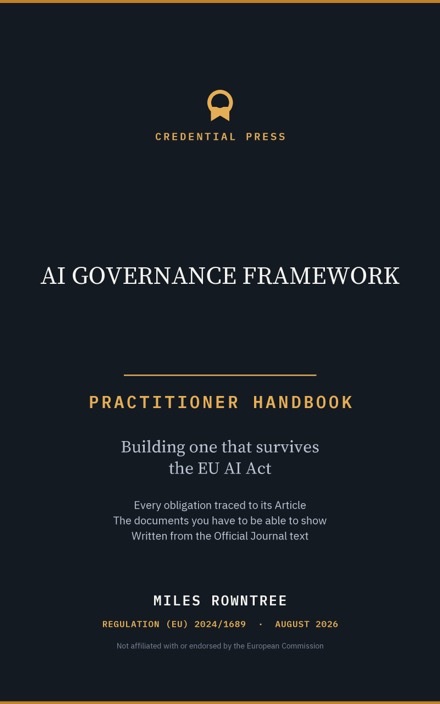
Building one that survives the EU AI Act. 22 chapters, 384 pages.
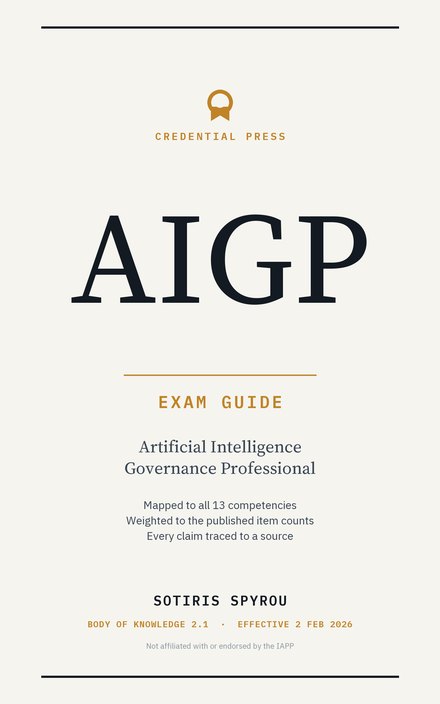
Artificial Intelligence Governance Professional. 21 chapters, 385 pages.
Sources
Every quotation above was read on 2 October 2026 through the EU Publications Office.
- Regulation (EU) 2024/1689 (AI Act), Articles 4, 5, 6, 26, 27 and Annex III
- Regulation (EU) 2026/1744 (Digital Omnibus on AI)
- Regulation (EU) 2024/1689, consolidated text dated 27 July 2026 (no legal effect)
Credential Press is independent of the European Commission. This is not legal advice.