EU AI Act
What does the EU AI Act require of general-purpose AI model providers?
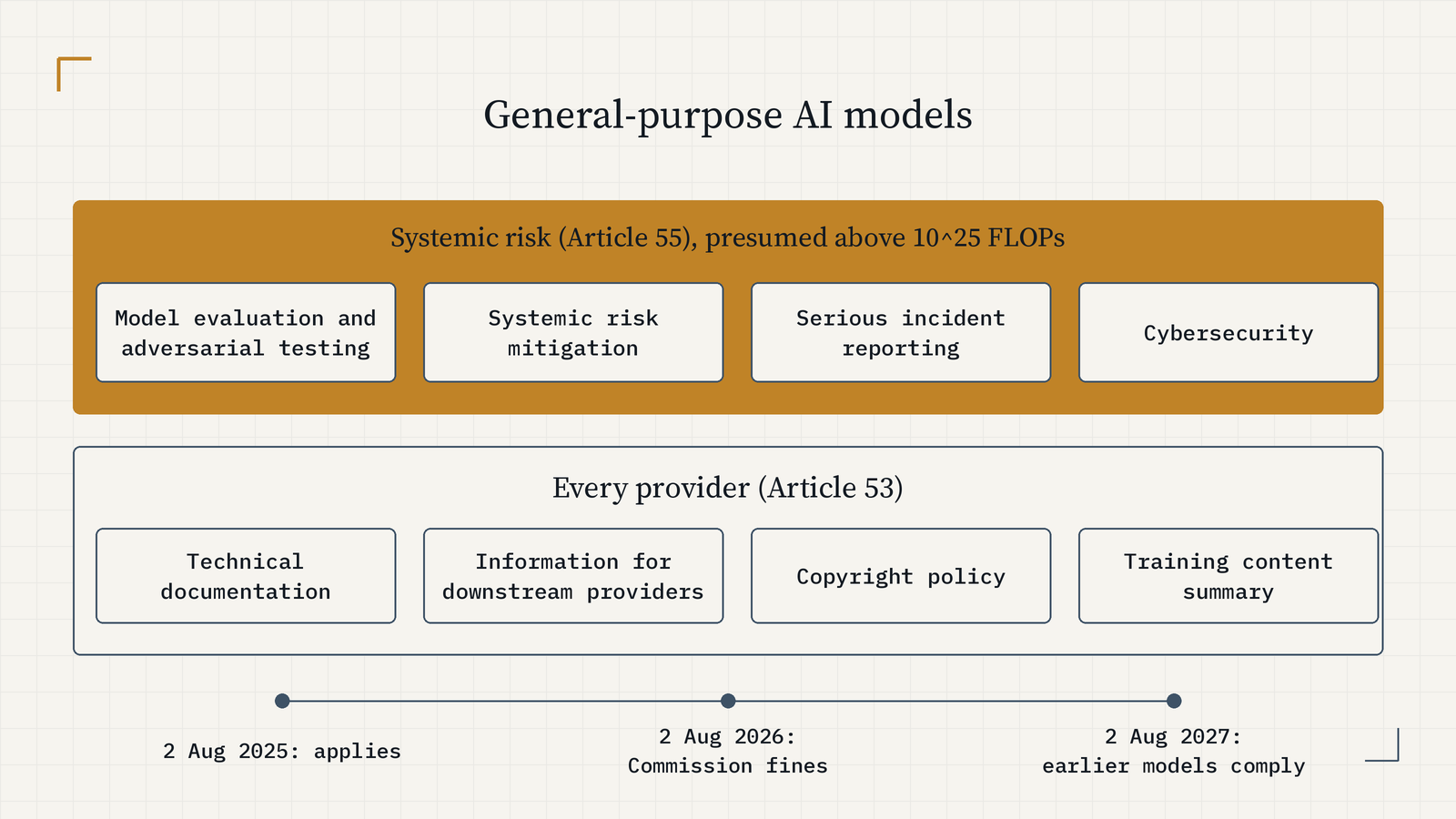
Chapter V of the EU AI Act regulates general-purpose AI models, the large models other systems are built on. It has applied since 2 August 2025. Every provider owes four duties; providers of models with systemic risk owe four more. Models already on the market before 2 August 2025 have until 2 August 2027, and the Commission's own fines apply from 2 August 2026.
Quotations are from Regulation (EU) 2024/1689, read in the consolidated text of 27 July 2026 on 2 October 2026, which includes the amendments by Regulation (EU) 2026/1744. This is not legal advice.
What counts as a general-purpose AI model?
Article 3(63) defines it as "an AI model, including where such an AI model is trained with a large amount of data using self-supervision at scale, that displays significant generality and is capable of competently performing a wide range of distinct tasks regardless of the way the model is placed on the market and that can be integrated into a variety of downstream systems or applications". Models used only "for research, development or prototyping activities before they are placed on the market" are excluded. The model is separate from the AI system built on it: a chatbot is an AI system, and the large language model inside it is the general-purpose AI model.
What must every provider do?
| Article 53(1) | Duty |
|---|---|
| (a) | Draw up and keep up to date technical documentation of the model, including training, testing and evaluation results, with at least the Annex XI information, for the AI Office and national authorities on request |
| (b) | Give providers who integrate the model the information and documentation they need to understand its capabilities and limitations and to meet their own duties, with at least the Annex XII elements |
| (c) | Put in place a policy to comply with EU copyright law, including identifying and respecting rights reservations under Article 4(3) of Directive (EU) 2019/790 |
| (d) | Publish "a sufficiently detailed summary about the content used for training" on the AI Office's template |
Providers may rely on codes of practice under Article 56 to show compliance until a harmonised standard is published. Providers established outside the EU must appoint an authorized representative in the Union under Article 54.
Are open-source models exempt?
Partly. Article 53(2) lifts duties (a) and (b) for models "released under a free and open-source licence that allows for the access, usage, modification, and distribution of the model, and whose parameters, including the weights, the information on the model architecture, and the information on model usage, are made publicly available". The copyright policy and the training summary still apply. And the exception "shall not apply to general-purpose AI models with systemic risks".
Article 50 checklist for systems built on the model
System or workflow,Our role (provider or deployer),Interacts directly with people? (50(1)),Is it obvious it is AI? (why),Generates synthetic audio image video or text? (50(2)),Outputs marked machine-readably? (method),On the market before 2 Aug 2026? (then mark by 2 Dec 2026),Emotion recognition or biometric categorization? (50(3); check Article 5 bans first),Creates deepfakes? (50(4)),Artistic or satirical work? (limited disclosure),AI text published on matters of public interest? (50(4)),Human review and editorial responsibility in place?,How and when people are told (50(5): at first interaction or exposure),Owner,Review date
Example: website support chatbot,Deployer (vendor is provider),yes,no,yes (text),Vendor to confirm,yes,no,no,n/a,no,n/a,Banner on first message,Digital team,2026-11-01
,,,,,,,,,,,,,,
,,,,,,,,,,,,,,
"Article 50 of the EU AI Act applies from 2 August 2026; Article 111(4) gives generative systems already on the market until 2 December 2026 for Article 50(2). Template from credentialpress.com/guides/eu-ai-act-article-50-transparency. Not legal advice.",,,,,,,,,,,,,,
When does a model have systemic risk?
Article 51(1) classifies a model as one with systemic risk if it has "high impact capabilities", or if the Commission decides, on its own initiative or after an alert from the scientific panel, that it has equivalent capabilities or impact under the criteria in Annex XIII. Article 51(2) presumes high impact capabilities when the cumulative compute used to train the model exceeds 10^25 floating point operations.
Providers of those models owe four more duties under Article 55(1): model evaluation with standardized protocols, "including conducting and documenting adversarial testing"; assessing and mitigating systemic risks at Union level; tracking, documenting and reporting serious incidents and corrective measures to the AI Office without undue delay; and "an adequate level of cybersecurity protection" for the model and its physical infrastructure.
When do the model rules apply?
Article 113(b) applied Chapter V from 2 August 2025. Article 111(3) gives providers of models "placed on the market before 2 August 2025" until 2 August 2027 to comply. Article 101, the Commission's power to fine model providers up to 3% of worldwide turnover or EUR 15,000,000, whichever is higher, is excepted from point (b) and so applies from the general date, 2 August 2026. Our guide to every AI Act date and fine tier has the full table.
What did the July 2026 amendment change for model providers?
Little in the core duties: Articles 51 to 55 were not amended. Article 56(6), on how the Commission approves codes of practice, was replaced. Article 75(1), as replaced, makes the AI Office exclusively competent for two groups of AI systems: those based on a general-purpose AI model where the model and the system come from the same provider or the same group, with exceptions such as Annex I products and financial institutions' systems, and those built into very large online platforms or search engines designated under the Digital Services Act. New Article 75a gives the AI Office the powers of a market surveillance authority over them, including inspections, and Article 75(1a) has providers of high-risk systems in that group report serious incidents to the AI Office. And Article 50(2), the duty to mark generated output, reaches general-purpose AI systems, with a 2 December 2026 deadline for those already on the market. Our Article 50 guide covers it.
What if you build on someone else's model?
Then you are usually the provider of an AI system, not of the model. Your duties depend on what the system does: Article 50 transparency for chatbots and generative features, and the high-risk rules if the system falls in Annex III, from 2 December 2027. The model provider owes you the Article 53(1)(b) information. Our guide to provider and deployer roles covers the tests.
What should you do this week?
Decide whether you provide a model, a system, or both. If you provide a model, check the four Article 53 duties against what you publish today, and estimate your training compute against 10^25 FLOPs. If you build on a model, ask your model provider for its Article 53(1)(b) documentation. Credential Press is independent of the EU institutions.
Frequently asked questions
What is a general-purpose AI model under the EU AI Act?
Article 3(63) defines it as an AI model that displays significant generality and is capable of competently performing a wide range of distinct tasks, and that can be integrated into a variety of downstream systems or applications. Models used only for research, development or prototyping before they are placed on the market are excluded.
What must every general-purpose AI model provider do?
Under Article 53(1): keep technical documentation for the AI Office and national authorities, give downstream providers the information they need, put in place a policy to comply with EU copyright law, and publish a sufficiently detailed summary of the training content on the AI Office's template.
Are open-source models exempt?
Partly. Article 53(2) exempts models released under a free and open-source license with public weights, architecture and usage information from the technical documentation and downstream information duties. The copyright policy and training summary still apply, and the exception never applies to models with systemic risk.
When is a model a general-purpose AI model with systemic risk?
When it has high impact capabilities, or the Commission designates it. Article 51(2) presumes high impact capabilities when the cumulative compute used to train the model exceeds 10^25 floating point operations.
When did the general-purpose AI rules start?
Chapter V has applied since 2 August 2025. Providers of models placed on the market before that date must comply by 2 August 2027. The Commission's power to fine model providers under Article 101 applies from 2 August 2026.
Did the July 2026 amendment change the model rules?
Not the core duties in Articles 53 and 55. It replaced Article 56(6) on approving codes of practice, and made the AI Office exclusively competent, with market surveillance powers under new Article 75a, for AI systems built on a provider's own model and for systems in very large online platforms.
EU AI Act: test yourself in five minutes
Which books cover the EU AI Act?
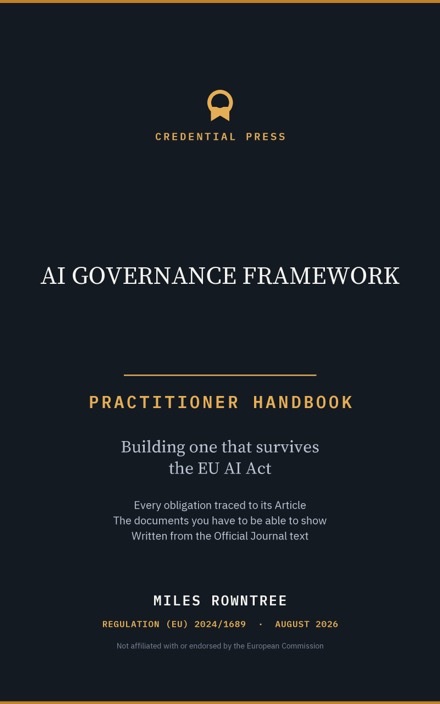
Building one that survives the EU AI Act. 22 chapters, 384 pages.
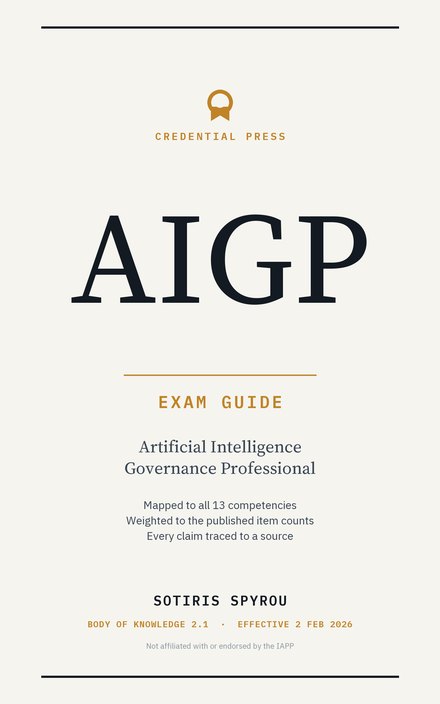
Artificial Intelligence Governance Professional. 21 chapters, 385 pages.
Sources
Every quotation above was read on 2 October 2026 through the EU Publications Office.
- Regulation (EU) 2024/1689 (AI Act), Articles 3(63), 51, 53, 54, 55, 56, 101, 111 and 113
- Regulation (EU) 2026/1744 (Digital Omnibus on AI)
- Regulation (EU) 2024/1689, consolidated text dated 27 July 2026 (no legal effect)
Credential Press is independent of the European Commission. This is not legal advice.