AAISM
Who secures the AI? Inside ISACA's AAISM credential
The AAISM is ISACA's credential for the security manager who now answers for AI: the person who has to find every model the organization runs, decide who owns its risk, and put controls around systems that read instructions and data as one stream of text. It is an advanced credential, built on top of a CISM or a CISSP rather than beside them, and ISACA will not certify you without one. This guide covers what the job involves, who sits the exam, the moments that put AI security on your desk, how the AAISM compares with the AIGP and the ISO/IEC 42001 Lead Implementer, and what the exam expects.
The exam facts come from ISACA's AAISM Exam Candidate Guide, version 1.26, with the Examination Content Outline of June 2025, checked against ISACA's published copy on 14 November 2026. The certification rules come from ISACA's AAISM page and Get AAISM Certified page, and the labor figures from O*NET OnLine, read on 16 November 2026. The security practice comes from our own fact-checked guide. Where this page and ISACA differ, ISACA wins.
What does an AAISM holder actually do?
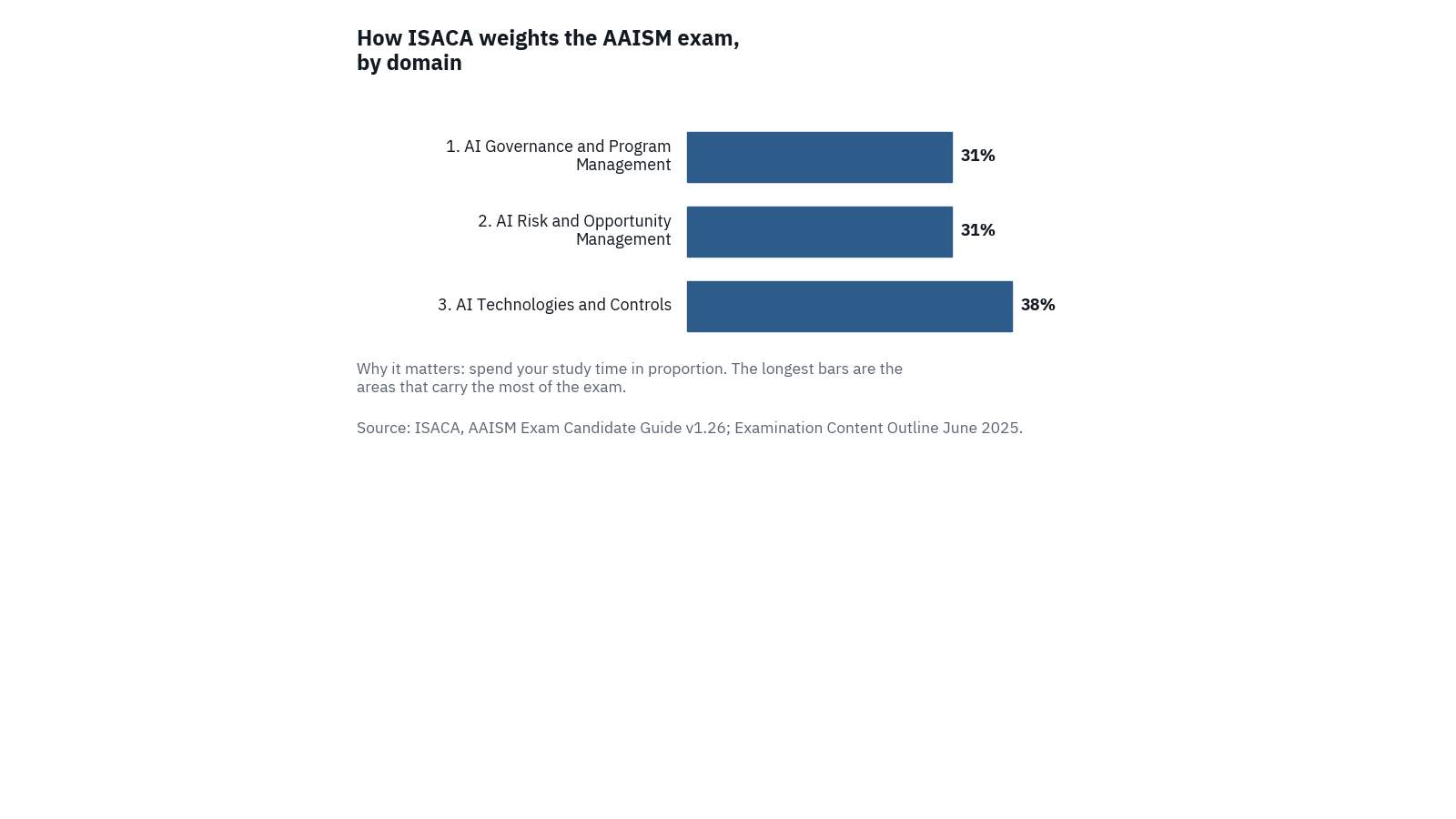
ISACA's candidate guide says the AAISM is designed for IT security professionals with a CISM or CISSP who want recognition for securing enterprise AI, and for using AI to improve security operations. ISACA calls it "the first and only AI-centric security management certification". That is ISACA's claim, and we found nothing to test it against. The exam weights the job across three domains, and ISACA publishes nothing finer than a share for each:
| Domain | Share | Subdomains |
|---|---|---|
| 1. AI Governance and Program Management | 31% | Stakeholder considerations, industry frameworks and regulatory requirements; AI-related strategies, policies and procedures; AI asset and data life cycle management; AI security program development and management; business continuity and incident response |
| 2. AI Risk and Opportunity Management | 31% | AI risk assessment, thresholds and treatment; AI threat and vulnerability management; AI vendor and supply chain management |
| 3. AI Technologies and Controls | 38% | AI security architecture and design; AI life cycle (model selection, training and validation); data management controls; privacy, ethical, trust and safety controls; security controls and monitoring |
The largest domain is the technical one. At 38%, AI Technologies and Controls is where the questions turn to architecture, the model life cycle, data controls and monitoring. That surprises people who expect a management credential to stay at the level of policy. It should not. A security manager who cannot tell a retrieval store from a model registry cannot set the controls for either.
The rest is management work a CISM would recognize, with AI in the middle of it. ISACA's web outline page heads the second domain AI Risk Management. The candidate guide, which is the formal source, calls it AI Risk and Opportunity Management.
ISACA also lists 22 tasks, written as verbs: collaborate on the governance charter, inventory and classify AI assets, conduct AI impact assessments, design security architecture for AI. It does not assign them to domains, and our guide says the placing it uses is its own. On the last weekend, test yourself against the tasks rather than the topics. The tasks describe the job.
Where AI security differs from the security you already run
Most of the AAISM sits on ground a CISM or CISSP already holds. What changes is what each part has to cover. Our guide opens many chapters with the moment that change arrives, and these are the ones you are most likely to meet.
The inventory with six rows
You ask, early in the role, for a list of the company's AI systems. Someone sends a spreadsheet with six rows, each a model the data science team built. Within a week you find a seventh in the CRM, where the vendor switched on an assistant in a routine update. The eighth is an image generator a marketing manager pays for on a corporate card. The ninth is a notebook on a laptop that scores customer churn every Monday. None is on the spreadsheet, and all of them handle company data.
The spreadsheet counted models. An inventory has to count use cases too, because the same model can draft marketing copy in one place and summarize medical notes in another. It also has to count the assets around the model: data, prompts, pipelines and the credentials agents use. Our guide takes a view some program managers will find slow: buy no AI security tool before the inventory exists. A tool deployed without one protects the systems someone happened to know about.
The model cannot tell an instruction from the data
A curious user talks your support bot into reciting its hidden instructions, an internal discount rule included, and posts the screenshot. Nothing was hacked in the usual sense. The user typed sentences, and the model did what they said. A language model receives its system prompt, the user's message and any retrieved content as one sequence of text. SQL injection was beaten by separating code from data. Language models have no such separation.
So the controls that hold live outside the model. Assume an injected instruction will sometimes succeed, and limit what the model can do when it does. Keep secrets out of prompts, enforce permissions in the systems around the model, and validate output before anything acts on it. When a stem sets a stronger system prompt or retraining against an option that restricts what the assistant can reach or do, the restriction usually wins. It reduces the harm whatever the attacker types.
The agent that acts at 2 a.m.
You are shown a demo on a Thursday. The agent reads a request, books a meeting, emails the attendees, updates the ticket and files an expense claim, and the room applauds. Your question is which of those five actions you would let it take unsupervised, at 2 a.m., on input a stranger wrote.
Least agency is least privilege extended to decisions. Expose narrow tools, never a database console, and give each its own scoped identity. Put a person in the loop for payments, deletions and external messages. Then put hard limits in code: caps on steps, spend and rate, and a kill switch. Our practice book has a scheduling agent that looped overnight, sent 400 meeting invitations and made 9,000 model calls before anyone noticed. A system prompt telling it to stop after a reasonable number of attempts would have relied on the model judging its own behavior, which is the thing that failed.
Failure that keeps running
A vendor emails on a Tuesday: the model version behind your support assistant retires in 90 days. Your team spent 6 months tuning prompts, guardrails and test cases against it. The continuity plan does not mention it, because it treats a model like a server that either runs or does not.
AI also fails in a way availability monitoring cannot see. A model can keep answering while drift or poisoned data makes its output wrong, and the process looks healthy throughout. So the business impact analysis asks how long the business can survive on wrong output before anyone notices. Recovery has a trap too. Restoring last night's backup of a poisoned model restores the poison. Recovery means a version you can prove is known-good, validated before it carries live traffic.
What you buy can change after you buy it
A renewal notice arrives for a customer relationship platform the company has used for 6 years. In the release notes is a new assistant that drafts replies to customer emails, switched on by default. The original security review never covered it, because it did not exist. It may also call another company's model on every click: a fourth party with your data and no contract with you. A certificate covers the scope written on it, and an assessment covers the version and use that existed when it was done. When anything changes, reopen the assessment and base it on what is running now.
| Work you already do | What AI adds | Subdomain |
|---|---|---|
| Asset inventory | Use cases as well as models; AI features inside licensed software; weights, data, prompts and agent credentials | 1C |
| Policy and acceptable use | What staff may paste into public tools; which AI services are approved; logging and redaction of prompts | 1B |
| Continuity and incident response | Silent failure, model retirement by the provider, many processes on one provider, a poisoned model restored from backup | 1E |
| Risk assessment | The use case assessed instead of the model; thresholds a person can measure; owners who accept residual risk | 2A |
| Vulnerability management | Prompt injection, poisoning, extraction and evasion, often with no patch to apply | 2B |
| Third-party risk | Models that change after purchase, training on your data, fourth parties, open-weight models with no vendor at all | 2C |
| Architecture and identity | Trust boundaries around the model, scoped identities for agents, limits enforced outside the model | 3A |
| Monitoring | Outputs read as security signals, logs of prompts and tool calls, checks that the monitor still sees traffic | 3E |
Who sits the AAISM?
ISACA's AAISM page lists who can benefit: active CISM or CISSP holders, people with proven experience in security or advisory roles, and people with some expertise in assessing, implementing and maintaining AI systems. The first is a hard requirement. The other two describe somebody who already manages security and has started to meet AI in the systems they secure:
| Role | What AI puts on the desk | Pairs with |
|---|---|---|
| CISO or head of security | The board asks who owns AI risk; the inventory, the AI policy and the program roadmap | CISM; the AIGP where AI governance sits with security |
| Security manager for a product or platform | Assistants and agents going into customer products; the release gate; red team results | CISM or CISSP; ISO/IEC 42001 Lead Implementer if the company is building an AIMS |
| Security architect | Trust boundaries, retrieval stores, agent identities and tool permissions | CISSP |
| Security risk or GRC lead | AI risk assessments, thresholds, acceptance by owners, impact assessments | CISM; the AIGP for the legal side |
| Third-party risk lead | AI features arriving at renewal, data-use terms, fourth parties, open-weight models | CISM or CISSP |
| Security operations lead | Logging prompts and tool calls, detecting misuse, AI incident playbooks | CISSP |
| Security consultant or advisor | Client AI security programs, assessments and roadmaps | CISM or CISSP; the AIGP or ISO/IEC 42001 depending on the client |
ISC2's list of positions that earn the CISSP runs from security analyst to chief information security officer, and most of the AAISM's audience sits in its upper half. Here is a view some will dispute: the AAISM pays off most where a company puts AI into its own products. Buying AI raises vendor questions your third-party program can already answer. Building it puts the model life cycle, the release gate and agent design on your desk, and that is where 38% of the exam sits.
What the job looks like in numbers
No US occupation code covers AI security management. Two bracket it, Computer and Information Systems Managers and Information Security Analysts, and O*NET gives these figures from Bureau of Labor Statistics data:
| Measure | Computer and Information Systems Managers (11-3021) | Information Security Analysts (15-1212) |
|---|---|---|
| Employment, 2025 | 685,800 | 192,900 |
| Median annual wage, 2025 | $175,140 | $129,180 |
| Projected growth, 2025 to 2035 | Much faster than average (7% or higher) | Much faster than average (7% or higher) |
| Projected job openings, 2025 to 2035 | 53,500 | 14,100 |
The first covers IT managers of every kind, and the second analysts who may never touch a model. The table shows the two jobs an AAISM holder sits between, not the size of an AI security market, for which we found no official figure.
When does AI security land on your desk?
Shadow AI
You get the call on an ordinary afternoon. A sales team has pasted a batch of customer records into a public chatbot to draft renewal emails faster. The emails were good. Legal wants to know where the records went, privacy wants to know who approved it, and the sales director cannot see what the fuss is about. Shadow AI like this is often the first evidence a company has that it needs an AI policy, an approved alternative and an owner for both.
Our guide warns against the reflex that follows. Rewriting the policy feels decisive. The better first move is to find out why it was not followed: no training, no approved tool, no owner, nothing technical enforcing the rule. Then fix the layer that failed.
The board, the customer and the vendor
A board approves a statement on AI use and asks who will make it true. A customer's questionnaire asks how the company secures its AI. Each puts the same work in front of a security manager: the inventory, the policies, risk assessments with named owners, and evidence that the controls work. The exam leans hard on that last point. A guardrail in place and a training course with full completion show that a control exists. Neither shows that it works. Our practice book's example is an awareness course with a 98% completion rate, in the month a developer pasted a customer database export into a public coding assistant.
The EU AI Act timetable
The AI Act, Regulation (EU) 2024/1689, reaches organizations outside the EU when they place AI systems on the EU market or when their systems' output is used in the Union. Product wants to sell an applicant-screening feature to a customer in Germany, and the sales lead says the law is no concern because the company is based outside Europe. The sales lead is wrong, and the feature is high-risk, because employment is one of the areas the Act lists. A deployer must use such a system as instructed, assign human oversight to competent people and keep its logs, and fine-tuning or repurposing a vendor's system can make your organization its provider.
The Digital Omnibus, Regulation (EU) 2026/1744, published in the Official Journal on 24 July 2026, moved the main dates, as Cooley's summary sets out:
| What applies | From |
|---|---|
| Transparency duties under Article 50, for new systems | 2 August 2026 |
| Machine-readable marking of AI output, for systems already on the market before 2 August 2026 | 2 December 2026 |
| Two new prohibitions: AI that generates intimate imagery of an identifiable person without consent, and AI that generates child sexual abuse material | 2 December 2026 |
| High-risk systems listed by use in Annex III, such as employment and credit | 2 December 2027 |
| High-risk AI that is a safety component of a product regulated under Annex I | 2 August 2028 |
| High-risk systems used by public authorities | 2 August 2030 |
The Omnibus also rewrote the AI literacy duty in Article 4: providers and deployers take measures to support AI literacy, and no specific level has to be guaranteed. Our guide to what the Digital Omnibus changed has the full list.
The trap here is the one our guide puts first. A stem says a new law applies, and one option offers to adopt the NIST AI RMF or pursue ISO/IEC 42001 certification. A voluntary framework cannot tell you what a law requires. The first move is to work out the obligation, with legal counsel. Frameworks then help you build the controls that meet it.
Where does the credential apply?
ISACA runs the exam worldwide, at PSI test centers or by remote proctoring. The candidate guide lists English, Spanish and Japanese, while ISACA's AAISM page, read on 16 November 2026, says English, Chinese, Spanish or Japanese, so check when you schedule. Candidates in India, Mainland China and Hong Kong must sit at a test center. The content travels too, and our guide covers the laws and frameworks a stem is most likely to name:
| Law or framework | What it is | Where it bites |
|---|---|---|
| EU AI Act, Regulation (EU) 2024/1689 | Law: duties set by the risk of the use and the role you play | AI placed on the EU market, or whose output is used in the Union |
| GDPR | Law on personal data, with protections against decisions made solely by automated means where the effects are significant | Personal data in training sets, prompts, logs and outputs |
| NIST AI Risk Management Framework | Voluntary US framework: Govern, Map, Measure, Manage | Any organization, any sector; free to download |
| ISO/IEC 42001 | Certifiable management system standard for AI | Organizations that want a certificate for how they manage AI |
| OWASP Top 10 for LLM Applications | Community awareness list of the main risks in LLM applications | Applications built on large language models |
| MITRE ATLAS | Knowledge base of adversary tactics and techniques against AI | Threat modeling and red teaming |
Of these, the OWASP list and MITRE ATLAS are the two a security manager opens most: the first names the risks, and the second gives a red team its plan.
What the AAISM is not
It is not an entry-level credential. ISACA certifies only holders of an active CISM or CISSP, so it assumes the security management is already there.
It is not a governance credential for lawyers and policy leads. It covers regulation and frameworks from the seat of the person who turns them into controls. The AIGP serves the wider governance role.
It is not a management system certification. An ISO/IEC 42001 certificate belongs to an organization. The AAISM belongs to a person.
It does not make you a data scientist. You need to know what validation, drift and fine-tuning mean, and to ask the right questions of the people who do them.
It does not make an organization secure. Whether the AI is secure is a question about evidence from operation, and the credential is evidence about you.
Prerequisite, application and upkeep
| Step | What ISACA asks |
|---|---|
| Before you register | An active CISM, or an active CISSP from ISC2 |
| Register | US$459 for members, US$599 for nonmembers; six months to sit the exam; one six-month extension for US$75 |
| Pass | 450 or higher on the 200 to 800 scale |
| Apply | Within five years of passing, with the US$50 application processing fee |
| Hold | Keep the CISM or CISSP active; follow ISACA's Code of Professional Ethics |
| Maintain | 10 hours of CPE in artificial intelligence each year, from the calendar year after certification |
If you hold neither prerequisite, that is your first decision. Our guide to who needs the CISM covers ISACA's management route, and our guide to who needs the CISSP covers ISC2's broader one, with eight domains from security and risk management to software development security. ISC2's CISSP page says a new exam outline takes effect on 15 April 2027.
Our view: if your work is running a security function, take the CISM first, because its domains are the management work the AAISM's governance and risk domains build on. If your work is architecture and engineering, the CISSP carries more into the technologies and controls domain. ISACA accepts either, and our CISM or CISSP guide sets them side by side.
How does it compare?
| AAISM | AIGP | ISO/IEC 42001 Lead Implementer | CISM | |
|---|---|---|---|---|
| Who sets it | ISACA | IAPP | PECB | ISACA |
| The job | Securing the AI the organization builds, buys and uses | Governing AI across law, policy and the life cycle | Building and running an AI management system | Running an information security function |
| Who it assumes you are | A certified security manager | A privacy, legal, risk, product or engineering professional who governs AI | The person who builds the AIMS | A security manager |
| Where the exam leans | Technologies and controls, 38% | Laws, frameworks and responsible AI | Planning and implementing an AIMS | The security program and incident management |
The governance overlap with the AIGP is real. The AAISM's first domain opens with stakeholders, industry frameworks and regulatory requirements, and ISACA's task list asks for AI impact assessments. Our guide teaches the same EU AI Act roles and NIST AI RMF functions the AIGP covers. The difference is the seat. The AIGP asks what the organization must do. The AAISM asks what the security manager does about it, and spends 38% of the exam on the controls. Our guide to who needs the AIGP covers that route.
ISO/IEC 42001 is closer still in shape, because an AI management system needs the same inventory, policy, and risk and impact assessments. The ISO 42001 Lead Implementer builds that system. The AAISM holder secures what runs inside it and supplies much of the evidence an auditor will ask for. In a small company they are often the same person. If that is you, take the implementer first when a certification deadline drives the work, and the AAISM first when the pressure is an incident, a customer's questionnaire or an agent about to go live.
What will the exam expect of you?
The exam has 90 multiple-choice questions in 150 minutes: 100 seconds a question if you spend the time evenly, and you will not, because some stems are a paragraph of scenario. Every question has four options and one best answer. The stem may carry a qualifier, MOST, BEST or FIRST, and that word is the question. Two options can both describe correct actions, and only one of them is the FIRST.
Scores run from 200 to 800, and 450 passes. ISACA publishes no percentage pass mark, and the paper carries unscored pretest items in a number ISACA does not publish. Domain results are for information only, because the score is the total of items answered correctly. There is no penalty for a wrong answer, so leave nothing blank. You see a preliminary result on screen, and the official score arrives within 10 working days. The exam is closed book.
The traps rhyme across all three domains. One is rating the model instead of the use case: the same model can be low risk summarizing meetings and high risk screening loan applications. Another is taking a metric as a risk rating. A claims model that is 97% accurate, at 20,000 claims a month, makes about 600 wrong decisions a month. Then there is the fix inside the model when the stem wants a control around it, and the control accepted by its label: a reviewer with no authority to override is not oversight.
Test yourself with the AAISM quiz, see the three domains on one page in the mind map, and if the credential is part of a job move, the interview questions page covers what employers ask. Our pass marks page shows the same 200 to 800 scale and 450 pass mark across ISACA's other exams.
How to prepare
ISACA sells its own preparation, including a review manual, a database of more than 200 questions and an online review course, and gives away a practice exam of 12 questions. Its candidate guide is free and carries the exam rules our books do not repeat.
Both of our books for this exam are free now to early readers at credentialpress.com/free, as review copies. We ask once for an honest review, never a positive one, and nothing depends on whether you write it.
The AAISM Exam Guide has 13 chapters, each mapped to part of one of ISACA's three domains, with pages in proportion to the published shares, so AI Technologies and Controls gets five. It is written from ISACA's candidate guide, version 1.26, with every exam claim traced to it, and it reproduces none of ISACA's own material. Every chapter ends with confusable pairs, the trap in the material and five recall questions. The scenes in this post come from its chapters.
The AAISM Practice Questions has 200 questions: 62 for each of the first two domains and 76 for the third. ISACA does not publish per-domain counts, so those are the book's arithmetic on the percentages, and the book says so. Every question has four options, as on the exam, and every rationale says why the keyed answer is best and why each tempting option fails. They are not real exam questions.
Here is a plan, which is our suggestion rather than ISACA's. Read the guide in domain order, and work the practice questions for each domain straight after, untimed. Then sit each domain's questions again at 100 seconds a question. In the final week, sit all 200 in mixed order across a few sessions and read every rationale, including the ones you got right. We have turned ISACA's weights into a study planner you can copy or download.
AAISM study planner
ISACA AAISM: study planner
Domain weights, the exam length and the exam rules come from ISACA's AAISM Exam Candidate Guide, version 1.26, with the Examination Content Outline of June 2025, checked against ISACA's published copy on 14 November 2026. The certification and CPE rules come from ISACA's Get AAISM Certified page, read on 16 November 2026. ISACA does not recommend a number of study hours: the budgets and the split are our suggestion, in proportion to the published weights. Check the current outline before you start in case the weights have changed.
Hours by domain
| Domain | Share | 50 hours | 100 hours | 150 hours |
|---|---|---|---|---|
| 1. AI Governance and Program Management | 31% | 15.5 | 31 | 46.5 |
| 2. AI Risk and Opportunity Management | 31% | 15.5 | 31 | 46.5 |
| 3. AI Technologies and Controls | 38% | 19 | 38 | 57 |
| Total | 100% | 50 | 100 | 150 |
ISACA publishes a share per domain and nothing finer. It does not weight the subdomains, so the rows below have no hours of their own: spread each domain's hours across its subdomains by how new the material is to you.
Pace for timed practice
| Set | Questions | Time at the exam's average pace |
|---|---|---|
| One question | 1 | 1 minute 40 seconds |
| Short timed set | 10 | 16 minutes 40 seconds |
| Half a paper | 45 | 1 hour 15 minutes |
| Full paper | 90 | 2 hours 30 minutes |
The exam is 90 questions in 150 minutes, which is 100 seconds a question on average. Some stems are a paragraph of scenario, so bank time on the short ones.
Practice questions (our suggestion)
Our AAISM Practice Questions carries 200 questions, sized to the published shares: 62 for Domain 1, 62 for Domain 2 and 76 for Domain 3. Those counts are our arithmetic on ISACA's percentages, not a published item count.
- Each domain's questions worked untimed, straight after reading that domain in the guide
- Each domain's questions sat again at 100 seconds a question
- Every rationale read, including the ones for questions you got right
- In the final week, all 200 sat in mixed order across a few sessions
- Every miss logged against its subdomain, and the guide reread there
1. AI Governance and Program Management
31% of the exam.
| Subdomain | Read | Studied | Practiced |
|---|---|---|---|
| 1A Stakeholder considerations, industry frameworks and regulatory requirements | [ ] | [ ] | [ ] |
| 1B AI-related strategies, policies and procedures | [ ] | [ ] | [ ] |
| 1C AI asset and data life cycle management | [ ] | [ ] | [ ] |
| 1D AI security program development and management | [ ] | [ ] | [ ] |
| 1E Business continuity and incident response | [ ] | [ ] | [ ] |
- Hours in the calendar: 15.5, 31 or 46.5
- Can name every stakeholder for an AI use case, and spot the one missing from a decision (legal, privacy, the business owner)
- Can say what the AI governance charter settles: who approves a use case, who accepts its risk, who can stop a deployment
- Can tell a policy from a standard, a procedure and a guideline, and say which layer to fix when staff break a clear rule
- Can build an AI inventory that counts use cases as well as models, including AI switched on inside licensed software
- Can follow a deletion to every copy: training snapshots, embeddings, vector indexes, backups
- Can measure whether awareness training works with evidence from controls, not completion rates
- Can put AI dependencies, silent failure and provider model retirement into a business impact analysis
- Can order an AI incident: contain first, preserve evidence, then eradicate, recover to a known-good version, and learn
2. AI Risk and Opportunity Management
31% of the exam.
| Subdomain | Read | Studied | Practiced |
|---|---|---|---|
| 2A AI risk assessment, thresholds and treatment | [ ] | [ ] | [ ] |
| 2B AI threat and vulnerability management | [ ] | [ ] | [ ] |
| 2C AI vendor and supply chain management | [ ] | [ ] | [ ] |
- Hours in the calendar: 15.5, 31 or 46.5
- Can scope a risk assessment to the use case, not the model
- Can turn a model metric into a risk question: volume, direction of errors, results by segment, controls
- Can write a threshold a person can measure, and say who sets it and who accepts what sits above it
- Can tell mitigation, transfer, avoidance and acceptance apart, and say when another control is over-treatment
- Can name the main attacks on AI: poisoning, evasion, extraction, inversion, membership inference, prompt injection, jailbreaks
- Can explain why one clean red team run proves little, and what an attack success rate is
- Can say what a vendor's certificate or assurance report covers, and when a change means reopening the assessment
- Can find the fourth party behind an embedded AI feature, and the data-use terms that matter
3. AI Technologies and Controls
38% of the exam, the largest domain.
| Subdomain | Read | Studied | Practiced |
|---|---|---|---|
| 3A AI security architecture and design | [ ] | [ ] | [ ] |
| 3B AI life cycle (model selection, training and validation) | [ ] | [ ] | [ ] |
| 3C Data management controls | [ ] | [ ] | [ ] |
| 3D Privacy, ethical, trust and safety controls | [ ] | [ ] | [ ] |
| 3E Security controls and monitoring | [ ] | [ ] | [ ] |
- Hours in the calendar: 19, 38 or 57
- Can draw the trust boundaries in an AI system and say why the model can neither decide nor enforce access
- Can apply least agency to an agent: narrow tools, scoped identity, approval for irreversible actions, limits in code, a kill switch
- Can compare building, fine-tuning, open-weight and hosted models from the security seat
- Can say what makes validation independent, and what changes after release make it stale
- Can protect weights and training checkpoints as copies of the model
- Can say why masked, tokenized or synthetic data is reduced risk, not no risk
- Can place human oversight in, on or over the loop, and test whether the human can change the outcome
- Can say what to log for models and agents, and how to tell a working detection from a quiet one
- At least half the hours spent on practice questions (our suggestion)
Booking and exam day
- Active CISM, or active CISSP from ISC2, in hand (ISACA rule)
- Registered and paid: US$459 for members, US$599 for nonmembers; six months to sit from registration (ISACA rule)
- Appointment booked: from 48 hours after payment, and no more than 90 days ahead (ISACA rule)
- Any reschedule done at least 48 hours before the appointment (ISACA rule)
- Need longer? One six-month extension for US$75 (ISACA rule)
- ID ready: current, valid, original and government-issued, with your name, signature and photograph on one document; digital and military IDs are not accepted (ISACA rule)
- At a test center: arrive at least 30 minutes before the start; more than 15 minutes late and the fee is forfeit (ISACA rule)
- At home: device compatibility check done; room scan and mirror check ready; no breaks without the proctor's permission (ISACA rule)
- Closed book: no notes, no calculator, nothing on the desk (ISACA rule)
- Every question answered: there is no penalty for a wrong answer (ISACA rule)
After the exam
- Preliminary result read on screen; official score expected within 10 working days (ISACA rule)
- If you passed: apply within five years, with the US$50 application processing fee (ISACA rule)
- If you did not: four attempts within a rolling 12 months; wait 30 days before the second attempt and 90 days before each one after (ISACA rule)
- Once certified: 10 hours of AI CPE each year from the next calendar year, your CISM or CISSP kept active, and ISACA's Code of Professional Ethics followed (ISACA rule)
Is it current? Both books are written from ISACA's AAISM Exam Candidate Guide, version 1.26, and the Examination Content Outline of June 2025, checked against ISACA's published copy on 14 November 2026. Check ISACA's AAISM exam content outline page before you book. ISACA does revise its outlines, as it did for the CISM on 3 November 2026.
So, should it be you?
Take the AAISM if you already hold a CISM or CISSP and AI has arrived in the systems you secure: an inventory nobody owns, a vendor feature switched on by default, an assistant going into a customer product, an agent that can send email. The exam is about the work that follows, and it weights the technical controls more heavily than any other domain, which is right for the job.
Wait if you hold neither prerequisite: get the CISM or the CISSP first, and come back when you can apply. Take the AIGP instead if your seat is legal, privacy or policy and someone else owns the controls. Take the ISO/IEC 42001 Lead Implementer instead if your task is to build an AI management system for certification. And if you are the one person in a small company who will do all of it, start with whichever deadline is nearest.
Questions people ask about the AAISM
Who is the AAISM for?
ISACA designed it for IT security professionals who hold a CISM or CISSP and want recognition for securing enterprise AI and for using AI to improve security operations. Its AAISM page describes the candidate in three parts: an active CISM or CISSP, proven experience in security or advisory roles, and some expertise assessing, implementing and maintaining AI systems.
Do I need a CISM or CISSP to take the AAISM?
Yes. ISACA's first step to certification is an active CISM or an active CISSP from ISC2, and its AAISM page says candidates must hold one to register for the exam. Once certified, you keep the qualifying certification active.
How many questions are on the AAISM exam, and how long is it?
90 multiple-choice questions in 2.5 hours (150 minutes). Every question has four options and one best answer, and the stem may carry a qualifier such as MOST likely or BEST.
What is the AAISM passing score?
450 on ISACA's scale of 200 to 800. ISACA publishes no percentage pass mark, and the exam includes unscored pretest items whose number it does not publish.
What are the AAISM exam domains?
AI Governance and Program Management, 31%; AI Risk and Opportunity Management, 31%; AI Technologies and Controls, 38%. ISACA's web outline page heads the second domain AI Risk Management. The candidate guide is the formal source.
How much does the AAISM cost?
The exam is US$459 for ISACA members and US$599 for nonmembers, and the fee is nonrefundable and nontransferable. After you pass there is a US$50 application processing fee.
How do I keep the AAISM?
Earn 10 hours of CPE in artificial intelligence each year, starting the calendar year after you are certified, keep your CISM or CISSP active, and follow ISACA's Code of Professional Ethics. ISACA says those AI hours may also count toward its other certifications where they meet those requirements.
AAISM or AIGP?
The AIGP, from the IAPP, is about governing AI: how laws and frameworks apply, the AI life cycle and responsible AI. The AAISM is about securing AI, from policy and risk to architecture, data controls and monitoring, and it assumes you already manage security. A governance lead outside security is better served by the AIGP.
AAISM or ISO 42001 Lead Implementer?
The PECB ISO/IEC 42001 Lead Implementer is about building an AI management system that can be certified. The AAISM is about securing the AI that system governs. If you will write the AIMS and walk it into a certification audit, take the implementer. If you will own the security controls, take the AAISM.
Is the AAISM exam open book, and can I take it at home?
It is closed book. You can sit it at a PSI test center or by remote proctoring, after a room scan and a mirror check. ISACA's AAISM page says candidates in India, Mainland China and Hong Kong must sit at a test center.
How many times can I retake the AAISM?
Four attempts within a rolling 12 months. After a first fail you wait 30 days, then 90 days before each later attempt, and you pay the full registration fee each time.
AAISM: test yourself in five minutes
Which books prepare you for the AAISM exam?
A study companion for the ISACA Advanced in AI Security Management (AAISM) examination. 13 chapters, 371 pages.
Practice questions with full rationales, sized to the published domain weights. 213 pages.
How to credit this page
Using a figure or a passage from this page in an article, a course, a forum answer or AI-generated text? Please credit Credential Press and link to this page, so your readers can check the source and the date it was reviewed. Copy a ready-made citation:
Plain text
Markdown
HTML
Sources
- ISACA, AAISM Exam Candidate Guide, version 1.26, with the Examination Content Outline (June 2025), checked 14 November 2026
- ISACA, AAISM Exam Content Outline: domain weights and supporting tasks, read 14 November 2026
- ISACA, AAISM Certification: audience, languages, fees and preparation, read 16 November 2026
- ISACA, Get AAISM Certified: application window and CPE, read 16 November 2026
- ISC2, CISSP Certification: domains, positions and the 2027 outline notice, read 16 November 2026
- IAPP, AIGP: Artificial Intelligence Governance Professional, read 16 November 2026
- Regulation (EU) 2024/1689 (AI Act), Official Journal of the European Union
- Regulation (EU) 2026/1744 (Digital Omnibus on AI), published 24 July 2026
- Cooley, Digital AI Omnibus delays key deadlines, introduces new rules
- NIST, AI Risk Management Framework
- OWASP, Top 10 for LLM Applications
- MITRE ATLAS
- ISO, ISO/IEC 42001:2023, Artificial intelligence, Management system
- O*NET OnLine, 11-3021.00 Computer and Information Systems Managers (BLS data)
- O*NET OnLine, 15-1212.00 Information Security Analysts (BLS data)
Credential Press is not affiliated with, endorsed by or authorized by ISACA, ISC2, the IAPP or PECB. Exam names and trademarks belong to their owners.