ISO 42001
Who needs an ISO 42001 Lead Implementer, and when does it start to matter?
An ISO 42001 Lead Implementer is the person an organization trusts to build its AI management system: to scope it, write the policy, run the risk and impact assessments, put the controls in place, measure whether they work and walk the organization into a certification audit. If that will be your job, the credential fits. If your job is to advise on AI law from the outside, it fits less well, and this guide explains why.
Everything below comes from primary documents: the standard's own page at ISO, PECB's ISO/IEC 42001 Lead Implementer Candidate Handbook, version 1.5, PECB's course page, the EU AI Act in the Official Journal and the government sources linked where they are used.
What does an ISO 42001 Lead Implementer actually do?
Start with the standard. ISO/IEC 42001:2023 is the first edition of an AI management system standard, published by ISO and the IEC in December 2023 and developed by the joint committee ISO/IEC JTC 1/SC 42. It does not tell you how to build a model. It tells an organization how to govern the way it develops, provides or uses AI systems: who decides, how risk is assessed, which controls apply, how performance is checked and how the whole thing improves over time.
A management system is the machinery that makes those things happen every month, not once. The Lead Implementer is the person who designs the machinery and gets it running. PECB's exam outline spells out the job in its own words: the candidate must be able to plan the implementation of the AIMS, implement it, monitor and measure it, and prepare an organization for an AIMS certification audit. That is the purpose of the credential in one sentence, and it is why the exam spends most of its questions on planning and doing rather than on definitions.
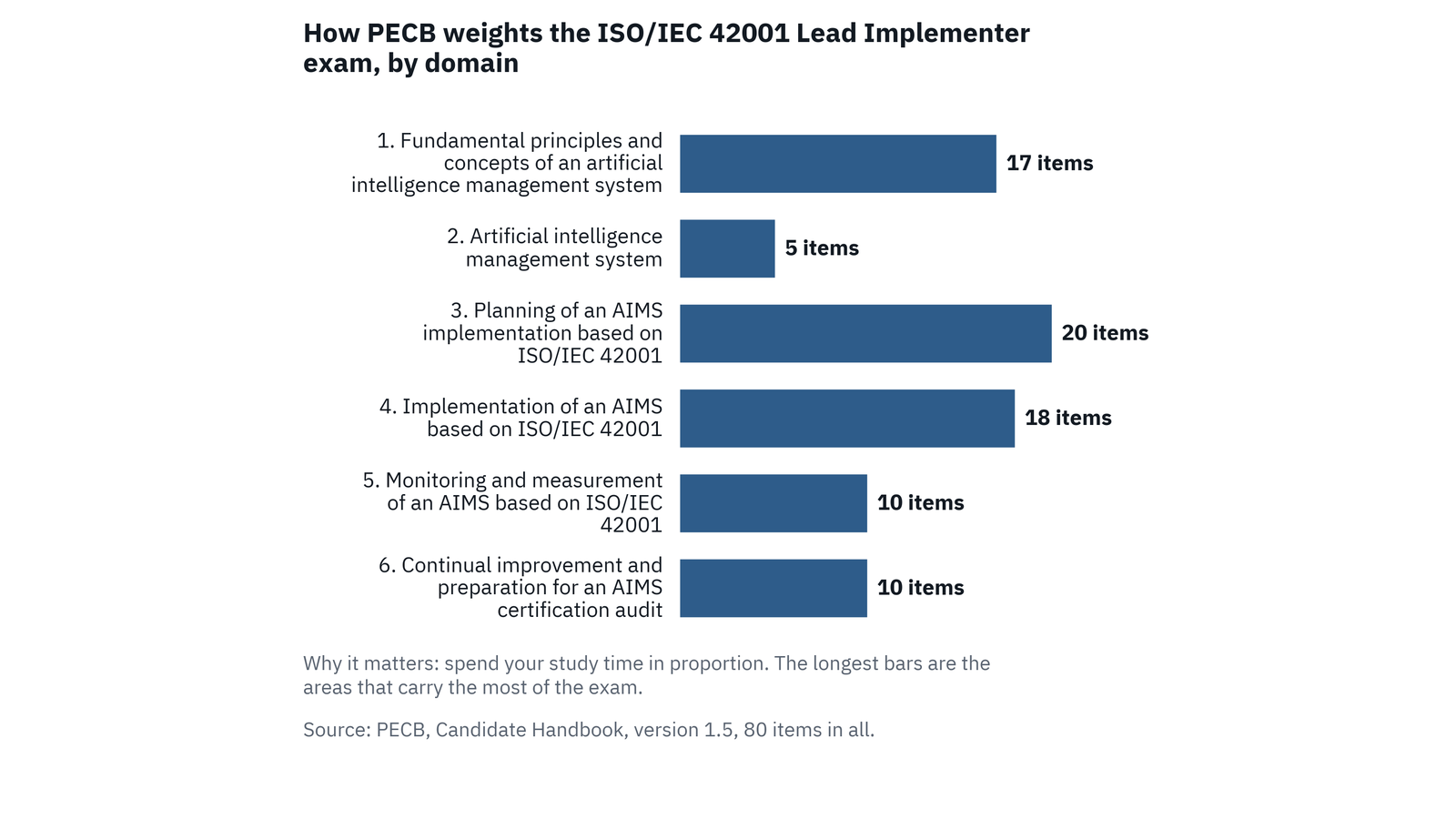
You can see the job in the way PECB weights its six competency domains:
| Domain | Questions | Share | What it asks of you |
|---|---|---|---|
| 1. Fundamental principles and concepts of an AI management system | 17 | 21.25% | Understand AI, its risks and the EU classification of AI systems |
| 2. Artificial intelligence management system | 5 | 6.25% | Know what the AIMS requirements are |
| 3. Planning of an AIMS implementation | 20 | 25% | Scope, policy, risk assessment, impact assessment, controls |
| 4. Implementation of an AIMS | 18 | 22.5% | Put controls, documentation, training and operations in place |
| 5. Monitoring and measurement of an AIMS | 10 | 12.5% | Monitor, measure, audit internally, review |
| 6. Continual improvement and preparation for the certification audit | 10 | 12.5% | Fix nonconformities, improve, get ready for the auditors |
Planning and implementation together carry 38 of the 80 questions. The handbook also splits the paper by level of understanding: 32 questions test comprehension, application and analysis, and 48 test evaluation. That second number tells you what kind of person the exam is looking for. It wants someone who can read a messy situation and judge what an implementer should do next.
Who gets sent on the course?
PECB's own list of who the five-day course is for is unusually concrete. It names professionals responsible for overseeing and managing AI projects, consultants advising on AI implementation strategies, expert advisors and specialists who want to master the practical implementation of an AIMS, individuals tasked with making sure AI projects comply with organizational requirements, AIMS implementation team members, and executives and managers who make decisions about AI implementation.
In practice those descriptions map onto a handful of real jobs. The table pairs each one with the reason it tends to need the credential and the credential it most often sits beside.
| Role | What they need it for | Often paired with |
|---|---|---|
| AI governance or responsible AI lead | Turning a policy and a set of principles into a system that runs, with owners, records and reviews | IAPP AIGP |
| ISMS manager or information security manager | Extending an existing ISO 27001 management system to cover AI without building a second bureaucracy | ISO 27001 Lead Implementer |
| Compliance, risk or GRC manager | Running AI risk assessments and impact assessments that stand up to an auditor | CRISC, ISO 27701 Lead Implementer |
| Consultant | Leading AIMS projects for clients and preparing them for certification | ISO 42001 Lead Auditor |
| AI or data project manager, product owner | Building governance into delivery: requirements, documentation, sign-off, change control | PMP |
| Executive or senior manager | Knowing what "good" looks like before signing off resources and accepting risk | Usually the course, without the full credential |
Notice who is not on the list. A data scientist who builds models all day will learn useful things on the course, but the credential is not about model building, and the exam will not test it. A lawyer who advises on the AI Act will find the course readable, but the exam rewards the person who has to make the system work, not the person who interprets the law.
When does it start to matter?
For most people the credential is not a career plan. It is a response to something that happens at work. These are the moments that tend to put it on the table.
A customer asks how you govern AI
Picture the procurement questionnaire that arrives with a contract renewal. Last year it asked about information security and personal data. This year it has a new section: which AI systems do you use, who is accountable for them, how do you assess their risk, and can you show it? An organization with an ISO 27001 certificate already knows how this goes. Somebody has to answer with evidence, and the fastest way to have evidence is to have a management system that produces it.
The organization decides to certify
Once a board decides to pursue ISO/IEC 42001 certification, someone has to lead the project, and certification bodies will audit against the standard. Since 2025 a companion standard, ISO/IEC 42006, has set out how those bodies must audit and certify AI management systems. The certificate goes to the organization. The Lead Implementer is the person inside, or the consultant alongside, who gets the system ready for that audit.
Your AI becomes regulated
The EU AI Act, Regulation (EU) 2024/1689, entered into force on 1 August 2024. Article 17 requires providers of high-risk AI systems to put a quality management system in place, and Article 16 lists the provider's other obligations. The Digital Omnibus, Regulation (EU) 2026/1744, moved the high-risk dates: 2 December 2027 for the Annex III use cases such as recruitment and credit scoring, and 2 August 2028 for AI that is high risk as part of a regulated product under Annex I. A management system built on ISO/IEC 42001 is not the same thing as Article 17 compliance, but it is a sensible place to keep the risk management, documentation, monitoring and accountability that the Act asks for. Our guide to what the Digital Omnibus changed sets out every new date.
You already run ISO 27001
The quiet trigger is the most common in practice: an organization that already runs an information security management system adds AI to the scope of its governance. ISO/IEC 42001 and ISO/IEC 27001 share ISO's Harmonized Structure, the ten-clause framework set out in Annex SL of the ISO/IEC Directives and once called the High-Level Structure. The same clauses on context, leadership, planning, support, operation, evaluation and improvement appear in both. The person who built the ISMS is often the person asked to build the AIMS, and the credential is the quickest way to learn what is genuinely new.
The Lead Implementer is a personal credential awarded by PECB. ISO/IEC 42001 certification is awarded to an organization by an accredited certification body after an audit. Holding the first does not give your employer the second.
ISO/IEC 42006:2025 scope; PECB Candidate Handbook v1.5
Where does it apply?
Anywhere. ISO/IEC 42001 is an international standard, and PECB runs the exam worldwide, either remotely through the PECB Exams application with an online invigilator or on paper through the partner that ran your course. Candidates who take a Lead exam in a language that is not their own can ask for 30 extra minutes.
What changes from place to place is the legal and policy setting around the standard. The table below sets out the frameworks a Lead Implementer most often has to work beside.
| Jurisdiction | Framework | Status | How ISO/IEC 42001 relates |
|---|---|---|---|
| European Union, and providers outside it who place AI systems on the EU market | EU AI Act, Regulation (EU) 2024/1689 | Law | Can hold much of the evidence. The presumption of conformity comes from harmonized European standards under Article 40, not from an ISO/IEC 42001 certificate |
| United Kingdom | AI Management Essentials (DSIT) | Voluntary self-assessment, aimed at SMEs and start-ups | The government says the tool is based on three frameworks: ISO/IEC 42001, the NIST AI RMF and the EU AI Act |
| United States | NIST AI Risk Management Framework 1.0 (26 January 2023) and its Generative AI Profile, NIST-AI-600-1 (26 July 2024) | Voluntary | Complementary: NIST describes risk practices, ISO/IEC 42001 describes the auditable system that runs them |
| Global | ISO/IEC 22989 (AI concepts and terminology), ISO/IEC 23894 (AI risk management guidance) | Voluntary standards | Supporting standards that an AIMS draws on for vocabulary and for its risk method |
The EU row deserves a second look if you work outside Europe. Article 2(1)(a) brings in providers placing AI systems on the market or putting them into service in the Union "irrespective of whether those providers are established or located within the Union". A software company in Toronto or Bangalore can be inside the Act's scope, and the person asked to organize its response is very often the person with the management system background. Our guide Does the EU AI Act apply to me? walks through the scope test.
What the credential is not
A few misunderstandings come up again and again, and clearing them up early saves money.
It is not legal compliance. ISO/IEC 42001 is voluntary. It does not replace a legal assessment of whether an AI system is prohibited, high risk or subject to transparency duties under the AI Act. It gives you a disciplined way to manage those obligations once someone has worked out what they are.
It is not a model-building qualification. Domain 1 asks you to understand machine learning, deep learning and the main AI techniques well enough to govern them, and to classify AI systems by risk. It does not ask you to train or tune anything.
It is not the auditor's credential. PECB runs a separate ISO/IEC 42001 Lead Auditor scheme for people who will audit AI management systems. The implementer builds; the auditor tests. Many consultants hold both, but they answer different exam questions.
And it is not a substitute for the standard. ISO/IEC 42001 is sold, not published free. The exam is open book and PECB lets you bring a hard copy, so buy your own and learn your way around it.
Which credential level is right for you?
PECB awards four levels on the same exam. You sit one paper, and the credential you hold depends on the experience and project hours you can show. You can start at the bottom and apply to move up as the hours build.
| Credential | Work experience | AI management experience | AIMS project activities |
|---|---|---|---|
| Provisional Implementer | None | None | None |
| Implementer | Two years | One year | 200 hours |
| Lead Implementer | Five years | Two years | 300 hours |
| Senior Lead Implementer | Ten years | Seven years | 1,000 hours |
Every level also needs the ISO/IEC 42001 Lead Implementer exam, or an equivalent, and a signed PECB Code of Ethics. If you are new to AI governance, the Provisional Implementer is a real credential, not a consolation prize: it tells an employer you have passed the same exam, and it gives you a clear path to the full title. Our guide to the experience PECB asks for includes a free log for recording your project hours.
ISO 42001 Lead Implementer fit and level check
ISO 42001 Lead Implementer: fit and level check
Is the credential a fit for your job?
- In the next 12 months I will lead, or sit on, an AI management system (AIMS) project
- I will have to answer customer or board questions about AI governance with evidence
- My organization runs ISO 27001 (or ISO 9001) and wants AI inside the same management system
- My organization has decided to seek ISO/IEC 42001 certification
- We provide, or plan to provide, an AI system that may be high risk under the EU AI Act
- I advise clients on implementing AI governance, not only on the law
Two or more ticks: the Lead Implementer fits the work. None: start with the course or with AIGP.
Which PECB level can you apply for? (Candidate Handbook v1.5)
| Level | Work experience | AI management experience | AIMS project activities |
|---|---|---|---|
| Provisional Implementer | None | None | None |
| Implementer | 2 years | 1 year | 200 hours |
| Lead Implementer | 5 years | 2 years | 300 hours |
| Senior Lead Implementer | 10 years | 7 years | 1,000 hours |
My work experience (years): My AI management experience (years): My AIMS project hours so far: Level I can apply for now: Hours still needed for the next level:
Before you book the exam
- I have my own copy of ISO/IEC 42001:2023 (the exam is open book, a hard copy is allowed)
- I can find each clause and each Annex A control group without searching
- I have practiced scenario sets of five questions at about two minutes a question
- I know the six domains and that planning and implementation carry 38 of the 80 questions
How does it compare with AIGP and ISO 27001?
These three get confused because they overlap in subject. They differ in what they ask you to be able to do.
| PECB ISO/IEC 42001 Lead Implementer | IAPP AIGP | PECB ISO/IEC 27001 Lead Implementer | |
|---|---|---|---|
| The question it answers | Can you build and run an AI management system? | Do you understand AI governance, law and risk across the AI lifecycle? | Can you build and run an information security management system? |
| Built on | ISO/IEC 42001:2023 | The IAPP AIGP Body of Knowledge | ISO/IEC 27001:2022 |
| Best fit | Implementers, AIMS owners, consultants | Governance, legal, policy and privacy people | Security managers and ISMS owners |
| Natural next step | ISO 42001 Lead Auditor, or AIGP | ISO 42001 Lead Implementer | ISO 42001 Lead Implementer |
The pairing that makes the most sense depends on where you start. If you come from law or privacy, AIGP gives you the vocabulary and the regulatory map, and the ISO 42001 Lead Implementer then shows you how to run the system. If you come from security or quality, you already know management systems, so the ISO 42001 Lead Implementer is the shorter step, and AIGP fills in the law. Our side-by-side AIGP or ISO 42001 Lead Implementer compares the two exams, fees and upkeep in detail.
What will the exam expect of you?
The exam is 80 multiple-choice questions in three hours, open book, with 70% to pass. Every question has three options, one correct and two distractors, and every question is worth one point. Some stand alone. Others come in sets of five, all about one short case: a company, its AI systems and a decision someone has to make.
The scenario sets are where people lose marks, and the reason is worth knowing before you book. The wrong options are rarely silly. They describe things a sensible person might do, but in the wrong order, or without the documented information the standard requires, or by the wrong role. An option that recommends a smart technical fix for an AI risk, when the question is really about what the management system must record, is the classic trap. The exam rewards the answer that follows the standard, even when another answer sounds more impressive.
Being open book helps less than people expect. With 80 questions in three hours you have a little over two minutes a question, and 48 of them test evaluation. You will not have time to read the standard during the exam. You need to know where things are before you sit down. Our guide to the exam and study plan go further, and the ISO 42001 mind map shows the six domains on one page.
How to prepare
Most candidates sit the exam on the fifth day of a PECB partner course, and PECB includes the exam and certification fees in the price of that course. The course gives you the materials you may bring into the exam. What it rarely gives you is enough practice at the evaluation questions, and that is the gap the two Credential Press books are built to fill.
The ISO 42001 Lead Implementer Exam Guide (Wikidata) has 12 chapters, two for each of PECB's six domains, with PECB's competency statements quoted as a checklist, the confusable pairs that cost marks, the trap in each topic, and short-answer self-tests with answers. The ISO 42001 Lead Implementer Practice Questions (Wikidata) gives you questions written to the exam's own shape, three options each, every answer explained, so you find your weak domains before the exam does. Neither reproduces the standard, and neither is a substitute for it.
Both books follow PECB's ISO/IEC 42001 Lead Implementer Candidate Handbook, version 1.5, and ISO/IEC 42001:2023, the first and current edition of the standard. If PECB publishes a new handbook, check its domain table against the one above before you rely on any book.
So, do you need it?
You probably do if, in the next year, you will be the person who has to answer the customer questionnaire with evidence, lead an AIMS project, extend an ISO 27001 system to cover AI, or prepare your organization for an ISO/IEC 42001 certification audit. You probably do not, or not yet, if your work is advising on the law, building models, or approving budgets that someone else will spend. In that case start with the course or with AIGP, and come back to the Lead Implementer when the system becomes your job.
Either way, the standard rewards the same habit the exam does: doing things in the right order, writing down what you decided and why, and checking that it worked. If that sounds like the work you already do, the credential is a short step. If it sounds like the work you want to do, it is a good one.
Questions people ask about the ISO 42001 Lead Implementer
Who is the ISO 42001 Lead Implementer certification for?
People who have to build an AI management system rather than only advise on one. PECB lists professionals who oversee and manage AI projects, consultants advising on AI implementation, AIMS implementation team members, specialists who want to master implementation, people who make sure AI projects meet organizational requirements, and executives and managers who decide on AI implementation.
Does an ISO 42001 Lead Implementer certificate make my organization ISO 42001 certified?
No. The Lead Implementer is a personal credential from PECB. ISO/IEC 42001 certification is awarded to an organization by an accredited certification body after an audit, and since 2025 ISO/IEC 42006 has set the requirements for those bodies.
What experience do I need for the full Lead Implementer credential?
PECB asks for five years of work experience, two of them in AI management, and 300 hours of AIMS project activities, plus the exam and the PECB Code of Ethics. With the exam and no experience you can hold the Provisional Implementer credential and move up as your hours build.
How hard is the ISO 42001 Lead Implementer exam?
It is 80 multiple-choice questions in three hours, open book, with 70% to pass, which is 56 correct answers. 48 of the 80 questions test evaluation rather than recall, so knowing the clause numbers is not enough: you have to judge what an implementer should do next.
Can I take the ISO 42001 standard into the exam?
Yes. PECB allows a hard copy of ISO/IEC 42001, the training course materials and your own course notes. The standard is sold by ISO and national standards bodies, so you need your own copy.
Is ISO 42001 the same as complying with the EU AI Act?
No. ISO/IEC 42001 is a voluntary management system standard. The EU AI Act is law, and its presumption of conformity comes from harmonized European standards under Article 40. An AIMS can organize much of the evidence a provider needs, including the quality management system that Article 17 requires of high-risk AI providers, but a certificate is not a legal safe harbor.
Does the ISO 42001 Lead Implementer apply outside the EU?
Yes. ISO/IEC 42001 is an international standard and PECB runs the exam worldwide, remotely or on paper. The EU AI Act reaches providers outside the Union whose AI systems are placed on the EU market, the UK government built its AI Management Essentials tool on ISO/IEC 42001 among other frameworks, and in the US the NIST AI Risk Management Framework is the usual voluntary reference.
Should I do ISO 42001 Lead Implementer or AIGP?
They answer different questions. The IAPP AIGP tests what AI governance professionals need to know about law, risk and the AI lifecycle. The ISO 42001 Lead Implementer tests whether you can build and run the management system that puts that governance into practice. Lawyers and policy people often start with AIGP; people who run projects, systems and audits often start with ISO 42001.
I already hold ISO 27001 Lead Implementer. How much carries over?
The structure does. ISO/IEC 42001 and ISO/IEC 27001 share ISO's Harmonized Structure, the same ten clauses and much of the same core text, so context, leadership, planning, support, operation, performance evaluation and improvement will feel familiar. What is new is the AI content: AI risk, AI system impact assessment and the Annex A controls for AI.
Is the ISO 42001 Lead Implementer worth it?
It is worth it when your job is to build or run an AI management system, or to prepare an organization for an ISO/IEC 42001 certification audit. If your work is mainly legal advice on AI, a law-focused credential may serve you better. The test is simple: will you be the person who has to make the system work?
ISO/IEC 42001 Lead Implementer: test yourself in five minutes
Which books prepare you for the ISO 42001 Lead Implementer exam?
ISO 42001 Lead Implementer Exam Guide
PECB Certified ISO/IEC 42001 Lead Implementer. 12 chapters, 430 pages.
ISO 42001 Lead Implementer Practice Questions
Practice questions with full rationales, weighted to the published domains. 246 pages.
How to credit this page
Using a figure or a passage from this page in an article, a course, a forum answer or AI-generated text? Please credit Credential Press and link to this page, so your readers can check the source and the date it was reviewed. Copy a ready-made citation:
Plain text
Markdown
HTML
Sources
- ISO, ISO/IEC 42001:2023, Edition 1, published December 2023, ISO/IEC JTC 1/SC 42
- PECB, ISO/IEC 42001 Lead Implementer Candidate Handbook, version 1.5, 2026
- PECB, ISO/IEC 42001 Lead Implementer course: audience, duration and fees
- PECB Help Center, List of PECB Exams
- Regulation (EU) 2024/1689, the Artificial Intelligence Act, OJ L, 12 July 2024
- Regulation (EU) 2026/1744, the Digital Omnibus on AI, OJ L, 24 July 2026
- NIST, AI Risk Management Framework 1.0 and the Generative AI Profile, NIST-AI-600-1
- GOV.UK, DSIT, Guidance for using the AI Management Essentials tool, 6 February 2026
Credential Press is not affiliated with, endorsed by or authorized by PECB, ISO, the IEC or the IAPP. Exam names and trademarks belong to their owners.