PMP
Who the PMP is for under the July 2026 outline
The PMP is PMI's credential for people who lead projects, and the July 2026 exam outline makes that plainer than ever: the application asks for experience leading and directing projects, and the exam asks what a project leader would do in situations that mix predictive, agile and hybrid ways of working. This guide is about who the PMP suits, which of PMI's four eligibility paths applies to you, what the 26 tasks say about the job, and what the exam will expect.
The facts here come from PMI's PMP Examination Content Outline for the July 2026 exam, revised 11 August 2026, PMI's Certification Handbook, revised June 2026, and PMI's PMP page, read on 20 October 2026. Labor figures come from O*NET OnLine, which publishes US Bureau of Labor Statistics data. Where this page and PMI differ, PMI wins.
What does the July 2026 outline say about the job?
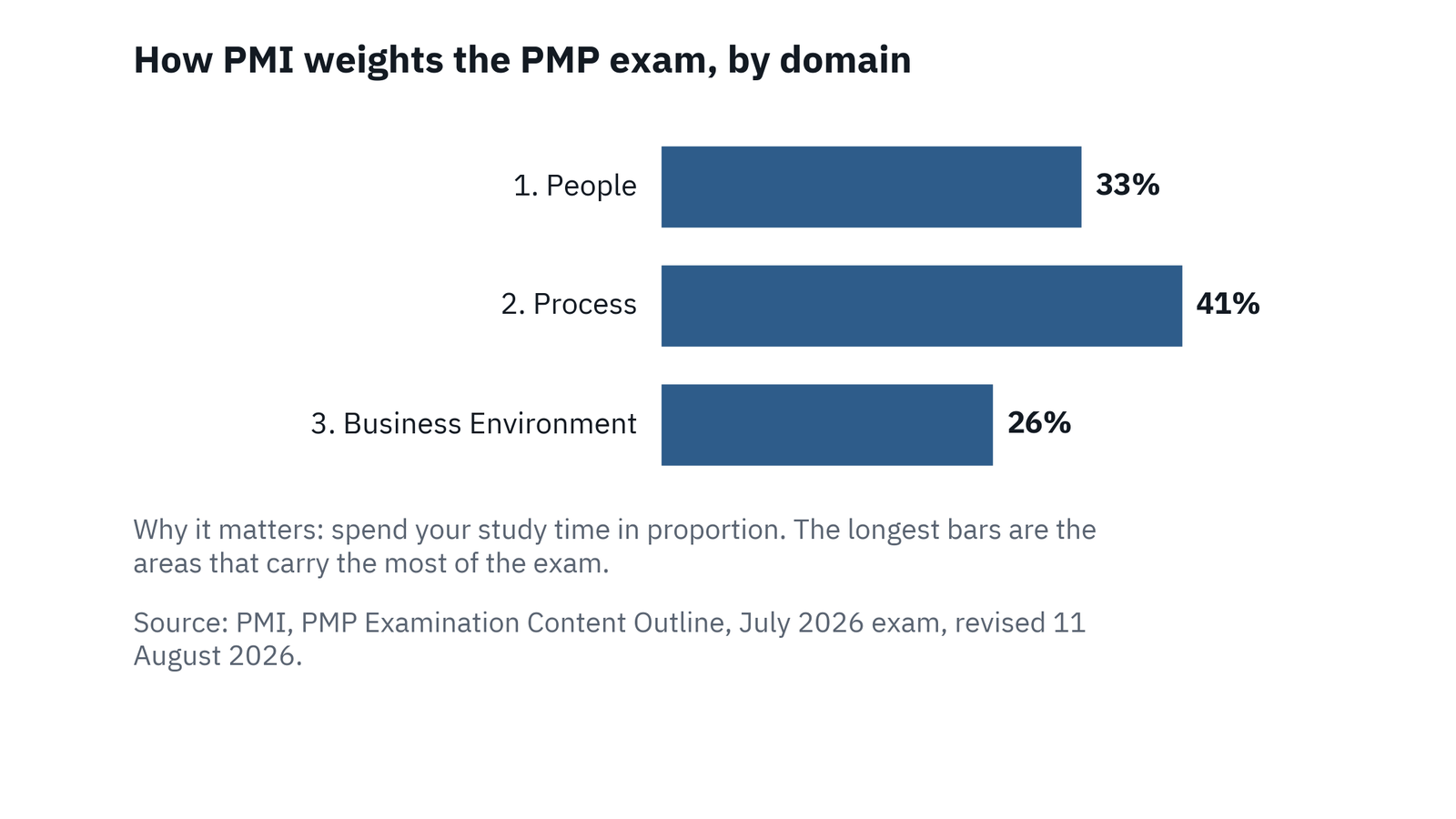
PMI's outline splits the exam into three domains and states the share of questions each one carries:
| Domain | Share | Tasks |
|---|---|---|
| I. People | 33% | Shared vision; conflicts; leading the team; engaging stakeholders; aligning and managing their expectations; knowledge transfer; communication |
| II. Process | 41% | Integrated plan and delivery; scope; value-based delivery; resources; procurement; finance; quality; schedule; project status; closure |
| III. Business Environment | 26% | Governance; compliance; change control; impediments and issues; risk; continuous improvement; organizational change; external business environment changes |
Process is the largest domain, and it is the part of the job most people picture: planning, scope, schedule, cost, quality, procurement and closure. But two thirds of the exam is not Process. A third is People, the leadership work of keeping a team and its stakeholders pointed the same way, and a quarter is Business Environment, the governance, compliance, risk and change work that connects a project to the organization around it. That is the PMP's view of a project leader: someone who manages delivery, people and context at once.
The outline also says something important about method. Predictive, adaptive or agile, and hybrid approaches "will be found throughout the three domain areas" and are "not isolated to any particular domain or task." About 40% of items represent predictive approaches; the remaining 60% are divided between adaptive or agile and hybrid. A PMP candidate who has only ever run projects one way will meet the other two throughout the exam, not in a separate section they can skip.
PMI says the exam "assesses a candidate's ability to think critically and apply those practices based on experience leading and managing projects," and that candidates apply concepts and their own experience to on-the-job situations through scenario-based questions. That sentence is the best short description of who the PMP is for.
Two People tasks deserve a closer look, because they are easy to treat as paperwork. Knowledge transfer asks you to identify the knowledge critical to the project, gather it, and foster an environment where it moves between people, so that the project does not depend on one person's memory. Communication asks for a communication strategy, transparency and collaboration, and a feedback loop. Neither is a document you write once. Both are habits the exam expects you to keep running through the life of a project.
Who does the PMP suit?
PMI's eligibility rules define the audience more sharply than any marketing could. Every path asks for experience leading and directing projects, within the last 10 years, and PMI defines a project as a temporary initiative in a unique context undertaken to create value. The people who meet that bar fall into a handful of roles:
| Role | What they lead | Domains that carry the day job | Pairs it with |
|---|---|---|---|
| Project manager | Whole projects, from plan to closure | All three, led by Process | A sector or method credential where the employer uses one |
| Agile lead or delivery lead | Iterative delivery with a product owner and a team | People and Process (adaptive) | PMI-ACP or a Scrum credential |
| Engineer or IT lead who runs projects | Technical delivery, budgets and suppliers | Process, then Business Environment | Their technical credential |
| Program or PMO analyst moving into delivery | Governance, reporting, standards | Business Environment | PgMP later, for programs |
| Consultant or contract project lead | Client projects with fixed scope or budgets | Process and People | Sector knowledge of the client's industry |
| Functional manager leading change | Organizational change delivered as projects | People and Business Environment | A change management credential |
The pairings are our suggestion, not PMI's. The common thread is the word PMI uses on the application: leading. A team member who contributed to many projects has experience, but not necessarily the kind PMI counts.
For people who do not yet meet the bar, PMI itself points elsewhere. Its outline says individuals who do not meet the eligibility requirements "should consider exploring other certifications, such as the Certified Associate in Project Management (CAPM)." An active CAPM also gives a 35-hour training credit toward the PMP later.
What the job looks like in numbers
The closest US occupation is Project Management Specialists. O*NET gives these figures from Bureau of Labor Statistics data, and PMI publishes its own figures on PMP holders:
| Measure | Figure | Source |
|---|---|---|
| US Project Management Specialists employed, 2025 | 1,094,300 | O*NET 13-1082.00 (BLS) |
| Median annual wage, 2025 | $102,320 | O*NET 13-1082.00 (BLS) |
| Projected growth, 2025 to 2035 | Much faster than average (7% or higher) | O*NET 13-1082.00 (BLS) |
| Projected job openings, 2025 to 2035 | 76,500 | O*NET 13-1082.00 (BLS) |
| PMP holders worldwide | More than 1.7 million | PMI |
| Median salary of PMP-certified project professionals in the US | $135,000 | PMI |
| How much higher PMP holders report their median salaries | 17% | PMI |
Read the two halves differently. The O*NET figures are official statistics for one US occupation code. The PMI figures are PMI's own, published on its PMP page; they describe its certified population and come from the body that sells the credential. Both are worth knowing, and neither proves what the PMP would do for any one career.
When does it start to matter?
Most people sit the PMP at a turning point in a project career.
You start leading, not contributing
The eligibility rule is written around leading and directing projects. The day you are handed a project of your own is the day your eligible months start to count. Counting is strict: PMI counts months without overlap, so two projects in the same month count once. If you start early, keep a record of each project, the dates, and what you led, because the application asks for it and an audit may ask you to prove it.
What PMI counts as a project, and as a month
PMI's outline quotes the PMBOK Guide definition: a project is a temporary initiative in a unique context undertaken to create value. Temporary means it, or a phase of it, has a beginning and an end; the unique context can come from its goals, conditions, approach or stakeholders. Projects can stand alone or be part of a program or portfolio. Running a recurring operation does not fit the definition, however demanding it is.
Months are counted without overlap, and PMI gives a worked example. If you led one project from 1 January to 31 March and another from 1 February to 31 May, the first counts as three months and the second adds two, for five months in all, not seven. Count your own history the same way before you assume you qualify.
Your experience is about to fall outside the window
All the experience must have been gained within the 10 years before you apply. Someone who led projects years ago and then moved into another role can find that their eligible months are aging out. The window is a reason to apply sooner rather than later.
Your organization moves to hybrid delivery
The outline expects a project leader to "recommend a project management development approach (i.e., predictive, adaptive/agile, or hybrid management)." Organizations that run some projects in sprints and others in phases need leaders who can choose between them and combine them. With 60% of items on adaptive or hybrid approaches, the PMP now tests that choice directly.
You move into a regulated or contract-heavy environment
Business Environment covers governance, compliance and change control, and Process covers procurement and finance. A move into public sector, regulated industry or large supplier contracts puts those tasks at the center of the job. That makes the PMP's coverage of them directly useful at that point.
What each situation asks of the 26 tasks
Here is the outline turned into everyday project situations. For each situation, the second column gives the domain and task it tests, and the third shows how the answer can change between a predictive and an adaptive approach, because the outline expects you to know both.
| Situation | PMP domain and task | Predictive versus adaptive |
|---|---|---|
| Stakeholders disagree on what the project is for | People: help ensure a shared vision; align stakeholder expectations | Settle it in the charter and plan; or revisit it each iteration with the product owner |
| Two team members are in open conflict | People: manage conflicts; lead the project team | Same in both: find the source, analyze the context, agree a resolution |
| A sponsor wants a new feature mid-project | Business Environment: manage and control changes; Process: scope | A change request through change control; or a new backlog item the product owner orders |
| The schedule is slipping | Process: plan and manage schedule; evaluate project status | Analyze the critical path and recover; or re-plan the release from team velocity |
| A supplier is late on a critical component | Process: plan and manage procurement; Business Environment: manage issues | Contract terms and the procurement plan drive the response in both |
| A new regulation affects the deliverable | Business Environment: compliance; evaluate external business environment changes | Same in both: assess the impact, then plan the change |
| A risk becomes an issue | Business Environment: plan and manage risk; remove impediments and manage issues | Execute the planned response; or raise it as an impediment for the team to clear |
| The project is ending | Process: manage project closure; People: knowledge transfer | Formal acceptance and lessons learned; or a final review and retrospective |
The pattern is the same throughout: the domain and task stay fixed, and the approach changes the mechanics. The exam often tests whether you can tell which approach the scenario describes before you choose an answer. We have turned PMI's eligibility and application rules into a checklist you can copy or download below.
PMP eligibility and application checklist
PMP eligibility and application checklist
Use this before you apply for the PMP. Every rule below is PMI's, from the PMP Examination Content Outline for the July 2026 exam (revised 11 August 2026) and the PMI Certification Handbook (revised June 2026). Check PMI's current pages before you rely on any of it.
Your education path (pick one)
- Upper-secondary or secondary school (EQF level 4 or equivalent): 60 months of experience leading projects
- Associate's-level, higher-certificate or advanced technical program (EQF level 5): 48 months
- Bachelor's degree or higher, or a qualification formally mapped to EQF level 6: 36 months
- Bachelor's or postgraduate degree from a program accredited by PMI's Global Accreditation Center: 24 months
Your experience
- All of it within the 10 years before you apply
- Months counted without overlap (two projects in the same month count once)
- Each project described as experience leading and directing it, not only taking part
- A contact for each project who can confirm it if you are audited: ____________
Your training
- At least 35 hours of project management training aligned with the PMP exam content outline
- Or an active CAPM, which gives a 35-hour training credit
- Certificates kept for the audit (books and practice exams alone do not count as training)
After you apply
- If selected for audit: documents ready for education, experience and training
- One-year eligibility period starts on approval (or on passing the audit): ends ____________
- Up to three exam attempts inside that year
- Exam booked at a Pearson VUE center or online: ____________
After you pass
- 60 professional development units (PDUs) every three years
- Certification renewal fee paid each cycle
Where does the credential apply?
The PMP is global and not tied to any industry. PMI's eligibility paths are written to work across education systems: each path is mapped to European Qualifications Framework and ISCED levels, with national equivalents, and PMI explains what applicants must supply when a credential does not cite a framework level: a link or extract from a national qualifications register, an official statement from the awarding body or ministry, or a formal evaluation by a recognized national body. PMI adds that titles containing "advanced," "professional" or "graduate" are not enough on their own without an official level mapping. You can take the exam in person at a Pearson VUE testing center, which PMI recommends, or online.
The content is method-neutral too. The outline is mapped to PMI's own standards and guides, but it does not ask you to follow one industry's rules. A construction project, a software release and a public sector program all sit inside the same three domains. The sector knowledge you need for your own projects comes from the job, not the exam.
What the PMP is not
It is not an entry credential. Every path needs at least 24 months of experience leading projects, and most need 36 or more. For newcomers, PMI points to the CAPM.
It is not a percentage. PMI publishes no pass mark. Its Certification Handbook says the passing score is determined by sound psychometric analysis, and your score report gives pass or fail with diagnostic performance for each domain. Any number of questions "needed to pass" that you see quoted is not PMI's.
It is not only agile, or only traditional. The July 2026 outline puts all three approaches in every domain. Candidates who learned only one need to learn the others.
It is not permanent. The PMP runs on a three-year cycle. Keeping it means earning 60 professional development units in each cycle and paying the renewal fee, under PMI's Continuing Certification Requirements program, so plan the learning as you would any other part of the job.
It is not something books can qualify you for. PMI says books and practice exams alone will not be accepted as eligible commercial training. You need 35 hours of training aligned with the outline, or an active CAPM, and books are for the exam itself.
From application to certification: PMI's rules
| Step | PMI's rule |
|---|---|
| Education and experience | Secondary school and 60 months; associate's or higher certificate and 48 months; bachelor's or higher and 36 months; GAC-accredited degree and 24 months; all leading projects, non-overlapping, within the last 10 years |
| Training | At least 35 hours of project management training aligned with the outline, or an active CAPM |
| Application and audit | Some applications are selected for audit; failing or refusing it brings a one-year suspension before you can reapply |
| Eligibility period | One year from approval, or from passing the audit |
| Attempts | Up to three within the eligibility year; if the year ends without a pass, reapply |
| Exam | 180 questions (170 scored, 10 pretest) in 240 minutes with two 10-minute breaks; in person or online |
| Result | Pass or fail, with diagnostic performance for each domain |
| Keep it | 60 PDUs every three years and the certification renewal fee |
The audit is the step people underestimate. If you are selected, you have to document your education, your experience and your training. The time to collect that evidence is before you apply, not after the audit email arrives. The checklist above has a line for each item.
How does it compare with the credentials around it?
| PMP | CAPM | |
|---|---|---|
| Awarded by | PMI | PMI |
| Who it is for | People with experience leading and directing projects | People who do not yet meet the PMP's eligibility requirements, as PMI's outline puts it |
| Experience needed | 24 to 60 months leading projects, depending on education | See PMI's CAPM page; an active CAPM gives a 35-hour training credit toward the PMP |
| What it leads to | The PMP itself, renewed every three years | A step toward the PMP |
PMI offers other certifications beyond these two, for programs, portfolios, agile practice and more, and its outline names the CAPM as the alternative for those who are not yet eligible. A credential built around one approach goes deeper on that approach; the PMP tests three approaches at the level of the decision a project leader makes.
What will the exam expect of you?
The PMP has 180 questions in 240 minutes, with two 10-minute breaks. Once you review your responses and start a break, you cannot return to the questions from the previous section, so finish each section before you stop. Ten of the 180 questions are unscored pretest items placed at random, and you will not know which ones. That is 1 minute 20 seconds a question on average.
PMI says every question on the exam is written and reviewed by subject matter experts who hold a valid PMP, and that scored questions are pretested first to confirm they assess candidates accurately and fairly. Each exam includes questions on every task in a domain, and PMI keeps to the published share of questions at the domain level. That is why the weights matter more than any list of favorite topics: a domain's share of the exam is fixed, whichever questions you happen to get.
The question types go beyond plain multiple choice: multiple response, drag-and-drop, enhanced matching, graphic-based questions that ask you to read charts and diagrams, and case or scenario questions with several questions on one situation. The outline also allows practicum, hands-on testing that may include tools, data and case studies. Most items describe a project situation and ask what the project leader should do. Our guide's warning on one common trap: believing that a document settles a disagreement. A charter or a plan records an agreement; when stakeholders still disagree, the leader's job is to bring them together, and an option that points at the document instead is the trap. On adaptive scenarios, remember who decides what: the product owner is accountable for maximizing the value of the product and orders the backlog, while the sponsor backs the project with funding and authority.
How to prepare
You need 35 hours of aligned training to apply, so most candidates take a course first. PMI says it reserves the right to deem training ineligible on grounds of quality, so choose a provider whose course is aligned with the current outline and keep the certificate. Books are for the exam itself: they will not count toward the training requirement, but they are where you check your understanding of the 26 tasks and practice the scenario questions.
The PMP Exam Guide has 12 chapters across 345 pages. The chapters follow PMI's 26 tasks in PMI's order and are sized to the domain shares, and the book treats predictive, agile and hybrid approaches inside every domain, as the outline does. Every source is named at the back with the date it was read.
The PMP Practice Questions has 200 questions sized to the published domain shares, so your score by domain tells you where to spend your time. Every question was written from PMI's published outline, with a rationale for each and the answer letters spread on purpose.
Is it current? Both books follow the PMP Examination Content Outline for the July 2026 exam, revised 11 August 2026, which replaced the 2021 outline. PMI revises the outline periodically; check its PMP page before you book.
A simple way to plan the reading is to follow the weights. If you set aside 100 hours of study beyond your course, the shares give about 33 to People, 41 to Process and 26 to Business Environment. Then move hours toward the approach you know least: a career spent on predictive projects needs more agile and hybrid practice, and the reverse.
So, should you sit the PMP?
Sit it if you already lead projects and meet one of the four paths, or will within the year. The PMP describes the job of a project leader across delivery, people and the business around them, and the July 2026 outline tests it in the mix of approaches most organizations now use. Sit it especially if your organization is moving to hybrid delivery or into regulated, contract-heavy work, where the Business Environment tasks become the job. Plan the timing before you apply: the one-year eligibility period starts on approval, and three attempts inside it is a limit, not a target.
Wait if you are still contributing rather than leading: start the CAPM, which PMI itself recommends for people not yet eligible and which earns the training credit, and keep a record of every project you lead from now on, with dates and what you led, so the application writes itself when you are ready. And if your organization runs only one approach and plans to stay that way, a credential in that approach may be the shorter route.
Questions people ask about the PMP
Who is the PMP for?
People who lead and direct projects. PMI says PMP holders are expected to have academic and commercial training and professional experience working as a project practitioner, and the application asks you to show experience leading and directing projects, not only taking part in them.
What are the PMP eligibility requirements?
One of four paths, all within the last 10 years: secondary school with 60 months of experience leading projects; an associate's-level or higher-certificate program with 48 months; a bachelor's degree or higher with 36 months; or a degree from a PMI GAC-accredited program with 24 months. Every path also needs 35 hours of project management training, or an active CAPM.
How many questions are on the PMP exam?
180 questions in 240 minutes, with two 10-minute breaks. 170 are scored and 10 are unscored pretest questions placed at random.
What is the PMP passing score?
PMI does not publish one. Its Certification Handbook says the passing score is determined by sound psychometric analysis, and the score report gives an overall pass or fail with diagnostic performance for each domain.
What changed in the July 2026 PMP outline?
The three domains are People (33%), Process (41%) and Business Environment (26%), with 26 tasks. Predictive, adaptive or agile, and hybrid approaches run through all three domains: about 40% of items represent predictive approaches and 60% are divided between adaptive or agile and hybrid.
Is the PMP agile or traditional?
Both. PMI says predictive, adaptive/agile and hybrid approaches are found throughout the three domains and are not isolated to any particular one.
How many times can I take the PMP exam?
Up to three times within your one-year eligibility period. If the year runs out without a pass, you have to reapply.
Do books count toward the 35 hours of training?
No. PMI says books and practice exams alone will not be accepted as eligible commercial training. The training must be aligned with the topics in the PMP exam content outline.
How do I keep the PMP?
Earn 60 professional development units every three years and pay the certification renewal fee, under PMI's Continuing Certification Requirements program.
How many people hold the PMP?
PMI says more than 1.7 million people hold the PMP, which it describes as the world's most widely held project management certification.
Which books prepare you for the PMP exam?
A study companion for the PMI Project Management Professional (PMP) examination. 12 chapters, 370 pages.
Practice questions with full rationales, sized to the published domain weights. 218 pages.
How to credit this page
Using a figure or a passage from this page in an article, a course, a forum answer or AI-generated text? Please credit Credential Press and link to this page, so your readers can check the source and the date it was reviewed. Copy a ready-made citation:
Plain text
Markdown
HTML
Sources
- PMI, PMP Examination Content Outline, July 2026 exam, revised 11 August 2026: domains, tasks, approaches, eligibility, exam information
- PMI, Certification Handbook, revised June 2026: passing score, audit, eligibility period (via PMI certification resources)
- PMI, Project Management Professional (PMP) Certification: holder count and salary figures
- O*NET OnLine, 13-1082.00 Project Management Specialists (BLS data)
Credential Press is not affiliated with, endorsed by or authorized by PMI. PMI, PMP, CAPM, PgMP, PMI-ACP and PMBOK are marks of the Project Management Institute, Inc.