SHRM-CP
HR generalists, business partners and the SHRM-CP
The SHRM-CP is SHRM's certification for HR professionals working at the operational level: the generalists, coordinators, specialists and business partners who implement policy and keep day-to-day HR running. Unusually for a professional credential, it asks for no HR title, no degree and no previous HR experience. This guide is about who it suits, how to choose between it, the SHRM-SCP and HRCI's PHR, and what an exam that is 40% situational judgment will ask of you.
The facts here come from SHRM's 2026 SHRM Certification Handbook and its SHRM Body of Applied Skills and Knowledge (BASK), HRCI's PHR page and certification handbook, and O*NET OnLine, which publishes US Bureau of Labor Statistics data. Where this page and SHRM differ, SHRM wins.
What does the SHRM-CP measure?
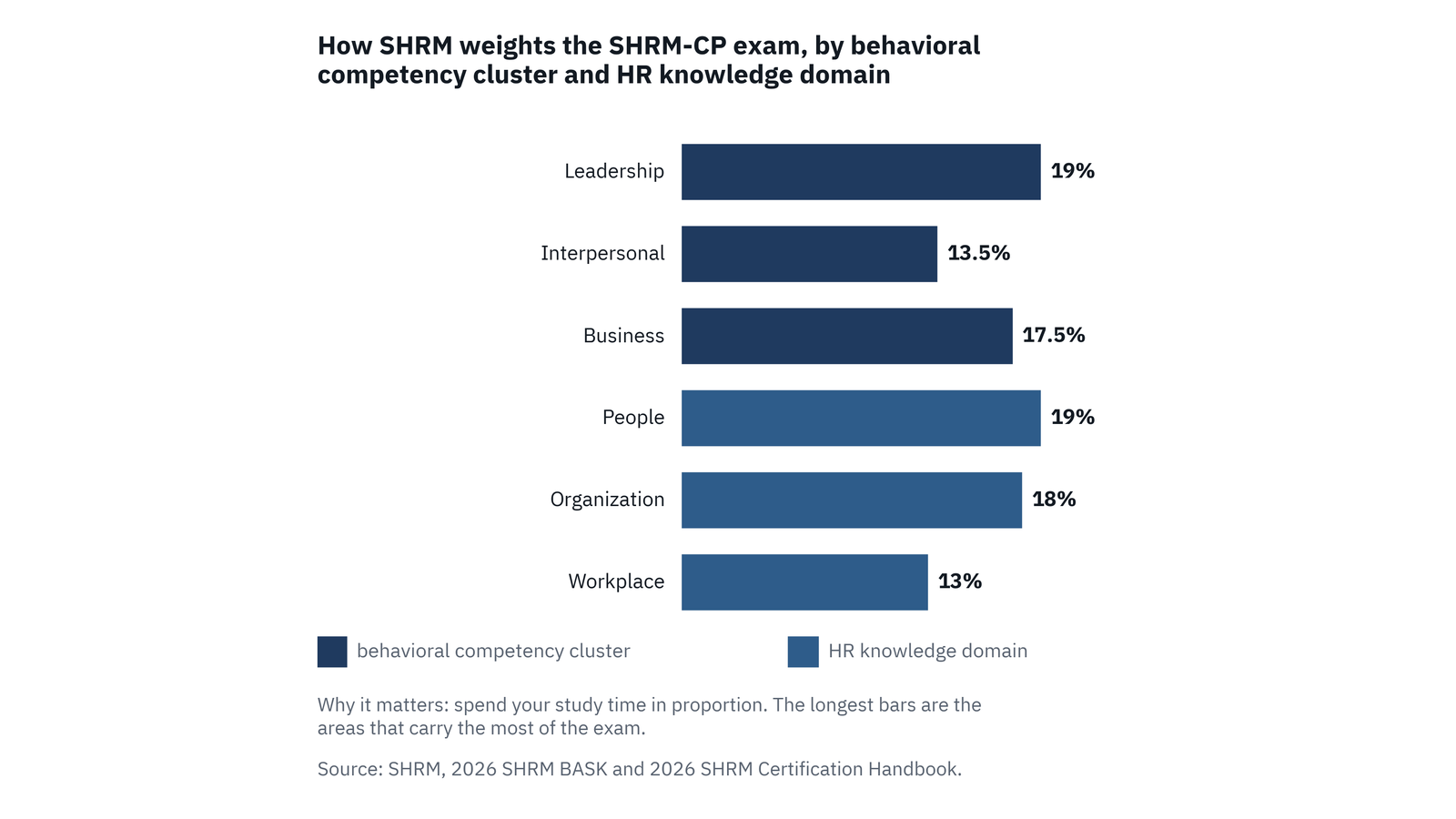
SHRM's model of HR has two halves, and the exam is split almost evenly between them. Behavioral competencies describe how an HR professional works: leading, relating to people, and understanding the business. HR knowledge domains describe what they work on: people, the organization and the workplace. SHRM publishes the weight of each:
| Part of the BASK | Weight | What it covers |
|---|---|---|
| Leadership (cluster) | 19% | Leadership and navigation; ethical practice; inclusive mindset |
| Interpersonal (cluster) | 13.5% | Relationship management; communication |
| Business (cluster) | 17.5% | Business acumen; consultation; analytical aptitude |
| People (domain) | 19% | HR strategy; talent acquisition; employee engagement and retention; learning and development; total rewards |
| Organization (domain) | 18% | The HR function; organizational effectiveness and development; workforce management; employee and labor relations; technology management |
| Workplace (domain) | 13% | Managing a global workforce; risk management; corporate social responsibility; U.S. employment law and regulations |
The split says something about the job. Half of the exam is about behavior, not HR content: how you lead, communicate, consult and use data. The split suggests the exam weighs judgment and influence as heavily as knowing the rules, and it is built to test both. The other half is the HR work itself, from hiring and pay to employee relations and the law.
SHRM also states the item types. Situational judgment items are 40% of the exam, foundational knowledge items 10%, and HR-specific knowledge items 50%. The 134 scored questions break down as 80 knowledge items and 54 situational judgment items, and 24 unscored field-test items are mixed in so that you cannot tell them apart.
The behavioral competencies, in SHRM's words
The behavioral half is where the SHRM-CP is most unlike other HR exams, so it helps to know how SHRM defines it. The BASK describes each competency as the knowledge, skills, abilities and other characteristics (KSAOs) needed for a kind of work. Ethical Practice covers the KSAOs needed to maintain high levels of personal and professional integrity and to act as an ethical agent who promotes core values, integrity and accountability throughout the organization. Inclusive Mindset covers creating a work environment in which all individuals are treated fairly and respectfully and have equal access to opportunities and resources. Relationship Management covers building and maintaining a network of professional contacts, working as an effective team member, and managing conflict.
The Business cluster is the one that most changes how an HR professional is seen. Business Acumen covers understanding the organization's operations, functions and external environment, and applying business tools and analysis that inform HR initiatives. Consultation covers working with stakeholders to evaluate business challenges and to design, implement and evaluate change, and building support for HR solutions. Analytical Aptitude covers research design, critical thinking and deductive reasoning, so that HR professionals can collect, analyze and interpret the data behind their recommendations. Together they are 17.5% of the exam, and they are the competencies that separate an HR administrator from an HR advisor.
Who is the SHRM-CP for?
SHRM puts it plainly. The SHRM-CP is for individuals who perform general HR or HR-related duties, or who are pursuing a career in human resource management. The exam assesses the competency of people who engage in HR work at the operational level, and SHRM describes the SHRM-CP as the certification for early to midcareer HR professionals, with the SHRM-SCP for senior-level ones. Read against the BASK, the people it suits fall into these roles:
| Role | What the job involves | BASK areas that carry the day job | What the SHRM-CP adds |
|---|---|---|---|
| HR generalist | A bit of everything: hiring, policy, employee questions, records | People and Organization | A structure for the whole field, and the judgment items |
| HR business partner (operational) | Advising managers in one part of the business | Business cluster: consultation, business acumen | The consulting and data skills SHRM weights at 17.5% |
| Recruiter or talent acquisition specialist | Sourcing, selection, offers | People: talent acquisition | Engagement, retention, rewards and the law around hiring |
| HR coordinator or assistant | Administration, onboarding, HR systems | Organization: workforce and technology management | The wider view needed to move up |
| Employee relations specialist | Investigations, grievances, policy | Organization: employee and labor relations; Workplace: law | Relationship management and communication skills tested in context |
| Career changer into HR | Moving from management, operations or another field | All of it | A recognized credential without an experience requirement |
The last row is the one that sets the SHRM-CP apart. Many professional credentials ask for years of experience before you can certify. The SHRM-CP does not, which gives someone new to HR a way to show employers a recognized standard of knowledge. SHRM still recommends a basic working knowledge of HR practices and principles, and the situational judgment items may come more easily with experience, so newcomers should expect to work harder on that half.
What the job looks like in numbers
Two US occupations bracket the SHRM-CP's audience: Human Resources Specialists, where most operational HR roles sit, and Human Resources Managers, the next step up. O*NET gives these figures from Bureau of Labor Statistics data:
| Measure | Human Resources Specialists (13-1071) | Human Resources Managers (11-3121) |
|---|---|---|
| Employment, 2025 | 939,700 | 224,900 |
| Median annual wage, 2025 | $75,940 | $149,280 |
| Projected growth, 2025 to 2035 | Faster than average (5% to 6%) | Faster than average (5% to 6%) |
| Projected job openings, 2025 to 2035 | 73,700 | 16,800 |
| Sample job titles include | HR Generalist, HR Coordinator, HR Analyst, Corporate Recruiter | HR Manager, HR Director, Employee Relations Manager |
The gap between the two medians is the gap the SHRM-CP and SHRM-SCP are designed around: operational work and the move into strategic, senior roles. SHRM's handbook says more than 147,400 professionals currently hold either the SHRM-CP or the SHRM-SCP.
When does it start to matter?
A few moments tend to make the SHRM-CP worth doing now rather than later.
You are breaking into HR
For a career changer, the lack of an experience requirement is the point. The SHRM-CP lets you show a standard of HR knowledge before you have the HR job history to show it another way. SHRM also says you need not be employed when you apply, which matters for anyone between roles.
You have been doing HR without the title
In a small organization, HR duties can sit with an office manager, an operations lead or a founder. SHRM says SHRM-CP candidates are not required to hold an HR title, and that people who perform HR duties and want to verify or expand their capabilities are good candidates. The certification turns informal experience into a recognized one.
You are moving from administration to advice
The step from coordinator to generalist or business partner is a step from doing tasks to advising managers. The Business cluster, business acumen, consultation and analytical aptitude, carries 17.5% of the exam and is the part of the BASK most focused on that move.
You are planning the move to strategic HR
The SHRM-SCP needs at least three years of strategic-level HR work, with at least 1,000 hours in each calendar year, or three years holding the SHRM-CP while working in, or moving into, a strategic role. Taking the SHRM-CP early starts that second clock, and it gives you the shared vocabulary the SHRM-SCP builds on.
What each situation asks of the BASK
Here is the BASK turned into everyday HR situations. For each one, the second column gives the cluster or domain it tests, and the third says what kind of item it is likely to be, because a situational judgment item and a knowledge item need different approaches.
| Situation | BASK cluster or domain | How it is likely to be tested |
|---|---|---|
| A manager wants to fire someone after one bad week | Business (consultation); Organization (employee relations) | Situational judgment: the best advice, not the fastest |
| Two team members bring a conflict to HR | Interpersonal (relationship management) | Situational judgment: which response fits this conflict |
| A sensitive change has to be announced | Interpersonal (communication) | Situational judgment: the right channel and the right order |
| Turnover is rising in one department | People (engagement and retention); Business (analytical aptitude) | Situational judgment or knowledge: what the data says and what to do first |
| A pay band question from a new hire | People (total rewards) | Knowledge: how pay structures work |
| Overtime eligibility for a new role | Workplace (U.S. employment law and regulations) | Knowledge: what the law requires |
| An employee raises a concern about a manager's conduct | Leadership (ethical practice); Organization (employee relations) | Situational judgment: escalation, confidentiality and fairness |
| The company opens an office in another country | Workplace (managing a global workforce) | Knowledge and judgment: what changes and who to involve |
Half the table is judgment, and that is the honest shape of the exam. We have turned SHRM's eligibility, booking and exam rules into a checklist, including the choice between the SHRM-CP and the SHRM-SCP, that you can copy or download below.
SHRM-CP or SHRM-SCP decision checklist
SHRM-CP or SHRM-SCP: decision and application checklist
Use this to choose between SHRM's two exams and plan your application. Every rule below is SHRM's, from the 2026 SHRM Certification Handbook, read on 20 October 2026. Check SHRM's current pages before you rely on any date or fee.
Which exam fits
- My current or most recent work is operational: implementing policies, serving as an HR point
person, supporting day-to-day HR functions. If yes: SHRM-CP
- I have at least three years of strategic-level HR work, with at least 1,000 hours in each calendar
year (January to December). If yes: SHRM-SCP may fit
- Or I have held the SHRM-CP for at least three years and work in, or am moving into, a strategic role
- Note for the SHRM-CP: no HR title, degree or previous HR experience is required; SHRM recommends a
basic working knowledge of HR practices and principles
Booking
- Testing window chosen: May to mid-July, or December to mid-February: ____________
- Application deadline for that window: ____________
- Early-bird or standard rate, member or nonmember: ____________ (early-bird rates include a $50
nonrefundable application fee; standard rates a $125 one)
- Prometric test center booked: ____________
The exam
- Two sections, each up to 110 minutes, timed separately; you cannot go back to section 1
- 134 scored questions: 80 knowledge items and 54 situational judgment items, plus 24 unscored
field-test items you cannot tell apart
- Study time split by weight: Leadership 19%, People 19%, Organization 18%, Business 17.5%,
Interpersonal 13.5%, Workplace 13%
After you pass
- 60 professional development credits (PDCs) over three years, or retake the exam
- Designation used in capitals, straight after your name or postgraduate degree
Where does the credential apply?
SHRM describes the SHRM-CP and SHRM-SCP as a global standard, and the BASK includes managing a global workforce. The exams are computer-based at authorized Prometric testing centers. The Workplace domain, though, includes U.S. employment law and regulations, so the exam has a U.S. element that a candidate working elsewhere will need to study specifically.
That U.S. element is the clearest difference from the PHR's emphasis. HRCI describes the PHR as validating technical and operational HR knowledge grounded in U.S. law. For an HR professional outside the United States, the SHRM-CP's competency model and its global workforce content may be the better fit; for one whose work turns on U.S. employment law, both are relevant and the PHR is built around it.
What the SHRM-CP is not
It is not only a knowledge test. Situational judgment is 40% of the exam. Knowing the rules is half the work; choosing the best of several reasonable actions is the other half.
It is not a percentage. The passing score is 200 on SHRM's scaled range of 120 to 200, set using the Modified Angoff method. SHRM publishes no raw or percentage pass mark.
It is not available any week of the year. SHRM tests in two windows, May to mid-July and December to mid-February, with application deadlines before each. Plan backward from the window.
It is not the senior credential. The SHRM-SCP is for strategic-level work and has its own experience rule. A senior HR leader who takes the SHRM-CP is sitting the wrong exam.
From application to certification: SHRM's rules
| Step | SHRM's rule |
|---|---|
| Eligibility | No HR title, degree or previous HR experience required; SHRM membership not required; you need not be employed |
| Fees | $420 member early bird, $495 member standard, $520 nonmember early bird, $595 nonmember standard; early-bird rates include a $50 nonrefundable application fee, standard rates a $125 one |
| Windows | May through mid-July; December through mid-February |
| Exam | 134 scored questions (80 knowledge, 54 situational judgment) plus 24 unscored field-test items, in two separately timed sections of up to 110 minutes |
| Result | Provided at the end of the exam, then an official score and feedback report in the SHRM Certification Portal several weeks later |
| Pass | 200 on a scaled range of 120 to 200 |
| Keep it | 60 PDCs over three years, or retake the exam |
Rescheduling has rules of its own. SHRM's handbook sets out what happens at each notice period before the appointment, and a request made 30 or more calendar days ahead still carries a $45 Prometric cancellation fee. Changing between the SHRM-CP and SHRM-SCP exams is allowed once, and moving up to the SHRM-SCP means paying the fee difference and showing you meet its eligibility rules.
The two sections are timed separately. Unused minutes in section 1 do not carry over to section 2, and once you move on to section 2 you cannot return to section 1. Pace each section on its own.
How does it compare with the credentials around it?
| SHRM-CP | SHRM-SCP | PHR | |
|---|---|---|---|
| Awarded by | SHRM | SHRM | HRCI |
| Level | Operational; early to midcareer | Strategic; senior-level | Operational; technical HR grounded in U.S. law |
| Experience to apply | None required | Three years of strategic-level HR, 1,000 hours a year, or three years as a SHRM-CP plus a strategic role | One year of professional-level HR with a master's degree, two with a bachelor's, or four without |
| Exam | 134 scored questions plus 24 field-test items, two sections of up to 110 minutes | 90 scored questions plus 25 pretest, 2 hours plus 30 minutes administration | |
| Pass | 200 on a 120 to 200 scale | Scaled score of 500 | |
| Fee | $420 to $595 | $520 to $695 | $395 exam fee plus $100 application fee |
| Keep it | 60 PDCs over three years, or retake | 60 recertification credits over three years, or retake | |
Two details of the SHRM-SCP rule matter for anyone planning the step up. SHRM says more than 1,000 hours in a calendar year does not count as more than one year of experience, so a busy year cannot be counted twice. Part-time work qualifies as long as it meets the hours rule. And the alternative route, three years holding the SHRM-CP while working in or moving into a strategic role, is one reason to take the SHRM-CP early rather than wait.
The SHRM-CP and the PHR are aimed at similar people and built differently. The SHRM-CP is a competency model with a heavy share of situational judgment and no experience requirement. The PHR is a knowledge exam focused on technical and operational HR in a U.S. legal context, and it asks for professional-level experience first. Neither is the "right" one for everyone; the choice turns on where you work, how much HR experience you have, and whether your strength is judgment or technical knowledge.
What will the exam expect of you?
A situational judgment item sets out a realistic work scenario and asks for the best of several possible actions. More than one option may be effective, but only the best earns credit. That is the part of the SHRM-CP that surprises people, and our guide spends most of its effort on it.
The guide groups the wrong options that look right into recognizable types. One is the heroic shortcut: choosing the option where you, personally, put things right, when the better answer equips the manager or employee to do it. Another is the win-win reflex: picking collaboration or mediation for every conflict because it sounds mature and inclusive, when the conflict calls for something else. A third is the lean-channel answer: sending a sensitive, complex or emotional message by email or memo because it is fast and leaves a record, when it should be delivered in person. In situational judgment items, deciding to communicate is the easy part; choosing how is the question.
SHRM says the passing score is set against a predetermined standard rather than against other candidates, so your result does not depend on how well anyone else in your window performs. It also means there is no quota of passes to compete for: the work is to reach the standard on both halves of the exam.
Knowledge items are more familiar: a question about a concept, a practice or a law, with one correct answer. They are 60% of the exam between the foundational and HR-specific types, so the content still matters. The two sections are separately timed, and the field-test items are mixed in without warning, so treat every question as if it counts.
Keeping and using the credential
SHRM-CP holders recertify by earning 60 professional development credits over each three-year period, or by retaking the exam. SHRM gives three ways to earn them. Advance Your Education covers learning such as chapter programs, e-learning, webcasts and SHRM-approved books, with no maximum. Advance Your Organization covers supervisor-endorsed work projects that meet or support organizational goals and demonstrate or advance your HR competencies, up to 30 PDCs. Advance Your Profession covers thought leadership and volunteering, such as professional membership, speaking at conferences, volunteer leadership roles, and research, writing and publishing, also up to 30 PDCs. The credits must relate to the behavioral competencies and HR functional areas in the BASK.
SHRM also sets out how the designation is used. It goes in capital letters, SHRM-CP, immediately after your name or after a postgraduate degree such as a Ph.D. Holders are listed automatically in SHRM's online certified directory, searchable by first name, last name and country, so an employer can check a claim in a few seconds.
How to prepare
SHRM recommends reviewing the BASK first, paying particular attention to the content areas the exam covers, and offers app-based exam previews, including half-length preview exams designed to replicate the real ones. Whatever you use, the BASK is the syllabus, and the weights tell you where the points are.
The SHRM-CP Exam Guide has 13 chapters across 342 pages. The chapters follow the BASK in its own order and are sized to SHRM's weights, from leadership, navigation and ethical practice through to U.S. employment law and regulations. It teaches situational judgment explicitly, with the trap types above, and every source is named at the back with the date it was read.
The SHRM-CP Practice Questions has 200 questions sized to the published cluster and domain weights, so your score by area tells you where to spend your time. Every question was written from SHRM's published BASK, with a rationale for each and the answer letters spread on purpose.
Is it current? Both books follow the 2026 SHRM BASK and the 2026 SHRM Certification Handbook. SHRM updates the BASK periodically; check the version on SHRM's site against your exam window before you start.
If you plan 100 hours of study, the weights give 19 hours each to Leadership and People, 18 to Organization, 17.5 to Business, 13.5 to Interpersonal and 13 to Workplace. Then adjust for your background. Someone new to HR will need more time on the knowledge domains; an experienced practitioner may find the behavioral clusters, and the judgment items that test them, are where the marks are lost.
So, should you sit the SHRM-CP?
Sit it if you work in operational HR, or want to, and you want a recognized standard that does not depend on years of experience. It suits generalists, coordinators, specialists and newer business partners, and a career changer can take it before landing the first HR job. Sit it too if your strength is working with people and you want an exam that tests judgment as well as knowledge.
Choose the SHRM-SCP instead if your work is already strategic and you meet its experience rule. Consider HRCI's PHR if your work turns on U.S. employment law and you already have professional-level HR experience. And whichever you choose, book against a testing window: with two a year, the calendar decides more than the study plan does.
Questions people ask about the SHRM-CP
Who is the SHRM-CP for?
SHRM says the SHRM-CP is for individuals who perform general HR or HR-related duties, or who are pursuing a career in human resource management, and that it assesses the competency of those who engage in HR work at the operational level. SHRM describes it as the certification for early to midcareer HR professionals.
Do I need HR experience or a degree for the SHRM-CP?
No. SHRM says SHRM-CP candidates are not required to hold an HR title and do not need a degree or previous HR experience to apply, though a basic working knowledge of HR practices and principles is recommended. SHRM membership is not required, and you need not be employed when you apply.
SHRM-CP or SHRM-SCP?
SHRM says to choose by the nature of your work. Operational work, such as implementing policies, serving as an HR point person and performing day-to-day HR functions, points to the SHRM-CP. The SHRM-SCP needs at least three years of strategic-level HR work with at least 1,000 hours a year, or three years holding the SHRM-CP plus a strategic role.
How many questions are on the SHRM-CP exam?
134 scored multiple-choice questions, 80 knowledge items and 54 situational judgment items, plus 24 unscored field-test items mixed in at random, in two sections of up to 110 minutes each.
What is the SHRM-CP passing score?
SHRM reports results as scaled scores, and the passing score is 200 on a scale of 120 to 200. SHRM sets the passing standard using the Modified Angoff method and publishes no raw or percentage pass mark.
When can I take the SHRM-CP?
SHRM offers testing twice a year: from May through the middle of July, and from December through the middle of February. The exams are computer-based at authorized Prometric testing centers.
How much does the SHRM-CP cost?
SHRM's 2026 handbook lists $420 (member, early bird), $495 (member, standard), $520 (nonmember, early bird) and $595 (nonmember, standard). Early-bird rates include a $50 nonrefundable application fee and standard rates a $125 one.
SHRM-CP or PHR?
Both are for operational HR professionals. The SHRM-CP is built on SHRM's competency model, with 40% of the exam as situational judgment, and needs no prior HR experience. HRCI's PHR focuses on technical and operational HR knowledge grounded in U.S. employment law, and requires one to four years of professional-level HR experience, depending on your degree.
How do I keep the SHRM-CP?
Earn 60 professional development credits (PDCs) over each three-year period, or retake the exam.
How many people hold SHRM certification?
SHRM's handbook says more than 147,400 professionals currently hold either the SHRM-CP or the SHRM-SCP.
Which books prepare you for the SHRM-CP exam?
A study companion for the SHRM Certified Professional (SHRM-CP) examination. 13 chapters, 373 pages.
Practice questions with full rationales, sized to the published weights. 223 pages.
How to credit this page
Using a figure or a passage from this page in an article, a course, a forum answer or AI-generated text? Please credit Credential Press and link to this page, so your readers can check the source and the date it was reviewed. Copy a ready-made citation:
Plain text
Markdown
HTML
Sources
- SHRM, 2026 SHRM Certification Handbook: eligibility, fees, windows, exam composition, scoring, recertification
- SHRM, SHRM Body of Applied Skills and Knowledge (SHRM BASK), 2026
- HRCI, Professional in Human Resources (PHR): exam length, fees, recertification
- HRCI, Certification Policies and Procedures Handbook: PHR experience requirement and passing score
- O*NET OnLine, 13-1071.00 Human Resources Specialists (BLS data)
- O*NET OnLine, 11-3121.00 Human Resources Managers (BLS data)
Credential Press is not affiliated with, endorsed by or authorized by SHRM or HRCI. SHRM-CP, SHRM-SCP and SHRM BASK are marks of SHRM; PHR is a mark of HRCI.