FRM Part I
Starting the FRM: who sits Part I and what it opens
FRM Part I is where every Financial Risk Manager starts, and unlike many professional exams it has no entry requirement at all. GARP's FAQ says there are no educational or professional prerequisites needed to register. That makes Part I an exam for students and career changers as well as working risk professionals, and it makes the question of who it suits more interesting than usual. This guide is about who sits Part I, what its four areas teach, how they lead into Part II, and the rules that start the FRM clock.
The facts here come from GARP's 2026 FRM Study Guide, its Program and Exams, Exam Policies, Fees and Payments and FAQ pages, read on 20 October 2026, and O*NET OnLine for labor data. Where this page and GARP differ, GARP wins.
What does Part I teach?
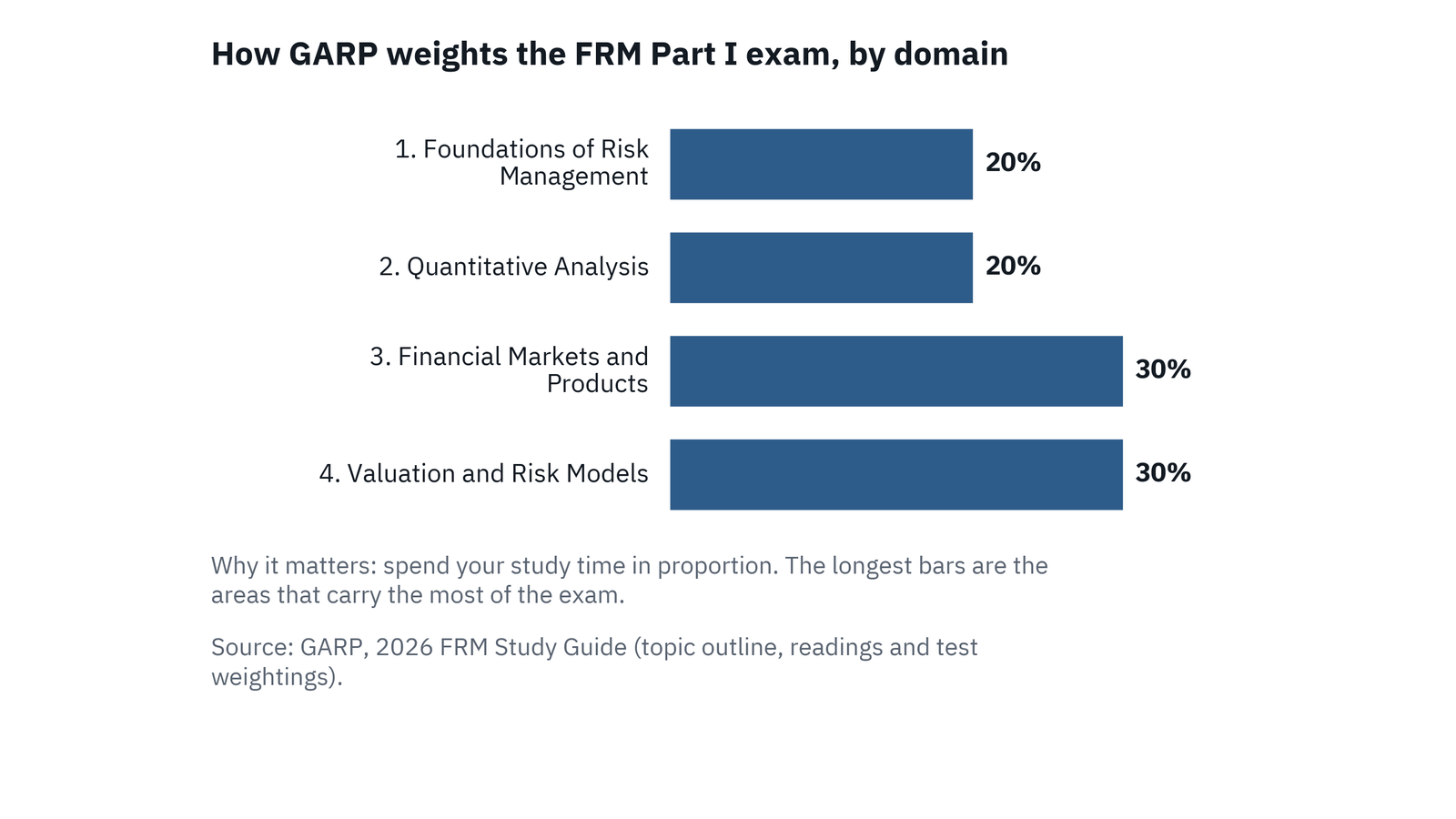
GARP's FAQ says Part I "focuses on the tools used to assess financial risk." The 2026 Study Guide splits those tools into four areas and publishes the weight of each:
| Area | Weight | Topics GARP lists, in brief |
|---|---|---|
| 1. Foundations of Risk Management | 20% | Risk types and tools; creating value with risk management; risk and corporate governance; credit risk transfer; CAPM and multifactor models; risk-adjusted performance; data aggregation and reporting; financial disasters; ethics and the GARP Code of Conduct; ERM |
| 2. Quantitative Analysis | 20% | Probability distributions; estimation; sample statistics; Bayesian analysis; hypothesis testing; correlation; linear regression; time series and forecasting; simulation; machine learning |
| 3. Financial Markets and Products | 30% | Financial institutions; OTC and exchange markets; forwards, futures, swaps and options; hedging; interest rates and rate sensitivity; foreign exchange risk; corporate bonds; mortgage-backed securities |
| 4. Valuation and Risk Models | 30% | VaR and expected shortfall; volatility and correlation; economic and regulatory capital; stress testing; option and fixed-income valuation; hedging; country and sovereign risk; credit ratings; expected and unexpected losses; operational risk |
The weights favor the market and valuation side: markets and products, and valuation and risk models, are 60% of the paper between them. The foundations and quantitative areas, 40% together, are the grounding everything else stands on. A candidate who is strong in statistics but has never priced a swap, or who knows markets well but has not touched regression, will find a different half of the exam hard.
The four areas, in practice
Foundations of Risk Management is the area that explains why the profession exists. It covers the basic types of risk and the tools for measuring and managing them, how risk management creates value, how risk governance fits into corporate governance, the capital asset pricing model and multifactor models, risk-adjusted performance measurement, data aggregation and risk reporting, enterprise risk management, and the financial disasters and risk management failures that shaped the field. It also covers ethics and the GARP Code of Conduct, which every FRM candidate agrees to.
Quantitative Analysis supplies the statistics. It runs from discrete and continuous probability distributions and parameter estimation, through sample statistics, Bayesian analysis and hypothesis testing, to correlation, linear regression with one or more regressors, time series analysis and forecasting, simulation methods and machine learning. Much of it is used again in Part II.
Financial Markets and Products is the largest area by weight, with Valuation and Risk Models. It covers how financial institutions and markets work, over-the-counter and exchange markets, the structure and valuation of forwards, futures, swaps and options, hedging with derivatives, interest rates and rate sensitivity, foreign exchange risk, corporate bonds and mortgage-backed securities. For someone from outside finance, this is the area with the most new vocabulary.
Valuation and Risk Models brings the tools together. It covers value at risk and expected shortfall, estimating volatility and correlation, economic and regulatory capital, stress testing and scenario analysis, option and fixed-income valuation, hedging, country and sovereign risk, external and internal credit ratings, expected and unexpected losses, and operational risk. It is the area that looks most like the day job of a risk analyst.
Part I is also broader than its name suggests. It covers governance, ethics and the GARP Code of Conduct, famous financial disasters and what went wrong, and machine learning alongside the classic statistics. It is a survey of the tools of the profession, which is why it works as a starting point.
Who sits Part I?
Because there are no prerequisites, Part I is open to a wider range of people than exams with experience rules. GARP's list of the jobs where the FRM's material applies, risk analysis, model validation, trading, portfolio management, treasury, audit and consulting, describes where most of them work or want to:
| Starting point | Why Part I | Areas likely to be new | What comes next |
|---|---|---|---|
| University student in finance, economics or a quantitative subject | A recognized standard before or alongside a first job | Markets and products; foundations | Part II once working; experience later |
| Junior risk analyst | Structure for the job they already do | Whichever area their desk does not touch | Part II within the four-year window |
| Quant, data scientist or engineer moving into finance | The finance vocabulary for skills they already have | Markets and products; foundations | Part II and a risk role |
| Trader or portfolio analyst | A risk view of the products they already use | Quantitative analysis; foundations | Part II for market and investment risk |
| Auditor, accountant or consultant | Credibility on financial risk engagements | Quantitative analysis; valuation and risk models | Part II if risk becomes the job |
| Treasury or banking professional | The market and valuation tools behind their work | Quantitative analysis | Part II, where liquidity and treasury is its own area |
Each starting point has a different hard area, and knowing it in advance shapes the plan. A student may know the theory and lack the market vocabulary. A quant may know the statistics and lack the products and governance. A trader may know the products and lack the statistics behind the risk measures. The weights are the same for all of them, so the plan has to start from the gap.
The table is our reading, not GARP's. What every row shares is that Part I is a beginning. It does not make anyone an FRM by itself: certification needs Part II and two years of relevant work, and GARP says candidates cannot use the FRM designation until they are certified.
What the experience rule will ask, later
Part I needs no experience, but it is worth knowing what GARP will ask for at the end, because the right job now makes certification easier later. GARP looks for full-time work where the identification, measurement, monitoring or management of risk is a meaningful part of the job's responsibility. The application asks for a description of at least four to five sentences of your professional role in managing financial risk. Experience gained while at school, including internships and part-time jobs, does not count. A Part I candidate who chooses a first job with that description in mind is building toward the FRM from day one.
What the job looks like in numbers
The FRM points toward two US occupations. O*NET gives these figures from Bureau of Labor Statistics data:
| Measure | Financial Risk Specialists (13-2054) | Financial and Investment Analysts (13-2051) |
|---|---|---|
| Employment, 2025 | 66,000 | 377,200 |
| Median annual wage, 2025 | $117,330 | $102,740 |
| Projected growth, 2025 to 2035 | Much faster than average (7% or higher) | Much faster than average (7% or higher) |
| Projected job openings, 2025 to 2035 | 4,800 | 24,700 |
| Sample job titles include | Risk Analyst, Risk Manager, Risk Specialist | Financial Analyst, Investment Analyst, Portfolio Manager, Credit Products Officer |
Those are US figures for two occupation codes, and FRM candidates work across many more, worldwide. The table shows that the core risk role is smaller and better paid than the broader analyst role, which is a step some Part I candidates are trying to make. It does not show what the FRM itself is worth, and we found no credible published figure for that.
When does Part I make sense?
Because anyone can register, the question is less "can I?" than "is now the time?" These are the moments when it usually is.
You want a risk job and do not have one yet
For a student or a career changer, Part I is a way to show a recognized standard of risk knowledge before the job history exists. The experience requirement only applies at certification, after both exams, and GARP says the two years of work can be built before or after the exams. So a pass at Part I can come first and the experience can follow.
You have just started in risk
A junior analyst who sits Part I early uses the material while it is fresh in the job, and starts the clock early enough to fit Part II and the experience in comfortably. That clock matters: once you pass Part I, you have until December 31 of the 4th year of passing it to pass Part II.
Your firm is changing how it measures risk
Part I's valuation and risk models area covers VaR, expected shortfall, stress testing and regulatory capital. When a bank implements a standard such as the Basel Committee's minimum capital requirements for market risk, the people who understand those measures become more useful, and Part I is where the measures are first taught.
You are moving between finance and technology
Quantitative analysis now includes machine learning alongside regression, time series and simulation. A data scientist moving into a bank, or a risk analyst moving toward modeling, will find that Part I is where the two vocabularies meet.
How each Part I area leads into Part II
Part I teaches the tools; GARP's FAQ says Part II "focuses on the application of the tools acquired in the FRM Exam Part I." Here is how the two outlines connect, area by area, so that a Part I candidate can see what each area is preparing them for.
| Part I area (weight) | Tools it teaches | Where Part II applies them |
|---|---|---|
| Foundations of Risk Management (20%) | Risk governance, ERM, CAPM, multifactor models, risk-adjusted performance | Operational Risk and Resilience; Risk Management and Investment Management |
| Quantitative Analysis (20%) | Distributions, correlation, regression, time series, simulation, machine learning | Market Risk (estimation, correlations and copulas, extreme value theory); Current Issues (AI) |
| Financial Markets and Products (30%) | Derivatives, rates and rate sensitivity, foreign exchange, bonds, mortgage-backed securities | Credit Risk (credit derivatives, securitization); Liquidity and Treasury Risk; Market Risk (term structure) |
| Valuation and Risk Models (30%) | VaR, expected shortfall, stress testing, capital, credit ratings, expected and unexpected losses, operational risk | Market Risk (backtesting, FRTB); Credit Risk (credit VaR); Operational Risk and Resilience (capital, stress testing) |
The table is a study tool as much as a map. A topic that appears in both columns is one to learn properly the first time, because Part II will assume it. We have turned the registration rules and an hours plan sized to the weights into a checklist you can copy or download below.
FRM Part I registration and study plan
FRM Part I: registration and study plan
Use this to plan FRM Part I from registration to results. Every rule below is GARP's, from its FRM Program and Exams, Exam Policies, Fees and Payments and FAQ pages, read on 20 October 2026. Check your GARP account and GARP's current pages before you rely on any date or fee.
Before you register
- No educational or professional prerequisites: anyone can register
- One-time enrollment fee (USD 400) paid with your first Part I registration
- Exam window chosen (May, August or November): ____________
- Early registration opening date for that window: ____________ (USD 600 early, USD 800 standard,
for the 2027 windows, before taxes)
- Planning to sit Part II in the same window? Only August allows both on the same day, and if you fail
or miss Part I, your Part II is not graded
Study hours, sized to the weights
GARP's own figure is about 240 hours on average (a survey of May 2015 candidates). Split by the 2026 Part I weights, that is:
- Foundations of Risk Management (20%): about 48 hours
- Quantitative Analysis (20%): about 48 hours
- Financial Markets and Products (30%): about 72 hours
- Valuation and Risk Models (30%): about 72 hours
Then move hours toward the areas your background does not cover.
Exam day
- Authorized calculator: HP 12C (including Platinum and Prestige editions), HP 10B II, HP 10BII+, HP 20B,
or Texas Instruments BA II Plus (including Professional)
- Phone fully off and stored (airplane mode is not enough)
- Pace: 100 questions in 4 hours is 2 minutes 24 seconds a question on average
After you pass
- Date you passed Part I: ____________
- Your Part II deadline (pass Part II by December 31 of the 4th year of passing Part I), as your GARP
account shows it: ____________
- Work experience log started: two years of full-time work where risk is a meaningful part of the job
Where does the exam apply?
The FRM is a global certification. GARP runs both exams by computer-based testing, mainly in English, and its FAQ says candidates in Mainland China have the option of taking the exam in Simplified Chinese, identical to the English version. The content is not built around one country's rules. It teaches the tools and the international standards national rules are built from, which is why the same exam serves candidates in many markets.
GARP offers the exams in three windows a year: May, August and November. For 2027, its Fees and Payments page lists Part I on May 8 to 13, in the morning sessions of August 13 to 14, and on November 13 to 18.
What Part I is not
It is not the FRM. Passing Part I is the first of three steps. Certification also needs Part II and two years of full-time relevant work experience, and GARP's policy says candidates cannot use the FRM designation after their name until they are certified.
It is not a score. Both FRM exams are pass or fail, with quartile results comparing you with other candidates. GARP publishes no pass mark.
It is not a math test alone. Quantitative analysis is 20% of the paper. Governance, ethics, markets and products carry more of it.
It is not frozen. GARP says its FRM Committee reviews and revises the curriculum every year. Check which year's Study Guide your exam uses.
From registration to Part II: GARP's rules
| Step | GARP's rule |
|---|---|
| Prerequisites | None, educational or professional |
| Enrollment | A one-time USD 400 fee when you first register for Part I |
| Exam fee | USD 600 at early registration, USD 800 at standard registration (2027 windows), before taxes |
| Exam | 100 equally weighted multiple-choice questions in 4 hours, computer-based |
| Results | Pass or fail with quartile results, on the GARP candidate portal within eight weeks of the window closing |
| Next deadline | Pass Part II by December 31 of the 4th year of passing Part I |
| Same window as Part II | Same day only in August; if you fail or miss Part I, Part II is not graded |
Results arrive on the GARP candidate portal within eight weeks of the exam window closing, as a pass or fail with quartile results that show how you performed against other candidates. If you cannot sit in the window you registered for, GARP's exam policies allow a deferral to the next administration, provided it is requested and paid for by the published deadline.
If you register for both exams in different windows and then fail or miss Part I, GARP converts your Part II registration to Part I. You cannot sit Part II in a later window before you have taken and passed Part I.
What will the exam expect of you?
Part I has 100 equally weighted multiple-choice questions in four hours, which is 2 minutes 24 seconds a question on average. Questions often involve calculations, so an authorized calculator matters: GARP allows the HP 12C (including the Platinum and Prestige editions), the HP 10B II, HP 10BII+ and HP 20B, and the Texas Instruments BA II Plus (including the Professional), and a candidate using any other calculator will not have the exam graded.
Our guide is built around the traps in the calculations. A stem that gives a semi-annual yield and asks for a price change is testing whether you convert it. A stem that describes an analyst dividing the sum of squared deviations by n to estimate variance is testing whether you know the sample estimator divides by n minus 1. A question asking which condition is MOST likely to bias OLS coefficient estimates is testing whether you know that heteroskedasticity and autocorrelation bias the standard errors, not the coefficients. And in hedging, a negative number in the beta adjustment formula means you short the contracts. Each is a single idea, and each is a common wrong answer.
For more on the format and dates, see the FRM Part I exam page. Test yourself with the Part I quiz, see the areas on one page in the Part I mind map, and if Part I is part of a job move, the FRM interview questions page covers what employers ask.
How to prepare
GARP publishes its own FRM Exam Books and practice exams and lists approved exam preparation providers, and it says candidates spend about 240 hours studying on average, with individual figures from less than 100 to more than 400 hours. Split by the Part I weights, 240 hours gives about 48 each to foundations and quantitative analysis and about 72 each to markets and products and to valuation and risk models. Move hours toward the areas your background does not cover.
The FRM Part I Exam Guide (Wikidata) has 13 chapters across 398 pages. Every chapter maps to a published area, the weight is printed at the head of each area, and the chapters are sized to it, from risk and the firm to valuation, credit and operational models. Every source is named at the back with the date it was read.
The FRM Part I Practice Questions (Wikidata) has 202 questions weighted to the published areas, with a full rationale for each and the answer letters spread on purpose so pattern-guessing does not help.
How you study depends on where you start. Someone coming from outside finance should spend the first weeks on Financial Markets and Products, because its vocabulary appears in every other area, and come back to the statistics once the products make sense. Someone coming from a quantitative background will move quickly through Quantitative Analysis and should give the time saved to markets, products and the governance topics in Foundations, which are easy to underestimate because they read like common sense and are tested on precise distinctions.
Use the practice questions as a diagnostic rather than a final check. Take a set early, note your score by area, and let the weakest heavily weighted area decide your next week. Read every rationale, including for questions you answered correctly, because in a calculation-heavy exam the right answer reached by the wrong method fails on the next question that changes one input.
Is it current? Both books follow GARP's 2026 FRM Study Guide. GARP revises the curriculum every year, so check the Study Guide for your own exam year against the books before you start.
So, should you sit Part I now?
Sit it now if you want a career in financial risk and are ready to commit around 240 hours, whether you are a student, a junior analyst or someone moving across from another field. With no prerequisites, there is no reason to wait for a job title. Sit it soon after starting in a risk role, too: the material is easiest to learn while you use some of it, and an early start gives you room inside the four-year window for Part II.
It also makes sense for experienced professionals who have worked around risk without a credential to show for it: a trader, a treasury manager or an auditor whose work already touches several Part I areas. For them Part I is mostly about filling gaps, and the four-year window to Part II is rarely the constraint.
Wait if you cannot yet see your way to Part II within four years of passing, because the clock starts the day you pass. And if your interest is narrow, mainly AI risk or climate risk, GARP's shorter RAI and SCR certificates may suit you better than the full FRM.
Questions people ask about FRM Part I
Who should sit FRM Part I?
Anyone starting the FRM. GARP sets no educational or professional prerequisites to register, so Part I is sat by students, analysts and people moving into financial risk, as well as experienced professionals who want the FRM. GARP says the exam's application can be found in jobs including risk analysis, model validation, trading, portfolio management, treasury, audit and consulting.
Are there prerequisites for FRM Part I?
No. GARP's FAQ says there are no educational or professional prerequisites needed to register. The two years of work experience are needed for certification, after both exams, not to sit them.
How many questions are on FRM Part I?
100 equally weighted multiple-choice questions in four hours, by computer-based testing.
What does FRM Part I cover?
Four areas in the 2026 Study Guide: Foundations of Risk Management (20%), Quantitative Analysis (20%), Financial Markets and Products (30%) and Valuation and Risk Models (30%). GARP says Part I focuses on the tools used to assess financial risk.
What is the pass mark for FRM Part I?
GARP does not publish one. The FRM exams are scored pass or fail, and candidates also receive quartile results comparing their performance with other candidates.
How much does FRM Part I cost?
For the 2027 windows GARP lists USD 600 at early registration and USD 800 at standard registration, plus a one-time USD 400 enrollment fee when you first register for Part I. Fees exclude taxes and are subject to change.
When can I take FRM Part I?
GARP offers the exams in May, August and November. For 2027 it lists Part I on May 8 to 13, in the morning sessions of August 13 to 14, and on November 13 to 18.
Can I take Part I and Part II together?
You can sit both on the same day only in August; in May and November you can sit both in the same window on different days. If you fail or miss Part I in that window, your Part II is not graded.
What happens after I pass Part I?
You have until December 31 of the 4th year of passing Part I to pass Part II. Then you need two years of full-time relevant work experience to be certified.
How long should I study for FRM Part I?
GARP says candidates spend about 240 hours studying on average, based on a survey of May 2015 candidates, with individual figures from less than 100 to more than 400 hours. GARP does not split the figure by part.
FRM Part I: test yourself in five minutes
Which books prepare you for FRM Part I?
Practice questions with full rationales, sized to the published domain weights. 215 pages.
How to credit this page
Using a figure or a passage from this page in an article, a course, a forum answer or AI-generated text? Please credit Credential Press and link to this page, so your readers can check the source and the date it was reviewed. Copy a ready-made citation:
Plain text
Markdown
HTML
Sources
- GARP, 2026 FRM Study Guide (topic outline, readings and test weightings)
- GARP, FRM Program and Exams: format, windows, study time, results
- GARP, FRM Exam Policies: certification requirements, calculators
- GARP, FRM Fees and Payments: 2027 dates and fees, enrollment fee
- GARP, FRM Frequently Asked Questions: prerequisites, Part I focus, same-day rules
- O*NET OnLine, 13-2054.00 Financial Risk Specialists (BLS data)
- O*NET OnLine, 13-2051.00 Financial and Investment Analysts (BLS data)
- Basel Committee on Banking Supervision, Minimum capital requirements for market risk
Credential Press is not affiliated with, endorsed by or authorized by GARP. FRM and Financial Risk Manager are trademarks of the Global Association of Risk Professionals.