ISO 42001
What is on the PECB ISO 42001 Lead Implementer exam?
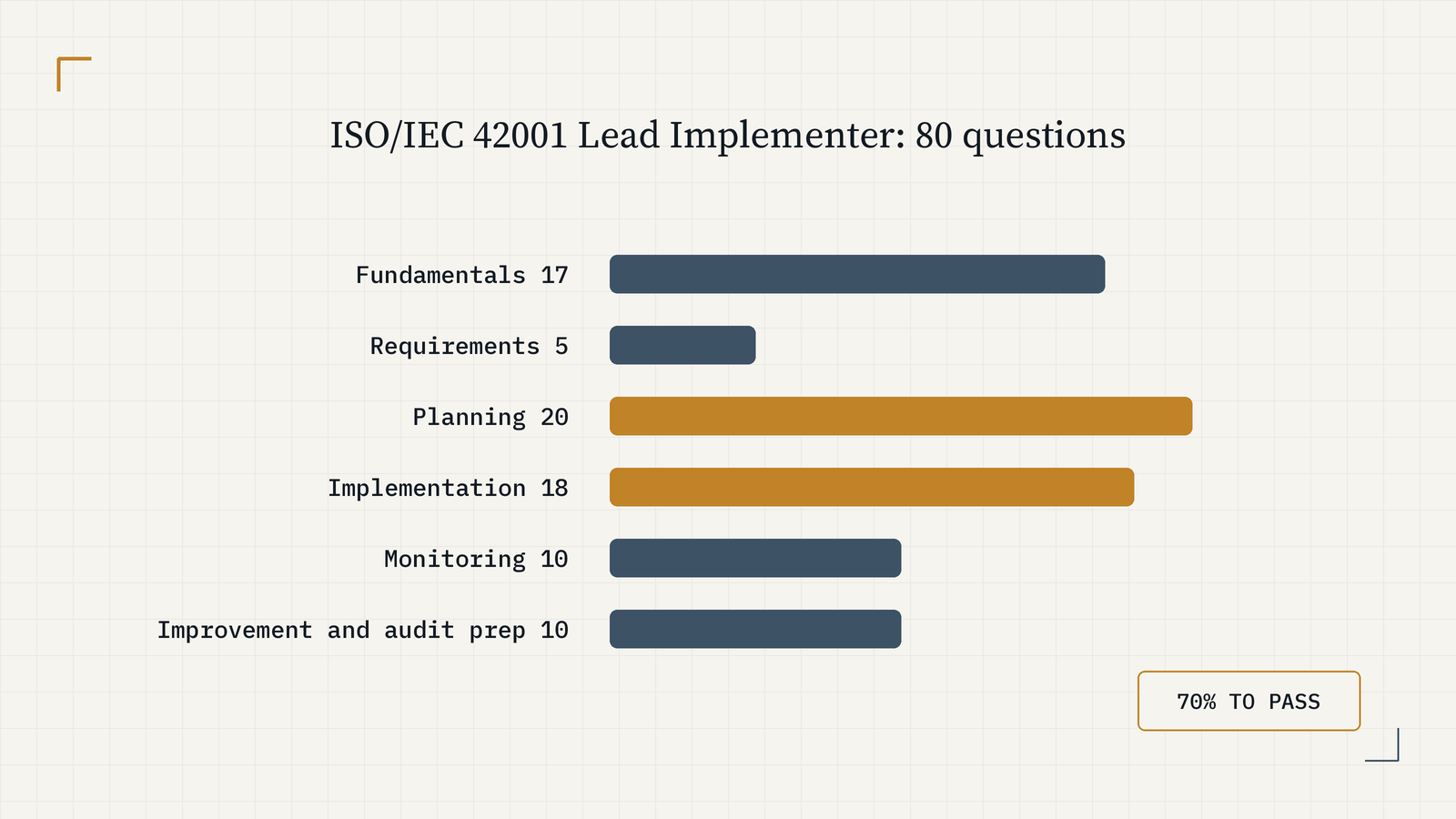
The PECB ISO/IEC 42001 Lead Implementer exam is 80 multiple-choice questions in three hours, open book, with a 70% pass mark: 56 correct answers. It is weighted toward doing the work. Planning and implementing an AI management system carry 38 of the 80 questions, and 48 questions, 60% of the paper, test evaluation rather than recall.
Every fact below comes from PECB's own documents: the ISO/IEC 42001 Lead Implementer Candidate Handbook, version 1.5, the course page and the List of PECB Exams, all read on 2 October 2026.
How is the ISO 42001 Lead Implementer exam structured?
PECB lists the English exam as three hours, multiple choice, open book, 80 questions. It is the last day of a five-day course: four days on starting, planning, implementing and monitoring an AI management system (AIMS), then the exam on day five. You can sit it online through the PECB Exams application, with an invigilator watching through your camera, or on paper through the partner that ran your course.
The paper mixes two kinds of question. Stand-alone questions test one idea on its own. Scenario-based questions come in sets of five, all about one short case: a company, its AI systems and a decision someone has to make. Every question has three options, one correct and two distractors, and every question is worth one point.
PECB Candidate Handbook, ISO/IEC 42001 Lead Implementer, v1.5
Which domains carry the most questions?
The handbook publishes the count for each of the six competency domains, so you can plan from the real weights.
Comprehension, application, analysisEvaluation
| Domain | Questions | Share | Tests |
|---|---|---|---|
| 1. Fundamental principles and concepts of an AIMS | 17 | 21.25% | Comprehension |
| 2. AIMS requirements | 5 | 6.25% | Comprehension |
| 3. Planning an AIMS implementation based on ISO/IEC 42001 | 20 | 25% | Evaluation |
| 4. Implementing an AIMS based on ISO/IEC 42001 | 18 | 22.5% | Evaluation |
| 5. Monitoring and measurement of an AIMS | 10 | 12.5% | Comprehension |
| 6. Continual improvement and preparation for an AIMS certification audit | 10 | 12.5% | Evaluation |
| Total | 80 | 100% | 32 and 48 |
Want it on one page? Our free ISO/IEC 42001 Lead Implementer mind map gives the six domains with a mnemonic, and the 10-question quiz checks your recall in five minutes.
Two numbers in that table should shape your preparation. The first is domain 2: the requirements of ISO/IEC 42001 as such carry just 5 questions. The exam assumes you can find a requirement in the standard you are allowed to bring, and spends its questions on what you do with it. The second is the split at the bottom. 48 questions test evaluation, judging which option is right for the organization in front of you, against 32 that test comprehension, application and analysis.
What does a 70% pass mark mean in practice?
70% of 80 one-point questions is 56. You can get 24 wrong and still pass, so a scenario set that goes badly costs at most five and does not decide the result.
The clock is tighter than it looks. 180 minutes over 80 questions averages 2 minutes 15 seconds each, and scenario sets eat into that because you read the case before you answer anything. If English is not your first language, ask on the day: PECB allows 30 extra minutes on Lead exams.
What can you take into the exam?
PECB allows three things: a hard copy of the ISO/IEC 42001 standard, your training course materials, and the personal notes you took during the course, in the PECB Exams app or printed. Online, phones, tablets and any second device are banned; on paper, you get the paper and a pen. Bring a national ID card, driver's license or passport, and be there 30 minutes early, because late arrivals get no extra time.
PECB Candidate Handbook, ISO/IEC 42001 Lead Implementer, v1.5
Open book helps only if you can find things fast. With 2 minutes 15 seconds a question, there is time to confirm a clause and no time to read one for the first time. Our guide to PECB's open-book exam rules shows how to tab the standard and your course notes.
PECB ISO 42001 Lead Implementer exam-day checklist
PECB ISO/IEC 42001 Lead Implementer: exam-day checklist
Rules come from PECB's ISO/IEC 42001 Lead Implementer Candidate Handbook, version 1.5 (2026), read on 2 October 2026. Suggestions are marked as ours. Check PECB's Exam Rules and Policies page before your exam in case anything has changed.
The week before
- Book the exam: online through the PECB Exams application, or on paper through the PECB partner that ran your course (PECB rule)
- Need special arrangements (dyslexia, ADHD, vision impairment, pregnancy, recent surgery)? Apply through the myPECB dashboard before the day (PECB rule)
- Print or download your course materials and notes so you can reach them quickly in the exam
- Tab your hard copy of ISO/IEC 42001 by clause, 4 to 10, and by annex (our suggestion)
What you may use in the exam (open book)
- A hard copy of the ISO/IEC 42001 standard
- Your training course materials, through the PECB Exams app or printed
- Any personal notes you took during the training course, through the app or printed
On the day
- Be there, or logged in, at least 30 minutes before the start. Late arrivals get no extra time and may not be allowed to sit (PECB rule)
- Bring a valid ID: national ID card, driver's license or passport (PECB rule)
- Online: no phones, tablets or other second devices; a PECB invigilator watches through your camera (PECB rule)
- Paper: only the exam paper and a pen; no electronic devices (PECB rule)
- Sitting in a language that is not your first? Ask on the day for 30 extra minutes, which PECB allows on Lead exams (PECB rule)
Pace
| What | Figure |
|---|---|
| Questions | 80, multiple choice, three options each |
| Time | 3 hours (180 minutes) |
| Average per question | 2 minutes 15 seconds |
| Pass mark | 70%, which is 56 correct answers |
| Scenario sets | one scenario, five questions |
| Heaviest domain | Planning an AIMS implementation, 20 questions |
After
- Online exam: your result arrives straight away. Paper multiple choice: two to four weeks (PECB)
- If you do not pass, the email lists the domains where you scored poorly (PECB)
- Disagree with the result? Ask for a re-evaluation within 30 days of receiving it (PECB)
Where does ISO 42001 sit next to the EU AI Act and NIST?
Candidates often arrive from one of three directions: a regulation, a risk framework or a management system standard. They are different kinds of document. The EU AI Act is binding law. The NIST AI Risk Management Framework is a voluntary method. ISO/IEC 42001 is a certifiable management system standard. The UK government drew on all three when it designed its AI Management Essentials self-assessment, and its guidance names ISO/IEC 42001 first.
The exam is about ISO/IEC 42001, but domain 1 reaches past it. Its knowledge statements in the handbook include the relationship between ISO/IEC 42001 and other ISO standards and regulatory frameworks, the EU's classification of AI systems by risk level, and the terminology of ISO/IEC 22989. So learn the AI Act's risk categories; outside domain 1 the handbook does not mention the Act. Our comparison of the AI Act, NIST AI RMF and ISO/IEC 42001 shows where each one applies.
How should you split your revision?
Start from the weights. Planning (20) and implementation (18) are 38 questions, 47.5% of the paper, and both are tested at the evaluation level. That is where most of your hours belong. The handbook's planning competencies include analyzing the organization's context, a gap analysis, AIMS objectives, the AIMS policy, roles and responsibilities, the risk assessment and the Statement of Applicability; implementation is putting that plan into operation.
Next comes domain 1 at 17 questions. It is comprehension level, so it rewards clear definitions: AI concepts, the EU's risk classes for AI systems, ISO/IEC 22989 terminology and management system ideas. Monitoring and measurement (10) and continual improvement with audit preparation (10) finish the paper. Leave domain 2 until last: 5 questions, and the standard is on your desk.
The ISO 42001 Lead Implementer exam guide follows this order. It maps each chapter to one of PECB's six domains and is written for the 80-question multiple-choice format. For practice, the ISO 42001 Lead Implementer practice questions book has 227 questions with full rationales, weighted to the published counts.
What happens after you pass?
The exam opens the door; your experience decides which credential you get. PECB issues four implementer credentials from the same exam:
| Credential | Professional experience | AIMS project activities |
|---|---|---|
| Provisional Implementer | None | None |
| Implementer | 2 years, at least 1 in artificial intelligence | At least 200 hours |
| Lead Implementer | 5 years, at least 2 in artificial intelligence | At least 300 hours |
| Senior Lead Implementer | 10 years, at least 7 in artificial intelligence | At least 1,000 hours |
Each one also requires you to sign the PECB Code of Ethics. Our guide to ISO 42001 Lead Implementer requirements covers each credential level and gives you a log template for your project hours.
What if you do not pass?
Online, the result is instant; on paper it takes two to four weeks. If you fail, the email names the domains where you scored poorly, and you can ask for a re-evaluation within 30 days. There is no limit on retakes, though PECB sets minimum gaps between attempts, and the course page says candidates who completed the course can retake once for free within 12 months of the first attempt. Our guide to PECB results and retakes has the detail.
What should you do this week?
Print the checklist, tab the standard, and sit one timed set of questions before day five so the pace is not a surprise. Credential Press is independent of PECB and ISO. Nothing here comes from inside the exam, and PECB's handbook is clear that disclosing exam content breaks its Code of Ethics.
Frequently asked questions
How many questions are on the PECB ISO 42001 Lead Implementer exam?
80 multiple-choice questions in three hours. Each question has three options and one correct answer, and some come in sets of five that share a scenario.
What is the pass mark for the ISO 42001 Lead Implementer exam?
70%. Each question is worth one point, so you need 56 of the 80 right and can miss 24.
Is the PECB ISO 42001 exam open book?
Yes. PECB allows a hard copy of the ISO/IEC 42001 standard, your training course materials and the notes you took during the course, either in the PECB Exams app or printed.
Which domain carries the most questions?
Planning an AIMS implementation based on ISO/IEC 42001, with 20 of the 80 questions. Implementation follows with 18. Together they are almost half the paper.
Do I need AI experience to sit the exam?
No. PECB's Provisional Implementer credential needs the exam and no experience. The Lead Implementer credential needs five years of professional experience, at least two in artificial intelligence, and at least 300 hours of AIMS project activities.
What happens if I fail?
The results email lists the domains where you scored poorly, and you can ask for a re-evaluation within 30 days. PECB's course page says candidates who completed the course but failed can retake once for free within 12 months of the first attempt.
ISO/IEC 42001 Lead Implementer: test yourself in five minutes
Which books prepare you for this exam?
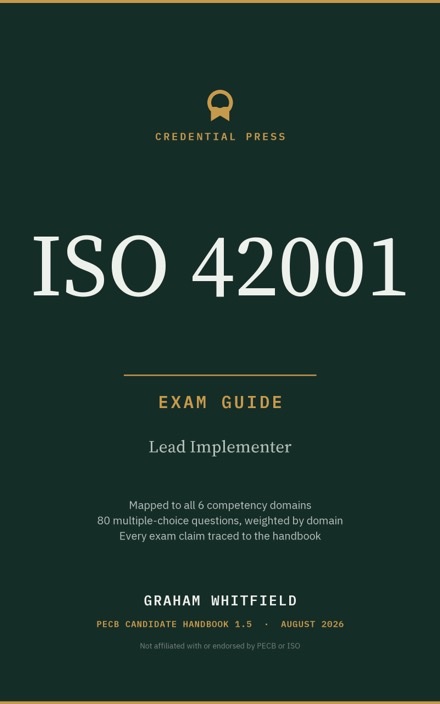
ISO 42001 Lead Implementer Exam Guide
PECB Certified ISO/IEC 42001 Lead Implementer. 12 chapters, 387 pages.
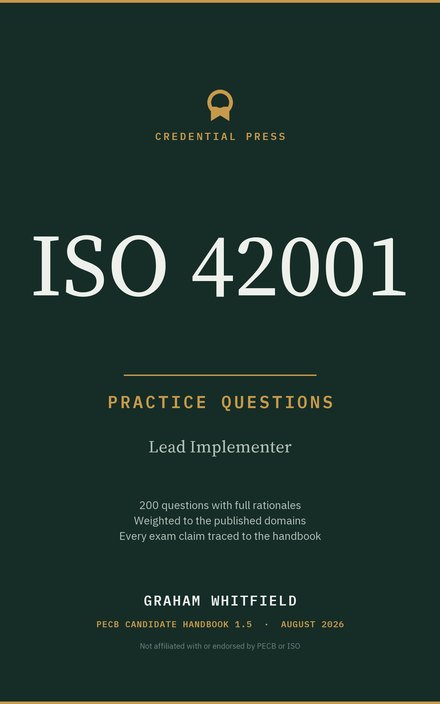
ISO 42001 Lead Implementer Practice Questions
Practice questions with full rationales, weighted to the published domains. 246 pages.
Sources
Every figure above was read from the document itself on 2 October 2026.
- PECB, ISO/IEC 42001 Lead Implementer Candidate Handbook, version 1.5, 2026
- PECB, ISO/IEC 42001 Lead Implementer course, agenda and credential requirements
- PECB Help Center, List of PECB Exams
- GOV.UK, DSIT, Guidance for using the AI Management Essentials tool
Credential Press is not affiliated with, endorsed by or authorized by PECB, ISO or the IEC. Exam names and trademarks belong to their owners.