PECB exams
What can you take into a PECB open-book exam?
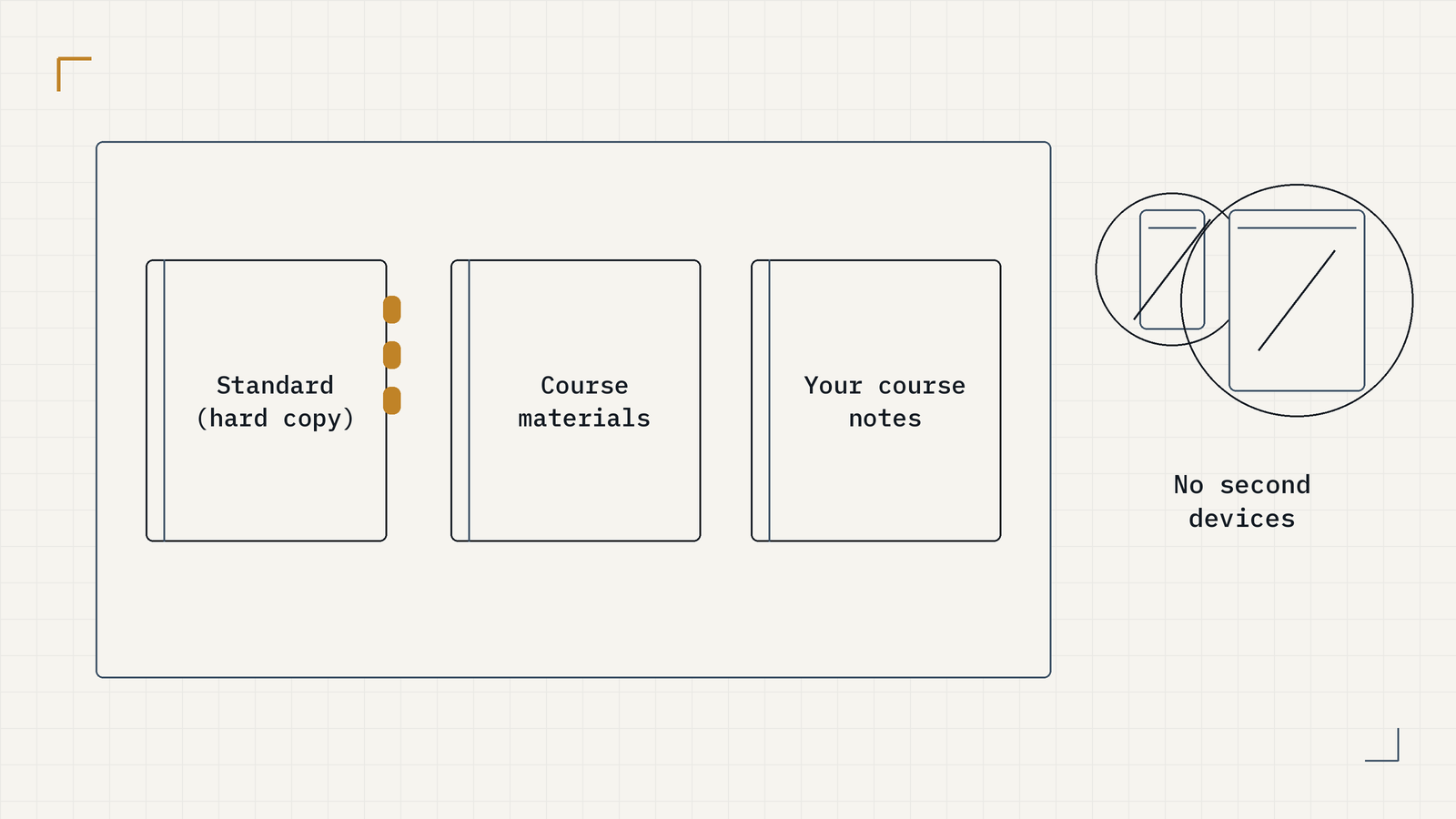
You can take three things into a PECB multiple-choice Lead exam: a hard copy of the standard the exam is about, your training course materials, and the personal notes you took during the course. That is the whole list, so a study guide, ours included, stays on the shelf. The rules are simple. The clock is the hard part, because 80 questions in three hours leaves 2 minutes 15 seconds for each one, lookups included.
These rules are the same in every version 1.5 Candidate Handbook we read for PECB's multiple-choice Lead exams, including the ISO/IEC 42001, ISO 22301 and ISO/IEC 27701 Lead Implementer handbooks we use as examples, all read on 2 October 2026. The List of PECB Exams still shows essay versions in some languages, such as Spanish, Portuguese and French, so check which format you are booked on. New to the 42001 exam? Start with what is on the ISO 42001 Lead Implementer exam.
What does PECB allow on your desk in an open-book exam?
The handbook's list of reference materials has three entries:
- A hard copy of the standard the exam is about. For our three examples, that is ISO/IEC 42001, ISO 22301 or ISO/IEC 27701.
- Your training course materials, through the PECB Exams app, printed, or both.
- Any personal notes you took during the training course, through the app, printed, or both.
Two phrases in that list do real work. "Hard copy" means paper, so a PDF of the standard on a screen does not qualify. "Notes taken during the training course" ties your notes to the course, which matters if you planned to write a fresh summary the night before. Anything else, a practice question book or a printout from a forum, is off the list. If you want something more on the desk, ask PECB well before the day.
Are the rules different for online and paper exams?
The three materials stay the same. The room and the supervision change.
| Online | Paper | |
|---|---|---|
| Booked through | The PECB Exams application, under Exam Events | The PECB authorized partner that ran your course |
| Devices | No secondary devices, phones and tablets included | No electronic devices: no laptop, tablet or phone |
| Supervised by | A PECB invigilator, remotely, through the app and your camera | A PECB-approved invigilator |
| Course materials and notes | In the app, printed, or both | Printed (our reading, since no devices are allowed) |
The paper rules mention only the exam paper and a pen, and ban every electronic device. Read alongside the open-book allowance, that points to printed materials, so confirm the arrangement with the partner running the exam. Online, the camera is the invigilator's view of your room, and a spare phone lying face down is still a second device.
What else do you need on exam day?
Two things, and PECB is strict about both. Bring a valid identity card, meaning a national ID card, driver's license or passport, to show the invigilator. And be there, or present online, at least 30 minutes before the start: late arrivals get no additional time and may not be allowed to sit at all. Separately, if you need special accommodations, for dyslexia, ADHD, a vision impairment or a temporary condition such as pregnancy, apply through Enroll for an Exam in your myPECB dashboard before the day.
Why is an open-book exam still a race against the clock?
Because the book comes with no extra minutes. 180 minutes over 80 questions is 2 minutes 15 seconds a question, and scenario questions come in sets of five that share one case, so the reading comes out of the same budget. If you sit in a language that is not your first and ask on the day, PECB adds 30 minutes on Lead exams, which lifts the average to roughly 2 minutes 38 seconds.
That budget decides what your materials are for: confirming a page you can find at once. There is no time to read a clause for the first time, or to leaf through a binder of slides for a diagram you half remember. You can get 24 of the 80 wrong and still reach the 70% pass mark; a quarter of an hour lost to searching is harder to absorb. Our guide to how PECB scenario-based questions work breaks the time down set by set.
How should you tab the standard?
Tab the structure, so your hand finds each part before your eyes do.
- Check the contents page of your copy. If the requirements run from clause 4 to clause 10, give each clause a tab on the side edge, in one color.
- Tab each annex on the top edge, in a second color.
- Label tabs with the number and a word or two of your own. Copy no headings or text from the standard; it is already on the desk.
- Use a third color for pages the course worked through. The handbook says the questions apply concepts and principles "explained during the training course".
Then note which exam domain each tab serves, using your handbook's domain names, and make the heavy ones easiest to reach. In ISO/IEC 42001, planning (20 questions) and implementation (18) carry 38 of the 80. In ISO/IEC 27701, implementation alone carries 23. In ISO 22301, planning and implementation carry 18 each. If you plan to write in the standard itself, check PECB's Exam Rules and Policies page first.
How do you organize course notes so you can find things fast?
Build a one-page index that sits on top of your notes and points into all three materials, with four columns: clause or topic, page, your own note, and the domain it serves. Put a letter before each page number, S for the standard, M for course materials and N for notes, so you know which pile to reach for.
Build it on days 1 to 4 of the course, before the exam on day 5. That keeps it inside the handbook's wording: personal notes taken during the training course. Write in your own words, sort by domain with the heaviest first, and number your note pages so the index can point at them. If your materials are in the PECB Exams app, practice moving around them before the day.
PECB open-book tab and notes template
PECB open-book exam: tab and notes template
Rules come from PECB's version 1.5 Candidate Handbooks for the ISO/IEC 42001, ISO 22301 and ISO/IEC 27701 Lead Implementer exams, read on 2 October 2026. Suggestions are marked as ours. Check PECB's Exam Rules and Policies page before your exam in case anything has changed. This template does not reproduce any ISO standard: fill it in from your own copy, in your own words.
What you may bring (PECB rule)
- A hard copy of the standard your exam is about (on paper; a PDF on a screen does not count)
- Your training course materials, through the PECB Exams app or printed
- Any personal notes you took during the training course, through the app or printed
Tab the standard (our suggestion)
Check the contents page of your copy first. If its requirements run from clause 4 to clause 10, tab each one on the side edge in one color, and each annex on the top edge in a second color. Label tabs with the number and a word or two of your own.
| Tab | Clause or annex | Page | Tab color | Domain it serves |
|---|---|---|---|---|
| 1 | Clause 4 | |||
| 2 | Clause 5 | |||
| 3 | Clause 6 | |||
| 4 | Clause 7 | |||
| 5 | Clause 8 | |||
| 6 | Clause 9 | |||
| 7 | Clause 10 | |||
| 8 | Annex ___ | |||
| 9 | Annex ___ | |||
| 10 | Annex ___ |
One-page notes index (our suggestion)
Build it during the course, on days 1 to 4, so it stays inside PECB's wording: personal notes taken during the training course. Put a letter before each page number: S for the standard, M for course materials, N for your notes. Example: M-47.
| Clause or topic | Page | My note | Domain it serves |
|---|---|---|---|
Sort by domain weight (from the handbooks)
Copy your own exam's domain table from its Candidate Handbook. The heaviest domains in our three examples:
| Exam | Heaviest domains (questions out of 80) |
|---|---|
| ISO/IEC 42001 Lead Implementer | Planning 20, implementation 18, fundamental principles and concepts 17 |
| ISO 22301 Lead Implementer | Planning 18, implementation 18, monitoring and measurement 12 |
| ISO/IEC 27701 Lead Implementer | Implementation 23, planning 15, monitoring and measurement 12 |
Before the day
- The standard is a hard copy, tabbed (PECB rule for the copy; tabs are our suggestion)
- Paper exam: course materials and notes printed, since no electronic devices are allowed (our reading; confirm with your partner)
- Online exam: you have practiced moving around your materials in the PECB Exams app (our suggestion)
- Timed lookup test: pick topics at random from your index and find each one. A question gets 2 minutes 15 seconds on average, so if a lookup eats a large share of that, fix the tab or the index (our suggestion)
- Valid ID ready: national ID card, driver's license or passport (PECB rule)
- Plan to be there, or present online, 30 minutes before the start (PECB rule)
- Nothing from inside an exam goes into your notes or index. Disclosing exam content breaks PECB's Code of Ethics (PECB rule)
Can you share what was in the exam afterward?
No. PECB's handbooks say any disclosure of information about the content of PECB exams is a direct violation of its Code of Ethics, and PECB may permanently ban you, revoke your credentials and pursue legal action. As written, that covers a "what came up" post on a forum as much as a copied question. Keep your tabs and index built from the course and the standard, and keep exam content out of them. Nothing on this site comes from inside a PECB exam.
What should you do before day one of the course?
Get a hard copy of the standard, tab it, and print the template above so you can fill the index as the course runs. When the result arrives, our guide to PECB results, re-evaluation and retakes covers what comes next.
Our books stay out of the exam room, so use them before it. The ISO 42001 Lead Implementer paperback is mapped to all six of PECB's competency domains for that exam, and the ISO 22301 Lead Implementer exam guide and ISO 27701 Lead Implementer exam guide are written for the same 80-question multiple-choice format. Credential Press is independent of PECB and ISO.
Frequently asked questions
What can I bring into a PECB open-book exam?
Three things: a hard copy of the standard the exam is about, your training course materials, and any personal notes you took during the training course. Course materials and notes can be in the PECB Exams app, printed, or both.
Can I use a PDF of the standard?
No. PECB's handbooks allow a hard copy of the standard, and a PDF on a screen is not one. Online exams also ban secondary devices such as phones and tablets.
Can I bring a study guide or a practice question book?
Neither is on PECB's list of allowed reference materials, which names only the standard, your course materials and your course notes. Use them before the exam.
What are the rules for a paper-based PECB exam?
Only the exam paper and a pen, no electronic devices, and a PECB-approved invigilator. Since devices are out, plan on printed course materials and notes, and confirm with the partner running the exam.
What ID do I need, and when should I arrive?
A valid national ID card, driver's license or passport, shown to the invigilator. Be there, or present online, at least 30 minutes before the start: late arrivals get no extra time and may not be allowed to sit.
Does open book make the exam easier?
It changes what you prepare. 80 questions in three hours averages 2 minutes 15 seconds each: time to confirm a page you can find at once, and little time to read a clause for the first time.
Which books help you prepare before exam day?
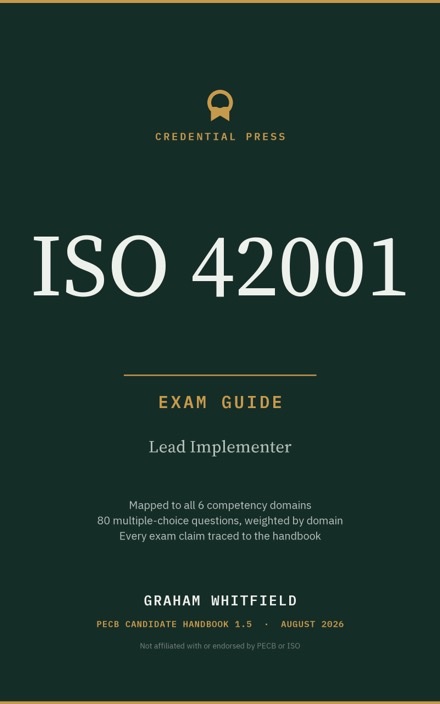
ISO 42001 Lead Implementer Exam Guide
PECB Certified ISO/IEC 42001 Lead Implementer. 12 chapters, 387 pages.
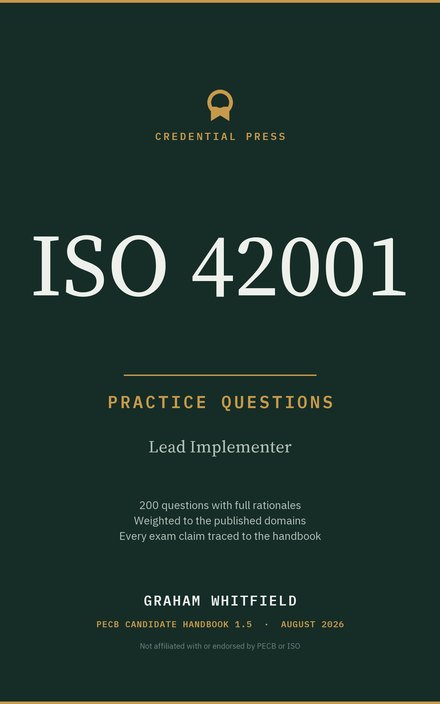
ISO 42001 Lead Implementer Practice Questions
Practice questions with full rationales, weighted to the published domains. 246 pages.
Sources
Every rule above was read from the document itself on 2 October 2026. Suggestions are marked as ours.
- PECB, ISO/IEC 42001 Lead Implementer Candidate Handbook, version 1.5, 2026
- PECB, ISO 22301 Lead Implementer Candidate Handbook, version 1.5
- PECB, ISO/IEC 27701 Lead Implementer Candidate Handbook, version 1.5
- PECB, ISO/IEC 42001 Lead Implementer course, agenda
- PECB Help Center, List of PECB Exams
- ISO, ISO/IEC 42001 standard page
Credential Press is not affiliated with, endorsed by or authorized by PECB, ISO or the IEC. Exam names and trademarks belong to their owners.