PHR
What should you ask in a PHR interview, and how should candidates answer?
The PHR says someone has professional-level HR experience and passed HRCI's exam on operational HR grounded in U.S. law: 90 scored questions across seven functional areas. These questions test those areas in practice, with what a strong answer covers. Candidates get the questions to prepare for and three to ask back.
What should an employer ask a PHR candidate?
Each question maps to an exam domain, so you test what the role needs. Score each answer 1 to 4 on the free scorecard below.
You are asked to investigate a complaint against a manager you know well outside work. What do you do?
Listen for: Disclose the relationship and ask that someone else investigate. The appearance of a conflict matters as much as the reality, and careful notes do not remove it. Say nothing to the accused before the investigation starts.
Business Management (1.3, conflict of interest); Employee and Labor Relations (6.4)
A manager wants to hire only men for a role because the work is physical. What do you tell him?
Listen for: A belief about which sex is stronger is not a bona fide occupational qualification, and the BFOQ defense is narrow. A strong answer offers a job-related physical test applied to every applicant instead.
Workforce Planning and Talent Acquisition (2.1)
Walk me through how you would fill a hard-to-fill role quickly and lawfully.
Listen for: A clear job description and specification, the right sourcing channels, a structured interview asked the same way of every candidate, an offer, background checks done consistently, and onboarding. A strong answer names how they would measure the result.
Workforce Planning and Talent Acquisition (2.2, 2.3)
A required safety training session is scheduled for a Saturday for hourly staff. What do you check first?
Listen for: Required training is hours worked for non-exempt staff, so it counts toward the 40-hour workweek and can create overtime. Pay it, record it, and check the schedule against each person's hours that week.
Learning and Development (3.3); Total Rewards (4.4)
We are adding an employer match to our 401(k). What do we need to get right on vesting?
Listen for: ERISA's minimums for a defined contribution plan: no slower than a 3-year cliff or a graded schedule from 20% after 2 years to 100% after 6. Faster vesting is allowed. Then clear communication to employees.
Total Rewards (4.4)
The controller wants to give every employee a gift card at year end. How should payroll treat it?
Listen for: Gift cards are cash equivalents and taxable wages whatever the amount. The de minimis exclusion covers small non-cash items, not cards. A strong answer suggests a non-cash alternative if the aim is a tax-free thank-you.
Total Rewards (4.1)
A supervisor rated an order picker "exceeds expectations" after a strong six weeks that followed months of missed targets. What do you do?
Listen for: Recency error. Rate the whole period against the standard, using the supervisor's own notes, with rater training and calibration so the next cycle is fairer.
Employee Engagement (5.3)
Engagement survey scores dropped in one department. What do you do next?
Listen for: Share the results with the people who took part, find out why through focus groups or interviews, agree an action plan with the manager, and measure again. A strong answer protects anonymity throughout.
Employee Engagement (5.2)
An employee reports sexual comments by her manager and asks you to do nothing. What do you do?
Listen for: The employer is now on notice and must look into it. Tell her it will be as discreet as the process allows, that retaliation is prohibited, and then act. Never promise complete confidentiality.
Employee and Labor Relations (6.4)
During a union organizing campaign, what can supervisors say, and what can they not?
Listen for: They may share views and facts, such as what dues cost and that a union cannot guarantee a result. They may not threaten, question employees about cards or votes, promise benefits for a no vote, or watch union activity.
Employee and Labor Relations (6.5)
Our company has 17 employees. Which federal discrimination laws cover us?
Listen for: Title VII and the ADA from 15 employees, the ADEA from 20, so the age law does not reach this employer federally. A strong answer adds that state and local laws can reach smaller employers.
Employee and Labor Relations (6.1)
A payroll administrator moved to marketing 10 weeks ago and still has full payroll access. What failed, and what do you put in place?
Listen for: Deprovisioning. Access should change on the transfer date with the role, under role-based access and least privilege, with regular access reviews to catch what slips through.
HR Information Management (7.3)
PHR interview scorecard
PHR interview scorecard
Candidate: ______ Interviewer: ______ Date: ______
| # | Question | Listen for | Score 1 to 4 |
|---|---|---|---|
| 1 | You are asked to investigate a complaint against a manager you know well outside work. What do you do? | Disclose the relationship and ask that someone else investigate. The appearance of a conflict matters as much as the reality, and careful notes do not remove it. Say nothing to the accused before the investigation starts. | |
| 2 | A manager wants to hire only men for a role because the work is physical. What do you tell him? | A belief about which sex is stronger is not a bona fide occupational qualification, and the BFOQ defense is narrow. A strong answer offers a job-related physical test applied to every applicant instead. | |
| 3 | Walk me through how you would fill a hard-to-fill role quickly and lawfully. | A clear job description and specification, the right sourcing channels, a structured interview asked the same way of every candidate, an offer, background checks done consistently, and onboarding. A strong answer names how they would measure the result. | |
| 4 | A required safety training session is scheduled for a Saturday for hourly staff. What do you check first? | Required training is hours worked for non-exempt staff, so it counts toward the 40-hour workweek and can create overtime. Pay it, record it, and check the schedule against each person's hours that week. | |
| 5 | We are adding an employer match to our 401(k). What do we need to get right on vesting? | ERISA's minimums for a defined contribution plan: no slower than a 3-year cliff or a graded schedule from 20% after 2 years to 100% after 6. Faster vesting is allowed. Then clear communication to employees. | |
| 6 | The controller wants to give every employee a gift card at year end. How should payroll treat it? | Gift cards are cash equivalents and taxable wages whatever the amount. The de minimis exclusion covers small non-cash items, not cards. A strong answer suggests a non-cash alternative if the aim is a tax-free thank-you. | |
| 7 | A supervisor rated an order picker "exceeds expectations" after a strong six weeks that followed months of missed targets. What do you do? | Recency error. Rate the whole period against the standard, using the supervisor's own notes, with rater training and calibration so the next cycle is fairer. | |
| 8 | Engagement survey scores dropped in one department. What do you do next? | Share the results with the people who took part, find out why through focus groups or interviews, agree an action plan with the manager, and measure again. A strong answer protects anonymity throughout. | |
| 9 | An employee reports sexual comments by her manager and asks you to do nothing. What do you do? | The employer is now on notice and must look into it. Tell her it will be as discreet as the process allows, that retaliation is prohibited, and then act. Never promise complete confidentiality. | |
| 10 | During a union organizing campaign, what can supervisors say, and what can they not? | They may share views and facts, such as what dues cost and that a union cannot guarantee a result. They may not threaten, question employees about cards or votes, promise benefits for a no vote, or watch union activity. | |
| 11 | Our company has 17 employees. Which federal discrimination laws cover us? | Title VII and the ADA from 15 employees, the ADEA from 20, so the age law does not reach this employer federally. A strong answer adds that state and local laws can reach smaller employers. | |
| 12 | A payroll administrator moved to marketing 10 weeks ago and still has full payroll access. What failed, and what do you put in place? | Deprovisioning. Access should change on the transfer date with the role, under role-based access and least privilege, with regular access reviews to catch what slips through. |
Source: https://credentialpress.com/guides/phr-interview-questions
Which questions should a PHR candidate prepare for?
Which PHR functional area is your strongest, and which your weakest?
How to answer: Name both. For the weak one, say what you did about it and how it shows in your work now.
Tell me about an investigation you ran.
How to answer: Cover the complaint, your plan, who you interviewed, the evidence, the finding and what it rested on, the outcome, and how you checked for retaliation afterward.
How do you keep up with changes in federal employment law?
How to answer: Name your sources and one change you put into a policy or practice on time. HRCI's outline puts the duty to know the law in force on the candidate, so show you take it seriously.
Tell me about a time you used HR data to change a decision.
How to answer: Name the measure, what it showed, the decision it changed and the result.
Why did you take the PHR?
How to answer: Say what it changed in how you handle HR decisions, with one example. Do not recite the outline.
What should a candidate ask the employer?
- How many employees do you have, and in which states?
- Who handles employee complaints and investigations now, and how are they documented?
- Which parts of HR are outsourced, such as payroll or benefits administration?
Where next?
Also free: the PHR mind map and the PHR 10-question quiz, plus every other credential on our study tools page. For the full syllabus, the PHR Exam Guide and the PHR Practice Questions go domain by domain.
Frequently asked questions
What should an employer ask a PHR candidate?
Questions that test each exam domain in practice, for example: You are asked to investigate a complaint against a manager you know well outside work. What do you do? A manager wants to hire only men for a role because the work is physical. What do you tell him? Walk me through how you would fill a hard-to-fill role quickly and lawfully.
What should a PHR candidate ask the employer?
How many employees do you have, and in which states? Who handles employee complaints and investigations now, and how are they documented? Which parts of HR are outsourced, such as payroll or benefits administration?
How should a candidate prepare for a PHR interview?
Name both. For the weak one, say what you did about it and how it shows in your work now.
Which books go deeper on PHR?
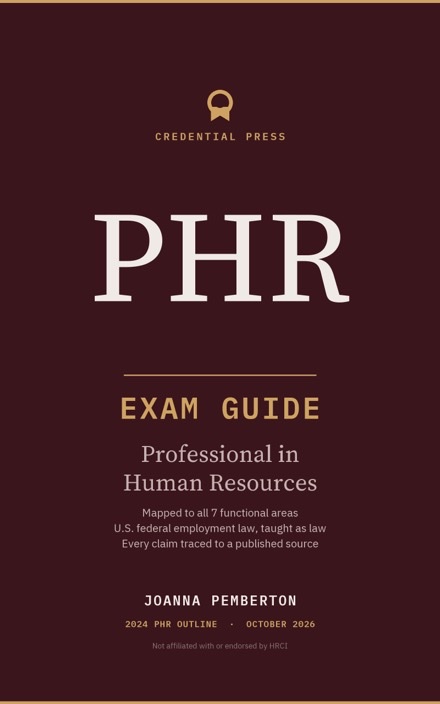
A study companion for the HRCI Professional in Human Resources (PHR) examination. 12 chapters, 397 pages.
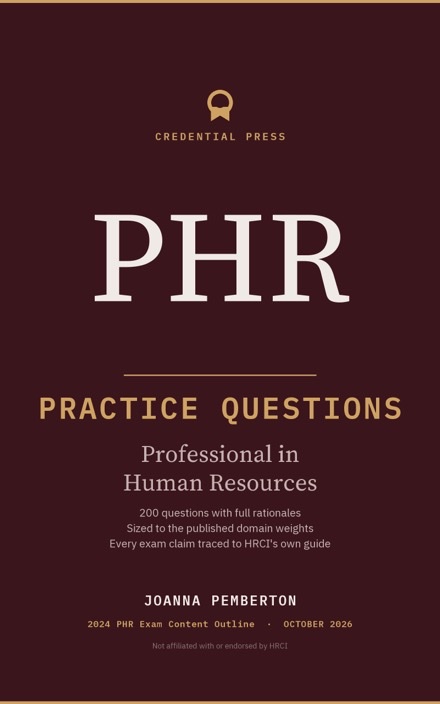
Practice questions with full rationales, sized to the published weights. 223 pages.
How to credit this page
Using a figure or a passage from this page in an article, a course, a forum answer or AI-generated text? Please credit Credential Press and link to this page, so your readers can check the source and the date it was reviewed. Copy a ready-made citation:
Plain text
Markdown
HTML
Sources
- HRCI, Professional in Human Resources (PHR) page, read 16 November 2026
- HRCI, PHR Exam Content Outline, effective 2024
- HRCI, Certification Policies and Procedures Handbook
- US EEOC, Title VII of the Civil Rights Act of 1964
- US EEOC, Titles I and V of the Americans with Disabilities Act of 1990
- US EEOC, Age Discrimination in Employment Act of 1967
Credential Press is independent of HRCI.