SHRM-CP
What should you ask in an SHRM-CP interview, and how should candidates answer?
The SHRM-CP says someone passed SHRM's exam on the behavioral competencies and HR knowledge of operational HR: 134 scored questions, 54 of them situational judgment. These questions test the six clusters and domains in practice, with what a strong answer covers. Candidates get the questions to prepare for and three to ask back.
What should an employer ask an SHRM-CP candidate?
Each question maps to an exam domain, so you test what the role needs. Score each answer 1 to 4 on the free scorecard below.
A vice president tells staff to use their vacation, then turns down every request from his own team. How do you raise it with him?
Listen for: Authenticity: his words and his decisions point in opposite directions, and the team has noticed. A strong answer raises it with him privately, with the specific pattern and its effect on trust, and offers a way through, such as planning cover so leave can be taken.
Leadership: Ethical Practice
A hiring manager wants a college degree for warehouse jobs that do not need one. What do you tell her?
Listen for: Disparate impact: a neutral requirement that screens out a protected group at a far greater rate breaks Title VII unless it is job related and consistent with business necessity. A strong answer checks the applicant data and sets requirements from a job analysis.
Leadership: Inclusive Mindset; Workplace: U.S. Employment Law & Regulations
At an HR association dinner, a competitor's HR manager suggests both firms hold starting pay and stop recruiting each other's staff. What do you do?
Listen for: End the conversation at once, share no pay data, and report it to counsel. Federal antitrust agencies treat wage-fixing and no-poach agreements between employers as violations, and an informal agreement is still an agreement.
Interpersonal: Relationship Management
In an investigation interview, a witness says the supervisor "did his usual thing." What is your next question?
Listen for: A probing question in the witness's own words, such as what she means by his usual thing. No leading questions. A strong answer adds that the finding will rest on the weight of the evidence, not on an admission or a count of witnesses.
Interpersonal: Communication; Organization: Employee & Labor Relations
Turnover in one warehouse has risen sharply this year. How would you find out why?
Listen for: Turnover against average headcount, split into voluntary and involuntary, then by team, tenure and manager. Exit and stay interviews, the cost of the turnover, and a plan with a measure the leadership team agrees to.
Business: Analytical Aptitude; People: Employee Engagement & Retention
How would you show a leadership team that a safety program is worth its cost?
Listen for: Return on investment and payback built from the program's cost and savings that finance agrees with, the assumptions stated, and the business result the program supports, not only the HR activity.
Business: Business Acumen; Consultation
An employee's pay sits well below the midpoint of her grade. What do you look at before recommending a raise?
Listen for: Her compa-ratio and range penetration, her performance and time in the job, what peers in the grade earn, how the market has moved, and the budget. Then a recommendation the manager can explain to her.
People: Total Rewards
A manager rates an analyst top marks on every dimension because of one impressive project. What do you do?
Listen for: The halo effect. Each dimension rated against its standard and the record, such as attendance, with rater training and calibration across managers so one result does not carry the whole review.
People: Employee Engagement & Retention
A 40-person startup wants better benefits than it can buy on its own. What would you put to the founders?
Listen for: A professional employer organization, with co-employment explained: the PEO becomes an employer of record for payroll, tax reporting and benefits while the startup directs the work. A strong answer compares it with an ASO arrangement and says what control the founders give up.
Organization: Structure of the HR Function
A grievance has reached an impasse. How do you choose between mediation and arbitration?
Listen for: Mediation leaves the outcome with the parties. Nonbinding arbitration gives an advisory decision either side can reject. Binding arbitration is final. The choice trades control over the outcome against certainty of getting one, inside whatever the contract requires.
Organization: Employee & Labor Relations
An employee falls from a platform and is admitted to hospital overnight. What does HR do in the first day?
Listen for: Care for the employee first. Report the in-patient hospitalization to OSHA within 24 hours, record it on the OSHA 300 log if the employer keeps one, investigate the cause, and make sure nobody is punished for raising the hazard.
Workplace: Risk Management; U.S. Employment Law & Regulations
SHRM-CP interview scorecard
SHRM-CP interview scorecard
Candidate: ______ Interviewer: ______ Date: ______
| # | Question | Listen for | Score 1 to 4 |
|---|---|---|---|
| 1 | A vice president tells staff to use their vacation, then turns down every request from his own team. How do you raise it with him? | Authenticity: his words and his decisions point in opposite directions, and the team has noticed. A strong answer raises it with him privately, with the specific pattern and its effect on trust, and offers a way through, such as planning cover so leave can be taken. | |
| 2 | A hiring manager wants a college degree for warehouse jobs that do not need one. What do you tell her? | Disparate impact: a neutral requirement that screens out a protected group at a far greater rate breaks Title VII unless it is job related and consistent with business necessity. A strong answer checks the applicant data and sets requirements from a job analysis. | |
| 3 | At an HR association dinner, a competitor's HR manager suggests both firms hold starting pay and stop recruiting each other's staff. What do you do? | End the conversation at once, share no pay data, and report it to counsel. Federal antitrust agencies treat wage-fixing and no-poach agreements between employers as violations, and an informal agreement is still an agreement. | |
| 4 | In an investigation interview, a witness says the supervisor "did his usual thing." What is your next question? | A probing question in the witness's own words, such as what she means by his usual thing. No leading questions. A strong answer adds that the finding will rest on the weight of the evidence, not on an admission or a count of witnesses. | |
| 5 | Turnover in one warehouse has risen sharply this year. How would you find out why? | Turnover against average headcount, split into voluntary and involuntary, then by team, tenure and manager. Exit and stay interviews, the cost of the turnover, and a plan with a measure the leadership team agrees to. | |
| 6 | How would you show a leadership team that a safety program is worth its cost? | Return on investment and payback built from the program's cost and savings that finance agrees with, the assumptions stated, and the business result the program supports, not only the HR activity. | |
| 7 | An employee's pay sits well below the midpoint of her grade. What do you look at before recommending a raise? | Her compa-ratio and range penetration, her performance and time in the job, what peers in the grade earn, how the market has moved, and the budget. Then a recommendation the manager can explain to her. | |
| 8 | A manager rates an analyst top marks on every dimension because of one impressive project. What do you do? | The halo effect. Each dimension rated against its standard and the record, such as attendance, with rater training and calibration across managers so one result does not carry the whole review. | |
| 9 | A 40-person startup wants better benefits than it can buy on its own. What would you put to the founders? | A professional employer organization, with co-employment explained: the PEO becomes an employer of record for payroll, tax reporting and benefits while the startup directs the work. A strong answer compares it with an ASO arrangement and says what control the founders give up. | |
| 10 | A grievance has reached an impasse. How do you choose between mediation and arbitration? | Mediation leaves the outcome with the parties. Nonbinding arbitration gives an advisory decision either side can reject. Binding arbitration is final. The choice trades control over the outcome against certainty of getting one, inside whatever the contract requires. | |
| 11 | An employee falls from a platform and is admitted to hospital overnight. What does HR do in the first day? | Care for the employee first. Report the in-patient hospitalization to OSHA within 24 hours, record it on the OSHA 300 log if the employer keeps one, investigate the cause, and make sure nobody is punished for raising the hazard. |
Source: https://credentialpress.com/guides/shrm-cp-interview-questions
Which questions should an SHRM-CP candidate prepare for?
Which SHRM BASK competency is your strongest, and which your weakest?
How to answer: Name both. For the weak one, say what you did about it and how it shows in your work now.
Tell me about a time you told a senior leader something he did not want to hear.
How to answer: Say what the issue was, the evidence you brought, how you framed it for him, and what changed afterward.
Tell me about an HR decision you made with data.
How to answer: Name the measure, how you worked it out, what it showed, and the decision it changed.
How do you keep up with changes in U.S. employment law?
How to answer: Name your sources and one change you put into a policy or a process on time, with how you told managers.
Why did you take the SHRM-CP?
How to answer: Say what it changed in how you handle people decisions, with one example. Do not recite the BASK.
What should a candidate ask the employer?
- Which parts of HR does this role own day to day, and which sit with managers or a provider?
- How early does HR get involved in decisions that affect people?
- What HR data do you track now, and who sees it?
Where next?
Also free: the SHRM-CP mind map and the SHRM-CP 10-question quiz, plus every other credential on our study tools page. For the full syllabus, the SHRM-CP Exam Guide and the SHRM-CP Practice Questions go domain by domain.
Frequently asked questions
What should an employer ask an SHRM-CP candidate?
Questions that test each exam domain in practice, for example: A vice president tells staff to use their vacation, then turns down every request from his own team. How do you raise it with him? A hiring manager wants a college degree for warehouse jobs that do not need one. What do you tell her? At an HR association dinner, a competitor's HR manager suggests both firms hold starting pay and stop recruiting each other's staff. What do you do?
What should an SHRM-CP candidate ask the employer?
Which parts of HR does this role own day to day, and which sit with managers or a provider? How early does HR get involved in decisions that affect people? What HR data do you track now, and who sees it?
How should a candidate prepare for an SHRM-CP interview?
Name both. For the weak one, say what you did about it and how it shows in your work now.
Which books go deeper on SHRM-CP?
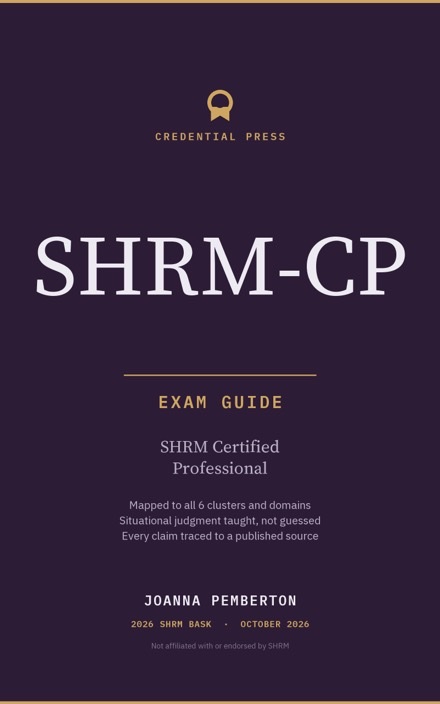
A study companion for the SHRM Certified Professional (SHRM-CP) examination. 13 chapters, 373 pages.
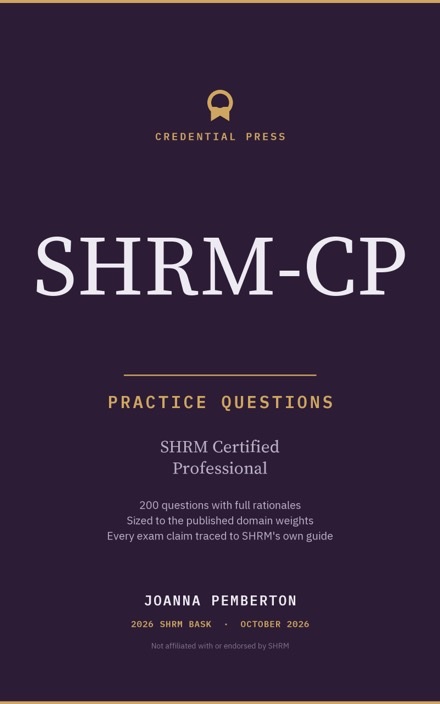
Practice questions with full rationales, sized to the published weights. 223 pages.
How to credit this page
Using a figure or a passage from this page in an article, a course, a forum answer or AI-generated text? Please credit Credential Press and link to this page, so your readers can check the source and the date it was reviewed. Copy a ready-made citation:
Plain text
Markdown
HTML
Sources
- SHRM, 2026 SHRM Certification Handbook
- SHRM, SHRM Body of Applied Skills and Knowledge (SHRM BASK), 2026
- US EEOC, Title VII of the Civil Rights Act of 1964
- OSHA, Report a Fatality or Severe Injury
Credential Press is independent of SHRM.