AAIA
Auditing AI when you already audit: who ISACA's AAIA is for
The AAIA, ISACA's Advanced in AI Audit, is for auditors who already hold an audit credential and keep finding AI systems inside the scope of their work. It does not teach auditing. It tests whether you can carry your method into AI governance, AI operations and audit technique, including AI inside the audit itself. It fits a CISA, or a CIA or CPA in an IT audit or advisory role. It does not fit anyone looking for a first credential, because you cannot sit it without one. This guide covers what the job asks, who qualifies, when it starts to matter, how it compares with the CISA and the ISO/IEC 42001 Lead Auditor, and what the exam expects.
The exam facts come from ISACA's AAIA Exam Candidate Guide (2026), which carries the Examination Content Outline of June 2025, checked against ISACA's published copy on 14 November 2026. Eligibility, fees and upkeep come from ISACA's AAIA page and its maintenance page, read on 16 November 2026. The legal dates come from the Official Journal text of the AI Act and a law firm's summary of the Digital Omnibus. The audit practice comes from our own fact-checked guide.
What does an AAIA holder actually do?
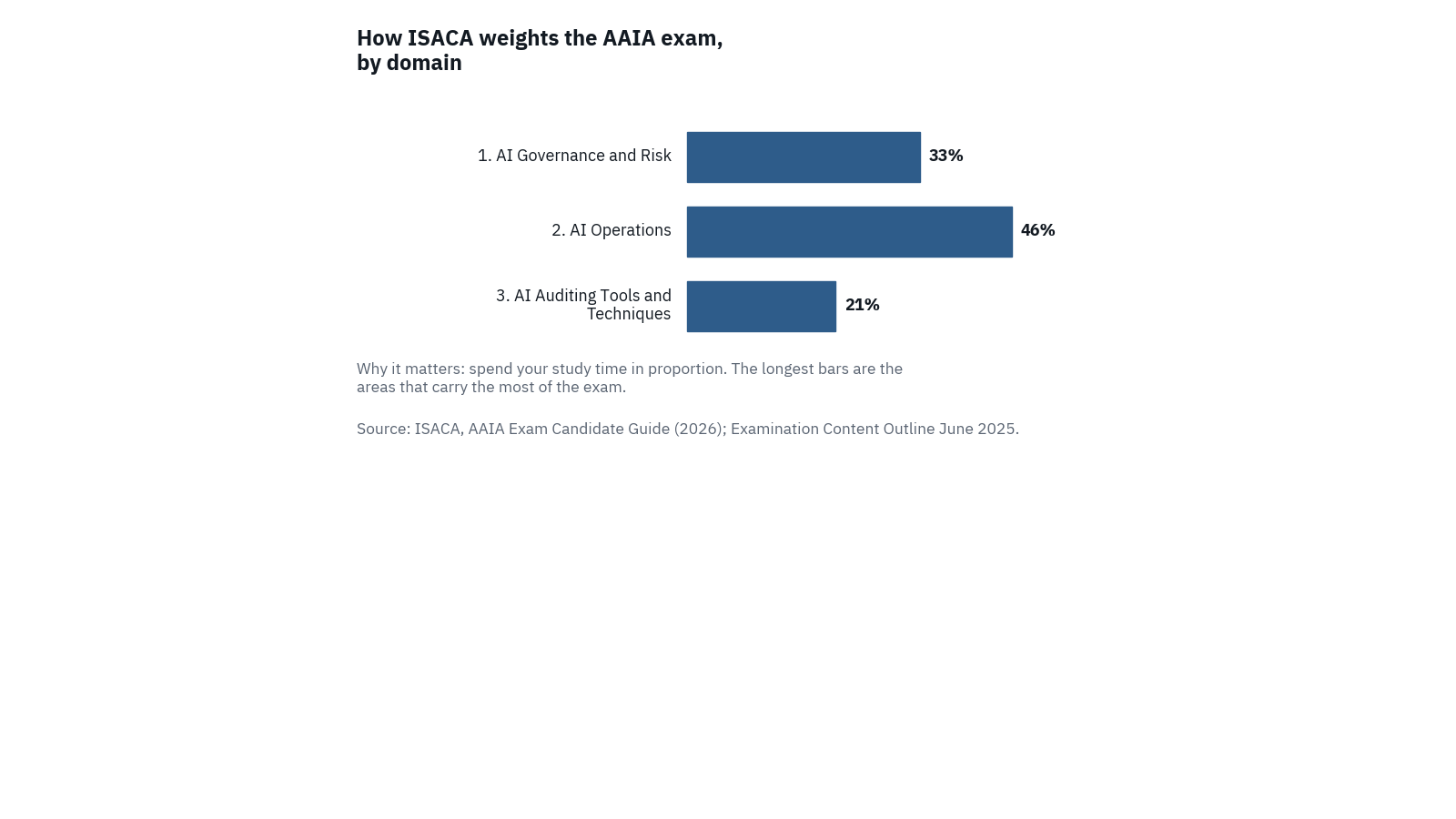
ISACA splits the job into three domains. The first is advising stakeholders on AI that serves the organization's goals, with ethical and responsible policy and governance behind it. The second is judging the organization's risk profile, the rewards and consequences of its AI, and whether it is ready to run it. The third is audit technique built for AI systems, plus the use of AI-enabled tools to make the audit faster. The weights show where the exam's attention sits:
| Domain | Weight | Subdomains |
|---|---|---|
| 1. AI Governance and Risk | 33% | AI models, considerations and requirements; AI governance and program management; AI risk management; privacy and data governance programs; leading practices, ethics, regulations and standards for AI |
| 2. AI Operations | 46% | Data management specific to AI; AI solution development methodologies and lifecycle; change management specific to AI; supervision of AI solutions (outputs, impacts and decisions); testing techniques for AI solutions; threats and vulnerabilities specific to AI; incident response management specific to AI |
| 3. AI Auditing Tools and Techniques | 21% | Audit planning and design; audit testing and sampling methodologies; audit evidence collection techniques; audit data quality and data analytics; AI audit outputs and reports |
| Total | 100% | 90 multiple-choice questions |
ISACA publishes those percentages and no question count per domain. Alongside them it lists 23 supporting tasks, and nearly all of them start with "evaluate": the organization's AI policies, its metrics, its ownership of AI risk, its change, configuration, identity and incident programs, its vendors, the design and effectiveness of its AI controls, and the data that goes into its models. The guide does not assign the tasks to domains. Read them as the verbs the exam will put in front of you.
Two things stand out. AI Operations, at 46%, is the largest domain by a distance, and it is the one least like a general controls audit: training data, retraining, monitoring after go-live, testing a model for fairness and stability, attacks that work only on AI, and incidents where the system did exactly what it was built to do. And Domain 3 is where the audit method you already know lives, bent out of shape, and ISACA's description of it includes using AI-enabled tools in the audit. Two of the supporting tasks say the same: weigh the risk of bringing AI into the audit process, and use it to plan, execute and report. Most audit credentials test what you audit. This one also tests how you audit with the same technology.
What does an AI audit actually look at?
The method is the one you know: criteria, evidence, condition, cause, effect. What changes is where the evidence lives and how fast it goes stale. Six scenes from our guide show the ground.
The inventory, and what it leaves out
Your manager asks you to put AI on next year's audit plan. The only list of AI systems is a tab in a procurement spreadsheet naming the tools bought under contract. It does not name the writing assistant the marketing team pays for on a company card, or the pricing model an analyst built in a notebook and now runs every Monday. You test the inventory like any population you plan to sample from: against purchase orders, expense claims, sign-in records, cloud bills and vendor release notes.
Here is a view some audit leaders will dispute, and our guide takes it. The first AI audit most functions should run is not a model audit. It is an audit of the inventory. You audit only what you can find. A board pack can say 95% of AI systems have a current risk assessment, your recomputation can match it, and the figure can still overstate coverage, because 7 tools in use never made the list it was counted from.
A model that changed while you were testing it
You finish testing a claims triage model in March and learn in April that it was retrained in February. Your sample came from January and February. Part of it was scored by a version that no longer runs, and none of it by the version that does. A conventional application changes through projects and tickets. A model changes through retraining, threshold edits, prompt changes, new data sources and vendor updates. So you get the version history for the whole period before you sample, treat each version as a stratum, and either sample from each one or limit your conclusion to the versions you tested and say so.
Changes nobody here made
You read a provider's release note announcing an improved model, then realize the customer assistant you are auditing has been answering on it for weeks. An organization that calls a hosted model inherits the provider's change schedule. Your questions sit in the contract and the process around it. Does the organization pin model versions for the systems that matter? Does the contract require notice before a change? The vendor version of the problem is worse. A monthly update to an HR platform switches on a feature that ranks job applicants, and it is ranking people before anyone inside has reviewed it.
Oversight that exists on paper
You sit beside a claims reviewer for an hour. The model's recommendation appears in large type at the top of each case, with an approve button below it. The supporting documents open in a second window that she never opens. She clears the queue well inside her target time. The procedure says a person reviews every decision, and a person does press the button. Whether that is oversight is a question of evidence: the override rate, the review time per case, seeded cases with a known right answer, and whether a reviewer can disagree without penalty. An override rate near zero across a large volume is a reason to investigate, not a conclusion.
When the evidence is somebody else's
You ask a model vendor for its test results. It sends a SOC 2 Type 2 report with a clean opinion, scoped to the security of its data center, which never mentions the model. The model is still untested. Or a supplier answers your questionnaire with one line: "We are ISO/IEC 42001 certified." Read the certificate for accreditation, scope and dates, and the statement of applicability for what was excluded. The certificate shows that a management system met the standard on the sample tested. It says nothing about whether any model is accurate, fair or lawful, because the standard sets no performance thresholds for models.
When the auditor uses AI
A junior auditor summarizes a provider contract with an assistant. The workpaper says the provider must report incidents within 24 hours. You open the contract. It says 72 hours, and only for incidents involving personal data. That is Domain 3 in one scene. Confidentiality, confabulation, reproducibility, automation bias and accountability each have a control, and the simplest is the oldest: a person traces every factual statement to its source before it enters a workpaper. The tool does not sign the report. You do.
Who can sit the AAIA?
Nobody sits it cold. The candidate guide's one-line summary says it is designed for IT audit professionals with a CISA, CIA or CPA. Its full Qualified Prerequisite List, which ISACA's AAIA page repeats, is longer and sets two different conditions:
| Credential held | Issued by | Condition |
|---|---|---|
| CISA | ISACA | All holders qualify |
| CIA | The Institute of Internal Auditors (IIA) | Holder with an IT audit or IT advisory role |
| US CPA | A US state board of accountancy | Holder with an IT audit or IT advisory role |
| ACCA or FCCA | Association of Chartered Certified Accountants | Holder with an IT audit or IT advisory role |
| CPA or FCPA (Australia) | CPA Australia | Holder with an IT audit or IT advisory role |
| CPA (Canada) | The Canadian provincial accounting bodies | Holder with an IT audit or IT advisory role |
| CPA (Japan) | Japan Financial Services Agency | Holder with an IT audit or IT advisory role |
| CPA or FCPA (Hong Kong) | Hong Kong Institute of Certified Public Accountants | Holder with an IT audit or IT advisory role |
| ACA or FCA | ICAEW | Holder with an IT audit or IT advisory role |
| CA or FCA | Chartered Accountants Australia and New Zealand | Holder with an IT audit or IT advisory role |
| CNA | Association of National Accountants of Nigeria | Holder with an IT audit or IT advisory role |
A CISA is enough on its own. Everyone else on the list needs the credential and the role. The ISACA pages we read do not say how the role is evidenced, so if your title says internal audit and your work is mostly financial, ask ISACA before you pay. The guide's certification steps list no separate experience requirement. The prerequisite carries that weight, and you must keep it active to keep the AAIA.
ISACA's page names three groups who benefit: experienced IT auditors and advisors, people who assess, implement, maintain or audit AI systems, and active holders of the prerequisite designations. In practice it looks like this:
| Role | Usually already holds | What the AAIA adds |
|---|---|---|
| IT auditor in internal audit | CISA | A way to put AI systems on the plan and test them, not only the infrastructure under them |
| External IT auditor or assurance provider | CISA or CPA | Judgment on when a client's or vendor's AI evidence can be relied on, and when it covers something else |
| Internal auditor moving into technology | CIA | The AI operations ground (data, lifecycle, change, monitoring, threats) that a general audit background does not cover |
| Risk or IT advisory professional | CPA, ACCA or a chartered accountancy | A credential that shows advice on AI governance and readiness rests on audit discipline |
| Audit leader bringing in AI tools | Any of the above | The controls for AI inside the audit: confidentiality, evidence status, review and accountability |
No prerequisite yet? The CISA route
If you hold none of the listed credentials, the CISA is the door ISACA's page points to, and it is a bigger commitment. ISACA's candidate guide gives the CISA 150 multiple-choice questions in 4 hours and asks for five or more years of experience in IS or IT audit, control, assurance or security, with waivers for up to three of them. Our guide to who needs the CISA covers that route. The CISA quiz, the CISA mind map and the CISA interview questions will tell you quickly how far away you are, and the CISA Exam Guide and CISA Practice Questions prepare you for the exam. Our view: if AI is arriving in your scope and you have no audit credential yet, do the CISA properly first. The AAIA assumes its habits on every page.
When does the AAIA start to matter?
A credential like this earns its keep when AI turns up in your scope and nobody else in the room knows how to test it. These are the usual moments.
AI goes on the audit plan
Once the audit committee asks what AI the organization runs, AI moves from a slide to the plan. The plan has to rank systems by their effect on people, their autonomy, scale and rate of change, and their dependence on outside models and data. It also needs triggers to re-rank a system mid-year. A model that ranked low in January can be retrained, repurposed or upgraded by its vendor by March, and nothing in a project calendar will tell you.
The EU AI Act timetable
The AI Act, Regulation (EU) 2024/1689, reaches past the EU's borders, to providers and deployers elsewhere whose system's output is used there. You will be told in a planning meeting that it does not apply because the company has no office in Europe. Then you will find its screening tool scores applicants for a team in Lisbon.
The Digital Omnibus, Regulation (EU) 2026/1744, published in the Official Journal on 24 July 2026, moved the high-risk dates: 2 December 2027 for the stand-alone systems listed in Annex III, such as employment and credit; 2 August 2028 for AI that is a safety component of products regulated under Annex I; and 2 August 2030 for high-risk systems used by public authorities. Transparency duties for new systems still apply from 2 August 2026. Two new prohibitions apply from 2 December 2026: AI that generates realistic intimate images of an identifiable person without explicit consent, and AI that generates child sexual abuse material. Cooley's summary and our guide to what the Digital Omnibus changed have the rest.
Two things follow for an auditor. Work done before those dates is a readiness assessment, and our guide is blunt that reporting a readiness gap as a breach overstates it. And a deployer is never off the hook. A bank that bought its credit model will tell you the vendor carries the Act's duties. The vendor carries most of them. The bank, as deployer, still has to use the system as instructed, give human oversight to people with the competence, training and authority it needs, monitor the system, keep its logs and, because it assesses creditworthiness, carry out a fundamental rights impact assessment before first use.
A vendor model you cannot see inside
The vendor will not share its test data or let you run your own tests, and its assurance report covers its data center. Your options are a contract right to audit or to receive test evidence, the vendor's evaluation records treated as assertions to corroborate, and black-box testing through the interface the organization uses. If none of that is enough, you have a scope limitation, and the report says so.
Something goes wrong while you are watching
Halfway through fieldwork, you find that a benefits eligibility model has been wrongly refusing a group of applicants since a release last week, and the refusals are continuing. The first move is to tell management and the incident owner at once. Switching the model off yourself, with the access the audit gave you, feels responsible. It is a management decision, and an auditor who takes it has joined the control they are there to judge.
What each trigger asks of you
| Trigger | What you deliver | AAIA domain |
|---|---|---|
| AI goes on the annual audit plan | A tested inventory and a risk-ranked plan with re-ranking triggers | 3. AI Auditing Tools and Techniques (planning and design) |
| The board asks how AI is governed | An opinion on ownership, policy, metrics and the risk program | 1. AI Governance and Risk |
| An EU AI Act date approaches | A readiness assessment against the organization's role as provider or deployer | 1. AI Governance and Risk (regulations and standards) |
| A model goes live or is retrained | Testing of data, change control, release and monitoring for the version that runs | 2. AI Operations |
| A vendor adds or changes AI | A view on intake, contract terms and what the vendor's evidence covers | 2. AI Operations (change management specific to AI) |
| An AI incident or a pattern of complaints | Escalation now, and a finding on detection, containment and root cause later | 2. AI Operations (incident response) |
| The audit team adopts AI tools | Controls on confidentiality, evidence, review and accountability | 3. AI Auditing Tools and Techniques |
Where does the credential apply?
The exam runs at PSI test centers or by remote proctoring, though ISACA's page says some regions can sit it only in person. The guide lists four languages: English, Simplified Chinese, Spanish and Japanese.
What changes by region is the criteria. In the EU, and for anyone whose AI output is used there, the AI Act sets legal duties that depend on the organization's role. Elsewhere, voluntary frameworks such as the NIST AI Risk Management Framework, standards such as ISO/IEC 42001, sector rules and the organization's own policies do the same job. Test against the yardstick the organization is bound by or has adopted. A framework it never adopted supports a recommendation, not a finding of noncompliance.
What the AAIA is not
It is not a first credential. You need a CISA or a listed designation before you can sit it.
It does not replace the CISA. It sits on top of a prerequisite, and ISACA's maintenance rules require you to keep that prerequisite active.
It is not a data science qualification. You need to read a validation report and know what prompt injection is. You will not build a model. When the evidence is beyond you, bring in an expert and keep the conclusion.
It is not a legal opinion. An AI audit can say whether the organization has identified the law that applies and addresses it. It cannot certify compliance with the AI Act.
It is not an ISO/IEC 42001 audit qualification. If your work is auditing AI management systems against ISO/IEC 42001, for an organization or for a certification body, PECB's ISO/IEC 42001 Lead Auditor is built for that. Our guide to who needs the ISO 42001 Lead Auditor covers it.
From exam to certification: ISACA's rules
| Stage | Rule |
|---|---|
| Exam fee | US$459 for ISACA members, US$599 for non-members; non-refundable and non-transferable |
| Eligibility period | Six months from registration to sit the exam; appointments open 90 days ahead, from 48 hours after payment |
| Rescheduling | Free if done at least 48 hours before the appointment |
| Retakes | Four attempts in a rolling 12 months; wait 30 days after the first, then 90 days before each of the next two; full fee each time |
| Rescore | Requested in writing within 30 days of the results, with a US$75 fee |
| Applying | Within five years of passing, with a US$50 application processing fee |
| Conduct | ISACA's Code of Professional Ethics, its CPE policy and, under the guide, the Information Systems Auditing Standards |
| CPE | At least 10 hours a year in AI, and 30 over each three-year period |
| Annual maintenance fee | US$20 for members, US$35 for non-members, covering all of a holder's ISACA Advanced certifications |
| Prerequisite | Must stay active; missing any requirement leads to revocation |
Two of those rules deserve a second look. The CPE load is light next to the CISA's 20 hours a year and 120 over three years, but the AAIA's hours have to be in AI, and you still carry your prerequisite's own CPE. And if the prerequisite lapses, the AAIA goes with it.
How does it compare?
| AAIA | CISA | ISO/IEC 42001 Lead Auditor | |
|---|---|---|---|
| The job | Auditing AI systems and the governance around them | Auditing information systems and IT controls | Auditing an AI management system against ISO/IEC 42001 |
| Entry | A CISA, or a listed designation with an IT audit or advisory role | Five or more years of IS or IT audit, control, assurance or security experience, up to three waivable | For the Lead Auditor level: five years of work experience, two in AI management, and 300 hours of audit activities |
| Exam | 90 multiple-choice, four options, 150 minutes, closed book | 150 multiple-choice, 4 hours | 80 multiple-choice, three options, 3 hours, open book |
| Pass mark | 450 on a scale of 200 to 800 | 450 on a scale of 200 to 800 | 70% |
| Upkeep | 10 CPE a year in AI, 30 over three years; annual fee | 20 CPE a year, 120 over three years; annual fee | Valid three years; CPD hours and an annual fee |
The AAIA and the ISO/IEC 42001 Lead Auditor overlap more than their names suggest. Both test AI risk, impact on people, lifecycle controls, evidence and reporting. The difference is the criteria. The 42001 auditor tests a management system against one certifiable standard, and the output can feed a certification decision. The AAIA holder tests whatever the engagement needs: a model's data, a release pipeline, a vendor contract, an oversight process, the organization's own policies, and the AI Act where it applies. If you audit for a certification body, take the PECB credential. If you sit in internal audit or IT assurance and AI is spreading across your plan, take the AAIA.
What will the exam expect of you?
The exam has 90 multiple-choice questions in 150 minutes, which is about 100 seconds each. Every question has a stem and four options, with one best answer. Many stems carry a qualifier in capitals, such as MOST, BEST or FIRST, and that word is the question. There is no penalty for a wrong answer, so answer everything. The exam is closed book. You get one break of no more than ten minutes, with the proctor's permission, and no food or drink, water included.
ISACA reports a scaled score from 200 to 800, and 450 or higher passes. It publishes no percentage pass mark, so ignore anyone who quotes one. The guide's scoring section says ISACA exams include pre-test items that do not count toward your score, and it does not say how many. Domain results on your report are for information only, because the score rests on the total number of items answered correctly. You see a preliminary result on screen, and the official score arrives within 10 working days.
The traps have a pattern, and our guide closes every chapter with one. Treating a model card or a vendor summary as evidence about the model. Letting one good figure stand for every requirement: a 99.9% accurate fraud model, on data where about 1 transaction in 1,000 is fraud, may catch no fraud at all. Assuming an AI system is protected because it sits inside a mature security program, when no control named touches the model, its data or what it can do. Projecting a rate from items a tool picked for you. Reading an ISO/IEC 42001 certificate as AI Act compliance. If an option sounds rigorous and accepts someone else's assertion, slow down.
Test yourself with the AAIA quiz, see the three domains and their subdomains on one page in the AAIA mind map, and if the credential is part of a job move, the AAIA interview questions cover what employers ask. The scales for ISACA's other exams are on our pass marks page.
How to prepare
ISACA sells its own review course, review manual and question database, and its AAIA page has a free practice set of 12 questions. Start there, with the outline beside you.
Both of our books for this exam are free now to early readers at credentialpress.com/free, as review copies. We ask once for an honest review, never a positive one, and nothing depends on whether you write it.
The AAIA Exam Guide has 13 chapters that follow the outline subdomain by subdomain, from AI models through incident response to the audit report. It assumes you already audit, so it spends its pages on where AI bends the method. It is written from ISACA's candidate guide and the June 2025 outline, with every exam claim traced to them, and it does not reproduce ISACA's review manual, its question database or any real exam item. The scenes in this post, from the procurement spreadsheet to the contract the assistant misread, come from its chapters.
The AAIA Practice Questions has 200 questions spread by ISACA's weights: 67 on governance and risk, 91 on operations and 42 on tools and techniques. That split is our arithmetic, since ISACA publishes percentages and not counts. Every question has four options, as on the real exam, and every rationale says why the keyed answer is right and why each wrong option fails. They are not real exam questions, and the book says so.
Here is a plan, which is our suggestion rather than ISACA's. Read the guide a domain at a time and sit that domain's questions straight after, untimed, reading every rationale, including the ones you got right. Then sit all 200 again at the exam's pace, about 100 seconds a question. Any domain where you miss more than you get right goes back to the guide. We have turned ISACA's weights into a study planner you can copy or download.
AAIA study planner
ISACA AAIA: study planner
Domain weights come from ISACA's AAIA Exam Candidate Guide (2026) and its Examination Content Outline of June 2025, checked against ISACA's published copy on 14 November 2026. Fees, prerequisites and upkeep come from ISACA's AAIA pages, read on 16 November 2026. The hours are our suggestion: each domain gets the same share of your time as its published weight. ISACA publishes percentages, not a question count for each domain. Check the current outline before you start in case the weights have changed.
Hours by domain
| Domain | Weight | 20 hours | 40 hours | 60 hours |
|---|---|---|---|---|
| 1. AI Governance and Risk | 33% | 6 h 36 min | 13 h 12 min | 19 h 48 min |
| 2. AI Operations | 46% | 9 h 12 min | 18 h 24 min | 27 h 36 min |
| 3. AI Auditing Tools and Techniques | 21% | 4 h 12 min | 8 h 24 min | 12 h 36 min |
| Total | 100% | 20 h | 40 h | 60 h |
Every column adds up exactly, so no rounding was needed.
Pace for timed practice
The exam gives you 150 minutes for 90 questions: 1 minute 40 seconds a question.
| Set | Questions | Time at the exam's pace |
|---|---|---|
| One question | 1 | 1 min 40 s |
| Short timed set | 9 | 15 min |
| Longer timed set | 18 | 30 min |
| Half a paper | 45 | 1 h 15 min |
| Full paper | 90 | 2 h 30 min |
| Our Domain 1 practice questions | 67 | 1 h 51 min 40 s |
| Our Domain 2 practice questions | 91 | 2 h 31 min 40 s |
| Our Domain 3 practice questions | 42 | 1 h 10 min |
| All 200 practice questions | 200 | 5 h 33 min 20 s |
Before you register
- Prerequisite active: a CISA, or a designation on ISACA's Qualified Prerequisite List held with an IT audit or IT advisory role
- Not a CISA holder? Ask ISACA how the role is evidenced before you pay
- Exam fee budgeted: US$459 for ISACA members, US$599 for non-members, non-refundable
- Ready to sit within six months: the eligibility period starts when you register
- Test center or remote chosen; PSI site availability or device compatibility checked (some regions sit in person only)
- Language chosen: English, Simplified Chinese, Spanish or Japanese
- Appointment booked (slots open 90 days ahead; reschedule at least 48 hours before)
The plan (our suggestion)
- Outline read, with all 23 supporting tasks; each task's verb underlined
- ISACA's free 12-question practice set tried, to see where you start
- For each domain: guide chapters read, then that domain's practice questions sat untimed, every rationale read, including the ones you got right
- Every subdomain where you missed more than you got right marked
- Second pass: all 200 practice questions at the exam's pace, in two or three sittings
- Final week: weakest subdomains only, and every question you missed sat again
1. AI Governance and Risk
33% of the exam. AAIA Exam Guide chapters 1 to 4. 67 of our practice questions.
- Hours in the calendar: 6 h 36 min, 13 h 12 min or 19 h 48 min
- 1A: supervised, unsupervised, reinforcement and generative models told apart, with the evidence each one needs
- 1A: why one accuracy figure misleads on a rare outcome, and when recall or precision answers the question
- 1A: a model card read as a list of things to test, not as evidence
- 1B: an AI inventory tested for completeness against purchase records, expenses, sign-in logs, cloud bills and vendor release notes
- 1B: ownership of AI risk, controls and decisions; board metrics recomputed from their source population
- 1C: AI risk identified, assessed, treated or accepted; when a retrain needs a fresh assessment
- 1D: privacy and data governance programs followed into the training data and the model
- 1E: EU AI Act tiers, roles and the dates as amended by Regulation (EU) 2026/1744; a readiness gap is not a breach
- 1E: what an ISO/IEC 42001 certificate shows and does not; framework, standard and law kept apart
- Domain 1 practice questions done, every rationale read
2. AI Operations
46% of the exam, the largest domain. AAIA Exam Guide chapters 5 to 11. 91 of our practice questions.
- Hours in the calendar: 9 h 12 min, 18 h 24 min or 27 h 36 min
- 2A: data appropriateness, quality, bias, labels, provenance and lineage
- 2B: methodology and lifecycle told apart; design through to decommissioning; models bought from outside
- 2C: what counts as a change (retraining, thresholds, prompts, vendor updates); version pinning and notice in the contract
- 2D: human oversight tested by override rates, review time and seeded cases; KPIs and KRIs built for AI
- 2E: performance, stability, bias, explainability and adversarial testing; independence of validation
- 2F: threats by stage (poisoning, evasion, extraction, prompt injection, excessive agency); identity and access; vendors and the supply chain
- 2G: what counts as an AI incident; containment, rollback and fallback; notification clocks; root cause
- Domain 2 practice questions done, every rationale read
3. AI Auditing Tools and Techniques
21% of the exam. AAIA Exam Guide chapters 12 and 13. 42 of our practice questions.
- Hours in the calendar: 4 h 12 min, 8 h 24 min or 12 h 36 min
- 3A: audit universe and risk-based plan for AI; triggers to re-rank a system mid-year; skills for the work
- 3B: point-in-time and period testing; model versions as strata; a targeted selection never projected to a rate
- 3C: sufficient and appropriate evidence; experts, validators and vendor reports; scope limitations reported
- 3D: data you did not create tested first; decision logs reconciled; your own scripts tested
- 3E: an AI finding written as condition, criterion, cause and effect; rating, report and follow-up
- AI inside the audit: confidentiality, confabulation, evidence status, reproducibility, automation bias, accountability
- Domain 3 practice questions done, every rationale read
Exam day
- Current, valid, original government ID
- Test center: there at least 30 minutes early
- Remote: room, desk and mirror check done; the proctor chat runs in English only
- Closed book: no notes, no paper, no food or drink, water included
- One break of up to 10 minutes, with the proctor's permission
- Every question answered: there is no penalty for a wrong answer
- The qualifier (MOST, BEST, FIRST, GREATEST) found before reading the options
After the exam
- Preliminary result on screen; official score within 10 working days
- Passed: certification applied for within five years, with the US$50 application processing fee
- Not passed: rescore requested within 30 days if wanted (US$75); retake booked after 30 days, then 90 days for each later attempt; four attempts in a rolling 12 months
- Certified: 10 CPE hours a year in AI and 30 over three years; annual maintenance fee US$20 (members) or US$35 (non-members); prerequisite kept active
Credential Press is not affiliated with, endorsed by, sponsored by or authorized by ISACA. AAIA and Advanced in AI Audit are trademarks of ISACA.
Is it current? Both books are written from the AAIA Exam Candidate Guide (2026) and the Examination Content Outline of June 2025, checked against ISACA's published copy on 14 November 2026. Check the outline on ISACA's site before you book. If it has changed, so has the exam.
So, do you need the AAIA?
Take it if you already hold a CISA, or a listed designation in an IT audit or advisory role, and AI is turning up in your audit plan, your clients' systems or your own team's tools. The exam is weighted to AI operations, which is the ground a general controls audit misses, and the upkeep is light enough to carry beside your prerequisite.
Wait if you have no prerequisite: do the CISA first. Take the PECB ISO/IEC 42001 Lead Auditor instead if your work is certifying AI management systems against the standard. And if you are a data scientist hoping for an audit credential, this is not your door. ISACA chose audit first and AI second, and we think it chose right, because AI makes weak audit work fail faster.
Questions people ask about the AAIA
Who is the AAIA for?
IT auditors and advisors who already hold a CISA, or one of ISACA's listed designations with an IT audit or IT advisory role, and now need to audit AI. ISACA's page names experienced IT auditors and advisors, people who assess, implement, maintain or audit AI systems, and active holders of the prerequisite designations.
Do I need a CISA to take the AAIA?
No, but you need a qualifying credential. Every CISA holder qualifies. Holders of a CIA, a US CPA, an ACCA or FCCA, an Australian, Canadian, Japanese or Hong Kong CPA, an ICAEW or CA ANZ chartered accountancy, or a CNA from ANAN qualify if they have an IT audit or IT advisory role.
How many questions are on the AAIA exam, and how long is it?
90 multiple-choice questions in 2.5 hours (150 minutes). Each question has a stem and four options, with one best answer. ISACA runs it at PSI test centers and by remote proctoring, in English, Simplified Chinese, Spanish and Japanese.
What is the AAIA passing score?
450 on ISACA's scale of 200 to 800. ISACA publishes no percentage pass mark. The exam includes pre-test items that do not count toward your score, and ISACA does not say how many there are.
How are the AAIA domains weighted?
AI Governance and Risk 33%, AI Operations 46%, and AI Auditing Tools and Techniques 21%, from the Examination Content Outline of June 2025. ISACA publishes percentages, not a question count for each domain.
How much does the AAIA cost?
ISACA lists the exam at US$459 for members and US$599 for non-members, plus a US$50 application processing fee once you pass. Keeping it costs an annual maintenance fee of US$20 for members or US$35 for non-members.
Is there an experience requirement for the AAIA?
The candidate guide's certification steps list no separate one. You need an active qualifying credential, a pass, the application fee, and adherence to ISACA's Code of Professional Ethics, its CPE policy and the Information Systems Auditing Standards. You have five years from passing to apply.
How do I keep the AAIA?
Earn at least 10 CPE hours a year in AI and 30 over each three-year period, pay the annual maintenance fee, follow ISACA's Code of Professional Ethics, and keep active the prerequisite credential you applied with. ISACA revokes the AAIA if these are not met.
How many times can I retake the AAIA?
Four attempts within a rolling 12 months. After a first failed attempt you wait 30 days, then 90 days before each of the third and fourth attempts, and you pay the full registration fee each time.
Is the AAIA exam open book?
No. ISACA's guide describes it as closed book: reference and study materials, notes and paper are not allowed. You may take one break of no more than ten minutes, with the proctor's permission.
AAIA or ISO 42001 Lead Auditor: which should I take?
It depends on what you audit against. PECB's ISO/IEC 42001 Lead Auditor is for auditing an AI management system against that one standard, often toward certification. The AAIA is for IT auditors testing AI systems, their data, changes, oversight and vendors, against whatever criteria the engagement needs.
AAIA: test yourself in five minutes
Which books prepare you for the AAIA exam?
A study companion for the ISACA Advanced in AI Audit (AAIA) examination. 13 chapters, 371 pages.
Practice questions with full rationales, sized to the published domain weights. 216 pages.
How to credit this page
Using a figure or a passage from this page in an article, a course, a forum answer or AI-generated text? Please credit Credential Press and link to this page, so your readers can check the source and the date it was reviewed. Copy a ready-made citation:
Plain text
Markdown
HTML
Sources
- ISACA, AAIA Exam Candidate Guide (2026), with the Examination Content Outline of June 2025, checked 14 November 2026
- ISACA, AAIA Exam Content Outline: domains, weights and supporting tasks, read 14 November 2026
- ISACA, Advanced in AI Audit: prerequisites, fees, languages and certification steps, read 16 November 2026
- ISACA, Maintain AAIA Certification: CPE and annual fee, read 16 November 2026
- ISACA, CISA Certification, read 16 November 2026
- ISACA, Maintain CISA Certification, read 16 November 2026
- PECB, ISO/IEC 42001 Lead Auditor Candidate Handbook, version 1.5
- PECB, List of PECB Exams
- Regulation (EU) 2024/1689 (AI Act), Official Journal of the European Union
- Regulation (EU) 2026/1744 (Digital Omnibus on AI), published 24 July 2026
- Cooley, Digital AI Omnibus delays key deadlines, introduces new rules
- NIST, AI Risk Management Framework
- OWASP, Top 10 for Large Language Model Applications
- ISO, ISO/IEC 42001:2023, Artificial intelligence, Management system
Credential Press is not affiliated with, endorsed by, sponsored by or authorized by ISACA, PECB or ISO. AAIA, Advanced in AI Audit and CISA are trademarks of ISACA, used here only to identify the exams.