ISO 42001
Who audits AI? Inside the ISO 42001 Lead Auditor role
The ISO/IEC 42001 Lead Auditor is the person who decides, on evidence, whether an organization's AI management system meets the standard and works the way its documents say it does. That judgment is what a customer leans on before it buys an AI supplier's product, what a board leans on before the certification body arrives, and what a certification body leans on before it issues a certificate. This guide covers what an AI management system audit actually tests, who asks for one, how the job differs from the Lead Implementer's, what PECB's credential levels mean, and what the exam expects.
The exam facts come from PECB's ISO/IEC 42001 Lead Auditor Candidate Handbook, version 1.5, checked against PECB's published copy on 14 November 2026. The course facts come from PECB's course page and its List of PECB Exams, and the legal dates from the Official Journal text of the AI Act and a law firm's summary of the Digital Omnibus, all read on 16 November 2026. The audit practice comes from our own fact-checked guide.
What does an ISO 42001 Lead Auditor do?
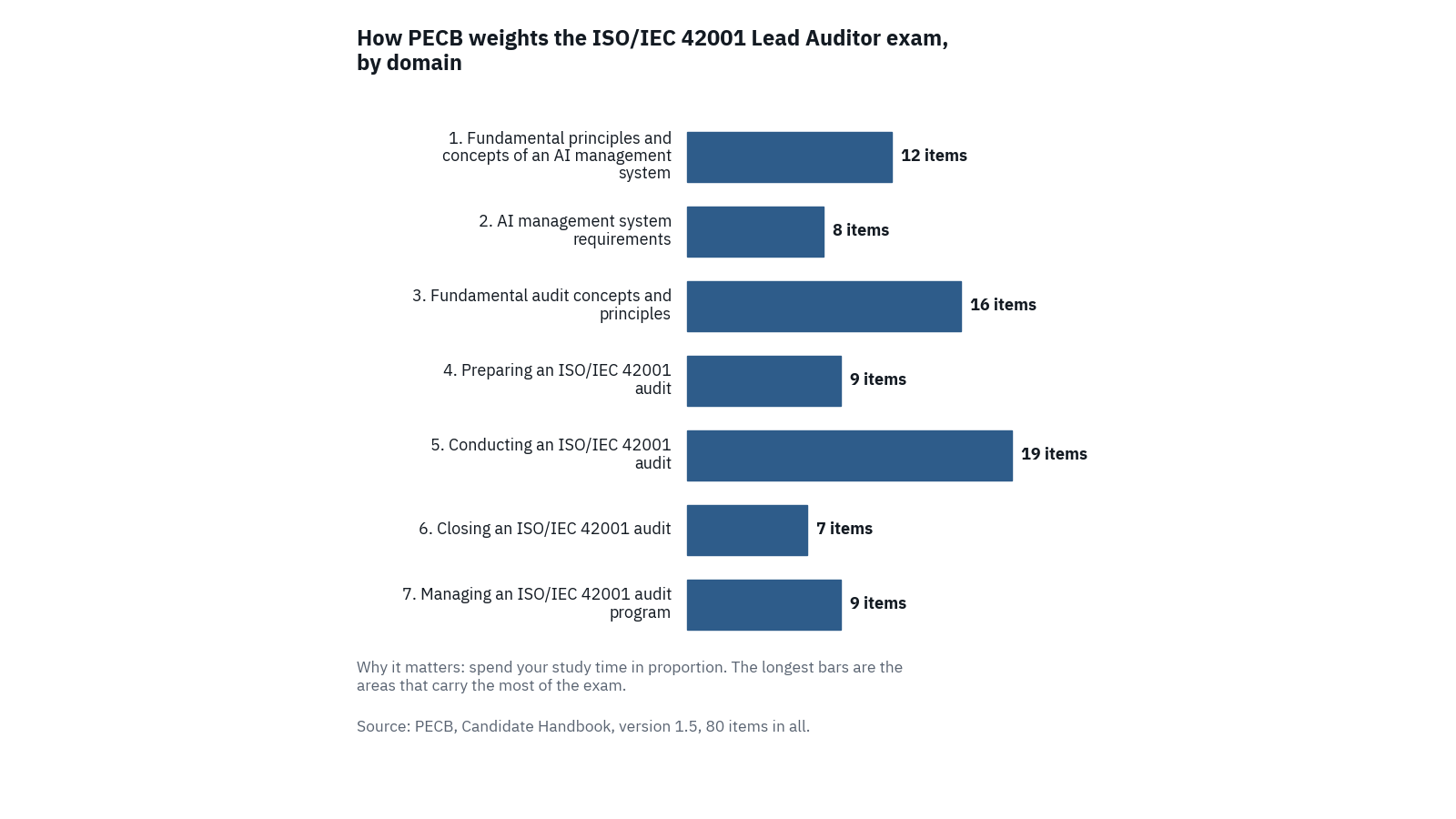
PECB's course page describes the job through what participants learn to do: explain the concepts of an AI management system, interpret the ISO/IEC 42001 requirements from an auditor's perspective, evaluate an AIMS's conformity, plan, conduct and close an audit in accordance with ISO/IEC 17021-1 requirements and ISO 19011 guidelines, and manage an audit program. The exam weights those tasks through the questions it takes from each of seven domains, and the handbook also says which domains test evaluation rather than comprehension:
| Domain | Questions | Share | Level tested |
|---|---|---|---|
| 1. Fundamental principles and concepts of an AI management system | 12 | 15% | Comprehension, application, analysis |
| 2. AI management system requirements | 8 | 10% | Comprehension, application, analysis |
| 3. Fundamental audit concepts and principles | 16 | 20% | Evaluation |
| 4. Preparing an ISO/IEC 42001 audit | 9 | 11.25% | Comprehension, application, analysis |
| 5. Conducting an ISO/IEC 42001 audit | 19 | 23.75% | Evaluation |
| 6. Closing an ISO/IEC 42001 audit | 7 | 8.75% | Comprehension, application, analysis |
| 7. Managing an ISO/IEC 42001 audit program | 9 | 11.25% | Evaluation |
| Total | 80 | 100% | 36 comprehension, 44 evaluation |
Of the 80 questions, 60 come from the five audit domains. AI and the standard itself, domains 1 and 2, carry 20. That balance is the defining fact about the credential. It is an audit qualification, and the AI content is there so the auditor can recognize what a working AI management system looks like and where a weak one hides. Conducting the audit, at 19 questions, is the largest domain: stage 1, the opening meeting, stage 2, interviews, sampling and the evidence everything else depends on.
The level split matters as much as the counts. 44 of the 80 questions measure evaluation, and they sit in the domains about audit principles, conducting the audit and running the program. Knowing that the standard asks for an AI system impact assessment earns you little there. Judging whether the one in front of you was really done, and what to do about it if it was not, is the work those questions test.
Audit, our guide reminds candidates, is a sampling exercise. If the team samples two of five AI systems and finds no problem, that does not mean all five conform. The opinion rests on reasonable assurance, a high level of confidence backed by sufficient sampling, and a good lead auditor says so at the opening meeting rather than leaving it for the report.
What does an AI management system audit actually look at?
This is where the credential stops looking like every other lead auditor course. The audit method is the one ISO 19011 describes for any management system. What you point it at is new, and some of it moves while you are looking.
The scope, and whether it is honest
A scope statement will land on your desk early. Suppose it reads "the development and operation of the customer support chatbot". Then you read the organization's website, and it sells a credit risk model to lenders and uses AI to screen job applicants. The scope statement is true. Your question is whether it is honest. The standard lets an organization set its own AIMS scope, under clause 4.3. It does not let it set one that makes no sense against its own context, and a certification body is expected to judge the proposed scope before it agrees to certify it.
Here is a view some auditors will dispute, and our guide takes it. If an organization leaves its highest-impact AI system outside its AIMS scope and cannot give a credible reason, challenge the scope at stage 1. A narrow first scope can be a sensible start, and the certificate states the scope for anyone who reads it. But a reader who sees "ISO/IEC 42001 certified" beside a company name will not read the scope line. An auditor who knows that and says nothing has let the certificate imply more than the audit tested.
The AI-specific machinery
Most of ISO/IEC 42001 reads like any management system standard built on ISO's harmonized structure. The AI material sits mainly in planning and operation. Clause 6 adds AI risk assessment (6.1.2), AI risk treatment (6.1.3) and AI system impact assessment (6.1.4), and clause 8 requires the organization to carry those processes out in operation (8.2 to 8.4). The statement of applicability, which records the controls chosen and why, is a requirement of 6.1.3, and that is where Annex A enters. If you already audit ISO/IEC 27001, the parts that need fresh study are the impact assessment and the link from risk treatment to Annex A. The standard is sold, so read those clauses in your own copy rather than in anyone's summary.
The impact assessment is the one an ISMS auditor has not met before. It asks what an AI system could do to people, to groups and to society, used as intended and in ways it could foreseeably be misused, and it has to feed back into the risk assessment. The people a system affects are rarely in the room when the organization rates its own risks. The impact assessment forces the outward view, and your job is to check that the view changed a decision rather than sitting in a separate file.
Where the evidence lives
Much AIMS evidence lives in platforms: model registries, monitoring dashboards, release records and ticketing systems. Confirm access before the first morning, because discovering on day two that nobody can share the monitoring screen costs the audit a day. Each source proves some things on its own and not others:
| Source | What it can show | What it cannot show alone |
|---|---|---|
| Results of AI risk assessments | That the process ran, and with which criteria | That the chosen treatment was carried out |
| Statement of applicability | Which controls were selected, and why others were left out | That the selected controls operate |
| Results of AI system impact assessments | That effects on individuals, groups and society were considered | That what they found reached the risk work |
| Model cards and system documentation | Intended use, design choices and known limits | That the system in production matches the description |
| Event logs and monitoring dashboards | That recording and monitoring ran over a period | That anyone read the alerts or acted on them |
| Change and release records | That changes were approved and tested | That a significant change led to a fresh assessment |
| Supplier agreements | What the organization required of its AI suppliers | That the suppliers do it |
Read the right-hand column as your next question. A model card tells you what a system is meant to do. The monitoring records and the incident log tell you what it did. When an auditee hands you a model card in place of a risk assessment, thank them and ask again: a model card describes a model and its limits, and it does not assess the risk the organization runs by using that model in a given process.
The trail from decision to practice
The heart of an AIMS stage 2 is a trail. Take one AI system from the sample. Its risk assessment names a risk of unequal error rates between groups of applicants. The treatment plan answers it with testing before each release and monitoring after, and the statement of applicability marks the matching controls as implemented. You ask for the test results from the last release and the monitoring records since. You talk to the person who reviews the monitoring. You check what happened the last time a threshold was crossed, and whether management review heard about it. Each step tests whether the one before it was real. A trail that breaks shows you exactly where the system does not work.
What raises the risk, and where to spend the days
Not every AI system deserves the same audit time. A recruitment screening model and an internal search tool can sit in the same inventory. Our guide lists the features that raise inherent risk in an AIMS: a system that makes or shapes decisions about people's credit, jobs, health, education or access to public services; little human review between output and effect; personal data, or data whose origin is unclear; frequent retraining, so the model you audit may not be the one running next month; a third-party model the organization cannot see inside; and a history of incidents. Give the high-impact stratum more of your sample, or all of it.
The populations are different too. You sample AI systems from the inventory, model releases and retrainings, impact assessments, human oversight decisions, incidents and complaints, AI suppliers and training data sets. An inventory smaller than the scope statement implies is a signal to stop and ask. So is a statement of applicability that gives every Annex A control the same one-line justification, or a folder of impact assessment templates with no completed assessments in it.
When the evidence is beyond you
Sooner or later you will be handed a validation report full of thresholds, or a drift monitor with alert levels somebody chose. Where the auditors cannot judge such evidence, ISO 19011 expects technical experts to support the team, in machine learning, data protection, security or the sector the AI serves. The expert can tell you that a validation used test data that overlapped its training data, and why that matters. The expert never audits alone and never decides a finding: the view goes to the auditor, who owns the conclusion. And the data scientist who helped the lender build its scoring model last year cannot be your expert this year.
Confidentiality carries extra weight on an AIMS audit. The team may see training data holding personal data, model files the organization treats as trade secrets and outputs from live systems. Agree at the opening meeting how evidence will be viewed, such as read-only access or a shared screen, and what, if anything, leaves the auditee's systems.
Who sits the ISO 42001 Lead Auditor?
PECB's course page names the audience: auditors, internal or external, who want to specialize in AIMS audits; managers or consultants who want to master the AIMS audit process; people responsible for keeping an organization conformant with the AIMS requirements; expert advisors in AI management; and people who analyze business requirements for AI or build and design AI systems. The prerequisite is a fundamental understanding of ISO/IEC 42001 and of AI principles and concepts. Those people audit in three settings, and the same method serves all three:
| Audit | Who does it | Who relies on the report | What the credential adds |
|---|---|---|---|
| First-party (internal) | Internal auditors, AI governance and risk staff, compliance teams | Top management and the AIMS owner | A method that will hold up when the certification body samples the same AI systems |
| Second-party (supplier) | Vendor risk, procurement, security and privacy assessors at a customer buying AI | The customer deciding whether to buy, renew, renegotiate or walk away | A way to test a supplier's AIMS against criteria the customer chose, beyond its questionnaire answers |
| Third-party (certification) | Auditors working for certification bodies | The certification decision, and everyone who later relies on the certificate | Evidence of competence, alongside the body's own ISO/IEC 17021-1 and ISO/IEC 42006 requirements |
Within those settings sit very different careers. An internal auditor moves into AI risk. An ISO/IEC 27001 or privacy auditor adds AI to a portfolio of audits. A data scientist who used to validate models now audits how they are managed. A consultant who built an AIMS for one client moves to auditing other people's. The method is the same; the independence, the audience and the weight of a finding differ.
Independence is the part that changes most, and AI makes it easy to get wrong, because the people who know the models best are often the people who built them. Objectivity rules out an auditor checking their own work: a data scientist can audit procurement, but not the model validation she performed herself. A certification body must not act as a management system consultant for the organizations it certifies, and under ISO/IEC 17021-1 it cannot use a person who consulted for the client on its management system in the previous 2 years. In every setting the duty is the same: stay on the evidence, and refuse pressure to soften or harden a finding.
What the job looks like in numbers
No US occupation code covers AI management system auditing. Two bracket it: Accountants and Auditors on the audit side, and Data Scientists on the AI side. O*NET gives these figures from Bureau of Labor Statistics data:
| Measure | Accountants and Auditors (13-2011) | Data Scientists (15-2051) |
|---|---|---|
| Employment, 2025 | 1,595,200 | 275,600 |
| Median annual wage, 2025 | $83,680 | $120,230 |
| Projected growth, 2025 to 2035 | Faster than average (5% to 6%) | Much faster than average (7% or higher) |
| Projected job openings, 2025 to 2035 | 115,300 | 24,800 |
The first occupation is dominated by accountants and financial auditors, and the second by people who build models rather than audit their management. The table shows the two professions an AIMS auditor sits between, not the size of the AIMS audit market, for which we found no official figure. PECB's course page speaks of rising demand for skilled AIMS auditors. That is PECB's own claim, and we found no figure to test it against.
Who asks for an AIMS audit, and when?
A certified AIMS creates audit work on a fixed rhythm. Customers, changes and the law add more.
An organization decides to certify
Initial certification runs in two stages. Stage 1 looks at readiness: the documented information, the scope, the risk and impact assessments, and whether stage 2 can go ahead. Its output is written, and areas of concern go to the auditee before stage 2. Stage 2 checks that the AIMS is really in place and doing its job. A certificate then runs on a 3-year cycle, with surveillance audits at least once each calendar year, the first within 12 months of the certification decision, and a recertification audit before the cycle ends.
You will meet the client who wants the certificate before a board meeting in March, finished building its AIMS 3 weeks ago, and has its first internal audit booked for February. Sales asks for stage 1 and stage 2 back to back in January. Readiness is a gate, not a date. Clause 9.2 requires the organization to run its own internal audit program, the certification body cannot run it for them, and stage 1 checks that internal audits and management review are planned and being performed. An organization a month away from its first internal audit has little to show.
A customer will not buy without assurance
AI systems are built from parts that come from elsewhere: a licensed model, a supplier's API, a labeled data set, a cloud platform. ISO/IEC 42001 expects the organization to keep control of the externally provided processes that matter to its AIMS, under clause 8.1, and Annex A carries controls on how responsibility is shared across the supply chain. A second-party audit is one way a customer exercises that control. The customer requests it, the supplier is audited, the criteria can include contract terms beside the standard, and no certificate results. It informs a business decision instead.
The EU AI Act timetable
The AI Act, Regulation (EU) 2024/1689, puts its heaviest duties on high-risk systems. Article 17 requires providers of high-risk AI systems to put a quality management system in place, documented as written policies, procedures and instructions. Article 26 requires deployers to use high-risk systems in line with their instructions for use and to assign human oversight to people with the competence, training and authority to do it. The Digital Omnibus, Regulation (EU) 2026/1744, moved the dates: 2 December 2027 for the stand-alone Annex III systems such as employment and credit, 2 August 2028 for AI built into products regulated under Annex I, such as medical devices and machinery, and 2 August 2030 for high-risk systems used by public authorities. Cooley's summary gives the late arrival of harmonized standards as the main reason for the Annex III delay. Our guide to what the Digital Omnibus changed has the full list.
That timetable sends organizations looking for evidence that their AI governance works. Here is the email you will get the week before stage 1: "Once we are certified, we can show the regulator that we comply with the AI Act. Correct?" The honest answer is no. Under Article 40, the presumption of conformity comes from harmonized standards whose references are published in the Official Journal, and whether any ISO/IEC AI standard holds that status depends on whether it has been cited. Your audit can say whether the AIMS has identified the legal requirements that apply to its AI and addresses them as it says it does. It cannot give a legal verdict, and a report that pretends to would mislead everyone who reads it.
Something goes wrong, or something changes
Some findings cannot wait for the closing meeting. Suppose that on day 2 of stage 2 you find a model used to triage benefit claims has been wrongly rejecting a group of applicants for 2 weeks, and the error is still happening. ISO 19011 expects evidence of a serious risk that is live now to reach the auditee straight away. You tell the audit team leader and the auditee's responsible manager at once and follow your certification body's procedures. You do not go to the regulator alone.
Change creates audit work too. A client that retrains its models, switches the supplier of the language model behind its chatbot, or buys a firm that trains its own models has changed what the original audit examined. It has to tell the certification body without delay, and the certification body decides what follows, from the next surveillance audit to a special audit such as a scope extension. And when an auditee says a system was "switched off last week", that is a claim to verify, with a record of who decided and what happened to its data.
What each trigger asks of the auditor
| Trigger | What the auditor delivers | PECB domain | Source of the requirement |
|---|---|---|---|
| The internal audit program | A risk-based program covering the AI systems and processes over the cycle | 7. Managing an audit program | ISO/IEC 42001, clause 9.2 |
| A stage 1 certification audit | A written readiness review of the scope, AI policy, risk and impact assessments and statement of applicability | 5. Conducting | ISO/IEC 17021-1 |
| A stage 2 certification audit | Trails from risk assessment to monitoring and management review, and graded findings | 5. Conducting; 6. Closing | ISO/IEC 17021-1 |
| A surveillance audit | Confirmation the certified AIMS still works after retraining, new systems and new suppliers | 7. Managing an audit program | ISO/IEC 17021-1 |
| A supplier audit of an AI vendor | A scope tied to the model, API or data bought, and findings the customer can act on | 4. Preparing; 5. Conducting | The customer's contract; ISO/IEC 42001, clause 8.1 |
| A serious live harm found mid-audit | Immediate communication to the team leader and the auditee's responsible manager | 3. Audit concepts and principles | ISO 19011 |
| AI Act preparation | Evidence that the AIMS identified its legal obligations and addresses them, never a legal verdict | 3. Audit principles; 6. Closing | Regulation (EU) 2024/1689, Articles 17, 26 and 40, as amended by Regulation (EU) 2026/1744 |
Lead Auditor or Lead Implementer?
PECB runs two lead-level ISO/IEC 42001 schemes, and it is easy to take the wrong one first. The Lead Implementer builds the AIMS: the scope, the AI policy, the risk and impact assessments, the statement of applicability, the controls and the records. The Lead Auditor tests it. The exams show the split plainly. The implementer's handbook puts 20 of its 80 questions on planning an AIMS and 18 on implementing one; the auditor's puts 60 on the audit method. The implementer's evaluation questions, 48 of them, ask what an implementer should do next. The auditor's 44 ask what the evidence shows and what the auditor does about it.
| ISO/IEC 42001 Lead Auditor | ISO/IEC 42001 Lead Implementer | ISO/IEC 27001 Lead Auditor | |
|---|---|---|---|
| The job | Auditing an AIMS against ISO/IEC 42001 | Building and running an AIMS | Auditing an ISMS against ISO/IEC 27001 |
| Exam | 80 multiple-choice questions, 3 hours, open book, 70% to pass | ||
| Where the questions go | 60 on the audit method; 20 on AI and the standard | 20 on planning; 18 on implementing; 17 on fundamentals | 59 on the audit method; 21 on the ISMS and the standard |
| Evaluation questions | 44 of 80 | 48 of 80 | 40 of 80 |
| Full credential needs | Five years, two in AI management; 300 audit hours | Five years, two in AI management; 300 project hours | Five years, two in information security management; 300 audit hours |
| Upkeep | Valid three years; CPD hours and an annual maintenance fee | ||
The two ISO/IEC 42001 credentials are two sides of one standard, and many consultants hold both. Our opinion, which some trainers will argue with: if you have already built an AIMS, the auditor credential is the better second step than a second implementer course. You know what a real impact assessment costs to produce, which makes you hard to fool with a template. You also cannot audit the system you built. Self-review is exactly what the audit principles rule out, so the move is to audit other organizations' systems, or a part of your own you had no hand in.
If you are still building, start on the other side. Our guide to who needs the ISO 42001 Lead Implementer covers that route, and the ISO 42001 Lead Implementer Exam Guide and ISO 42001 Lead Implementer Practice Questions prepare you for its exam. If you later move to audit work, that build knowledge is what will let you read a statement of applicability quickly. For the ISMS side, our ISO 27001 Lead Auditor guide covers the sister credential.
Where does the credential apply?
ISO/IEC 42001 is an international standard, published by ISO and the IEC in 2023, and Annex D explains that an AIMS can serve any sector where AI is developed, provided or used. PECB's certification scheme for the Lead Auditor is specified in compliance with ISO/IEC 17024, the standard for bodies that certify people. PECB runs the exam online through the PECB Exams application, supervised remotely by a PECB invigilator, or on paper through a partner. Its List of PECB Exams shows the 80-question exam in 11 languages: English, French, German, Italian, Spanish, Portuguese (BR), Japanese, Korean, Traditional Chinese, Turkish and Ukrainian.
The reasons to audit differ by region. The AI Act reaches providers and deployers whose AI is placed on the EU market or whose outputs are used in the Union, as Cooley's summary notes, so a supplier in Toronto that sells into the EU can be inside it. Elsewhere, customer contracts, sector regulators and voluntary frameworks such as the NIST AI Risk Management Framework do the same job. The audit method does not change at a border. The law the audit criteria include does, and the audit plan should name it before fieldwork starts.
What the credential is not
It is not an implementer credential. The Lead Auditor tests a system; the Lead Implementer builds one. An organization hiring for one should not accept the other.
It does not turn an audit into a verdict on a model. The certificate an AIMS audit leads to says the organization's management system conforms within a stated scope. ISO/IEC 42001 sets no accuracy target, no fairness metric and no error rate. A model card that calls a model "ISO/IEC 42001 certified" makes a product claim the certificate does not support, and our guide treats it as a misuse of the mark.
It does not make you a regulator. The audit can show that the AIMS identified the law that applies and addresses it, and nothing more.
It is not an appointment to audit for a certification body. Certification bodies operate under ISO/IEC 17021-1 and ISO/IEC 42006 and set their own competence requirements. The credential is evidence they can take into account.
It is not a copy of the standard. ISO/IEC 42001 is sold rather than published. PECB lets you take a hard copy into the exam, and you will need your own.
Which credential level can you claim?
| Credential | Exam | Professional experience | AIMS audit/assessment experience |
|---|---|---|---|
| PECB Certified ISO/IEC 42001 Provisional Auditor | ISO/IEC 42001 Lead Auditor exam or equivalent | None | None |
| PECB Certified ISO/IEC 42001 Auditor | Two years, one of them in AI management | 200 hours of audit activities | |
| PECB Certified ISO/IEC 42001 Lead Auditor | Five years, two of them in AI management | 300 hours of audit activities | |
| PECB Certified ISO/IEC 42001 Senior Lead Auditor | Ten years, seven of them in AI management | 1,000 hours of audit activities |
Every level also requires signing the PECB Code of Ethics. To count, audit activities have to follow best audit practice and include planning an audit, managing an audit program, drafting audit reports, nonconformity reports and working documents, managing the documented information related to the audit, conducting on-site audits, following up nonconformities and leading an audit team. Certifications are valid for three years. Keeping one means completing the required CPD hours and paying the annual maintenance fee; miss them and PECB suspends the certification for a 12-month period, and revokes it if they are still outstanding at the end.
One detail deserves a call to PECB before you apply. The handbook heads its hours column "AIMS audit/assessment experience". PECB's course page heads the same column "MS audit/assessment experience", which is how the ISO/IEC 27001 Lead Auditor handbook words it too. If your audit log is mostly ISO/IEC 27001 or ISO 9001 work, the two readings give different answers. Ask, and claim the level you can evidence today.
What will the exam expect of you?
The exam has 80 multiple-choice questions, one point each, and you need 70%, which is 56 correct answers. Each question has three options: one keyed answer and two distractors. PECB's List of Exams gives 3 hours, and candidates sitting a Lead exam in a language that is not their own can ask on the day for 30 additional minutes. It is open book: a hard copy of ISO/IEC 42001, the training course materials and any personal notes taken during the course. Online results arrive instantly, and a candidate who fails gets a list of the domains where they performed poorly.
Questions are stand-alone or scenario-based, and a scenario carries five questions. PECB's own sample gives you Company A, an AI solutions firm going into its stage 1 audit. The team reviews the strategic documents first, then risk management, then processes, then supporting forms. It notices inconsistencies in the AI policy and procedures, and some documents lack version numbers and approval dates. It does not fully assess the technological infrastructure. Then it reports its stage 1 conclusions verbally. Every one of those details is a question waiting to be asked.
The traps follow a pattern. The biggest is reading more into a certificate than it says: an option that says "certification shows the AI system is fair" or "demonstrates compliance with the EU AI Act" sounds like a natural summary and is wrong. Close behind are the four scopes that look alike: the scope of the standard, the AIMS scope the organization sets, the scope of certification, and the audit scope the certification body establishes. Then correction against corrective action, where a correction fixes the missing assessment and corrective action stops next month's retrained model going live the same way. Then the benefit of the doubt, which never covers a record the standard says must be kept: "we did the assessment but never wrote it down" describes how the requirement was missed. And then dates, where the first surveillance audit counts 12 months from the certification decision, not from the end of stage 2.
Test yourself with the ISO 42001 Lead Auditor quiz, see the seven domains on one page in the mind map, and if the credential is part of a job move, the interview questions page covers what employers ask. The pass marks for this and every other exam we cover are on our pass marks page.
How to prepare
Most candidates sit the exam at the end of a PECB partner course. PECB's agenda runs four days of training and the exam on day five: the AIMS and ISO/IEC 42001, audit principles and preparation, on-site audit activities, and closing the audit. Participants get training material of over 450 pages, an attestation worth 31 CPD credits, and a free retake within 12 months if the first attempt fails. Without a course, PECB's handbook lists the Lead Exam at $1,000 and the application fee at $500.
Both of our books for this exam are free now to early readers at credentialpress.com/free, as review copies. We ask once for an honest review, never a positive one, and nothing depends on whether you write it.
The ISO 42001 Lead Auditor Exam Guide has 13 chapters, each mapped to a published competency domain, and 60 of the 80 exam questions it prepares you for are about running the audit, which is where its weight sits. It is written from PECB's Candidate Handbook version 1.5, with every exam claim traced to it, and it contains no clause text and no Annex A control text. The scenes in this post, from the honest scope to the model card handed over in place of a risk assessment, come from its chapters.
The ISO 42001 Lead Auditor Practice Exams has three complete papers of 80 questions each, 240 in all, drawn from each of PECB's seven domains exactly as the exam does. Every question has three options, like the real thing. Answers come after each paper, so you sit it straight through, and every rationale says why the keyed answer is right and why each distractor fails. They are not real exam questions, and the book says so.
Three papers suggest a plan, which is our suggestion rather than PECB's. Sit the first before or early in the course, untimed, to see which domains are new to you. Sit the second straight after the course, open book as the exam allows, in 3 hours. Keep the third for the week before the exam. If you clear 56 out of 80 on the third paper with time to spare, you are ready; if not, the domain counts tell you where to go back to. We have turned the handbook's counts and levels into a study planner you can copy or download.
ISO 42001 Lead Auditor study planner
PECB ISO/IEC 42001 Lead Auditor: study planner
Question counts and levels come from PECB's ISO/IEC 42001 Lead Auditor Candidate Handbook, version 1.5, checked against PECB's published copy on 14 November 2026. The exam length comes from PECB's List of PECB Exams, read on 16 November 2026. The hours are our suggestion: each domain gets the same share of your time as it has of the 80 questions. Check the current handbook before you start in case the counts have changed.
Hours by domain
| Domain | Questions | Share | 20 hours | 40 hours | 60 hours |
|---|---|---|---|---|---|
| 1. Fundamental principles and concepts of an AI management system | 12 | 15% | 3 | 6 | 9 |
| 2. AI management system requirements | 8 | 10% | 2 | 4 | 6 |
| 3. Fundamental audit concepts and principles | 16 | 20% | 4 | 8 | 12 |
| 4. Preparing an ISO/IEC 42001 audit | 9 | 11.25% | 2.25 | 4.5 | 6.75 |
| 5. Conducting an ISO/IEC 42001 audit | 19 | 23.75% | 4.75 | 9.5 | 14.25 |
| 6. Closing an ISO/IEC 42001 audit | 7 | 8.75% | 1.75 | 3.5 | 5.25 |
| 7. Managing an ISO/IEC 42001 audit program | 9 | 11.25% | 2.25 | 4.5 | 6.75 |
| Total | 80 | 100% | 20 | 40 | 60 |
Hours are in quarter hours: 0.25 is 15 minutes, 0.5 is 30 minutes and 0.75 is 45 minutes. Every column is exact, at 15, 30 and 45 minutes per question, so no rounding was needed.
Hours by level
| Level | Domains | Questions | Share | 20 hours | 40 hours | 60 hours |
|---|---|---|---|---|---|---|
| Comprehension, application, analysis | 1, 2, 4 and 6 | 36 | 45% | 9 | 18 | 27 |
| Evaluation | 3, 5 and 7 | 44 | 55% | 11 | 22 | 33 |
| Total | 80 | 100% | 20 | 40 | 60 |
The evaluation domains are where practice questions earn their time: they ask what the evidence shows and what the auditor should do next, not what the standard says.
Pace for timed practice
| Set | Questions | Time at the exam's average pace |
|---|---|---|
| One question | 1 | 2 minutes 15 seconds |
| One scenario set | 5 | 11 minutes 15 seconds |
| Short timed set | 20 | 45 minutes |
| Half a paper | 40 | 1 hour 30 minutes |
| Full paper | 80 | 3 hours |
Sitting in a language that is not your own? PECB gives 30 additional minutes on a Lead exam if you ask on the day.
Three practice papers (our suggestion)
- Paper 1 before or early in the course, untimed: mark every domain where you missed more than you got right
- Paper 2 straight after the course, open book, timed at 3 hours
- Paper 3 in the week before the exam, timed; 56 out of 80 is the pass line, so aim to clear it with time to spare
- After each paper, every rationale read, including the ones for questions you got right
1. Fundamental principles and concepts of an AI management system
12 questions, 15%. Level: comprehension, application, analysis. Matching course day, on our reading of PECB's agenda: day 1.
- Hours in the calendar: 3, 6 or 9
- Can say what an ISO/IEC 42001 certificate covers, and why it is not a statement that any AI system is safe, fair or legal
- Four scopes told apart: the standard, the AIMS, certification, and the audit
- Who does what: ISO and the IEC, the certification body, the accreditation body, the audit team, and the standard each one works to
- Machine learning, deep learning and neural networks: how the terms nest
- The AI system life cycle, stage by stage, and why it loops back
- The EU AI Act, the NIST AI Risk Management Framework and ISO/IEC 42001 sorted into law, voluntary framework and certifiable standard
- Practice questions done untimed, every rationale read
2. AI management system requirements
8 questions, 10%. Level: comprehension, application, analysis. Matching course day, on our reading: day 1.
- Hours in the calendar: 2, 4 or 6
- Hard copy of ISO/IEC 42001 tabbed at clauses 4 to 10 and Annexes A to D (our suggestion)
- Where the AI-specific requirements sit: AI risk assessment, risk treatment and impact assessment in clause 6, and their operation in clause 8
- Which annexes are normative and which informative, and what that means for an auditor
- What makes a statement of applicability justification real, and what a copied one tells you
- One timed set at 2 minutes 15 seconds a question
3. Fundamental audit concepts and principles
16 questions, 20%. Level: evaluation. Matching course day, on our reading: day 2.
- Hours in the calendar: 4, 8 or 12
- The seven principles of auditing, with one AIMS example of each
- First-, second- and third-party audits, including a supplier audit of an AI vendor
- Inherent, control and detection risk on an AIMS; materiality; reasonable assurance
- What to do with evidence of a serious risk that is live now
- At least half the hours spent on practice questions (our suggestion)
- For every practice question, said why each wrong option is wrong before checking the answer
4. Preparing an ISO/IEC 42001 audit
9 questions, 11.25%. Level: comprehension, application, analysis. Matching course day, on our reading: day 2.
- Hours in the calendar: 2.25, 4.5 or 6.75
- Team leader, team members and technical experts: who does what, and who owns a finding
- Feasibility for an AIMS audit: access to model registries, monitoring output and supplier evidence
- The AIMS scope against the audit scope, and who sets each
- Practice questions done untimed, every rationale read
5. Conducting an ISO/IEC 42001 audit
19 questions, 23.75%. Level: evaluation. Matching course day, on our reading: day 3.
- Hours in the calendar: 4.75, 9.5 or 14.25
- Stage 1 against stage 2: purpose, place and output
- The opening meeting for an AIMS: confidentiality of training data and model files, and how evidence will be viewed
- The six evidence collection procedures: interview, documented information review, observation, analysis, sampling and technical verification
- The populations an AIMS gives you to sample, and why to stratify by impact
- The benefit of the doubt, and the records it never covers
- Scenario sets done as sets of five, timed at 11 minutes 15 seconds a set
6. Closing an ISO/IEC 42001 audit
7 questions, 8.75%. Level: comprehension, application, analysis. Matching course day, on our reading: day 4.
- Hours in the calendar: 1.75, 3.5 or 5.25
- Findings reviewed against the audit objectives and criteria before the closing meeting
- What the audit report must contain under ISO/IEC 17021-1, and why there is only one version of it
- Correction against corrective action, and what makes an action plan acceptable
- Practice questions done untimed, every rationale read
7. Managing an ISO/IEC 42001 audit program
9 questions, 11.25%. Level: evaluation. Matching course day, on our reading: day 4.
- Hours in the calendar: 2.25, 4.5 or 6.75
- Follow-up, surveillance and recertification, and the first surveillance audit counted from the certification decision
- An audit program built on PDCA, and how to tell activity from effectiveness
- Combined audits with ISO/IEC 27001 or ISO 9001
- Trademark rules: why a model card that says "ISO/IEC 42001 certified" is a product claim
- At least half the hours spent on practice questions (our suggestion)
Before day five
- Materials ready: a hard copy of ISO/IEC 42001, your training course materials and the personal notes you took during the course, in the PECB Exams app or printed (PECB rule)
- Notes written outside course hours? Ask your trainer or PECB whether they count before you rely on them (our suggestion)
- Valid ID ready: national ID card, driver's license or passport (PECB rule)
- Be there, or logged in, at least 30 minutes before the start (PECB rule)
- Sitting in a language that is not your own: ask for the 30 additional minutes on the day (PECB rule)
Is it current? Both books are written from PECB's Candidate Handbook version 1.5, checked against PECB's published copy on 14 November 2026. Check PECB's site for a newer handbook before you book, and ISO's page for ISO/IEC 42001 before you buy your copy of the standard.
So, should it be you?
Take the Lead Auditor if your job is to judge an AI management system on evidence: internally, at an AI supplier, before certification or for a certification body. The exam is about the audit method, the levels let you claim the audit hours you have actually logged, and the AI Act timetable has given organizations a reason to want auditors who can tell a working AIMS from a folder of templates.
Take the Lead Implementer instead if your job is to build or run the AIMS, and come back to the auditor credential once you have built one. If you already audit ISMSs, this is the shortest route into AI work, because the method carries over and only the AI content is new. And if you are new to auditing, start where the levels start: pass the exam, log the audit hours, and claim the Lead Auditor title when the hours are real.
Questions people ask about the ISO 42001 Lead Auditor
Who is the ISO 42001 Lead Auditor for?
People who will audit AI management systems. PECB's course page lists auditors, internal or external, who want to specialize in AIMS audits; managers and consultants who want to master the AIMS audit process; people responsible for keeping an organization conformant with ISO/IEC 42001; expert advisors in AI management; and people who analyze business requirements for AI or develop and design AI systems.
What is the difference between the ISO 42001 Lead Auditor and Lead Implementer?
The Lead Implementer builds and runs an AI management system. The Lead Auditor tests one against ISO/IEC 42001 and reports on what the evidence shows. Both exams have 80 questions, but the auditor's exam puts 60 of them on the audit method, while the implementer's spends 20 on planning an AIMS and 18 on implementing one.
What experience do I need for the full ISO 42001 Lead Auditor?
PECB's handbook asks for five years of work experience, two of them in AI management, and 300 hours of audit activities, plus the exam and the PECB Code of Ethics. With less, you can hold the Provisional Auditor (exam only) or the Auditor (two years, one in AI management, and 200 audit hours).
What is the pass mark for the ISO 42001 Lead Auditor exam?
70%. The exam has 80 multiple-choice questions worth one point each, so 56 correct answers is the pass mark. Each question has three options: one keyed answer and two distractors.
Is the ISO 42001 Lead Auditor exam open book?
Yes. PECB allows a hard copy of ISO/IEC 42001, the training course materials and any personal notes taken during the course, in the PECB Exams app or printed.
How long is the ISO 42001 Lead Auditor exam?
PECB's List of PECB Exams gives 3 hours for the 80-question multiple-choice exam. If you sit it in a language that is not your own, the handbook lets you ask on the day for 30 additional minutes on a Lead exam.
Does an ISO 42001 certificate mean an organization's AI is safe, fair or legal?
No. The certificate says a certification body audited the organization's AI management system within a stated scope and found that it conforms to ISO/IEC 42001. It is not a test result for any model and not a ruling under the EU AI Act or any other law.
Does the Lead Auditor credential let me audit for a certification body?
It is evidence of competence, not an appointment. Certification bodies work under ISO/IEC 17021-1, and for AI management systems ISO/IEC 42006 adds requirements, including on the competence of the people who audit. Each body decides who may audit for it.
How much does the ISO 42001 Lead Auditor exam cost?
If you sit without a course, PECB's handbook lists the Lead Exam at $1,000 and the certification application fee at $500. A course delivered by a PECB partner includes the first exam attempt, one free retake, the application fee and the first year of the annual maintenance fee.
Do my ISO 27001 audit hours count toward the ISO 42001 Lead Auditor?
Check with PECB before you apply. The ISO/IEC 42001 Lead Auditor handbook heads its hours column AIMS audit/assessment experience, while PECB's course page heads the same column MS audit/assessment experience. The two readings give different answers for hours logged on ISO/IEC 27001 or ISO 9001 audits.
How long is the certification valid?
Three years. To keep it, you complete the required CPD hours and pay the annual maintenance fee. If you miss them, PECB suspends the certification for a 12-month period, and it can be revoked if they are still outstanding at the end.
ISO/IEC 42001 Lead Auditor: test yourself in five minutes
Which books prepare you for the ISO 42001 Lead Auditor exam?
ISO 42001 Lead Auditor Exam Guide
A study companion for the PECB Certified ISO/IEC 42001 Lead Auditor examination. 13 chapters, 354 pages.
ISO 42001 Lead Auditor Practice Exams
Three complete 80-question practice papers with full rationales. 317 pages.
How to credit this page
Using a figure or a passage from this page in an article, a course, a forum answer or AI-generated text? Please credit Credential Press and link to this page, so your readers can check the source and the date it was reviewed. Copy a ready-made citation:
Plain text
Markdown
HTML
Sources
- PECB, ISO/IEC 42001 Lead Auditor Candidate Handbook, version 1.5, checked 14 November 2026
- PECB, ISO/IEC 42001 Lead Auditor course: audience, objectives, agenda, credential levels, read 16 November 2026
- PECB, List of PECB Exams: duration, format and languages, read 16 November 2026
- PECB, ISO/IEC 42001 Lead Implementer Candidate Handbook, version 1.5
- PECB, ISO/IEC 27001 Lead Auditor Candidate Handbook, multiple-choice exam, version 1.5
- ISO, ISO/IEC 42001:2023, Artificial intelligence, Management system
- ISO, ISO 19011:2018, Guidelines for auditing management systems
- ISO, ISO/IEC 17021-1:2015, Requirements for bodies providing audit and certification of management systems
- ISO, ISO/IEC 42006, Requirements for bodies providing audit and certification of AI management systems
- Regulation (EU) 2024/1689 (AI Act), OJ L, 12 July 2024, Articles 17, 26 and 40
- Regulation (EU) 2026/1744 (Digital Omnibus on AI), published 24 July 2026
- Cooley, Digital AI Omnibus delays key deadlines, introduces new rules
- O*NET OnLine, 13-2011.00 Accountants and Auditors (BLS data)
- O*NET OnLine, 15-2051.00 Data Scientists (BLS data)
Credential Press is not affiliated with, endorsed by or authorized by PECB, ISO or the IEC. Exam names and trademarks belong to their owners.