ISO 9001
The ISO 9001 Lead Auditor: who audits quality systems
ISO says more than one million ISO 9001 certificates have been issued in 189 countries. Every one of them rests on audits: internal audits by the organization, audits by its customers, and the certification body's audits that issue the certificate and keep it alive. The ISO 9001 Lead Auditor is the person who leads those audits. This guide is about who they are, the certification cycle they work in, what ISO 9001:2026 means for the next few years of audits, and what PECB's credential and exam ask of you.
The facts here come from ISO's page for ISO 9001:2026, PECB's ISO 9001 Lead Auditor Candidate Handbook for the multiple-choice exam, version 1.6, PECB's course page, the EU public procurement Directive, and O*NET OnLine, all read on 20 October 2026.
What does an ISO 9001 Lead Auditor do?
An auditor gathers objective evidence about a quality management system, compares it with the audit criteria, and reports what conforms and what does not. A lead auditor plans the audit, runs the team, and is accountable for the conclusions. PECB's multiple-choice exam weights the job through the questions it takes from each of seven domains:
| Domain | Questions | Share |
|---|---|---|
| 1. Fundamental principles and concepts of a QMS | 10 | 12.5% |
| 2. Quality management system requirements | 11 | 13.75% |
| 3. Fundamental audit concepts and principles | 10 | 12.5% |
| 4. Preparing an ISO 9001 audit | 10 | 12.5% |
| 5. Conducting an ISO 9001 audit | 18 | 22.5% |
| 6. Closing an ISO 9001 audit | 11 | 13.75% |
| 7. Managing an ISO 9001 audit program | 10 | 12.5% |
Of the 80 questions, 59 come from the five audit domains, and conducting the audit is the largest single one. That is the honest shape of the job. A quality auditor needs to know ISO 9001 well enough to recognize conformity, but most of the work is the method: planning, sampling, interviewing, observing, recording, grading and reporting.
Our guide is direct about what good auditing looks like. Asked how to audit a specific process, a weak answer describes reading policies and checking manuals from a conference room; a strong one goes where the work happens. Effectiveness matters as much as conformity: an organization can have every procedure in place, but if its customer complaint rate is doubling every month, the system is not effective. And the notes must be clear enough that another auditor could read them and reach the same conclusions. A scenario will often hand you a confident claim about compliance, and the trap is to accept it and move on.
Who audits quality systems?
PECB says its ISO 9001 Lead Auditor course is intended for auditors seeking to perform and lead QMS audits, managers or consultants seeking to master the QMS audit process, individuals responsible for maintaining conformity to ISO 9001 in an organization, technical experts preparing for QMS audits, and expert advisors in quality management. Their work falls into three kinds of audit:
| Audit | Who does it | Who relies on it | What can follow from a finding |
|---|---|---|---|
| First-party (internal) | The organization's own quality staff and trained internal auditors | Top management and the QMS owner | Corrective action before the certification body finds the same problem |
| Second-party (supplier) | A customer's supplier quality or procurement auditors | The customer deciding whether to buy, or keep buying | Conditions on the contract, or a change of supplier |
| Third-party (certification) | Auditors working for an accredited certification body | The certification decision, and every customer who trusts the certificate | A certificate issued, kept, suspended or withdrawn |
The three share a method and differ in independence and consequence. An internal auditor can fix a problem by telling management; a supplier auditor can cost the supplier a contract; a certification body auditor can cost the organization its certificate. The higher the consequence, the more the evidence has to carry the weight, and the PECB exam treats all three as variations on the same discipline.
The people in those roles
In practice the roles are familiar ones: a quality manager who also runs the internal audit program, a supplier quality engineer who audits suppliers on a rotating plan, a consultant who carries out pre-certification audits for clients, a technical specialist brought into an audit team for a particular process, and the career auditor at a certification body. Some of them come to auditing from quality management itself, and PECB's experience rule reflects that: the full Lead Auditor needs two years of work experience in quality management, not only audit hours.
Competence, and what a lead auditor owns
Our guide puts competence at the center of the role. An auditor who takes an assignment they lack the technical competence for has breached the principle before the audit even starts, however scrupulously they behave on site, and claiming competence you do not have is a serious ethical violation. Competence carries extra weight for a team leader, because the leader also manages the team, handles conflict, decides the sampling strategy and owns the conclusion. That is why audit teams bring in technical experts for unfamiliar processes, and why PECB's course audience includes technical experts preparing for QMS audits.
Competence also controls risk. Detection risk, the chance that an audit misses a real problem, increases when samples are too small, when the auditor lacks competence in the area audited, or when the audit is rushed. Confidentiality is part of the same discipline: findings are not discussed with anyone outside the audit team and the agreed recipients, including colleagues in other parts of the auditor's own firm.
What the job looks like in numbers
No US occupation code covers quality auditing alone. Two bracket it: Quality Control Systems Managers, on the quality side, and Accountants and Auditors, on the audit side. O*NET gives these figures from Bureau of Labor Statistics data:
| Measure | Quality Control Systems Managers (11-3051.01) | Accountants and Auditors (13-2011) |
|---|---|---|
| Median annual wage, 2025 | $126,060 | $83,680 |
| Projected growth, 2025 to 2035 | Average (3% to 4%) | Faster than average (5% to 6%) |
| Projected job openings, 2025 to 2035 | 17,000 | 115,300 |
Neither occupation is quality auditing, and the second is dominated by financial auditing. The table brackets the profession; we found no official count of QMS auditors.
The certification cycle: where the work comes from
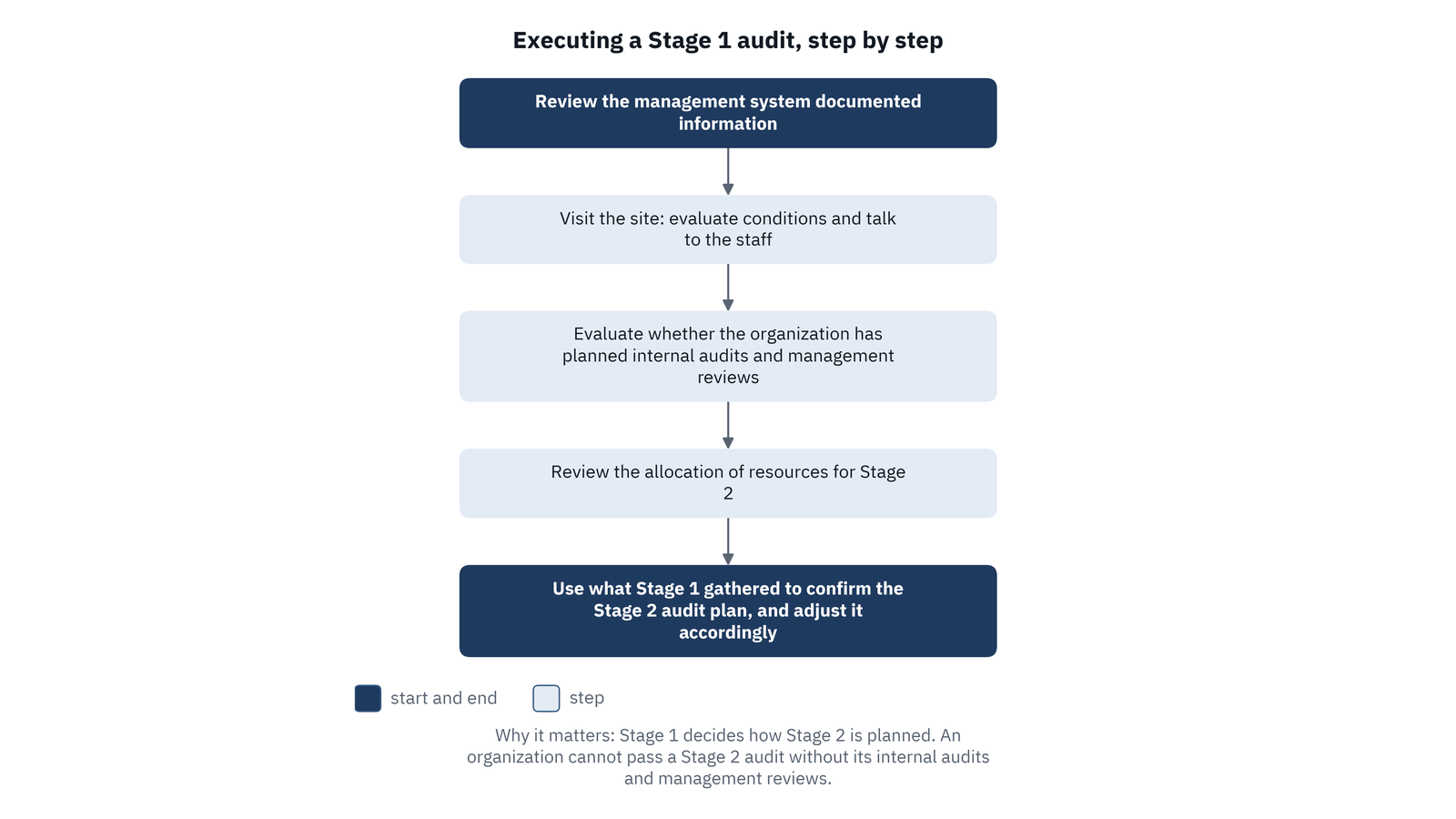
Most third-party quality auditing follows the same cycle, and internal auditing is built to support it. Our guide sets out each stage, and the hero chart above is its stage 1 flowchart.
Before certification
An organization cannot pass a stage 2 audit without having completed its internal audits and management reviews. That is the first source of audit work: an internal audit program that covers the scope before the certification body arrives.
Stage 1
The stage 1 audit reviews the organization's documented information and evaluates its site-specific conditions to determine whether it is ready for stage 2. The auditor visits the site, talks to staff, checks that internal audits and management reviews are planned, and reviews the resources for stage 2. A gap at this point is an area of concern, an issue that could become a nonconformity during stage 2. It is not graded as a nonconformity itself, and an answer that issues a major nonconformity at stage 1 is wrong. A target with no method behind it is a wish, and stage 1 is where an auditor notices that.
Stage 2
Stage 2 is the full audit of the system in operation. A nonconformity at this stage is a formal finding stating that a requirement is not fulfilled. The auditor goes where the work is done, checks effectiveness against results, and grades findings on the evidence.
Surveillance and recertification
After certification, the cycle turns. Our guide notes that the first surveillance audit falls inside a year of the certification decision, counting from the decision itself rather than from the end of stage 2. A surveillance audit samples only part of the system, so its scope is narrower: it might cover the headquarters and one regional office. A recertification audit in year three is a full system audit covering the whole scope, to renew the cycle. If an auditee refuses a surveillance audit, the auditor documents the refusal and recommends suspension to the certification body.
Running the internal audit program
For an in-house quality auditor, the program is the job. Our guide describes an audit program as a machine made of people, whose output is set by who you put in the room and how honestly they behave once they are there. Establishing one means setting objectives, risks and opportunities, extent, resources, competence, procedures and roles, then a schedule shaped by process importance, change and previous results. A program that only checks conformity, and never whether processes are effectively implemented, is incomplete.
What each stage asks of the auditor
Here is the cycle laid out as work. For each stage, the second column is what the auditor delivers, the third is the PECB domain that teaches it, and the fourth is the trap our guide warns about.
| Stage | What the auditor delivers | PECB domain | The trap |
|---|---|---|---|
| Internal audit program | Audits across the scope before certification, and evidence of corrective action | 7. Managing an audit program | Treating internal audit as optional; stage 2 cannot pass without it |
| Stage 1 | A readiness review and a confirmed stage 2 plan | 4. Preparing an audit | Grading a stage 1 gap as a nonconformity |
| Stage 2 | Graded findings on conformity and effectiveness | 5. Conducting; 6. Closing | Auditing documents from a meeting room instead of the process |
| Surveillance | A sampled audit verifying the system remains effective | 5. Conducting | Counting the first surveillance from the end of stage 2 instead of the decision |
| Recertification | A full system audit of the whole scope | 4. Preparing; 5. Conducting | Scoping it like a surveillance visit |
| Transition to ISO 9001:2026 | Audits against the new edition, and evidence of gaps closed | 2. Requirements; 7. Audit program | Auditing against the wrong edition |
| Supplier audit | Findings a customer can act on, tied to what it buys | 4. Preparing; 5. Conducting | Accepting a confident claim of compliance without evidence |
We have turned the cycle into a planner, with a line for each stage, that you can copy or download below.
QMS certification cycle audit planner
QMS certification cycle audit planner
Use this to plan the audits across one ISO 9001 certification cycle, whether you are the organization's internal auditor or the certification body's lead auditor. The stages follow the audit practice taught for PECB's ISO 9001 Lead Auditor exam. ISO 9001 is sold rather than published; check requirement wording against your own copy of the edition you are auditing (ISO 9001:2026 is current).
Before certification
- Internal audits completed across the scope (an organization cannot pass stage 2 without them)
- A management review held and recorded
- The edition being certified named in full: ISO 9001:2026, or a transition agreed with the certification body
Stage 1
- Documented information reviewed, including the organization's context and scope
- Site visited: conditions evaluated, staff spoken to
- Internal audits and management reviews planned or done
- Resources for stage 2 reviewed
- Gaps reported as areas of concern to resolve before stage 2 (not graded as nonconformities)
- Stage 2 audit plan confirmed and adjusted
Stage 2
- Processes audited where the work happens, not only from documents in a meeting room
- Effectiveness checked against results (for example complaint trends), not only conformity on paper
- Each nonconformity states the requirement not fulfilled and the evidence
- Notes clear enough that another auditor would reach the same conclusions
Surveillance (years one and two)
- First surveillance audit within a year of the certification decision (counting from the decision itself)
- Scope sampled, not the whole system: sites and processes chosen for this visit: ____________
- If the auditee refuses a surveillance audit: document the refusal and recommend suspension
Recertification (year three)
- A full system audit covering the whole scope
- Objectives set in advance (for example, the highest-risk processes confirmed effective)
What ISO 9001:2026 means for auditors
ISO published ISO 9001:2026, the sixth edition, on 16 September 2026, and lists ISO 9001:2015 and its 2024 amendment as withdrawn. ISO says the new edition focuses on clarity, emphasizes quality culture and leadership, separates risks and opportunities, and aligns more closely with other ISO management system standards. Certified organizations, ISO says, will have to transition to the new version within the timeframe set by their certification cycle.
For auditors, that means two things for the next few years. There will be transition work: gap analysis, internal audits against the new edition, and certification body audits that confirm each organization has moved. And there will be two editions in use at once, so every audit plan has to name the edition it audits against, in full. ISO itself asks certified organizations to use the full designation, such as "certified to ISO 9001:2026," for the same reason.
Where does the credential apply?
ISO 9001 certificates are recognized wherever accredited certification bodies operate, and PECB's scheme is specified in compliance with ISO/IEC 17024, the standard for bodies that certify people. PECB runs its exam online through the PECB Exams application or on paper through a partner, and online multiple-choice results arrive instantly.
The reasons organizations seek certification differ by place. In the EU, Article 62 of Directive 2014/24/EU says that where public buyers require certificates of quality assurance, they refer to quality assurance systems based on the relevant European standards series certified by accredited bodies. Elsewhere, customers' supplier requirements do the same work. Behind every one of those certificates is a certification audit.
What the credential is not
It is not an appointment to audit for a certification body. Certification bodies work under ISO/IEC 17021-1 and set their own competence requirements. The PECB credential is evidence they can take into account.
It is not an implementer credential. The auditor checks a system; the implementer builds it. Internal quality staff may need both, because they run the system and audit it.
It is not one exam format. PECB's English exam is 80 multiple-choice questions. PECB still publishes an essay-format handbook, but its list of exams gives the English exam as multiple choice. Check which one your course and exam use before you choose study material.
It is not a copy of the standard. ISO 9001 is sold rather than published. PECB lets you take a hard copy into the exam, and you will need your own.
Which credential level can you claim?
| Credential | Exam | Professional experience | Audit activities |
|---|---|---|---|
| PECB Certified ISO 9001 Provisional Auditor | ISO 9001 Lead Auditor exam or equivalent | None | None |
| PECB Certified ISO 9001 Auditor | Two years, one of them in quality management | 200 hours | |
| PECB Certified ISO 9001 Lead Auditor | Five years, two of them in quality management | 300 hours | |
| PECB Certified ISO 9001 Senior Lead Auditor | Ten years, seven of them in quality management | 1,000 hours |
Every level also requires signing the PECB Code of Ethics, and PECB checks the audit log for the hours. Certifications are valid for three years; keeping one means completing the required CPD hours and paying the annual maintenance fee, and missing either leads to a 12-month suspension during which you can make up what is outstanding. The levels protect the people who rely on the title: a Provisional Auditor has passed the exam, a Lead Auditor has also led at least 300 hours of audits.
How does it compare with the credentials around it?
| ISO 9001 Lead Auditor | ISO 9001 Lead Implementer | ISO/IEC 27001 Lead Auditor | |
|---|---|---|---|
| The job | Auditing a QMS | Building and running a QMS | Auditing an information security management system |
| Exam | 80 multiple-choice questions, 70% to pass, open book | ||
| Questions on the method of the job | 59 of 80 on auditing | Planning (17) is the largest domain | 59 of 80 on auditing |
| Full credential needs | Five years, two in quality management; 300 audit hours | Five years, two in quality management; 300 project hours | Five years, two in information security management; 300 audit hours |
Lead auditor credentials for different standards share PECB's audit method, so the second one is mostly about learning a new standard. The implementer and auditor credentials for the same standard share the standard but not the method. A quality professional who runs an internal audit program and helps the organization improve between audits may want both ISO 9001 credentials; a career auditor at a certification body is more likely to add other standards. Our ISO 9001 Lead Auditor interview questions page covers what employers ask.
What will the exam expect of you?
PECB's English ISO 9001 Lead Auditor exam has 80 multiple-choice questions. PECB's list of exams shows it as three hours and open book: the handbook allows a hard copy of ISO 9001, the training course materials and your personal notes. Questions are stand-alone or scenario-based, and a scenario set asks five questions about one organization. You need 70%, which is 56 correct answers, and candidates sitting a Lead exam in a language other than their own can ask for extra time.
The questions apply the method. Expect stems that describe what an auditor did and ask whether it was right: grading a stage 1 gap as a nonconformity, accepting a manager's assurance as evidence, auditing a process from its documents alone, or scoping a recertification like a surveillance visit. Expect questions on objectives, too. "Confirm that the four highest-risk production processes conform to the standard and are effective before the recertification audit" is an audit objective; a vague wish to "check quality" is not.
How to prepare
Most candidates sit the exam on day five of a PECB partner course. PECB's course page says participants receive more than 450 pages of training materials, an attestation worth 31 CPD credits, and a free retake within 12 months if the first attempt fails. PECB names the prerequisites as a fundamental understanding of ISO 9001 requirements and a thorough knowledge of audit principles. Without a course, PECB's handbook lists the Lead Exam at $1,000 and the application fee at $500.
The ISO 9001 Lead Auditor Exam Guide (Wikidata) has 12 chapters across 403 pages, mapped to all seven competency domains. It is written for PECB's essay-format exam, covering Candidate Handbook version 4.5 and its 75-point allocation, and it does not reproduce ISO 9001. Because PECB's English exam is now 80 multiple-choice questions, check which format you will sit before you choose it.
The ISO 9001 Lead Auditor Practice Exams (Wikidata) has three complete practice papers in PECB's essay format, 12 questions worth 75 points each, with a marking table for every answer, a model answer written as a candidate under time pressure could write it, and the things a weak answer leaves out.
Is it current? Both books are written for PECB's essay-format exam and name the edition of the handbook they cover. They do not quote ISO 9001 or tie their teaching to clause text, but ISO 9001:2026 is now the current edition, so check requirement wording against your own copy of the edition your exam uses. If you are sitting PECB's multiple-choice exam in English, use PECB's version 1.6 handbook as your blueprint, and the audit method in the guide still applies.
So, should it be you?
Take the ISO 9001 Lead Auditor if your job is to judge quality management systems on evidence, inside your organization, at suppliers or for a certification body. The exam is mostly about the audit method, the credential levels let you claim the audit hours you have actually logged, and the move to ISO 9001:2026 will keep quality auditors busy for the length of a certification cycle.
Take the Lead Implementer instead if your job is to build or run the QMS, and consider both if you do both. And whichever you choose, check the exam format and the edition of the standard before you buy study material, because both have changed recently.
Questions people ask about the ISO 9001 Lead Auditor
Who is the ISO 9001 Lead Auditor course for?
PECB says it is intended for auditors seeking to perform and lead QMS audits, managers or consultants seeking to master the QMS audit process, individuals responsible for maintaining conformity to ISO 9001 in an organization, technical experts preparing for QMS audits, and expert advisors in quality management.
What is the difference between first, second and third-party audits?
A first-party audit is an organization auditing itself, usually through internal auditors. A second-party audit is a customer auditing its supplier. A third-party audit is carried out by an independent certification body, and it is the one that leads to a certificate.
Is ISO 9001:2015 still current?
No. ISO published ISO 9001:2026 on 16 September 2026 and lists ISO 9001:2015 and its 2024 amendment as withdrawn. Certified organizations transition within the timeframe set by their certification cycle, so auditors will audit both editions for a while.
What experience do I need for the full ISO 9001 Lead Auditor?
PECB asks for five years of work experience, two of them in quality management, and 300 hours of audit activities. With less, you can hold the Provisional Auditor (exam only) or the Auditor (two years, one in quality management, and 200 audit hours).
What is the ISO 9001 Lead Auditor exam like?
PECB's English exam is 80 multiple-choice questions, open book, with a 70% pass mark, so 56 correct answers. PECB still publishes an essay-format handbook, but its list of exams gives the English exam as multiple choice; check which format your course uses.
How much of the exam is about auditing?
59 of the 80 questions come from the audit domains: audit concepts and principles, preparing, conducting and closing an audit, and managing an audit program. The other 21 cover the QMS and ISO 9001 requirements.
Does the credential let me audit for a certification body?
It is evidence of competence, not an appointment. Certification bodies operate under ISO/IEC 17021-1 and set their own requirements for the auditors they use.
How much does the exam cost?
If you sit without a course, PECB's handbook lists the Lead Exam at $1,000 and the certification application fee at $500. A PECB partner course includes the first exam attempt, one free retake, the application fee and the first year's annual maintenance fee.
Lead Auditor or Lead Implementer?
The Lead Auditor checks a QMS against ISO 9001 and reports on it. The Lead Implementer builds and runs one. Internal quality staff often need both, because they run the system and audit it.
How long is the certification valid?
Three years. To renew, you complete the required CPD hours and pay the annual maintenance fee.
ISO 9001 Lead Auditor: test yourself in five minutes
Which books prepare you for the ISO 9001 Lead Auditor exam?
ISO 9001 Lead Auditor Exam Guide
PECB Certified ISO 9001 Lead Auditor. 12 chapters, 404 pages.
ISO 9001 Lead Auditor Practice Exams
Three complete practice papers with model answers and marking schemes. 94 pages.
How to credit this page
Using a figure or a passage from this page in an article, a course, a forum answer or AI-generated text? Please credit Credential Press and link to this page, so your readers can check the source and the date it was reviewed. Copy a ready-made citation:
Plain text
Markdown
HTML
Sources
- ISO, ISO 9001:2026, edition 6, published 16 September 2026; ISO 9001:2015 withdrawn
- PECB, ISO 9001 Lead Auditor Candidate Handbook, multiple-choice exam, version 1.6
- PECB, ISO 9001 Lead Auditor course: audience, prerequisites, agenda, materials and retakes
- ISO, ISO/IEC 17021-1:2015, Requirements for bodies providing audit and certification of management systems
- Directive 2014/24/EU on public procurement, OJ L 94, 28 March 2014, Article 62
- O*NET OnLine, 11-3051.01 Quality Control Systems Managers (BLS data)
- O*NET OnLine, 13-2011.00 Accountants and Auditors (BLS data)
Credential Press is not affiliated with, endorsed by or authorized by PECB, ISO or the IEC. Exam names and trademarks belong to their owners.