ISO 9001
Building a quality management system for real: who leads an ISO 9001 implementation
The ISO 9001 Lead Implementer is the person who turns a decision to "get ISO 9001" into a quality management system that runs and that an auditor will accept. It is usually a role given to someone already inside the business: the quality manager, an operations lead, a project manager, or a consultant brought in for the job. This guide is about that person, the tenders and customers that put the work on their desk, what changes now that ISO 9001:2026 has replaced the 2015 edition, and when the PECB credential is the right preparation.
The facts here come from ISO's pages for ISO 9001:2026 and the withdrawn ISO 9001:2015, PECB's ISO 9001 Lead Implementer Candidate Handbook for the multiple-choice exam, version 1.6 (read 21 October 2026), PECB's course page, the EU public procurement Directive, and O*NET OnLine, all read on 20 October 2026.
What does an ISO 9001 Lead Implementer build?
ISO 9001 sets requirements for a quality management system, and ISO describes who it is for in the widest terms: any organization that wants to improve its QMS, meet customer and applicable statutory and regulatory requirements, and enhance customer satisfaction, of any size and in any sector, from manufacturing and services to healthcare, education, government and non-profits. ISO says more than one million certificates have been issued to organizations in 189 countries, which makes it the most widely used quality management standard in the world.
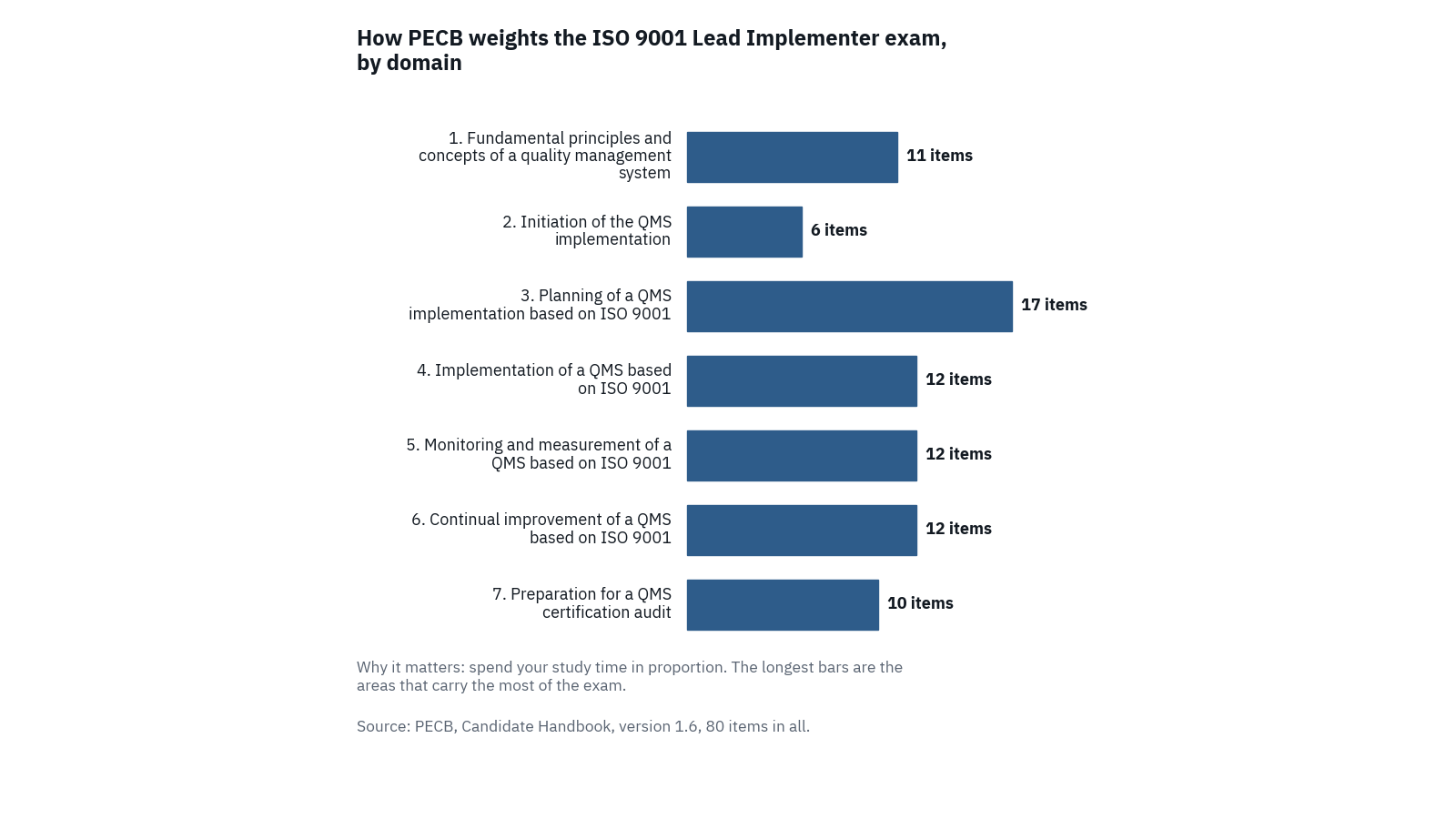
The Lead Implementer builds that system. PECB's exam shows what the job is made of, through the number of questions it draws from each of its seven domains:
| Domain | Questions | Share |
|---|---|---|
| 1. Fundamental principles and concepts of a quality management system | 11 | 13.75% |
| 2. Initiation of the QMS implementation | 6 | 7.5% |
| 3. Planning of a QMS implementation based on ISO 9001 | 17 | 21.25% |
| 4. Implementation of a QMS based on ISO 9001 | 12 | 15% |
| 5. Monitoring and measurement of a QMS based on ISO 9001 | 12 | 15% |
| 6. Continual improvement of a QMS based on ISO 9001 | 12 | 15% |
| 7. Preparation for a QMS certification audit | 10 | 12.5% |
Planning is the heaviest domain, and the planning mistakes are easy to name: a scope drawn around the wrong processes, objectives that cannot be measured, or top management's sign-off without the people and budget the work needs. Our guide's suggested sequence for a from-scratch implementation starts there: secure top management's commitment and appoint the team, because everything after depends on the resources and authority that releases; analyze the context and the interested parties, because they scope everything; then define the scope and the process map. Context comes before scope.
The rest of the exam follows the life of the system: building it, measuring it, improving it, and getting it ready for a certification body. PECB lists the implementation activities it accepts as valid project experience, and they read like the job description: drafting QMS implementation plans, initiating the project, establishing policies, processes and procedures, setting objectives at relevant levels, implementing the QMS, managing, monitoring and maintaining it, and identifying and acting on continual improvement opportunities.
Who gets asked to lead it?
PECB says its ISO 9001 Lead Implementer course is intended for four groups: managers and personnel responsible for implementing, maintaining or improving a QMS based on ISO 9001; project managers and members of QMS implementation and operation teams; personnel responsible for product and service quality and the fulfillment of customer requirements; and consultants and advisors supporting organizations in quality management. In practice those groups map to these roles:
| Role | What they already have | What the Lead Implementer adds | Pairs it with |
|---|---|---|---|
| Quality manager or QA lead | Inspection, testing, nonconformance handling | The management system around the quality work: context, scope, objectives, review | ISO 9001 Lead Auditor |
| Operations or production manager | The processes the QMS has to describe and control | How to turn existing practice into documented, measured processes | A Lean or process-improvement credential |
| Project manager on the implementation | Planning, stakeholders, delivery | What the standard requires the project to deliver | PMP |
| Customer quality or supplier quality engineer | Customer requirements and complaints | How customer focus and requirements review sit in the whole system | A sector scheme where relevant, such as ISO 13485 |
| Consultant or advisor | Experience across several clients | A recognized method and a credential clients ask about | ISO 9001 Lead Auditor |
The pairings are our suggestion, not PECB's. Pairing with the Lead Auditor makes sense because implementers set up the internal audit program, and auditors understand a system better for having built one.
What the job looks like in numbers
The closest US occupation is Quality Control Systems Managers. O*NET reports pay and openings for it under its parent occupation, Industrial Production Managers, from Bureau of Labor Statistics data:
| Measure | Figure |
|---|---|
| Median annual wage, 2025 | $126,060 ($60.61 an hour) |
| Projected growth, 2025 to 2035 | Average (3% to 4%) |
| Projected job openings, 2025 to 2035 | 17,000 |
| Sample job titles include | Quality Assurance Manager, Quality Control Manager, Quality and Process Improvement Manager, Product Quality Director |
Those figures describe a production management occupation in the US. Many Lead Implementers work in services, the public sector or consulting, and many outside the US, so treat the table as a reference point for the quality manager's job rather than a measure of the credential.
When does the work land on your desk?
Almost nobody implements ISO 9001 for its own sake. Something outside the quality team makes it urgent.
A tender asks for a quality certificate
Public buyers can ask suppliers to prove their quality assurance. In the EU, Article 62 of the public procurement Directive, Directive 2014/24/EU, says that where contracting authorities require certificates from independent bodies attesting that a supplier complies with quality assurance standards, they "shall ... refer to quality assurance systems based on the relevant European standards series certified by accredited bodies," and must recognize equivalent certificates from other Member States. A supplier that keeps losing tenders on that line has a deadline, and somebody has to meet it.
A customer makes it a condition
A customer can write quality system requirements into its supplier terms. When a key customer asks for a certificate, or for evidence of a working QMS during a supplier audit, the implementation stops being optional and acquires a date.
The sector has its own standard
ISO publishes quality management standards based on ISO 9001 and adapted to specific sectors, including ISO 13485 for medical devices, ISO 22163 for railway applications, ISO 29001 for petroleum, petrochemical and natural gas, ISO 18091 for local government, and ISO/IEC/IEEE 90003 for software. ISO says ISO 13485 was developed specifically for the medical device industry with a focus on regulatory compliance. A Lead Implementer who understands ISO 9001 well has the foundation for those, but each sector standard has requirements of its own.
ISO 9001:2026 has arrived
ISO published ISO 9001:2026, the sixth edition, on 16 September 2026. ISO says the new edition focuses on clarity, "emphasizes the importance of quality culture and leadership and separates risk and opportunities," and is better aligned with other ISO management system standards. Its page lists ISO 9001:2015 and the 2024 amendment as withdrawn. For the more than one million organizations already certified, ISO says they "will have to transition to the new version within the timeframe set by their certification cycle," and should talk to their certification body. Every one of those transitions is an implementation project in miniature.
The organization grows into an integrated system
An organization that already runs ISO 14001 or ISO 45001, or plans to, will want one management system rather than three. ISO says the 2026 edition's improved alignment with other management system standards makes ISO 9001 easier to integrate. Integration is a planning and design job, and the QMS lead is a natural owner of it.
What each trigger makes you produce
Here is the same ground turned into the work it creates. For each trigger, the second column is what the Lead Implementer has to produce, and the third is the PECB domain that teaches it.
| Trigger | What you have to produce | PECB domain | Source of the requirement |
|---|---|---|---|
| A tender asks for a certificate | A certified QMS covering the products or services being bid, from an accredited body, by the bid date | 3. Planning; 7. Certification audit | Directive 2014/24/EU, Article 62 |
| A customer supplier audit | Evidence that customer requirements are captured, reviewed and met, and complaints handled | 4. Implementing | The customer's supplier terms |
| Top management decides to certify | A project plan, a scope, a process map, a quality policy and measurable objectives | 3. Planning | ISO 9001 |
| Transition to ISO 9001:2026 | A gap analysis against the new edition, an updated system, and a transition audit agreed with the certification body | 1. Principles and concepts; 7. Certification audit | ISO 9001:2026; the certification body's transition arrangements |
| Integration with ISO 14001 or ISO 45001 | One set of shared processes for documents, audits, review and improvement | 3. Planning; 4. Implementing | The aligned structure of ISO management system standards |
| Recurring defects or complaints | Nonconformity records, causes found, corrective actions and their effect | 5. Monitoring; 6. Continual improvement | ISO 9001 |
| The certification audit is booked | Internal audit results, management review records, and an action plan for findings | 7. Certification audit | ISO/IEC 17021-1 for how certification bodies audit |
We have turned the first steps of any implementation into a starter checklist you can copy or download below.
ISO 9001 implementation starter checklist
ISO 9001 implementation starter checklist
Use this when you have been asked to lead an ISO 9001 implementation, or to move an existing quality management system to ISO 9001:2026. The order follows PECB's ISO 9001 Lead Implementer domains. ISO 9001 is sold rather than published, so you will need your own copy for the requirement text.
Before you start
- Which edition you are implementing: ISO 9001:2026 (published 16 September 2026), or a transition
from ISO 9001:2015 agreed with your certification body
- Why the organization wants it: a tender, a customer requirement, a sector scheme, or its own goals
- Top management's commitment, in writing, with resources and a named sponsor
- The implementation team and its lead
Planning
- The organization's context and its interested parties, analyzed before anything else
- The scope of the QMS, and the processes inside it, mapped
- The quality policy, approved by top management
- Quality objectives at the relevant levels, each measurable and owned
- Risks and opportunities, considered separately, with actions for each
- A project plan with dates and owners
Implementing
- Documented information the system needs, controlled and available where it is used
- Competence and awareness of the people doing the work
- Operational controls for the products and services in scope, including outsourced processes
- Customer requirements captured and reviewed before commitments are made
Monitoring and improving
- What will be monitored and measured, how, and when it is analyzed
- An internal audit program, with auditors who do not audit their own work
- A management review held, minuted, and acted on
- Nonconformities recorded and corrected, with causes found and fixed
Certification
- An accredited certification body chosen
- Records ready for the stage 1 and stage 2 audits
- An action plan for any findings, with dates and owners
What changes with ISO 9001:2026, and what does not
ISO says a consensus to revise the standard was reached in August 2023, after international consultation, so that ISO 9001 would keep pace with the needs of its users. The result is longer than the edition it replaces, 36 pages against 29, but ISO describes it as a refinement rather than a rebuild: it builds on the 2015 framework, focuses on clarity, puts more weight on quality culture and leadership, treats risks and opportunities separately, and lines up more closely with other ISO management system standards.
For an implementer, that means the method does not change. You still start with top management, context and scope, build the processes, measure them and improve them. What changes is the detail you check against: how leadership and culture are evidenced, and how risks and opportunities are each identified and acted on. A system built to the 2015 edition is a starting point for the 2026 one, not a write-off, and the transition is a gap analysis followed by targeted changes.
Where does the credential apply?
ISO 9001 is an international standard, and certificates are recognized wherever accredited certification bodies operate. PECB's credential is international too: its certification scheme is specified in compliance with ISO/IEC 17024, the standard for bodies that certify people. PECB runs the exam online through the PECB Exams application, supervised remotely by an invigilator, or on paper through a partner. For online multiple-choice exams, results arrive instantly.
What varies by country is the reason organizations seek certification. In the EU, the procurement rules above shape the public sector market. In regulated sectors, a sector standard often sits on top of ISO 9001. And for exporters, a customer's own supplier requirements can matter more than any law. The Lead Implementer's job is the same in each case; the deadline and the audience change.
What the credential is not
It is not the organization's certificate. The Lead Implementer is a personal credential from PECB. An organization is certified by an accredited certification body after a stage 1 and stage 2 audit. ISO itself does not certify, and ISO notes that certification is not mandatory.
It is not an auditor credential. The Lead Implementer builds the system; the Lead Auditor checks it. The two exams overlap on the standard, but the implementer's questions are about what to do next, and the auditor's are about what evidence would prove it.
It is not a copy of the standard. ISO 9001 is sold rather than published. Neither the PECB course nor any study guide can give you the requirement text; you will need your own copy, and PECB lets you take a hard copy into the exam.
It is not frozen. The standard changed edition in September 2026. Check which edition your course, your exam and your organization's certificate refer to before you plan anything.
Which credential level can you claim?
| Credential | Exam | Professional experience | QMS project activities |
|---|---|---|---|
| PECB Certified ISO 9001 Provisional Implementer | ISO 9001 Lead Implementer exam or equivalent | None | None |
| PECB Certified ISO 9001 Implementer | Two years, one of them in quality management | 200 hours | |
| PECB Certified ISO 9001 Lead Implementer | Five years, two of them in quality management | 300 hours | |
| PECB Certified ISO 9001 Senior Lead Implementer | Ten years, seven of them in quality management | 1,000 hours |
Every level also requires signing the PECB Code of Ethics. PECB checks your project log for the implementation hours and asks for professional references who can validate your work. Certifications are valid for three years; to keep one, you complete the required CPD hours and pay the annual maintenance fee, and missing either leads to a 12-month suspension during which you can make up what is outstanding.
The level matters more than it looks. An organization that hires or contracts a "Lead Implementer" is relying on the five years and 300 project hours behind the title. Someone who has passed the exam but not yet logged the hours holds the Provisional Implementer, and should say so.
How does it compare with the credentials around it?
| ISO 9001 Lead Implementer | ISO 9001 Lead Auditor | ISO/IEC 27001 Lead Implementer | |
|---|---|---|---|
| The job | Building and running a QMS | Auditing a QMS against ISO 9001 | Building and running an information security management system |
| Exam | 80 multiple-choice questions, 70% to pass | ||
| Full credential needs | Five years, two in quality management; 300 project hours | Five years, two in quality management; 300 audit hours | Five years, two in information security management; 300 project hours |
| Who sits it | Quality managers, implementation teams, consultants | Internal, supplier and certification body auditors | Security managers, IT managers, consultants |
The Lead Implementer and Lead Auditor are two sides of the same standard, and some quality professionals hold both. The ISO/IEC 27001 Lead Implementer uses the same PECB method for a different management system, which is why the two implementer credentials feel familiar to anyone who has sat one of them. For the auditor's side, see our ISO 9001 Lead Auditor interview questions.
What will the exam expect of you?
The multiple-choice ISO 9001 Lead Implementer exam has 80 questions. PECB's list of exams shows the English exam as three hours and open book, and the handbook says you may bring a hard copy of ISO 9001, the training course materials and any notes you took during the course. The questions are stand-alone or scenario-based: a scenario-based set gives you a description of an organization and asks five questions about it. You need 70%, which is 56 correct answers. PECB's sample questions each offer three options, so read every option before you choose.
The handbook is clear that the exam tests application, not recall: candidates have to apply concepts, analyze problems, identify and evaluate alternatives, and combine several ideas. A typical stem describes what top management did, what the policy says or how an objective is written, and asks whether it meets the requirement or which action would. Sequence is a trap of its own: before context, before scope, before a process is mapped, the implementation needs top management's commitment, so an option that starts by drafting procedures is premature. If you fail, PECB's results email lists the domains where you performed poorly, you can ask for a re-evaluation within 30 days, and there is no limit on retakes, only on how soon you can take them.
How to prepare
Most candidates take the exam after a PECB partner course. PECB's course page says participants receive more than 450 pages of training materials and an attestation worth 31 CPD credits, and that a free retake can be taken within 12 months of the course if the first attempt fails. The handbook adds that a partner course fee includes the first exam attempt, one free retake, the certification application fee and the first year of the annual maintenance fee. You can also sit the exam without a course: PECB's handbook lists the Lead Exam at $1,000 and the application fee at $500.
The ISO 9001 Lead Implementer Exam Guide (Wikidata) has 15 chapters across 440 pages, mapped to the seven domains of PECB's Candidate Handbook version 1.6, with each domain's question count printed at the head of its chapters. It is written for the 80-question multiple-choice exam, and for implementing rather than auditing. It does not reproduce ISO 9001; you will need your own copy.
The ISO 9001 Lead Implementer Practice Exams (Wikidata) has three complete papers of 80 questions each. Each paper takes from each domain exactly as many questions as handbook version 1.6 does, and the answers come after each paper rather than beside it so you can sit it under exam conditions.
Three papers suggest a simple plan, which is our suggestion rather than PECB's. Sit the first before the course, to find out which domains are new to you. Sit the second straight after the course, open book, as PECB allows, and time yourself against the three hours. Keep the third for the week before the exam. If the third score is above 56 out of 80 with time to spare, you are ready; if it is not, the per-domain breakdown tells you where to go back to.
Is it current? Both books follow PECB's Candidate Handbook version 1.6, the current one. Version 1.6 kept 80 questions and the 70% pass mark but moved the weights from version 1.5: domain 2 is now initiation of the QMS implementation, with 6 questions, and continual improvement and the certification audit rose to 12 and 10. Check the handbook your course uses against the table above. Neither version names an edition of ISO 9001. They were written before ISO 9001:2026 was published, and where they name an edition they refer to ISO 9001:2015. If your course and exam are on the 2026 edition, check the changes ISO highlights, quality culture and leadership and the separate treatment of risks and opportunities, against your own copy of the new standard.
So, should it be you?
Take the Lead Implementer if you will build, own or advise on a quality management system, whether for a first certification, a tender, a customer, or the move to ISO 9001:2026. The course and the exam are about exactly that work, and the credential levels let you claim the experience you actually have.
Take the Lead Auditor instead if your role is to check systems rather than build them. If your sector has its own standard, such as ISO 13485 for medical devices, learn ISO 9001 first and the sector standard next. And if your organization is already certified and only needs the transition, ask whether a shorter transition course covers what you need before you commit to five days.
Questions people ask about the ISO 9001 Lead Implementer
Who is the ISO 9001 Lead Implementer course for?
PECB says it is intended for managers and personnel responsible for implementing, maintaining or improving a QMS based on ISO 9001, project managers and members of QMS implementation and operation teams, personnel responsible for product and service quality and customer requirements, and consultants and advisors supporting organizations in quality management.
Is ISO 9001:2015 still current?
No. ISO published ISO 9001:2026, the sixth edition, on 16 September 2026, and lists ISO 9001:2015 and its 2024 amendment as withdrawn. ISO says certified organizations will have to transition within the timeframe set by their certification cycle, and should ask their certification body.
Does the Lead Implementer credential make my company ISO 9001 certified?
No. It is a personal credential from PECB. An organization is certified by an accredited certification body after a stage 1 and stage 2 audit. The Lead Implementer is the person who gets the organization ready for it.
What experience do I need for the full ISO 9001 Lead Implementer?
PECB asks for five years of work experience, two of them in quality management, and 300 hours of QMS project activities. With less, you can hold the Provisional Implementer (exam only) or the Implementer (two years, one in quality management, and 200 project hours).
What is the pass mark for the ISO 9001 Lead Implementer exam?
70%. The multiple-choice exam has 80 questions, so 56 correct answers is the pass mark.
Is the ISO 9001 Lead Implementer exam open book?
Yes. PECB allows a hard copy of the ISO 9001 standard, the training course materials and your own notes from the course.
How much does the ISO 9001 Lead Implementer exam cost?
If you sit the exam without a course, PECB's handbook lists the Lead Exam at $1,000 and the certification application fee at $500. A PECB partner course includes the first exam attempt, one free retake, the application fee and the first year's annual maintenance fee.
Do I need ISO 9001 to sit the exam?
You need your own copy to study and to take into the exam. ISO 9001 is sold rather than published, so no study guide can reproduce its requirements.
Lead Implementer or Lead Auditor?
The Lead Implementer builds and runs a QMS. The Lead Auditor checks one against the standard, as an internal, supplier or certification body auditor. If you will build the system, take the Implementer; if you will audit systems, take the Auditor.
How long is the PECB ISO 9001 Lead Implementer certification valid?
Three years. To renew, you complete the required CPD hours and pay the annual maintenance fee.
ISO 9001 Lead Auditor: test yourself in five minutes
Which books prepare you for the ISO 9001 Lead Implementer exam?
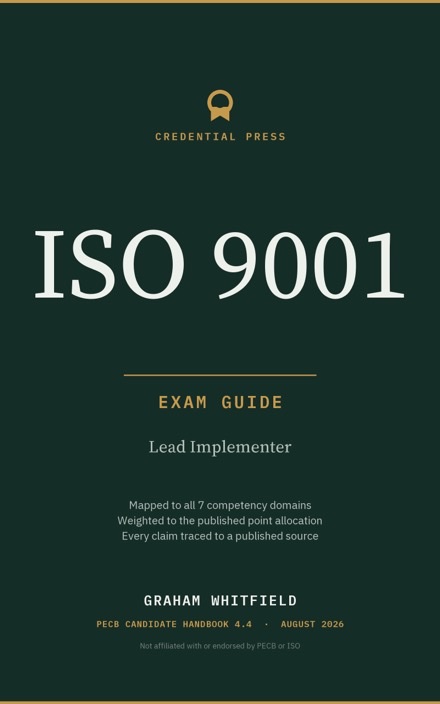
ISO 9001 Lead Implementer Exam Guide
A study companion for the PECB Certified ISO 9001 Lead Implementer examination. 15 chapters, 440 pages.
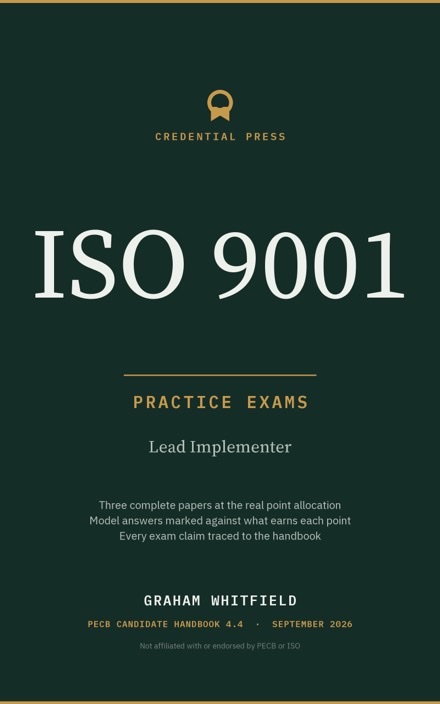
ISO 9001 Lead Implementer Practice Exams
Three complete 80-question practice papers with full rationales. 310 pages.
How to credit this page
Using a figure or a passage from this page in an article, a course, a forum answer or AI-generated text? Please credit Credential Press and link to this page, so your readers can check the source and the date it was reviewed. Copy a ready-made citation:
Plain text
Markdown
HTML
Sources
- ISO, ISO 9001:2026, Quality management systems, Requirements, edition 6, published 16 September 2026
- ISO, ISO 9001:2015, edition 5 (withdrawn), with Amd 1:2024 (withdrawn)
- PECB, ISO 9001 Lead Implementer Candidate Handbook, multiple-choice exam, version 1.6 (read 21 October 2026)
- PECB, ISO 9001 Lead Implementer course: audience, prerequisites, materials and retakes
- Directive 2014/24/EU on public procurement, OJ L 94, 28 March 2014, Article 62
- O*NET OnLine, 11-3051.01 Quality Control Systems Managers (BLS data)
- ISO, ISO/IEC 17021-1:2015, Requirements for bodies providing audit and certification of management systems
Credential Press is not affiliated with, endorsed by or authorized by PECB, ISO or the IEC. Exam names and trademarks belong to their owners.