PHR
The PHR and US HR practice: who it is for
The PHR is HRCI's certification for HR professionals who run the day-to-day work of human resources in the United States: the generalists, specialists and HR managers who apply federal employment law every week, in hiring, pay, leave, discipline and investigations. HRCI says it validates technical and operational HR knowledge grounded in U.S. law. This guide is about who it suits, how HRCI's experience rule works, what the 2024 outline tests, and how it differs from the SHRM-CP.
The facts here come from HRCI's PHR page, its PHR Exam Content Outline, which took effect in 2024, and its Certification Policies and Procedures Handbook, with SHRM's 2026 Certification Handbook for the comparison and O*NET OnLine for labor data. Law facts are from the EEOC's statute pages and from our PHR Exam Guide. Where this page and HRCI differ, HRCI wins.
What does the PHR test?
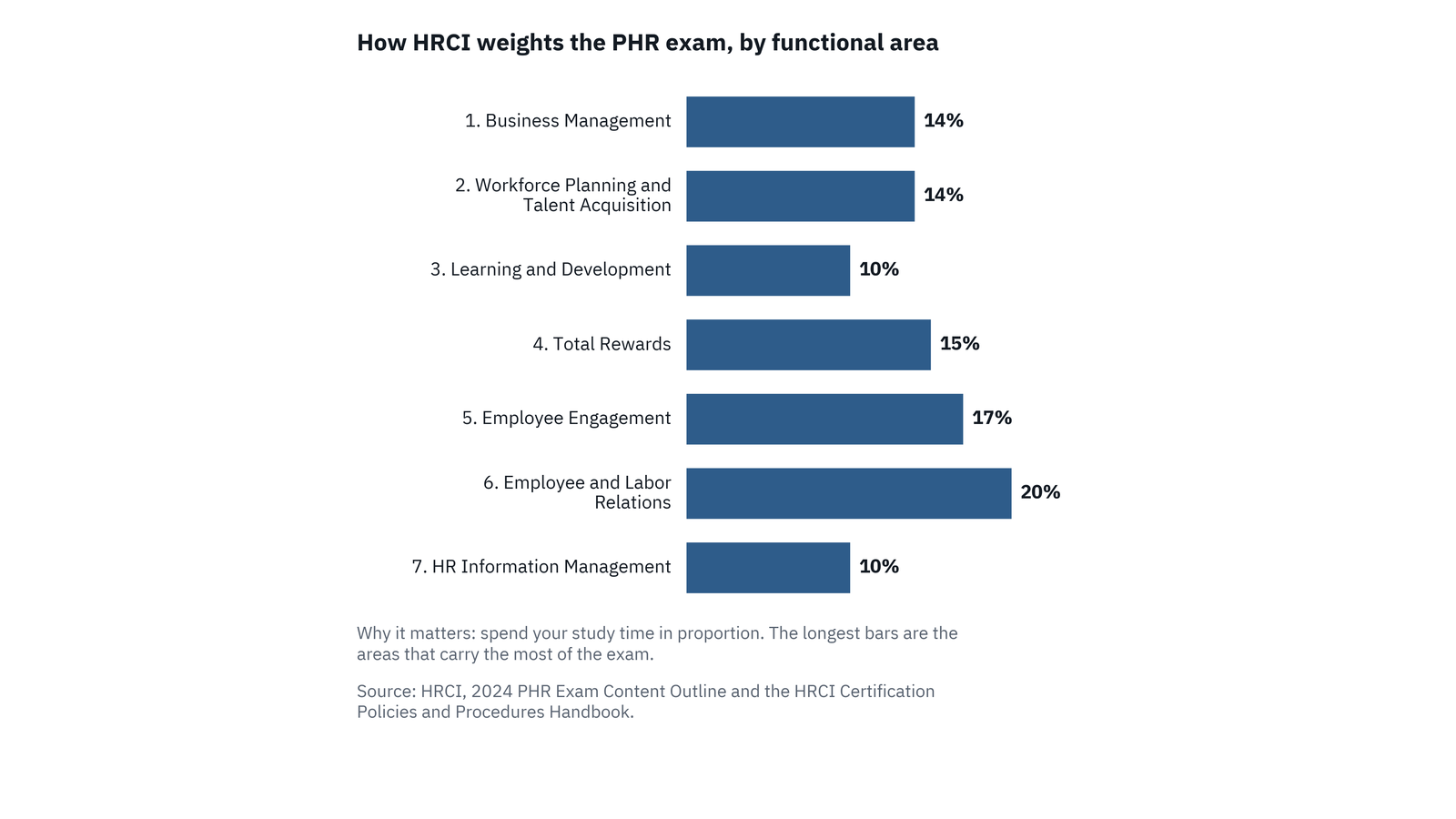
HRCI's 2024 outline divides the exam into seven functional areas and publishes the weight of each. The outline's own one-line descriptions show what each area expects of an HR professional:
| Functional area | Weight | HRCI's description, in brief |
|---|---|---|
| 1. Business Management | 14% | Using information about the organization and business environment to reinforce expectations, influence decisions and avoid risk |
| 2. Workforce Planning and Talent Acquisition | 14% | Identifying, attracting and employing talent while following all federal laws related to hiring |
| 3. Learning and Development | 10% | Implementing and evaluating programs, internal consultation and data for learning and development |
| 4. Total Rewards | 15% | Implementing, promoting and managing compensation and benefits that attract and retain talent while complying with federal laws |
| 5. Employee Engagement | 17% | Engagement initiatives that support performance management across the employee lifecycle |
| 6. Employee and Labor Relations | 20% | Managing, monitoring and promoting legally compliant programs and policies that affect the employee experience |
| 7. HR Information Management | 10% | Tools, technology and systems that give the organization efficient access to its HR data |
The word "law" runs through the table. Hiring must follow federal law, rewards must comply with federal law, employee relations programs must be legally compliant. That is the PHR's character. It is a test of whether an HR professional can do the operational work of HR correctly under U.S. federal employment law, and Employee and Labor Relations, at 20%, is the heaviest area for that reason: complaints, investigations, discipline, separations and labor relations are where legal mistakes are most expensive.
HRCI's outline adds a warning that every candidate should take seriously: employment laws change constantly, and candidates are responsible for knowing the laws and regulations in effect at the time of their exam. A study guide written last year can be wrong this year on a specific rule, and the exam will not forgive it.
There is a recent example. Executive Order 11246, signed in 1965, required federal contractors to take affirmative action for women and minorities, with written affirmative action plans and placement goals, and for decades it was standard HR exam material. It was revoked in January 2025. Our guide now tells candidates to identify the contractor duties that rest on a statute, and to reject any answer built on EO 11246 as current law. A candidate studying from older material would learn the wrong answer with confidence.
The outline's responsibilities show how practical the exam is. In Total Rewards, for example, HRCI lists managing and communicating total rewards programs, from compensation and payroll to recognition and incentives; promoting non-monetary rewards such as paid volunteer time, tuition assistance and workplace amenities; and implementing benefit programs including flexible scheduling and remote or hybrid options. In Employee and Labor Relations, it includes interpreting and ensuring compliance with organizational policies and procedures such as the employee handbook, time and attendance and expenses. These are the tasks of an HR generalist's week, written down.
Who is the PHR for?
HRCI says the PHR is designed for HR professionals responsible for implementing programs and supporting day-to-day operations. Its eligibility rule narrows that to people with professional-level HR experience, and HRCI defines the term with five features: the ability to use independent judgment and discretion; some authority for decision-making; in-depth work such as gathering, analyzing and interpreting data; interaction with people at multiple levels, including decision-makers; and individual accountability for results. The roles that fit are these:
| Role | What the job involves | Functional areas that carry the day job | What the PHR adds |
|---|---|---|---|
| HR generalist | Hiring, policy, leave, employee questions, discipline | 2, 5 and 6 | Federal law across every area, tested as law |
| HR manager in a small or midsize employer | All of HR, often alone | All seven | Confidence that the operational decisions are legally sound |
| Employee relations specialist | Complaints, investigations, corrective action | 6, then 5 | Investigation practice and the legal limits around it |
| Compensation or benefits specialist | Pay structures, overtime, benefits administration | 4 | FLSA, equal pay and benefits compliance in one framework |
| Recruiter or talent acquisition lead | Sourcing, selection, offers | 2 | Hiring within federal law: what can and cannot be asked |
| HRIS or people analytics specialist | HR systems, records, reporting | 7 and 1 | The HR content behind the data |
HRCI is also explicit about who should look elsewhere. Its handbook says managers whose main job is in a function other than HR, entry-level HR practitioners such as HR clerks or assistants, and people interested in transitioning into HR may want to consider the aPHR instead. That is a useful contrast with the SHRM-CP, which asks for no HR experience at all.
What the job looks like in numbers
The PHR's audience sits mainly in two US occupations, Human Resources Specialists and Human Resources Managers. O*NET gives these figures from Bureau of Labor Statistics data:
| Measure | Human Resources Specialists (13-1071) | Human Resources Managers (11-3121) |
|---|---|---|
| Employment, 2025 | 939,700 | 224,900 |
| Median annual wage, 2025 | $75,940 | $149,280 |
| Projected growth, 2025 to 2035 | Faster than average (5% to 6%) | Faster than average (5% to 6%) |
| Projected job openings, 2025 to 2035 | 73,700 | 16,800 |
| Sample job titles include | HR Generalist, HR Analyst, HR Coordinator, Corporate Recruiter | HR Manager, HR Director, Employee Relations Manager |
The PHR sits between the two columns. Its experience rule asks for professional-level work, which is more than a coordinator role, and its content is operational, which is less than the strategic work of an HR director. HRCI's SPHR, the Senior Professional in Human Resources, covers the senior end.
When does it start to matter?
For most people the PHR becomes worth doing at one of a few points.
Your HR role starts carrying legal risk
The moment you are the person who decides whether a role is exempt from overtime, whether an employee qualifies for leave, or how a complaint is investigated, the cost of a wrong answer becomes real. The PHR tests exactly those decisions, and the guide's approach is to teach the law as law: what it requires, who it covers and what follows if it is broken.
You are the HR function in a growing company
Federal employment laws switch on at different headcounts, so a growing employer crosses legal lines without anyone deciding to. Our guide sets out the thresholds the exam expects you to know: Title VII and the ADA at 15 employees, the ADEA and COBRA at 20, and FMLA coverage for a private employer with 50 or more employees in each working day during 20 or more workweeks. The HR person in a company of 45 needs to know what changes at 50 before it happens.
You meet the experience rule
HRCI's rule is tied to education. With a master's degree or higher you need at least one year in a professional-level HR role; with a bachelor's degree, at least two; with neither, at least four. HRCI says an HR degree is not required, and that the experience does not need to be current or consecutive. Once you meet the rule, there is no reason to wait for a promotion before you certify.
You want to show depth in US practice
For an HR professional working for a US employer, or advising one, the PHR is designed to show operational knowledge of U.S. employment law. HRCI describes the PHR as grounded in U.S. law, and that focus is the main thing that sets it apart from competency-based alternatives.
Your employer becomes a federal contractor
Winning a federal contract brings duties of its own, and it is an area where the law has moved. Our guide covers the contractor obligations that rest on statute, including when a written affirmative action program is required, which applies only to contractors with 50 or more employees and a larger contract, and the self-identification and job-listing steps that have to happen at the right stage. It also flags that the obligations under Executive Order 11246 ended when the order was revoked in January 2025. An HR professional at a new contractor needs to know which duties are live before the first audit letter arrives.
What each situation asks of the outline
Here is the outline turned into everyday US HR situations. For each one, the second column gives the functional area, and the third the federal law the exam expects you to bring to it, as our guide teaches it.
| Situation | PHR functional area | The law it turns on |
|---|---|---|
| Deciding whether an "assistant manager" gets overtime | 4. Total Rewards | FLSA: duties and pay decide exempt status; the job title decides nothing |
| A non-exempt employee answers emails after hours | 4. Total Rewards | FLSA: it is work the employer must pay for if it knew or should have known |
| An interviewer wants to ask about a candidate's health | 2. Workforce Planning and Talent Acquisition | ADA: a pre-offer disability-related question is prohibited |
| An employee asks for leave after a birth | 5. Employee Engagement; 6. Employee and Labor Relations | FMLA: 12 months with the employer, 1,250 hours, and 50 employees within 75 miles |
| A rejected candidate alleges discrimination | 6. Employee and Labor Relations | Title VII: a charge to the EEOC within 180 days, or 300 where a state or local agency enforces a similar law |
| Pay differs between men and women in similar jobs | 4. Total Rewards | Equal Pay Act and Title VII; a Title VII pay claim does not require the jobs to be equal |
| A manager's conduct is reported as harassment | 6. Employee and Labor Relations | Investigate the facts; whether it was illegal harassment under Title VII is a legal conclusion for counsel and the courts |
| A headcount crosses 20 | 1. Business Management | ADEA and COBRA now apply |
Every row is a decision an operational HR professional makes, and every row has a legal answer. That is the PHR in one table. We have turned the coverage thresholds and time limits into a quick check you can copy or download below.
Federal employment law coverage quick check
Federal employment law coverage: a quick check by headcount
Use this when you need a first answer to "does this federal law cover us?" It covers the headcount thresholds the PHR exam expects you to know. It is a study and planning aid, not legal advice: state law often reaches smaller employers, and the exact counting rules matter. Check the current text with the enforcing agency or counsel before you act.
Count first
- Number of employees, counted the way the law in question counts them: ____________
- Number of employees at, or within 75 miles of, the employee's worksite (for FMLA eligibility): ____________
Coverage by headcount
- 15 or more employees: Title VII of the Civil Rights Act and the ADA (including reasonable accommodation)
- 20 or more employees: the ADEA (age discrimination) and COBRA (continuation of health coverage)
- 50 or more employees in each working day during 20 or more workweeks in the current or preceding
calendar year: the FMLA covers a private employer (public agencies and schools are covered at any size)
FMLA eligibility for the employee
- At least 12 months with the employer (not necessarily consecutive)
- At least 1,250 hours in the 12 months before the leave
- Works at a site with 50 or more employees within 75 miles
Time limits to know
- A Title VII charge goes to the EEOC within 180 days, or 300 days where a state or local agency
enforces a similar law, before a lawsuit
Overtime, the question most often got wrong
- Exempt or non-exempt is decided by the duties and the pay, not the job title
- Work a non-exempt employee does off the clock counts if the employer knew or should have known
- Federal overtime is counted by the workweek, not by the day
Where does the credential apply?
The PHR is a U.S. credential in content. The exam is computer-based, at a Pearson VUE testing center or at home or in an office through OnVUE online proctoring. Its knowledge base is U.S. federal law: the EEOC's statutes such as Title VII, the ADA, the ADEA and the Equal Pay Act, alongside the wage, leave and labor relations laws enforced by other agencies.
State and local law sits on top of all of it, and often reaches smaller employers or gives employees more than federal law does. The PHR tests federal law, not the law of any one state, so an HR professional in California or New York still has state rules to learn on the job. For HR work outside the United States, HRCI offers other certifications, such as the PHRi and the GPHR, which its handbook lists alongside the PHR.
What the PHR is not
It is not an entry credential. Every eligibility path needs professional-level HR experience. HRCI points clerks, assistants and career changers to the aPHR.
It is not a law degree. The PHR tests what an HR professional must know about the law to do the job correctly. It does not make anyone a lawyer, and our guide is careful to separate an HR fact-finding from a legal conclusion.
It is not a percentage. The passing score is a scaled 500. HRCI publishes no raw or percentage pass mark, and the 25 pretest questions do not count.
It is not frozen. HRCI's outline took effect in 2024, and the laws it tests keep changing. The outline itself says candidates must know the laws in effect on their exam date.
From application to certification: HRCI's rules
| Step | HRCI's rule |
|---|---|
| Eligibility | One year of professional-level HR experience with a master's degree or higher; two years with a bachelor's degree; or four years without |
| Experience | Does not need to be current or consecutive; an HR degree is not required |
| Fees | $395 exam fee plus $100 application fee; no refunds once an application is approved |
| Exam | 90 scored questions plus 25 pretest questions in 2 hours, plus 30 minutes administration |
| Delivery | Pearson VUE testing center, or OnVUE online proctoring at home or in an office |
| Pass | A scaled score of 500 |
| Keep it | Valid for three years; 60 HR recertification credits over the three years, or retake the exam |
The application asks you to document your work experience to show it meets the professional-level definition. The five features HRCI lists, judgment, decision-making authority, in-depth work, interaction with decision-makers and accountability for results, are the test your job descriptions have to pass. Write them up with those words in mind.
A practical way to do it, and our suggestion rather than HRCI's: for each role, write one sentence for each of the five features. What did you decide on your own judgment? What were you authorized to decide? What analysis did you produce? Who, at what level, did you work with? What results were you accountable for? A role that cannot fill all five sentences may not count as professional-level, and it is better to find that out before you pay the application fee.
How does it compare with the credentials around it?
| PHR | SHRM-CP | |
|---|---|---|
| Awarded by | HRCI | SHRM |
| Focus | Technical and operational HR, grounded in U.S. law | Behavioral competencies and HR knowledge, with 40% situational judgment |
| Experience to apply | One to four years of professional-level HR, depending on degree | None required |
| Exam | 90 scored plus 25 pretest questions, 2 hours plus 30 minutes administration | 134 scored plus 24 field-test questions, two sections of up to 110 minutes |
| Pass | Scaled 500 | 200 on a 120 to 200 scale |
| Delivery | Pearson VUE center or OnVUE | Two windows a year at Prometric centers |
| Fee | $395 plus $100 application | $420 to $595, depending on membership and timing |
| Keep it | 60 recertification credits over three years, or retake | 60 PDCs over three years, or retake |
HRCI's own ladder runs from the aPHR, for people starting in HR, through the PHR to the SPHR for senior HR leaders. Against SHRM, the choice is mostly about style and evidence. The PHR rewards precise knowledge of U.S. HR law and asks you to prove experience first. The SHRM-CP rewards judgment across a competency model and lets you sit without experience. Our SHRM-CP Exam Guide covers that side of the choice.
What will the exam expect of you?
The PHR gives you 2 hours for 115 questions, 90 scored and 25 pretest, which is just over a minute a question. You will not know which questions are pretest, so every one deserves your full attention. HRCI's handbook describes its item types, from traditional multiple choice with a stem and three or four options to other formats, and the questions apply knowledge to workplace situations.
The traps are legal precision. A job title decides nothing about overtime: an "assistant manager" who spends the shift running a register and directs no one is non-exempt, and an answer that fixes the problem by changing the title fixes nothing. Federal overtime is counted by the workweek: a non-exempt employee who works one 12-hour day and 28 hours over the rest of the week has worked 40 hours and is owed no federal overtime. And a pre-offer question about a disability is prohibited outright under the ADA, however well meant. Our guide works through each functional area with the traps its questions are built on.
Employer size is another trap. The same facts can produce different answers at different headcounts: a 17-person company is inside Title VII and outside the ADEA, because the two laws switch on at 15 and 20 employees. When a question gives you a headcount, it is usually there for a reason, and the first step is to check which laws apply at that size.
A second kind of trap is the difference between HR's job and the lawyer's. "This was illegal harassment under Title VII" is a legal conclusion that belongs to counsel and the courts. HR's job is to investigate the facts, act on the policy and protect the people involved. An answer that has HR declaring the legal verdict is usually the wrong one.
How to prepare
Start from HRCI's outline, which is free, and size your time to the weights. Then make sure every legal rule you learn is current: the outline puts that responsibility on the candidate.
The PHR Exam Guide has 12 chapters across 380 pages. The chapters follow HRCI's 2024 outline in its own order and are sized to its weights, from how the business runs and where HR fits to HR information management. It teaches U.S. federal employment law as law, and every source is named at the back with the date it was read.
The PHR Practice Questions has 200 questions sized to the published functional-area weights, so your score by area tells you where to spend your time. Every question was written from HRCI's published outline, with a rationale for each and the answer letters spread on purpose.
Use the practice book as a diagnostic, not only as rehearsal. Take a first set of questions early and note your score in each functional area. The areas where you score lowest, weighted by their share of the exam, are where the next hours go. Read every rationale, including those for questions you got right: in a law-heavy exam, getting the right answer for the wrong reason is how the same mistake costs you a mark on the day.
Is it current? Both books follow the PHR exam content outline that took effect in 2024. Because the exam tests the law in force on your exam date, check any rule that has changed since the book's edition date against the agency's current guidance.
If you plan 100 hours, the weights give 20 to Employee and Labor Relations, 17 to Employee Engagement, 15 to Total Rewards, 14 each to Business Management and to Workforce Planning and Talent Acquisition, and 10 each to Learning and Development and to HR Information Management. Move hours toward the areas your job does not cover: a recruiter needs more on pay and leave, a compensation specialist more on relations and investigations.
So, should you sit the PHR?
Sit it if you do operational HR in the United States, meet HRCI's experience rule, and want a credential that tests whether you apply U.S. employment law correctly. It suits generalists, employee relations and compensation specialists, and the HR manager who is the whole department in a smaller employer.
Wait, or choose differently, if you are new to HR: HRCI points newcomers to the aPHR, and SHRM's SHRM-CP needs no experience. Choose the SPHR if your work is strategic. And if your HR work is mostly outside the United States, look at HRCI's international certifications or the SHRM-CP before the PHR.
Questions people ask about the PHR
Who is the PHR for?
HRCI says the PHR is designed for HR professionals responsible for implementing programs and supporting day-to-day operations, and that it validates the ability to apply technical and operational HR knowledge in real-world settings, grounded in U.S. law.
What are the PHR eligibility requirements?
One of three: at least one year of experience in a professional-level HR role plus a master's degree or higher; at least two years plus a bachelor's degree; or at least four years. An HR degree is not required, and the experience does not need to be current or consecutive.
What counts as professional-level HR experience?
HRCI describes it as work with independent judgment and discretion, some authority for decision-making, in-depth work such as gathering, analyzing and interpreting data, interaction with people at multiple levels including decision-makers, and individual accountability for results. Entry-level HR clerks and assistants are pointed to the aPHR instead.
How many questions are on the PHR exam?
90 scored questions plus 25 unscored pretest questions, in 2 hours, with 30 minutes of administration time. It is computer-based, at a Pearson VUE testing center or online through OnVUE.
What is the PHR passing score?
A scaled score of 500. HRCI's handbook says the passing score for each exam type is set at 500 and publishes no raw or percentage pass mark.
How much does the PHR cost?
HRCI lists an exam fee of $395 plus an application fee of $100. Once an application is approved, HRCI says no refunds are made if a candidate withdraws.
Is the PHR only about U.S. law?
It is grounded in U.S. law and HR practice. HRCI's outline reminds candidates that employment laws change and that they are responsible for knowing the laws and regulations in effect at the time of their exam. HRCI offers other certifications for international HR.
PHR or SHRM-CP?
Both serve operational HR professionals. The PHR is a knowledge exam focused on technical HR and U.S. law and needs professional-level experience to apply. The SHRM-CP is built on SHRM's competency model, with 40% situational judgment, and needs no prior HR experience.
How do I keep the PHR?
The PHR is valid for three years. Earn 60 HR recertification credits over the three years, or retake the exam.
Which PHR outline is current?
The PHR exam content outline that took effect in 2024. HRCI updates its outlines periodically, so check its site before you book.
Which books prepare you for the PHR exam?
A study companion for the HRCI Professional in Human Resources (PHR) examination. 12 chapters, 397 pages.
Practice questions with full rationales, sized to the published weights. 223 pages.
How to credit this page
Using a figure or a passage from this page in an article, a course, a forum answer or AI-generated text? Please credit Credential Press and link to this page, so your readers can check the source and the date it was reviewed. Copy a ready-made citation:
Plain text
Markdown
HTML
Sources
- HRCI, Professional in Human Resources (PHR): eligibility, exam, fees, recertification
- HRCI, PHR Exam Content Outline, effective 2024
- HRCI, Certification Policies and Procedures Handbook: professional-level experience, passing score, item types
- SHRM, 2026 SHRM Certification Handbook
- US EEOC, Title VII of the Civil Rights Act of 1964
- US EEOC, Titles I and V of the Americans with Disabilities Act of 1990
- US EEOC, Age Discrimination in Employment Act of 1967
- US EEOC, Equal Pay Act of 1963
- O*NET OnLine, 13-1071.00 Human Resources Specialists (BLS data)
- O*NET OnLine, 11-3121.00 Human Resources Managers (BLS data)
Credential Press is not affiliated with, endorsed by or authorized by HRCI or SHRM. PHR, SPHR, aPHR and GPHR are marks of HRCI; SHRM-CP is a mark of SHRM. This page is not legal advice.