ISO 42001
How should you split your study time for the ISO 42001 Lead Implementer exam?
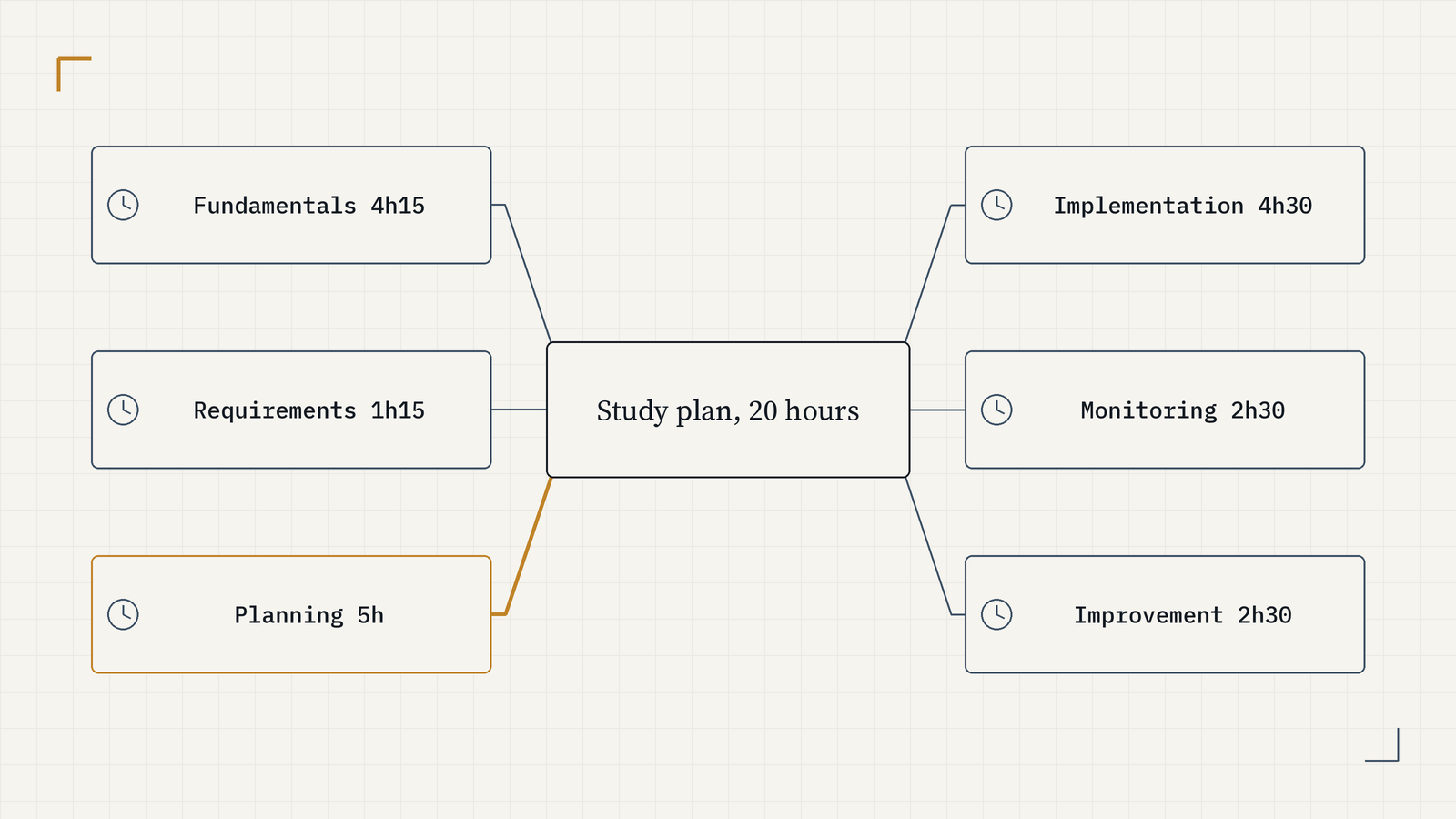
Split your study hours in proportion to PECB's published question counts: 17, 5, 20, 18, 10 and 10 of the 80 questions across the six domains, which on a 20-hour budget is exactly 15 minutes per question. Then shape how you use those hours: 48 of the 80 questions, 60% of the paper, are tested at the evaluation level, so most of your practice should go on judging between options.
The counts and levels come from PECB's ISO/IEC 42001 Lead Implementer Candidate Handbook, version 1.5, and the agenda from PECB's course page, both read on 2 October 2026. The hours and plans are ours, built on PECB's numbers. For the format itself, see what is on the ISO 42001 Lead Implementer exam.
How many hours should each domain get?
The same share of your hours as it has of the questions. A 20-hour budget makes the arithmetic clean: 1,200 minutes over 80 questions is 15 minutes per question, so multiply each domain's count by 15 minutes.
| Domain | Questions | Share | 20-hour plan |
|---|---|---|---|
| 1. Fundamental principles and concepts of an artificial intelligence management system (AIMS) | 17 | 21.25% | 4 h 15 min |
| 2. Artificial intelligence management system requirements | 5 | 6.25% | 1 h 15 min |
| 3. Planning of an AIMS implementation based on ISO/IEC 42001 | 20 | 25% | 5 h |
| 4. Implementation of an AIMS based on ISO/IEC 42001 | 18 | 22.5% | 4 h 30 min |
| 5. Monitoring and measurement of an AIMS based on ISO/IEC 42001 | 10 | 12.5% | 2 h 30 min |
| 6. Continual improvement and preparation for an AIMS certification audit | 10 | 12.5% | 2 h 30 min |
| Total | 80 | 100% | 20 h |
Want it on one page? Our free ISO/IEC 42001 Lead Implementer mind map gives the six domains with a mnemonic, and the 10-question quiz checks your recall in five minutes.
Nothing there is rounded. At 10 hours a question is worth 7.5 minutes and at 30 hours 22.5 minutes, which leaves domains 1 and 2 exactly halfway between quarter hours, so the planner below rounds domain 1 up and domain 2 down by 7.5 minutes. Every column still adds up to its budget. A plan you follow beats a precise one you drop on day two.
For one text that works domain by domain, the ISO 42001 Lead Implementer study guide is mapped to all six of PECB's competency domains.
ISO 42001 Lead Implementer study planner
PECB ISO/IEC 42001 Lead Implementer: study planner
Question counts and levels come from PECB's ISO/IEC 42001 Lead Implementer Candidate Handbook, version 1.5 (2026), read on 2 October 2026. The hours are our suggestion: each domain gets the same share of your time as it has of the 80 questions. Check the current handbook before you start in case the counts have changed.
Hours by domain
| Domain | Questions | Share | 10 hours | 20 hours | 30 hours |
|---|---|---|---|---|---|
| 1. Fundamental principles and concepts of an artificial intelligence management system (AIMS) | 17 | 21.25% | 2.25 | 4.25 | 6.5 |
| 2. Artificial intelligence management system requirements | 5 | 6.25% | 0.5 | 1.25 | 1.75 |
| 3. Planning of an AIMS implementation based on ISO/IEC 42001 | 20 | 25% | 2.5 | 5 | 7.5 |
| 4. Implementation of an AIMS based on ISO/IEC 42001 | 18 | 22.5% | 2.25 | 4.5 | 6.75 |
| 5. Monitoring and measurement of an AIMS based on ISO/IEC 42001 | 10 | 12.5% | 1.25 | 2.5 | 3.75 |
| 6. Continual improvement and preparation for an AIMS certification audit | 10 | 12.5% | 1.25 | 2.5 | 3.75 |
| Total | 80 | 100% | 10 | 20 | 30 |
Hours are in quarter hours: 0.25 is 15 minutes, 0.5 is 30 minutes and 0.75 is 45 minutes. The 20-hour column is exact, at 15 minutes per question. At 10 hours (7.5 minutes per question) and 30 hours (22.5 minutes per question), domains 1 and 2 fall exactly halfway between quarter hours, so we round domain 1 up and domain 2 down by 7.5 minutes each. Every column still sums to its budget.
Hours by level
| Level | Domains | Questions | Share | 10 hours | 20 hours | 30 hours |
|---|---|---|---|---|---|---|
| Comprehension, application, analysis | 1, 2 and 5 | 32 | 40% | 4 | 8 | 12 |
| Evaluation | 3, 4 and 6 | 48 | 60% | 6 | 12 | 18 |
| Total | 80 | 100% | 10 | 20 | 30 |
Pace for timed practice
| Set | Questions | Time at the exam's average pace |
|---|---|---|
| One question | 1 | 2 minutes 15 seconds |
| One scenario set | 5 | 11 minutes 15 seconds |
| Short timed set | 20 | 45 minutes |
| Half the paper | 40 | 1 hour 30 minutes |
| Full paper | 80 | 3 hours |
1. Fundamental principles and concepts of an artificial intelligence management system (AIMS)
17 questions, 21.25%. Level: comprehension, application, analysis. Matching course day, on our reading of PECB's agenda: day 1.
- Hours in the calendar: 2.25, 4.25 or 6.5
- Course materials for this domain read once, start to finish
- Key terms defined in your own words in the notes you take during the course (our suggestion)
- Practice questions done untimed, every rationale read
- One timed set at 2 minutes 15 seconds a question
2. Artificial intelligence management system requirements
5 questions, 6.25%. Level: comprehension, application, analysis. Matching course day, on our reading: day 1.
- Hours in the calendar: 0.5, 1.25 or 1.75
- Hard copy of ISO/IEC 42001 tabbed so you can find your way around it fast (our suggestion)
- Lookups timed with the standard open; any page that takes over a minute gets a tab (our suggestion)
- Practice questions done untimed, every rationale read
- One timed set at 2 minutes 15 seconds a question
3. Planning of an AIMS implementation based on ISO/IEC 42001
20 questions, 25%. Level: evaluation. Matching course day, on our reading: day 2.
- Hours in the calendar: 2.5, 5 or 7.5
- Course materials for this domain read, and the pages you will need tabbed
- At least half the hours spent on practice questions (our suggestion)
- For every practice question, said why each wrong option is wrong before checking the answer
- Scenario sets done as sets of five, timed at 11 minutes 15 seconds a set
4. Implementation of an AIMS based on ISO/IEC 42001
18 questions, 22.5%. Level: evaluation. Matching course day, on our reading: day 3.
- Hours in the calendar: 2.25, 4.5 or 6.75
- Course materials for this domain read, and the pages you will need tabbed
- At least half the hours spent on practice questions (our suggestion)
- For every practice question, said why each wrong option is wrong before checking the answer
- Scenario sets done as sets of five, timed at 11 minutes 15 seconds a set
5. Monitoring and measurement of an AIMS based on ISO/IEC 42001
10 questions, 12.5%. Level: comprehension, application, analysis. Matching course day, on our reading: day 4.
- Hours in the calendar: 1.25, 2.5 or 3.75
- Course materials for this domain read once, start to finish
- Practice questions done untimed, every rationale read
- One timed set at 2 minutes 15 seconds a question
6. Continual improvement and preparation for an AIMS certification audit
10 questions, 12.5%. Level: evaluation. Matching course day, on our reading: day 4.
- Hours in the calendar: 1.25, 2.5 or 3.75
- Course materials for this domain read, and the pages you will need tabbed
- At least half the hours spent on practice questions (our suggestion)
- For every practice question, said why each wrong option is wrong before checking the answer
- Scenario sets done as sets of five, timed at 11 minutes 15 seconds a set
Before day five
- Materials ready: a hard copy of ISO/IEC 42001, your training course materials and the personal notes you took during the course, in the PECB Exams app or printed (PECB rule)
- Notes written outside course hours? Ask your trainer or PECB whether they count before you rely on them (our suggestion)
- Valid ID ready: national ID card, driver's license or passport (PECB rule)
- Be there, or logged in, at least 30 minutes before the start (PECB rule)
What does the 60% evaluation split mean for how you study?
Planning (20 questions), implementation (18) and continual improvement with audit preparation (10) are tested at the evaluation level: 48 questions, 60% of the paper, and 12 of the 20 hours. The other 32 questions are tested at comprehension, application and analysis.
The handbook says the questions ask you to "apply various concepts and principles explained during the training course, analyze problems, identify and evaluate alternatives, combine several concepts or ideas". With three options per question, one correct and two distractors, the skill that carries the most marks is choosing between plausible answers for a particular situation. Definitions help with domain 1, and less when two options both sound right and only one fits the case.
Spend at least half of each evaluation domain's hours on practice questions, and before you check any answer, say why each wrong option is wrong. Our practice book has 227 ISO 42001 practice questions with rationales, weighted to PECB's published counts. One difference to know: the book's answer keys run A to D, and PECB's exam questions have three options.
Does an open-book exam mean you can study less?
No. Open book means find, not learn. PECB lets you bring a hard copy of ISO/IEC 42001, your training course materials and any personal notes you took during the training course. At an average of 2 minutes 15 seconds a question, there is time to confirm something you know is there and none to read it for the first time.
Answer some practice questions with your materials open and time the lookups; any page that takes more than a minute to find gets a tab. One wording point to settle early: PECB's rule covers notes taken during the training course, so ask your trainer or PECB before you rely on notes written in the evenings. Our guide to PECB's open-book exam rules shows how to tab the standard and organize your notes.
How do you prepare for the scenario sets?
Some questions come in sets of five about one scenario. At the average pace a set is worth 11 minutes 15 seconds, reading included, and a set that goes badly costs at most five of the 24 questions you can afford to miss.
Practice them as sets, timed, once you have covered the domain. Note the facts in the scenario that would change an answer, such as who is involved, what they want and what has already been decided, then judge each option against them. Our guide to PECB scenario-based questions walks through working a set.
How should you use the five course days?
The course teaches for four days and puts the exam on day five, so your study happens in the evenings. Our suggestion for a 10-hour budget pairs each evening with the domains whose names match that day on PECB's agenda; the pairing is our reading of the titles.
| Evening after | PECB agenda for the day | Domains | Hours |
|---|---|---|---|
| Day 1 | Introduction to ISO/IEC 42001 and the initiation of an AIMS implementation | 1 and 2 (22 questions) | 2 h 45 min |
| Day 2 | Planning the implementation of an AIMS | 3 (20 questions) | 2 h 30 min |
| Day 3 | Implementation of an AIMS | 4 (18 questions) | 2 h 15 min |
| Day 4 | AIMS monitoring, continual improvement, and preparation for the certification audit | 5 and 6 (20 questions) | 2 h 30 min |
| Total | 80 questions | 10 h |
With 20 or 30 hours, take the planner's column for your budget, subtract the 10-hour column, and study the difference in the weeks before day one.
When should you start timed practice?
Untimed while you learn a domain, timed once you have covered it. The exam's average pace gives you round numbers: 20 questions in 45 minutes, 40 in 90, all 80 in three hours. In the course week, end each evening with a short timed set from that evening's domains, inside the hours above. With a bigger budget, sit one full 80-question set before the course week, so you know what hour three feels like. If you will ask for the 30 extra minutes PECB allows on Lead exams when you sit in a language that is not your first, practice at the standard pace anyway.
What can you leave out of the plan?
Anything outside the six domains, but read domain 1 before you drop the law. Its knowledge statements in the handbook include the relationship between ISO/IEC 42001 and other ISO standards and regulatory frameworks, the EU's classification of AI systems by risk level, and the terminology of ISO/IEC 22989. So the AI Act's risk categories belong in your domain 1 hours. Beyond that, the handbook mentions neither the rest of the AI Act nor the NIST AI Risk Management Framework, so if your job needs those, study them after the exam. Inside the six, keep domain 2 lean: 5 questions, and the standard is on your desk.
What should you do first?
Download the planner, pick your column and book the hours in your calendar. Then sit one timed set of 20 questions in 45 minutes, so you have felt the pace before it counts. No study plan promises a pass, ours included. For what each credential needs beyond the exam, see ISO 42001 Lead Implementer requirements. Credential Press is independent of PECB and ISO, and nothing here comes from inside a PECB exam.
Frequently asked questions
How should you split study hours across the ISO 42001 Lead Implementer domains?
In proportion to PECB's published question counts: 17, 5, 20, 18, 10 and 10 of the 80 questions. On a 20-hour budget that is 15 minutes per question, so 4 h 15 min, 1 h 15 min, 5 h, 4 h 30 min, 2 h 30 min and 2 h 30 min.
Which ISO 42001 Lead Implementer domain needs the most study time?
Planning of an AIMS implementation based on ISO/IEC 42001, with 20 of the 80 questions, 25% of the paper. Implementation follows with 18. Both are tested at the evaluation level.
What does the 60% evaluation split mean for studying?
48 of the 80 questions, in domains 3, 4 and 6, are tested at the evaluation level. Practice choosing between options and saying why the wrong ones are wrong, as well as learning definitions.
Do you need to study for an open-book PECB exam?
Yes. You may bring a hard copy of ISO/IEC 42001, your course materials and your course notes, but at an average of 2 minutes 15 seconds a question there is time to confirm what you know and none to learn it.
How do you fit study into the five-day course?
Use the four evenings before the exam. Our suggestion for 10 hours: 2 h 45 min on domains 1 and 2 after day 1, 2 h 30 min on domain 3, 2 h 15 min on domain 4, and 2 h 30 min on domains 5 and 6 after day 4.
ISO/IEC 42001 Lead Implementer: test yourself in five minutes
Which books fit this study plan?
ISO 42001 Lead Implementer Exam Guide
PECB Certified ISO/IEC 42001 Lead Implementer. 12 chapters, 387 pages.
ISO 42001 Lead Implementer Practice Questions
Practice questions with full rationales, weighted to the published domains. 246 pages.
Sources
Every PECB figure above was read from the document itself on 2 October 2026. The hours are our arithmetic on those figures, and the plans are our suggestions.
- PECB, ISO/IEC 42001 Lead Implementer Candidate Handbook, version 1.5, 2026
- PECB, ISO/IEC 42001 Lead Implementer course, agenda and credential requirements
- ISO, ISO/IEC 42001, artificial intelligence management system
- NIST, AI Risk Management Framework
Credential Press is not affiliated with, endorsed by or authorized by PECB, ISO or the IEC. Exam names and trademarks belong to their owners.