PECB exams
How do PECB scenario-based questions work?
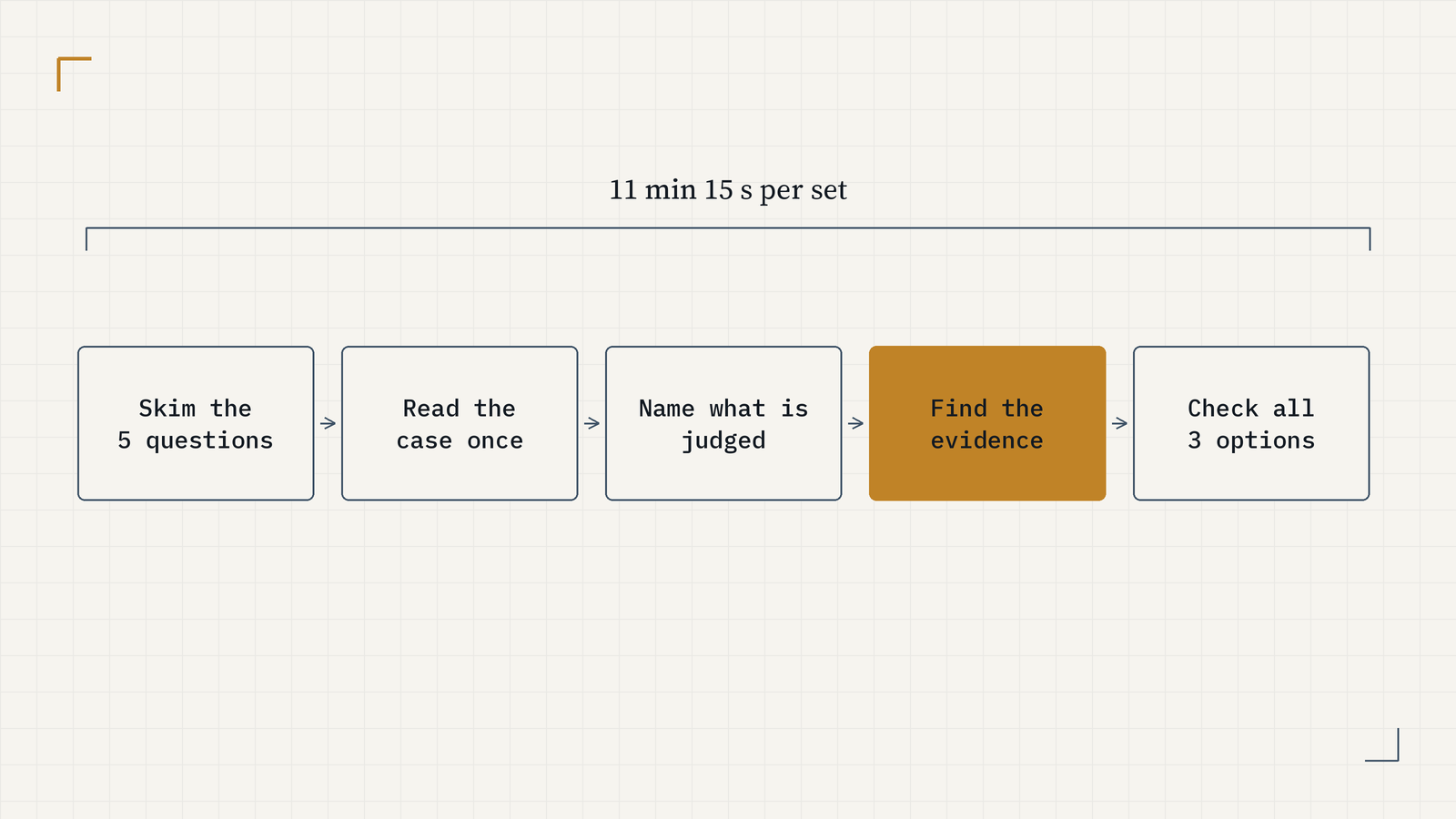
A PECB scenario-based question is one of five that share a single scenario: you read the case, then answer five questions about it. Each question has three options, one correct and two distractors, and is worth one point, exactly like the stand-alone questions on the rest of the paper. What makes the sets hard is the reading time and the level of judgment PECB asks for, and you can plan for both.
This applies to PECB's 80-question multiple-choice Lead exams. Our examples are the ISO/IEC 42001, ISO 22301 and ISO/IEC 27701 Lead Implementer exams, taken from their version 1.5 Candidate Handbooks (42001, 22301, 27701), all read on 2 October 2026.
What is the difference between stand-alone and scenario-based questions?
The handbook names two kinds of question. A stand-alone question is not context-dependent: everything you need to answer it is in the question. A scenario-based question hangs off a scenario you read first, and each scenario carries five questions. The paper mixes the two across its 80 questions.
Both kinds share one format: three options, one keyed response and two distractors, one point each. We have not seen a published count of scenario sets per paper, so do not plan around a number. Plan around the format.
What do PECB's handbooks say the questions ask you to do?
One sentence covers both kinds. The handbook says the questions ask candidates to "apply various concepts and principles explained during the training course, analyze problems, identify and evaluate alternatives, combine several concepts or ideas".
Read it as a list of verbs: apply, analyze, identify and evaluate, combine. Remembering is not on the list. The phrase "explained during the training course" also tells you where the reference point sits: your course materials, which you are allowed to bring into the exam. Our guide to what you can take into a PECB open-book exam shows how to make them fast to search.
How much of each exam tests evaluation?
Each handbook tags every competency domain with a level, and the totals differ by exam:
| Exam | Comprehension, application, analysis | Evaluation level |
|---|---|---|
| ISO/IEC 42001 Lead Implementer | 32 (40%) | 48 (60%) |
| ISO 22301 Lead Implementer | 40 (50%) | 40 (50%) |
| ISO/IEC 27701 Lead Implementer | 35 (43.75%) | 45 (56.25%) |
All three handbooks call the lower level "comprehension, application, and analysis". The more useful detail is that the domains behind those totals do not line up across exams. Planning is evaluation level in ISO/IEC 42001 (20 questions) and ISO/IEC 27701 (15), but comprehension level in ISO 22301 (18). Monitoring and measurement is evaluation level only in ISO 22301 (12). Implementation is evaluation level in all three: 18, 18 and 23 questions. Read your own handbook's table before you decide where your judgment practice goes.
How long do you have for a scenario set?
About 11 minutes 15 seconds. 180 minutes over 80 questions averages 2 minutes 15 seconds each, and five of those make a set. A stand-alone question gets that time to itself. In a scenario set, the reading comes out of the same budget, so every minute on the case is a minute you do not spend on the answers.
If you sit in a language that is not your first and ask on the day, PECB adds 30 minutes to Lead exams. That makes 210 minutes: roughly 2 minutes 38 seconds a question, and a little over 13 minutes a set.
How should you work through a scenario set?
This is our method, built around the reading grid below. Adapt it to how you read.
- Skim the five questions first. Half a minute is enough to know what the case has to tell you.
- Read the case once, carefully, and fill in the top of the grid: who the organization is and who is deciding, which system the case is about and what is inside it, and which stage the management system has reached. On the ISO/IEC 42001 course agenda, the stages run from initiation through planning, implementation, monitoring, continual improvement and preparation for the certification audit.
- For each question, name what it asks you to judge, in the handbook's verbs: apply, analyze, evaluate alternatives or combine.
- Find the evidence. Point to the sentence in the case that decides the answer. If you cannot find one, reread the question before you reread the case.
- Check all three options against the evidence and the stage. Strike the one that does not fit the case, then choose between the two left. Open your hard copy of ISO/IEC 42001, or whichever standard your exam is about, only when one specific clause would settle it.
For the clock, we budget about 30 seconds for the questions, 2 minutes for the case and 1 minute 30 seconds per answer. That is 10 minutes, leaving 1 minute 15 seconds of slack inside the 11 minutes 15 seconds. If the case still makes no sense after a second read, answer what you can and keep moving.
PECB scenario reading grid
PECB scenario reading grid
One grid per scenario set. Format figures come from PECB's version 1.5 Candidate Handbooks for the ISO/IEC 42001, ISO 22301 and ISO/IEC 27701 Lead Implementer exams, read on 2 October 2026. The method and the time split are our suggestion. This grid contains no exam content: it is a set of questions to ask of whatever case you are given.
The set at a glance
| What | Figure |
|---|---|
| Questions per scenario | 5 (PECB) |
| Options per question | 3: one correct, two distractors (PECB) |
| Points | 1 per question (PECB) |
| Average time for a set | 11 minutes 15 seconds: 5 x 2 minutes 15 seconds (arithmetic) |
| With 30 extra minutes for a non-native language, Lead exams | A little over 13 minutes (arithmetic) |
| Worst case for one set | 5 of the 24 questions you can miss and still pass (arithmetic) |
Read the case once (our suggestion)
| Ask | What you write |
|---|---|
| Who | The organization, and the person who has to decide |
| What system | Which system the case is about, and what is inside it |
| What stage | Initiation, planning, implementation, monitoring, continual improvement, or preparation for the certification audit |
| What has already happened | Decisions or documents the case says exist |
| What is missing or wrong | Anything the case flags as a gap, a complaint or a problem |
Work each question (our suggestion)
Judge is what the question asks you to do, in the handbook's verbs: apply, analyze, evaluate alternatives, combine. Evidence is the sentence in the case that decides it. Option check marks each of the three options Y (fits), N (fails) or ? (unsure).
| Q | Judge | Evidence in the case | Option check (1, 2, 3) | Answer |
|---|---|---|---|---|
| 1 | ||||
| 2 | ||||
| 3 | ||||
| 4 | ||||
| 5 |
Option check rules (our suggestion)
- Strike any option that contradicts a fact in the case
- Be wary of any option that belongs to a different stage than the one the case has reached
- Among the options left, pick the one your evidence sentence supports
- Open the standard only when one specific clause would settle it
Time box (our suggestion)
- About 30 seconds skimming the five questions
- About 2 minutes reading the case and filling the top grid
- About 1 minute 30 seconds per question, 7 minutes 30 seconds in all
- That leaves about 1 minute 15 seconds of slack in 11 minutes 15 seconds
- Case still unclear after a second read? Answer what you can and keep moving
What does a bad scenario set cost you?
Five points at most. The pass mark is 70%, which is 56 of 80, so you can get 24 wrong and still pass. A set that goes entirely wrong uses five of those 24 and leaves you 19.
The bigger cost is time. Every minute over budget on one set comes out of the questions after it, and each of those is worth the same one point. One bad set is a five-point problem. A bad set that also eats the time for the questions behind it can be a much bigger one.
How should you practice for scenario questions?
Practice in timed sets of five at 11 minutes 15 seconds, and fill in the grid each time until the steps stop needing thought. Put most of your hours where your handbook puts its evaluation-level questions. For ISO/IEC 42001, our guide to the ISO 42001 Lead Implementer exam format and domains sets out all six domains and their weights.
The ISO 42001 Lead Implementer eBook is mapped to all six competency domains and written for the 80-question multiple-choice format. The ISO 42001 Lead Implementer practice question bank has 227 questions with full rationales, weighted to the published item counts. Its answer keys run A to D, four options against the exam's three, so use the rationales: for each wrong option, say why it fails before you read the explanation. For privacy, the ISO 27701 Lead Implementer book is written for the same 80-question format.
Nothing on this page comes from inside a PECB exam, and PECB's handbooks treat any disclosure of exam content as a violation of its Code of Ethics. When your result arrives, our guide to PECB results, re-evaluation and retakes covers what happens next. Credential Press is independent of PECB and ISO.
Frequently asked questions
How many questions come with each PECB scenario?
Five. You read the scenario, then answer five questions about it. Each has three options, one correct and two distractors, and each is worth one point.
What is a stand-alone question?
A question that does not depend on a scenario: everything you need is in the question itself. PECB's multiple-choice Lead exams mix stand-alone and scenario-based questions across 80 questions.
What do PECB scenario questions ask you to do?
The Candidate Handbook says the questions ask candidates to apply various concepts and principles explained during the training course, analyze problems, identify and evaluate alternatives, and combine several concepts or ideas. The same description covers stand-alone questions.
How long should a scenario set take?
On average 11 minutes 15 seconds: five questions at 2 minutes 15 seconds each, which is 180 minutes divided by 80 questions. Reading the case comes out of that time.
What happens if I get a whole scenario set wrong?
You lose five points. The pass mark is 70%, which is 56 of 80, so you can miss 24 and still pass. One bad set uses five of them.
How many evaluation-level questions are on the exam?
It depends on the exam. The version 1.5 Candidate Handbooks put 48 of 80 at evaluation level for ISO/IEC 42001 Lead Implementer, 40 for ISO 22301 Lead Implementer and 45 for ISO/IEC 27701 Lead Implementer.
Which books help you practice for the multiple-choice exam?
ISO 42001 Lead Implementer Exam Guide
PECB Certified ISO/IEC 42001 Lead Implementer. 12 chapters, 387 pages.
ISO 42001 Lead Implementer Practice Questions
Practice questions with full rationales, weighted to the published domains. 246 pages.
Sources
Every figure above was read from the document itself on 2 October 2026. Suggestions are marked as ours.
- PECB, ISO/IEC 42001 Lead Implementer Candidate Handbook, version 1.5, 2026
- PECB, ISO 22301 Lead Implementer Candidate Handbook, version 1.5
- PECB, ISO/IEC 27701 Lead Implementer Candidate Handbook, version 1.5
- PECB, ISO/IEC 42001 Lead Implementer course, agenda
- PECB Help Center, List of PECB Exams
- ISO, ISO/IEC 42001 standard page
Credential Press is not affiliated with, endorsed by or authorized by PECB, ISO or the IEC. Exam names and trademarks belong to their owners.