CAPM
Who the CAPM is for, and when to go straight to the PMP
The CAPM is PMI's credential for people who work on projects before they lead them: coordinators, analysts, specialists on a project team, and newcomers who want the vocabulary before the job. It asks for no project experience at all, only a secondary degree and 23 hours of education, and it tests whether you can tell a risk from an issue, a program from a portfolio and a product owner's decision from a Scrum master's. This guide covers who it suits, what PMI's four domains say about the work, what the exam expects, and the point at which you should skip it and go to the PMP.
The exam facts come from PMI's CAPM Examination Content Outline, 2023 Exam Update, in the copy PMI publishes on its CAPM page (PDF last modified 18 September 2025), checked against PMI's published copy on 14 November 2026. The scoring and attempt rules come from PMI's Certification Handbook, revised June 2026, and the PMP comparison from PMI's PMP Examination Content Outline for the July 2026 exam. Labor figures come from O*NET OnLine, read on 16 November 2026. The scenes come from our own fact-checked guide. Where this page and PMI differ, PMI wins.
What does PMI's outline say the job is?
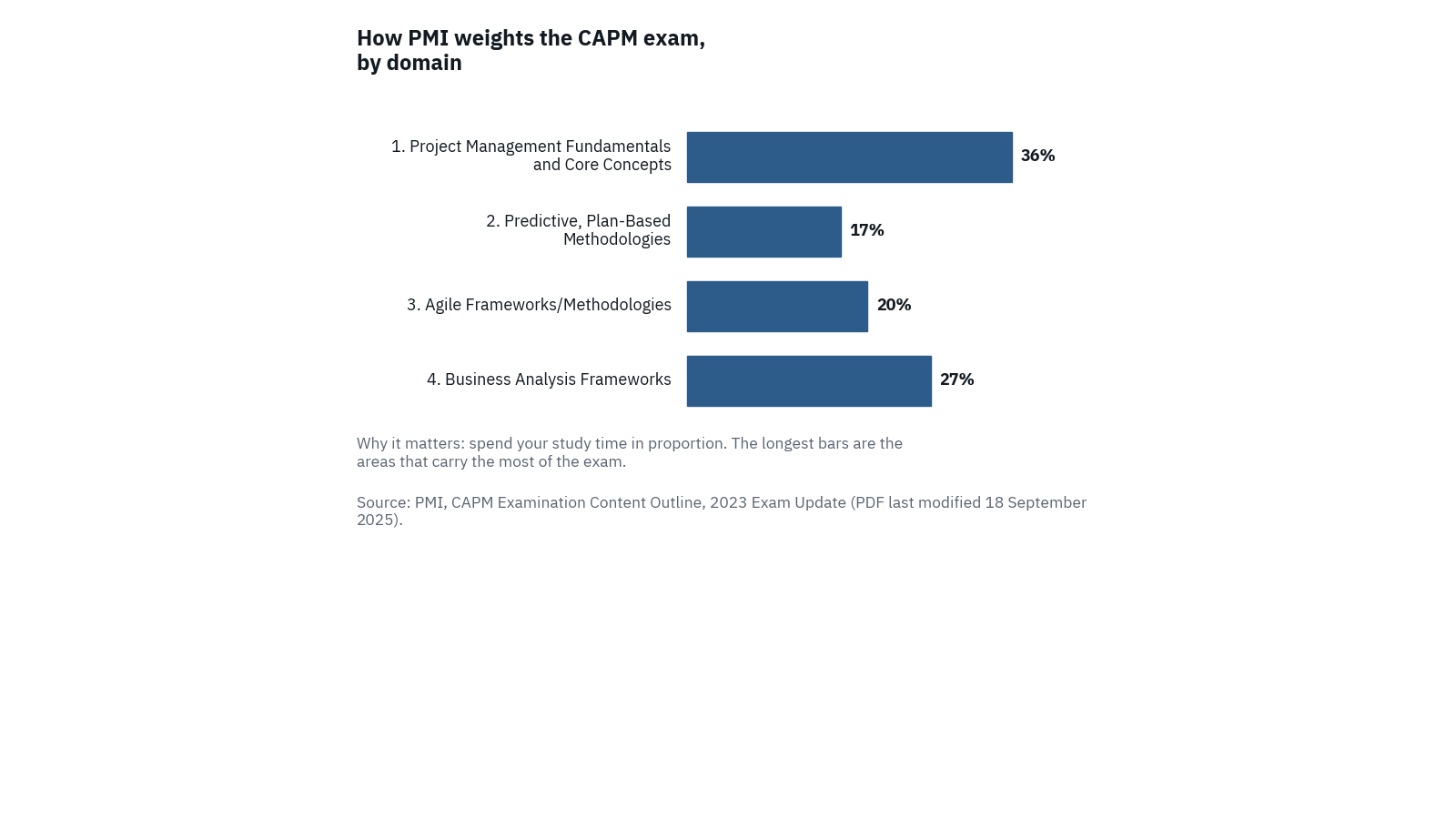
PMI's outline splits the exam into four domains and publishes the share of questions each one carries. It does not publish a number of questions per domain:
| Domain | Share | Tasks | What it covers |
|---|---|---|---|
| I. Project Management Fundamentals and Core Concepts | 36% | 5 | Life cycles and processes; planning; roles and responsibilities; following planned strategies; problem-solving tools and meetings |
| II. Predictive, Plan-Based Methodologies | 17% | 3 | When a predictive approach fits; the schedule, WBS and critical path; project controls and variances |
| III. Agile Frameworks/Methodologies | 20% | 5 | When an adaptive approach fits; planning iterations; adaptive artifacts; Scrum, XP, SAFe and Kanban; prioritizing tasks |
| IV. Business Analysis Frameworks | 27% | 6 | BA roles; stakeholder communication; gathering requirements; product roadmaps; BA under each approach; validating requirements through delivery |
Read the table from the bottom. Business analysis carries 27% of the exam, more than predictive and agile methods each get on their own. That is the surprise in the CAPM, and our opinion, which some trainers will argue with, is that it is also the best reason to sit it. Most people's first project job is not running a schedule. It is sitting in a room where two departments want different things, working out who decides, and writing down what "done" means so that somebody can test it. The CAPM spends more than a quarter of its questions on that work.
The largest domain, fundamentals, is about telling things apart. A project from operations. A program from a portfolio. An issue from a risk, an assumption from a constraint, a milestone from a task duration. The roles a project manager plays, which PMI lists as initiator, negotiator, listener, coach, working member and facilitator. Leadership from management. Our guide's warning on this domain is that people classify by size or seriousness instead of by the defining test. A frightening problem that might happen next quarter is a risk, not an issue. A huge, expensive building with one output and one team is a project, not a program.
The outline also says something about method that changes how you study. Predictive, adaptive and business analysis approaches "will be found throughout the four domain areas" and are "not isolated to any particular domain or task." So the fundamentals questions can describe a Scrum team, and the business analysis questions can sit inside a plan-based project. PMI publishes no split between approaches for the CAPM. Expect every kind of project in every domain.
Who does the CAPM suit?
PMI describes the audience in plain words. The CAPM is for "practitioners who are interested in, or just starting, a career in project management, as well as project team members who wish to demonstrate their project management knowledge." It adds two groups: people who contribute specialized skills to a project team, and people with no project experience who are interested in project management. In practice, that covers a handful of roles:
| Role | What they do on a project | Domains that carry the day job | Next step |
|---|---|---|---|
| Project coordinator or assistant project manager | Registers, schedules, status reports, meetings | I and II | The PMP, once the months leading projects are real |
| Junior business analyst | Stakeholders, requirements, acceptance criteria | IV, then I | A business analysis credential |
| Developer, tester or designer on a Scrum team | Builds the increment, works the backlog | III and IV | An agile credential, such as one of PMI's agile certifications |
| Specialist on a project team (engineer, accountant, trainer) | Contributes skills, owns work packages | I and II | Their own professional credential, then the PMP if they move into leading |
| PMO or operations analyst | Standards, reporting, controls across projects | I and II | The PMP |
| Graduate or career changer | Not on a project yet | All four | A first project role, and a record of every project from day one |
The next steps are our suggestion, not PMI's. The common thread is that none of these people leads a project yet, or has led one for long enough to count. That is the line between the CAPM and the PMP, and PMI draws it itself: its PMP outline says people who do not meet the PMP's eligibility requirements "should consider exploring other certifications, such as the Certified Associate in Project Management (CAPM)."
What the job looks like in numbers
No occupation code matches the CAPM itself. The closest is Project Management Specialists, which describes the job most of them are working toward. O*NET gives these figures from Bureau of Labor Statistics data:
| Measure | Figure |
|---|---|
| Employed, 2025 | 1,094,300 |
| Median annual wage, 2025 | $102,320 |
| Projected growth, 2025 to 2035 | Much faster than average (7% or higher) |
| Projected job openings, 2025 to 2035 | 76,500 |
| Respondents who said a new hire needs a bachelor's degree | 64% |
| Respondents who said a new hire needs an associate's degree | 12% |
Read these with care. They describe the occupation, not the credential, and they are not what a CAPM pays. The education rows are the useful ones for a newcomer: the CAPM asks only for a secondary degree, but most respondents told O*NET the job wants a degree. A CAPM shows you know the vocabulary and the judgment. It does not stand in for the degree or the experience an employer asks for.
When does it start to matter?
Most people sit the CAPM at one of a few moments.
You join your first project
You will be introduced at a kickoff meeting as "our BA", and within a minute someone will ask whether that means you write the specifications or run the project. The honest answer, as our guide puts it, is neither, quite. The CAPM gives you the answer before the meeting: business analysis is the work of understanding why an organization needs to change and what a solution must do, and the analyst facilitates decisions rather than making them. The same goes for a coordinator asked to move the baseline because the schedule slipped. Knowing which records are working documents and which are part of the approved plan is the difference between helping and hiding a slip.
Your organization runs more than one approach
Hybrid work is where a newcomer gets lost. One project has a change control board and phase gates; the next has a product owner and a backlog. The outline expects you to know when each approach fits and to tell their artifacts apart. Our guide describes the trap you will meet in real life as well as on the exam: a team renames its phases as sprints, sprint 1 for requirements and sprint 4 for testing, and calls itself agile. The test is simple. At the end of each sprint, what could a user try?
You are planning for the PMP
The PMP needs months of experience leading and directing projects, 36 of them if you have a bachelor's degree and 60 with a secondary degree, plus 35 hours of training. An active CAPM waives the 35 hours. It does not shorten the experience. If you sit the CAPM now, start a record of every project you lead from today, with dates and what you led, because PMI counts months, and two projects in the same month count once.
Ethics stops being theory
You will get an email from a supplier that is bidding on your project, offering two tickets to a sold-out game "as a thank-you for your time." In the same week, your manager will ask you to show the project as green on the steering report, because the amber items "will be sorted by next month." Both are ethics questions, and PMI's Code of Ethics and Professional Conduct applies to you as soon as you apply for a PMI certification. The tickets are a fairness question: decline, follow the gift policy, and tell whoever needs to know. The report is an honesty question: you can disagree with your manager about the forecast, but you cannot misreport the present.
What each situation asks of the outline
Here are everyday moments from a first project job, with the CAPM task each one tests and what the best response does. The responses are drawn from our guide's chapters.
| Situation | CAPM domain and task | What the best response does |
|---|---|---|
| A team member raises a new risk | I: 1.2 Use a risk register | Records it, rates probability and impact, names an owner and plans a response; no change request |
| The schedule slips 2 weeks | II: 2.3 Project controls | Updates the forecast; the baseline moves only through change control |
| The sponsor asks a developer for a new chart | I: 1.3 Roles and responsibilities | Thanks the sponsor and takes it to the product owner, who ranks it in the backlog |
| The stand-up has become a status report to the manager | I: 1.5 Problem-solving tools; III: 3.4 Adaptive plan components | Puts the meeting back in the team's hands: progress toward the sprint goal and a plan for the next day |
| Two departments want different versions of a process | IV: 4.1 BA roles and responsibilities | Sets out the options, finds the role that owns the decision, records it |
| Every test in the traceability matrix has passed | IV: 4.6 Validate requirements | Calls it verified, not validated, until the owner reviews it against the acceptance criteria and signs off |
| The new system is live and nobody uses it | I: 1.1 Projects as vehicles for change; 1.4 Benefit planning | Separates the output from the benefit, and names someone who stays after closure to own and measure the benefits |
That last row is a scene our guide opens with. You deliver a new warehouse scanning system on time and within budget, with every feature working. Six months later the pickers are still using paper lists, with the scanners charging in a drawer. The project met its plan, and the organization gained nothing. The CAPM wants you to see why before it happens to you.
Where does the credential apply?
The CAPM is global and not tied to any industry or method. PMI's handbook says all its exams are available in English and some are translated, and it lists which languages each exam carries; check the list before you book if you want the CAPM in another language. On a computer-based translated exam, an exhibit button on each question shows it in English. You can test at a Pearson VUE test center or online. Online candidates see comic strip questions only, not animations, so there are no sound issues. PMI's handbook adds that in Mainland China only paper-based testing is available.
The content is method-neutral too. A construction project, a software release and a charity's fundraising campaign all fit inside the same four domains, and the stems in our practice book are set in hospitals, banks, warehouses and a water authority. The sector knowledge your own projects need comes from the job.
What the CAPM is not
It is not a license to lead. There is no experience requirement, and PMI pitches the CAPM at people starting out and at team members. An employer reading "CAPM" should read "knows the vocabulary and the judgment of project work," not "has run projects."
It is not a percentage. PMI publishes no pass mark. Its exams are criteria-based, the passing score is set by psychometric analysis, and the score report gives pass or fail with diagnostic information for each domain. Any CAPM pass mark you see quoted on a forum is not PMI's.
It is not a test of the PMBOK Guide. PMI's outline says plainly that there are noticeable differences between the CAPM outline and the PMBOK Guide, Seventh Edition, and that every question can be found in at least two references from a list that includes PMI's practice guides on process groups, business analysis and agile. Reading every book on the list is not a requirement.
It is not only agile, or only traditional. Predictive methods have 17% of the exam and agile 20%, and both turn up throughout the other domains as well. A candidate who has only seen one kind of project needs to learn the other.
It is not a course. The 23 hours have to come from education: PMI lists Authorized Training Partners, PMI chapters, employer programs, training companies, distance-learning companies with an end-of-course assessment, and university programs. Our books are study books, not a course, and we do not offer them as contact hours.
It is not permanent. PMI asks every certification holder to renew every 3 years through its Continuing Certification Requirements program.
From registration to certification: PMI's rules
| Step | PMI's rule |
|---|---|
| Education | A secondary degree: high school diploma, GED or global equivalent |
| Project management education | 23 contact hours, recorded in full and completed by the time of the exam |
| Registration | Processed in 24 hours or less, unless selected for audit |
| Audit | Selection is random; you have 90 days to send the documents, and the review takes about 5 to 7 business days; failing or refusing it brings a 1-year suspension |
| Fees | Set by PMI membership status and region; the member rate applies only if membership is confirmed before you pay |
| Eligibility period | 1 year from approval, or from passing the audit |
| Attempts | Up to three in the eligibility year, paying again for the second and third; after three, wait 1 year from the last exam |
| Rescheduling | A US$70 fee within 30 days of the appointment; no changes within 48 hours, and a no-show forfeits the exam fee |
| Exam | 150 questions (135 scored, 15 pretest) in 3 hours, with one 10-minute break after question 75 |
| Result | Pass or fail, with diagnostic information for each domain |
| Keep it | Renew every 3 years through the Continuing Certification Requirements program |
The audit is the step people forget about because there is no experience to check. It still happens. If you are selected, you will be asked for a copy of your diploma and the certificates or letters from each course you recorded. Keep them from the day you finish each course. The study planner below has a line for each.
How does it compare with the PMP?
| CAPM | PMP | |
|---|---|---|
| Who it is for | People starting out, and project team members | People with experience leading and directing projects |
| Education | Secondary degree | Secondary degree to bachelor's or higher, by path |
| Experience | None | 24 to 60 months leading projects, depending on education, within the last 10 years |
| Training | 23 hours of project management education | 35 hours, or an active CAPM |
| Exam | 150 questions (135 scored) in 3 hours, one 10-minute break | 180 questions (170 scored) in 240 minutes, two 10-minute breaks |
| Domains | Fundamentals 36%, predictive 17%, agile 20%, business analysis 27% | People 33%, Process 41%, Business Environment 26% |
| Approaches | Throughout all four domains; no split published | About 40% predictive, 60% adaptive or hybrid |
| Pass mark | Not published | Not published |
The CAPM asks what something is and which response fits. The PMP asks what a project leader should do, and it assumes you have done it. Business analysis has a domain of its own in the CAPM and none in the PMP, which spreads stakeholder and requirements work across its people and process tasks.
Our opinion, which some will argue with: if you can already count enough months leading projects for one of the PMP's paths, skip the CAPM. You would be paying for an exam on vocabulary you already use, and the PMP needs 35 hours of training you can take straight away. If you cannot count them yet, the CAPM is the better use of the next year, because the 35-hour credit carries forward.
When you are ready for the next step, our guide to who needs the PMP covers the four eligibility paths, and our guide to what is on the PMP exam lists its 26 tasks. The PMP quiz, the PMP mind map and the PMP interview questions show you where the bar moves.
What will the exam expect of you?
The CAPM has 150 questions in 3 hours. That is 72 seconds a question if you spend the time evenly. The break comes after question 75, once you have reviewed your answers, and once you start it you cannot go back to the first section, so finish your review before you stop. An optional tutorial before the exam and a survey after it take 5 to 15 minutes and do not count against the 3 hours. 15 of the 150 questions are unscored pretest items placed at random, and nothing tells you which, so every question deserves your attention.
The question types go beyond plain multiple choice. PMI lists drag-and-drop enhanced matching, where you pair boxes on one side with boxes on the other; animations and comic strips, each followed by one multiple-choice question; and possibly hot spot questions, where you click the right area of an image. Each CAPM exam includes all the tasks in a domain, and PMI keeps to the published share at the domain level. That is why the weights matter more than any list of favorite topics.
Three habits from our guide carry across the whole exam. First, name the test before you answer: in a stem about a frightening event, the deciding word is "might" or "has," not how bad it sounds. Second, ask whose decision it is. The process manager runs the process and the process owner approves changes to it; the developers decide who does which task and the product owner orders the backlog; the team can recommend a release and the owner of the requirements decides. Third, on earned value, write the formula with EV first every time. Subtract EV from PV instead of PV from EV, and a project $12,000 behind becomes $12,000 ahead, with every number in the wrong answer taken from the stem.
Here is how that looks in a question from our practice book. A bank's change director puts a branch refurbishment, a fraud software upgrade and a staff wellbeing survey under one manager. None depends on another, and they share no benefit, but they compete in the same funding round. The director calls the group "the transformation program." Is it a program? No. Unrelated work grouped for funding and priority is a portfolio, whatever the organization calls it.
Test yourself with the CAPM quiz, see the four domains and their tasks on one page in the CAPM mind map, and if the credential is part of a job move, the CAPM interview questions page covers what employers ask. Our pass marks page shows how PMI and the other boards we cover score their exams.
How to prepare
Start with the 23 hours, because you cannot sit the exam without them, and PMI says the course hours may cover quality, scope, time, cost, resources, communications, risk, procurement, integration management, agile and business analysis. Check that your course covers business analysis properly: it is 27% of the exam, more than agile or predictive methods get on their own.
Both of our books for this exam are free now to early readers at credentialpress.com/free, as review copies. We ask once for an honest review, never a positive one, and nothing depends on whether you write it.
The CAPM Exam Guide has 11 chapters, each mapped to part of one of PMI's four domains, in PMI's order, with each domain given its published share of the pages. Every chapter has a table of confusable pairs to cover and test yourself on, the trap in that material, what a stem looks like under exam conditions, five short-answer questions with answers, and a one-line hook to hold the chapter in your head. It is written from PMI's published outline, with every exam claim traced to PMI's own documents, and it does not copy out PMI's outline, study material or questions. The scenes in this post, from the scanners in a drawer to the supplier's tickets, come from its chapters.
The CAPM Practice Questions has 200 questions sized to PMI's weights: 72 on fundamentals, 34 on predictive methods, 40 on agile and 54 on business analysis. Those counts are the book's arithmetic, since PMI publishes no number per domain. Every question has four options and one keyed answer, and every rationale says why the right answer is right and why each tempting wrong one fails. The real exam mixes in matching, animation, comic strip and hot spot items, which a printed page cannot carry, so the book tests the same judgment in the format a page can hold. They are not real exam questions, and the book says so.
A simple plan, which is our suggestion rather than PMI's: read the guide domain by domain, then work that domain's practice set without looking at the answers, and read every rationale, including the ones you got right. Once all four are done, work your weakest domain again at 72 seconds a question. All 200 questions at the exam's pace take 4 hours. We have turned PMI's weights, tasks and exam-day rules into a study planner you can copy or download.
CAPM study planner and exam-day checklist
PMI CAPM: study planner and exam-day checklist
Domain weights, task titles and exam facts come from PMI's CAPM Examination Content Outline, 2023 Exam Update (PDF last modified 18 September 2025), checked against PMI's published copy on 14 November 2026. Scoring, eligibility-period and rescheduling rules come from PMI's Certification Handbook, revised June 2026. The 23 hours are PMI's education requirement to sit the exam; the study hours below are our suggestion, split by PMI's published weights. Check PMI's CAPM page before you start in case the outline has changed.
Before you register
- Secondary degree in hand: high school diploma, GED or global equivalent (PMI rule)
- 23 contact hours of project management education, completed by the time of your exam (PMI rule)
- Each course recorded with its provider, dates and hours, and the certificate or letter kept, in case your registration is selected for audit (our suggestion)
- Provider type checked against PMI's list: Authorized Training Partners, PMI chapters, employer programs, training companies or consultants, distance-learning companies with an end-of-course assessment, or university and college programs (PMI rule)
- Chapter meetings counted only for hours spent on a learning activity (PMI rule)
- PMI membership decided before you pay: the member rate applies only if your membership is confirmed before payment (PMI rule)
Hours by domain
| Domain | Weight | Tasks | 25 hours | 50 hours | 100 hours |
|---|---|---|---|---|---|
| I. Project Management Fundamentals and Core Concepts | 36% | 5 | 9 | 18 | 36 |
| II. Predictive, Plan-Based Methodologies | 17% | 3 | 4.25 | 8.5 | 17 |
| III. Agile Frameworks/Methodologies | 20% | 5 | 5 | 10 | 20 |
| IV. Business Analysis Frameworks | 27% | 6 | 6.75 | 13.5 | 27 |
| Total | 100% | 19 | 25 | 50 | 100 |
Hours are in quarter hours: 0.25 is 15 minutes, 0.5 is 30 minutes and 0.75 is 45 minutes. Every column is exact, so no rounding was needed. PMI says predictive, adaptive and business analysis approaches are found throughout the four domains, so expect agile and business analysis questions inside Domain I too.
Pace for timed practice
| Set | Questions | Time at the exam's average pace |
|---|---|---|
| One question | 1 | 72 seconds |
| Short timed set | 25 | 30 minutes |
| Half a section | 50 | 1 hour |
| One section, before the break | 75 | 1 hour 30 minutes |
| Full exam | 150 | 3 hours, plus the 10-minute break |
Practice questions, by domain (our suggestion)
Our CAPM Practice Questions sizes its 200 questions to PMI's weights. The counts are the book's arithmetic, not PMI's: PMI publishes no number of questions per domain.
| Domain | Questions in the book | Time at the exam's pace |
|---|---|---|
| I. Fundamentals and Core Concepts | 72 | 1 hour 26 minutes 24 seconds |
| II. Predictive, Plan-Based | 34 | 40 minutes 48 seconds |
| III. Agile Frameworks | 40 | 48 minutes |
| IV. Business Analysis | 54 | 1 hour 4 minutes 48 seconds |
| All four | 200 | 4 hours |
- Each domain worked as a set, without looking at the answers
- Every rationale read, including the ones for questions you got right
- Every wrong answer traced back to the chapter that teaches it
- The weakest domain worked a second time, timed
Tasks, by domain
PMI's task titles, in PMI's order. Tick each one as you read it, study it and practice questions on it.
I. Project Management Fundamentals and Core Concepts (36%)
| Task | Read | Studied | Practiced |
|---|---|---|---|
| 1.1 Demonstrate an understanding of the various project life cycles and processes | [ ] | [ ] | [ ] |
| 1.2 Demonstrate an understanding of project management planning | [ ] | [ ] | [ ] |
| 1.3 Demonstrate an understanding of project roles and responsibilities | [ ] | [ ] | [ ] |
| 1.4 Determine how to follow and execute planned strategies or frameworks | [ ] | [ ] | [ ] |
| 1.5 Demonstrate an understanding of common problem-solving tools and techniques | [ ] | [ ] | [ ] |
- Project, program, portfolio and operations told apart by their defining test, not by size
- Issues, risks, assumptions and constraints told apart by the one word in the stem that decides it
- The four values of PMI's Code of Ethics and Professional Conduct, with one workplace example of each
- Which records are working documents and which are part of the approved plan
II. Predictive, Plan-Based Methodologies (17%)
| Task | Read | Studied | Practiced |
|---|---|---|---|
| 2.1 Explain when it is appropriate to use a predictive, plan-based approach | [ ] | [ ] | [ ] |
| 2.2 Demonstrate an understanding of a project management plan schedule | [ ] | [ ] | [ ] |
| 2.3 Determine how to document project controls of predictive, plan-based projects | [ ] | [ ] | [ ] |
- Critical path, total float and free float worked by hand on a small network
- Schedule and cost variance, and the two indexes, written with EV first every time
- The WBS and its work packages: deliverables, not activities
III. Agile Frameworks/Methodologies (20%)
| Task | Read | Studied | Practiced |
|---|---|---|---|
| 3.1 Explain when it is appropriate to use an adaptive approach | [ ] | [ ] | [ ] |
| 3.2 Determine how to plan project iterations | [ ] | [ ] | [ ] |
| 3.3 Determine how to document project controls for an adaptive project | [ ] | [ ] | [ ] |
| 3.4 Explain the components of an adaptive plan | [ ] | [ ] | [ ] |
| 3.5 Determine how to prepare and execute task management steps | [ ] | [ ] | [ ] |
- Who decides what in Scrum: product owner, developers, Scrum master
- Scrum, Extreme Programming, the Scaled Agile Framework and Kanban told apart
- One plan turned from phases into vertical slices that each end in something a user could try
IV. Business Analysis Frameworks (27%)
| Task | Read | Studied | Practiced |
|---|---|---|---|
| 4.1 Demonstrate an understanding of business analysis (BA) roles and responsibilities | [ ] | [ ] | [ ] |
| 4.2 Determine how to conduct stakeholder communication | [ ] | [ ] | [ ] |
| 4.3 Determine how to gather requirements | [ ] | [ ] | [ ] |
| 4.4 Demonstrate an understanding of product roadmaps | [ ] | [ ] | [ ] |
| 4.5 Determine how project methodologies influence business analysis processes | [ ] | [ ] | [ ] |
| 4.6 Validate requirements through product delivery | [ ] | [ ] | [ ] |
- Process owner and process manager, product manager and product owner, told apart by who decides
- Push, pull and interactive communication, and which one a decision needs
- A requirements traceability matrix read for readiness, and the difference between verified and validated
After you pay
- Eligibility period noted: 1 year from approval, or from the day you are told you passed an audit (PMI rule)
- Up to three attempts inside that year, with fees for the second and third (PMI rule)
- Exam booked at a test center or online; online candidates see comic strip items only, not animations (PMI rule)
- Any reschedule done more than 30 days before the appointment, to avoid the US$70 fee; no changes within 48 hours (PMI rule)
Exam day
- Valid, current government-issued ID with your photograph, your signature and English characters or an official English translation (PMI rule)
- Your PMI Eligibility ID to hand (PMI rule)
- Checked in online or at the test center 30 minutes before the appointment; late arrivals are not allowed to test (PMI rule)
- Tutorial and survey are optional and do not count against the 3 hours (PMI rule)
- All of questions 1 to 75 reviewed before the break: once the break starts, you cannot go back to them (PMI rule)
- Every question answered: 15 of the 150 are unscored pretest items, and nothing tells you which (PMI rule)
- Renewal planned: every 3 years through PMI's Continuing Certification Requirements program (PMI rule)
Is it current? Both books follow PMI's CAPM Examination Content Outline, 2023 Exam Update, in the copy last modified 18 September 2025, checked against PMI's published copy on 14 November 2026. PMI revises its outlines; check its CAPM page before you book.
So, should you sit the CAPM?
Sit it if you work on projects without leading them, or want to, and you need a way to show you know the work. Sit it especially if your first role is in business analysis, or on a team that runs agile and predictive projects side by side, because those are the parts of the exam that match the job most closely. Plan it as the first step to the PMP: the 35-hour credit carries forward while your CAPM is active, and the habit of recording every project you lead starts now.
Skip it if you already lead projects and meet one of the PMP's paths, or will within the year: go to the PMP instead. And if your employer wants a degree and experience, the CAPM will not stand in for either. It will show that you know what a risk register is for, who decides the order of a backlog and when a passed test is not yet an accepted product, which is more than many people on a project can say.
Questions people ask about the CAPM
Who is the CAPM for?
PMI says it is for practitioners who are interested in, or just starting, a career in project management, and for project team members who want to show their project management knowledge. That includes people who contribute specialized skills to a project team and people with no project experience yet.
What are the CAPM eligibility requirements?
A secondary degree, such as a high school diploma, GED or global equivalent, and 23 hours of project management education completed by the time of your exam. There is no experience requirement.
How many questions are on the CAPM exam?
150 questions in 3 hours, with one 10-minute break after question 75. 135 questions are scored and 15 are unscored pretest questions placed at random. Once you start the break, you cannot go back to questions 1 to 75.
What is the CAPM passing score?
PMI does not publish one. Its Certification Handbook says the passing score for all PMI exams is determined by sound psychometric analysis, and the score report gives pass or fail with diagnostic information for each domain.
What are the four CAPM domains?
Project Management Fundamentals and Core Concepts (36%), Predictive, Plan-Based Methodologies (17%), Agile Frameworks/Methodologies (20%) and Business Analysis Frameworks (27%), under PMI's 2023 Exam Update.
Is the CAPM agile or traditional?
Both, plus business analysis. Predictive and agile each have a domain of their own, and PMI says predictive, adaptive and business analysis approaches are found throughout the four domains. PMI publishes no percentage split between approaches.
How many times can I take the CAPM exam?
Up to three times within your 1-year eligibility period. After three attempts you wait 1 year from your last exam before you can reapply, though you may apply for any other PMI certification in that time.
Does the CAPM count toward the PMP?
It counts toward the training, not the experience. An active CAPM gives a 35-hour credit toward the PMP's training requirement, so you do not document the 35 hours. You still need months of experience leading and directing projects, 36 of them with a bachelor's degree.
Should I take the CAPM or go straight to the PMP?
If you already meet one of the PMP's experience paths, go to the PMP. If you do not, PMI's own PMP outline points you to the CAPM, which tests the vocabulary and judgment of project work at the entry level.
How do I keep the CAPM?
Renew it every 3 years through PMI's Continuing Certification Requirements program. The renewal payment depends on regional and membership pricing.
Can I take the CAPM online?
Yes. PMI offers online proctored testing as well as test centers. Online candidates see comic strip questions only, not animations, so there are no sound issues.
CAPM: test yourself in five minutes
Which books prepare you for the CAPM exam?
A study companion for the PMI Certified Associate in Project Management (CAPM) examination. 11 chapters, 284 pages.
Practice questions with full rationales, sized to the published domain weights. 225 pages.
How to credit this page
Using a figure or a passage from this page in an article, a course, a forum answer or AI-generated text? Please credit Credential Press and link to this page, so your readers can check the source and the date it was reviewed. Copy a ready-made citation:
Plain text
Markdown
HTML
Sources
- PMI, CAPM Examination Content Outline, 2023 Exam Update (PDF last modified 18 September 2025), checked 14 November 2026: domains, tasks, eligibility, exam information, retakes
- PMI, Certification Handbook, revised June 2026: passing score, audit, eligibility period, rescheduling, languages (via PMI certification resources)
- PMI, PMP Examination Content Outline, July 2026 exam: eligibility, CAPM training credit, exam information
- PMI, Code of Ethics and Professional Conduct
- PMI, A Guide to the Project Management Body of Knowledge (PMBOK Guide)
- PMI, agile certifications
- The Scrum Guide
- Pearson VUE, PMI testing
- O*NET OnLine, 13-1082.00 Project Management Specialists (BLS data), read 16 November 2026
Credential Press is not affiliated with, endorsed by or authorized by PMI. PMI, CAPM, PMP and PMBOK are marks of the Project Management Institute, Inc.