CPP
The CPP and US payroll practice: who it is for
The CPP, PayrollOrg's Certified Payroll Professional, is for people who already run payroll in the United States and want to prove they run it at the mastery level: the specialist who checks the system's math, the manager who signs off the tax deposit, the director who owns the controls. If you are new to payroll, it is not for you yet; PayrollOrg's Fundamental Payroll Certification is. This guide covers what the exam tests, who sits it, when it starts to matter, and how it compares with the FPC and with the HR credentials beside payroll.
The exam facts come from PayrollOrg's CPP page, its CPP Exam Content Outline effective 5 September 2026, and its guide Preparing for the 2026 CPP and FPC Exams, all read on 24 October 2026. Labor data comes from O*NET OnLine and the PHR facts from HRCI's PHR page, both read on 16 November 2026, and every payroll figure from the IRS, SSA and Department of Labor documents behind our fact-checked guide. Where this page and PayrollOrg differ, PayrollOrg wins. One more note: ASIS International's Certified Protection Professional shares the initials and has nothing to do with payroll.
What does a CPP actually do?
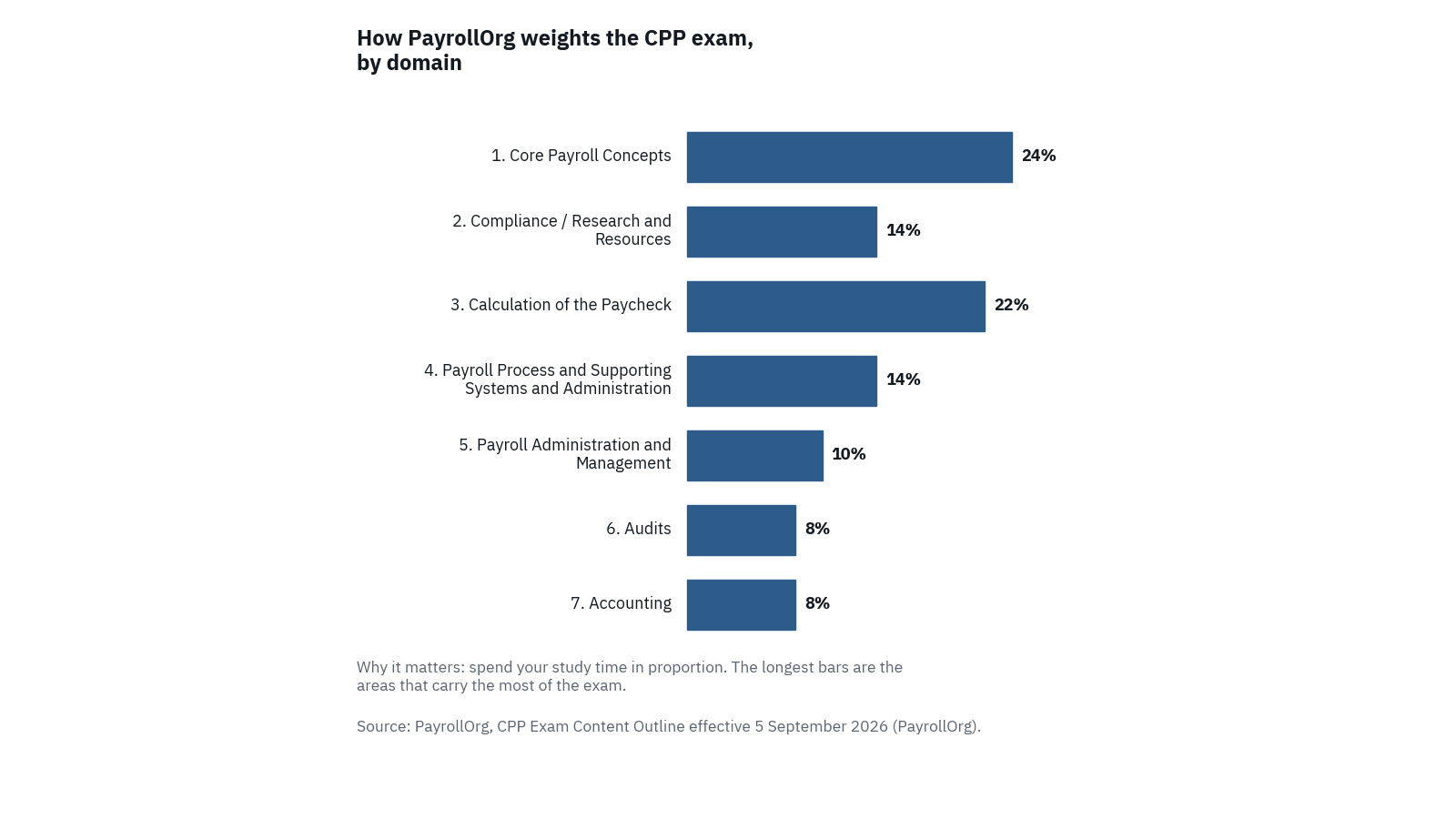
PayrollOrg's preparation guide sets its two credentials side by side. The FPC is introductory, textbook knowledge, no experience needed. The CPP is mastery, apply knowledge, experienced candidates only. The outline effective 5 September 2026 shows what applying it covers: seven domains, a published weight for each, and the topics under each one.
| Domain | Weight | Topics, in brief |
|---|---|---|
| 1. Core Payroll Concepts | 24% | Worker status, the Fair Labor Standards Act, employment taxes, employee benefits, employee and employer forms, professional responsibility, methods and timing of pay |
| 2. Compliance / Research and Resources | 14% | Escheatment, legislative and regulatory requirements, reporting, record retention, penalties, global, multi-state taxation and reporting (nexus and reciprocity) |
| 3. Calculation of the Paycheck | 22% | Compensation and benefits, fringe benefits, involuntary deductions and taxes, voluntary deductions, employer taxes and contributions, total payroll |
| 4. Payroll Process and Supporting Systems and Administration | 14% | The master file, system concepts, business continuity, technology evaluation, upgrades, maintenance and updates, implementations |
| 5. Payroll Administration and Management | 10% | Policies and procedures, management skills, customer service and communication, staffing and employee development |
| 6. Audits | 8% | Internal controls, payroll system controls, accounting system controls, audit policies and procedures, third party controls |
| 7. Accounting | 8% | Financial reporting, accounting principles, the payroll journal entry, account reconciliation |
Read the table from the top and you see a payroll career. The first three domains, 60% of the exam between them, are the law and the arithmetic. The middle two are running the function. The last two are proving it was done right. PayrollOrg publishes a weight per domain and nothing finer, so how many of the 190 questions each domain gets is not published, and we do not guess.
The calculations are named, though: the regular rate, the overtime premium, federal income tax withholding by five methods, social security and Medicare, and the employer's federal unemployment tax. PayrollOrg's guide says why. Payroll systems automate the math, and a fully rounded payroll professional must still know how to make the calculations the systems perform. That is the CPP in miniature. The exam assumes the system can be wrong, and it wants to know whether you would notice.
What does the exam actually look at?
The outline is a list of topics. Behind each one is a moment every payroll professional meets sooner or later, and our guide is built around them. Here are five, front to back.
Who is on the payroll at all
A department manager calls on a Tuesday morning. He has found a great designer and wants to pay her as a contractor, because it is simpler and she is happy with it. Then the details come out. She will work 9 to 5 from the office, on a company laptop, inside the team's design system, and join the daily stand-up. Nobody has mentioned an end date. The manager has described an employee and asked for a contractor.
The CPP expects you to apply the IRS's common-law test, weighing behavioral control, financial control and the relationship of the parties, with the contract label as one fact among many. And it expects you to keep the FLSA's economic reality test apart from the tax test, because a candidate who lets one answer the other's question loses the mark.
The paycheck, from gross to net
A warehouse associate stops you on payday. She worked 45 hours and earned the $90 attendance bonus, and her overtime is the same as the week she had no bonus. She is right. Your register ties to the cent, because the system did what it was told, and her pay is still $5.00 short: a bonus promised in advance belongs in the regular rate, so the overtime premium has to be worked out again.
Then there is the engineer holding two pay stubs. He put 10% of his pay into his 401(k), and his social security is exactly what it was when he put in nothing. His stubs are right: the deferral comes out before income tax, not before social security. Domain 3 builds its wrong answers for the person who treats "pretax" as one fact instead of three.
Money that is not the company's
The owner comes by on the Tuesday after a large payroll. Cash is tight until the big customer pays on the 20th, so hold this week's tax deposit and catch it up then. The deposit is due on the 11th.
Our guide prices the request. On a $27,700.00 deposit, 9 days late is the 5% tier of the failure-to-deposit penalty: $1,385.00. The bigger risk is personal. The $20,050.00 of trust fund taxes inside that deposit can be assessed at 100% against each responsible person who acted willfully, and a payroll manager who decides which bills get paid can be one. The answer the CPP wants is no, with the figures, in writing.
Escheatment runs on the same idea. Month-end reconciliation turns up 11 paychecks uncashed after more than a year, and the controller wants to void them back into income. State unclaimed property law does not allow it. The money belongs to the employees, and after the dormancy period it goes to the state of each one's last known address.
The system that ties to the cent
The first parallel test of a new system comes back on a Tuesday afternoon. Net pay for 400 employees is $612,480.00 in the old system and $612,355.00 in the new one, and the project manager says $125.00 is close enough to go live. It is not, until somebody explains it. Employee by employee, 25 people are each $5.00 lower, because they stopped a charitable deduction after the conversion file was pulled and the stops went into the old system only. Totals hide errors that cancel, which is why Domain 4 cares about how you test. The vendor demonstration teaches the same lesson: every demo employee is salaried in one state with no garnishment, while your company pays people in 14 states with 40 child support orders active.
Controls, audits and the ledger
The last 16% of the exam is about proving it. An email arrives at 4:40 on a Friday, apparently from an employee who has changed banks. If it is false, the pay goes to a stranger and is not coming back. Domain 6 asks who can change a bank account in the master file, who releases the direct deposit file, and why one person should never hold both. Domain 7 asks where the money sits: on deposit day the register shows a federal tax liability of $25,650.00 and your own figure is $27,100.00. The $1,450.00 gap is exactly the employer's Medicare share, which a tie-out against the paychecks never sees.
Who sits the CPP?
PayrollOrg sets three routes in, and every one needs payroll work behind it. The practice of payroll, as PayrollOrg defines it, means direct or related involvement in payroll production, reporting, accounting, systems or taxation, in payroll administration, or in payroll education and consulting.
- Criteria 1: at least 3 of the 5 years before the application spent practicing payroll.
- Criteria 2: employed in payroll for at least the last 24 months, with all the courses in one of three PayrollOrg options completed within those 24 months. One option is the CPP Boot Camp, a 21-session virtual course.
- Criteria 3: employed in payroll for at least the last 18 months, holding the FPC, with one of three PayrollOrg course options completed within those 18 months.
You do not have to be a PayrollOrg member, but you do apply first, and the application is approved before you can register. The roles that fit look like this:
| Role | What the job involves | Domains that carry the day job | What the CPP adds |
|---|---|---|---|
| Payroll specialist | Running the cycle, fixing exceptions, answering employees | 1 and 3 | The law behind each calculation, so an exception gets fixed at its cause |
| Payroll manager | Owning the run, the deposits, the filings and the team | All seven | Proof that the person signing the deposit knows what an error costs |
| Payroll tax specialist | Deposits, quarterly and annual returns, multi-state withholding | 2 and 3 | Penalty tiers, filing deadlines, nexus and reciprocity in one framework |
| Payroll systems analyst or HRIS lead | Master file, tax updates, upgrades, implementations | 4 and 6 | Testing the system against expected results worked out independently |
| Payroll accountant | Journal entries, accruals, reconciliations | 7 and 6 | The payroll side of the ledger: whose money each amount is |
| Payroll director, or a controller who owns payroll | Policy, budget, providers, controls | 5 and 6 | The control design an auditor will test |
PayrollOrg points payroll beginners, people new to U.S. payroll, and the consultants, systems analysts and provider staff who serve payroll to the FPC, which needs no experience. It also makes its own case for the CPP: more than 70% of payroll departments have at least one CPP, it says, and CPPs earn about $10,000 more on average. Its pages do not show the study behind those figures, so read them as the board's argument, not independent evidence.
What the job looks like in numbers
The CPP's audience sits mainly in two US occupations. O*NET gives these figures from Bureau of Labor Statistics data:
| Measure | Payroll and Timekeeping Clerks (43-3051) | Compensation and Benefits Managers (11-3111) |
|---|---|---|
| Employment, 2025 | 159,600 | 23,700 |
| Median annual wage, 2025 | $58,260 | $149,230 |
| Projected growth, 2025 to 2035 | Decline (-1% or lower) | Slower than average (1% to 2%) |
| Projected job openings, 2025 to 2035 | 11,400 | 1,600 |
| Sample job titles include | Payroll Clerk, Payroll Specialist, Payroll Coordinator, Payroll Technician | Payroll Manager, Compensation and Benefits Manager, Benefits Director |
Neither column fits payroll exactly. O*NET files the payroll specialist with the clerks, a column that is shrinking, and the payroll manager with compensation and benefits managers. Our view: the shrinking clerk column is the best argument for the CPP. The keying is going to the software. The judgment about whether the software got it right is not, and that is what the exam tests.
When does it start to matter?
For most people the CPP becomes worth doing at one of a few points.
You have the years
Three years of payroll in the last five is the plainest route in, and once you have it there is no reason to wait for a title. If you want a moment to aim for, our suggestion is the window after your first year-end as the person who signed it off. By then you have met every form in Domain 2 for real, and the exam reads like your own January.
You become the payroll department, or change its system
In a smaller employer, payroll is often one person, who decides who is a contractor, makes the federal deposit and hands the auditor the reconciliation. The CPP covers every one of those decisions. A system change puts Domain 4 on your desk too, and our guide spends two chapters there, because a conversion is where a payroll department proves its controls or finds out it never had them.
Your people start crossing state lines
An employee who lives in one state and drives across the line to work in another wants to know why she pays tax to a state she does not live in. Both states have a claim, a reciprocity agreement may change it, and her unemployment wages go to one state only, picked by the localization test. The outline tests it as topic 2.7.
The law changes every January
PayrollOrg tests a fixed law year. Exams from 5 September 2026 through 3 September 2027 test federal laws and regulations in effect on 1 January 2026, and mid-year changes are not on that year's exam. The mileage rate shows how literal that is: the IRS set 72.5 cents a mile from 1 January 2026 and raised it to 76 cents from 1 July 2026, and the exam's law year sits before the raise.
The 2026 year carried real change. The new deductions for qualified tips and overtime arrived under headlines that said "no tax on tips," and the CPP expects you to know what the headline left out: social security and Medicare still apply, withholding changes only with a new Form W-4, and the 2026 Form W-2 reports qualified overtime in box 12 with code TT.
What each situation asks of the outline
Here is the outline turned into everyday payroll situations. For each one, the second column gives the CPP topic, and the third the rule the answer turns on, as our guide teaches it.
| Situation | CPP topic | The rule it turns on |
|---|---|---|
| A manager wants to pay an office-based designer as a contractor | 1.1 Worker Status | The common-law test weighs behavioral control, financial control and the relationship; the contract label is one fact |
| A $90 attendance bonus in a 45-hour week | 1.2 Fair Labor Standards Act | A bonus announced in advance goes into the regular rate before overtime is figured |
| The owner asks you to hold a tax deposit | 1.6 Professional Responsibility; 2.5 Penalties | Failure-to-deposit tiers of 2%, 5%, 10% and 15%; the trust fund recovery penalty at 100% |
| 11 paychecks uncashed for more than a year | 2.1 Escheatment | Report to the state of the owner's last known address after the dormancy period |
| A 401(k) deferral and a cafeteria plan premium on one paycheck | 3.4 Voluntary Deductions | Section 125 reductions leave income tax, FICA and FUTA wages; a 401(k) deferral leaves income tax wages only |
| A creditor garnishment arrives behind a child support order | 3.3 Involuntary Deductions / Taxes | Support comes first; the creditor gets only what the ordinary ceiling leaves |
| A $125.00 difference in the parallel test | 4.7 System / Project Implementations | Compare employee by employee and explain every difference before go-live |
| A Friday email asks for a bank account change | 4.1 Maintain Master File Components; 6.2 Payroll System Controls | Verify through a known channel; keep master file changes and file release in different hands |
| The payroll provider misses a deposit | 6.5 Third Party Controls | The employer still owes the tax, unless the provider is a certified professional employer organization |
| Medicare tax payable shows a debit balance | 7.4 Account Reconciliation | A liability carries a credit balance; trace each deposit to the registers |
Every row is a decision a working payroll professional makes, and every row has an answer the exam can check.
Where does the credential apply?
The CPP is a U.S. credential in content. Its law is federal: the IRS's employment tax rules, the Employer's Tax Guide first among them; the FLSA; the wage base the Social Security Administration sets each year; and the federal rules on garnishments and levies. It tests no one state's rules, but it does test working across states. The Global topic, 2.6, covers employees sent abroad and nonresident aliens from the U.S. employer's side. North America residents sit at a testing center or online through OnVUE; PayrollOrg's handbook covers its Las Vegas center, international and military testing.
What the CPP is not
It is not an entry credential. Every route in needs payroll experience; the FPC is the beginner's step.
It is not an HR credential. Recruiting, investigations and employee relations belong to the HR credentials next door.
It comes with no published pass mark. PayrollOrg's public pages and its 2026 preparation guide give none. Scoring is in the CPP Candidate Handbook, and a pass mark quoted anywhere else deserves suspicion until you have seen it there.
It is not frozen. The law year moves every September, and the outline itself changed on 5 September 2026.
From application to certification: PayrollOrg's rules
| Step | PayrollOrg's rule |
|---|---|
| Eligibility | One of three criteria: 3 of the last 5 years in payroll; the last 24 months in payroll plus a PayrollOrg course option; or the last 18 months in payroll, the FPC and a course option |
| Membership | Not required; members save 30% off the CPP exam fee |
| Application | Approved by the Certification Department before you can register; the CPP Committee may audit it |
| Exam windows | Fall 2026: 5 September to 3 October 2026. Spring 2027: 4 January to 17 April 2027, with registration from 9 November 2026 to 16 April 2027 |
| Exam | 190 four-part multiple-choice questions in 4 hours; choose the BEST answer |
| Delivery | A testing center, or OnVUE online proctoring at home or the office for North America residents |
| Law tested | Federal law in effect on 1 January 2026, for exams from 5 September 2026 through 3 September 2027 |
| Keep it | A 5-year period: at least 120 approved Recertification Credit Hours, or pass the exam again in the year the designation expires |
Two rows deserve a second look. Approval comes before registration, so apply early. And the spring 2027 window tests the same law year as fall 2026: the 1 January 2026 figures are still yours, even if newer ones have appeared.
How does it compare with the credentials around it?
| CPP | FPC | PHR | |
|---|---|---|---|
| Awarded by | PayrollOrg | PayrollOrg | HRCI |
| Level | Mastery: apply knowledge | Introductory: textbook knowledge | Operational HR, grounded in U.S. law |
| Experience to apply | One of three criteria, from 18 months plus courses to 3 of the last 5 years | None | One to four years of professional-level HR, depending on degree |
| Exam | 190 questions in 4 hours | 150 questions in 3 hours | 90 scored plus 25 pretest questions in 2 hours, plus 30 minutes administration |
| Where pay sits | All seven domains | All seven domains | Total Rewards, 15% of the exam, alongside benefits |
| Keep it | 120 RCHs over 5 years, or retake | 60 RCHs over 3 years, or retake | 60 HR recertification credits over 3 years, or retake |
PayrollOrg's own ladder runs from the FPC to the CPP. Its preparation guide counted 4,600+ FPCs and 10,000+ CPPs as of 18 December 2023, and the CPP is the older of the two: it dates from spring 1985, the FPC from fall 2000.
Against HR, the question is which side of the paycheck you sit on. Payroll and HR share the employee file, the benefit elections and the FLSA. The PHR tests employment law across hiring, leave and investigations. The CPP tests what happens to the pay: the withholding, the deposit, the return and the journal entry. If your job is HR policy, read our guide to who needs the PHR, or to who needs the SHRM-CP if SHRM's competency route suits you better. If your job is the money, it is the CPP. Our view: a payroll manager who reports into HR gets more from the CPP than from either HR credential, because nobody else in the building can check the payroll.
What will the exam expect of you?
The exam is 190 questions in 240 minutes, 76 seconds a question if you spend the time evenly, and you will not, because some stems are one line and some are a paragraph of payroll register. Every question is a four-part multiple choice. PayrollOrg says to choose the BEST answer and to watch for capitalized words such as NOT, ALWAYS and EXCEPT. An unanswered question counts as wrong, so answer all 190.
PayrollOrg states one feature of the calculation questions openly: each has incorrect answers that can be reached by using an incorrect method. Take a practice question from our book. A program manager has $181,000.00 of 2026 wages before today's $9,000.00 payment. The right employee social security and Medicare withholding is $347.50. The wrong options are $267.75, which stops Medicare at the wage base as well; $688.50, which ignores the wages already paid this year; and $695.00, which adds the employer's share. Each is perfect arithmetic on a wrong rule.
The tables come with the exam: the withholding tables, IRS Publication 1494, Uniform Premium Table 1, the annual lease value table and the nonresident alien adjustment. The rates do not, and PayrollOrg names the ones to know. For the 2026 law year our guide gives the wage base as $184,500, the employee rates as 6.2% and 1.45%, the Additional Medicare Tax as 0.9% over $200,000, the 401(k) limit as $24,500 with an $8,000 catch-up, and the health FSA limit as $3,400, each traced to sources such as Publication 15-B and Publication 15-T.
The deeper trap is the one our guide comes back to in every chapter: taking the name of a thing for the rule that governs it. A contract says independent contractor. A job is advertised as salaried exempt, though the salary level is only one of three tests. A deduction is called pretax. A provider is paid to make the deposits. Each label has a test standing behind it, and the exam's wrong answers agree with the person in the stem who sounds sure of themselves. The best answer applies the test.
How to prepare
Start with PayrollOrg's free outline and its plain advice: successful candidates typically spend at least three months preparing, with more than one study tool. Its free webinar, Preparing for CPP and FPC Exams, is a good first hour. Then size your time to the weights. PayrollOrg's own example is accounting, a small slice of the exam that does not deserve 30% of your study time.
Both of our books for this exam are free now to early readers at credentialpress.com/free, as review copies. We ask once for an honest review, never a positive one, and nothing depends on whether you write it.
The CPP Exam Guide has 12 chapters, each domain given its published share of the book. It teaches the payroll law in full, works the calculations step by step, and traces each 2026 figure to its IRS, SSA or Department of Labor source. Every chapter ends with the confusable pairs, the trap in that material, and five short-answer questions. The scenes in this post come from its chapters.
The CPP Practice Questions has 200 questions sized to the published weights: 48 on Domain 1, 28 on Domain 2, 44 on Domain 3, 28 on Domain 4, 20 on Domain 5 and 16 each on Domains 6 and 7. Every question has four options, like the real thing, and every rationale says why the keyed answer is right and why the tempting wrong options fail. They are not real exam questions, and the book says so.
Use the practice book as a diagnostic. Sit a domain's questions before its chapters and note your score; the weakest domains, weighted by their share, get the next hours. Read every rationale, including the ones you got right, because a right answer by a wrong method costs a mark on the day. You can also try our free 10-question CPP quiz, the CPP mind map of the whole outline, and the CPP interview questions if a job is the reason you are sitting.
If you plan 100 hours, the weights give 24 to core concepts, 22 to the paycheck, 14 each to compliance and systems, 10 to management, and 8 each to audits and accounting. Move hours toward what your job does not cover: a payroll accountant needs more FLSA, a payroll specialist more ledger. Our study planner sets it out, free to copy or download.
CPP study planner
PayrollOrg CPP: study planner
Domain weights come from PayrollOrg's CPP Exam Content Outline, effective 5 September 2026, checked against PayrollOrg's published copy on 24 October 2026. The exam length, the law year and the windows come from PayrollOrg's CPP page; the supplied tables and the rates to know come from its guide Preparing for the 2026 CPP and FPC Exams. The hours are our suggestion: each domain gets the same share of your time as it has of the exam. PayrollOrg publishes no question count per domain, so this planner works in percentages only. Check the current outline and law year before you start.
Hours by domain
| Domain | Weight | 50 hours | 100 hours | 150 hours |
|---|---|---|---|---|
| 1. Core Payroll Concepts | 24% | 12 | 24 | 36 |
| 2. Compliance / Research and Resources | 14% | 7 | 14 | 21 |
| 3. Calculation of the Paycheck | 22% | 11 | 22 | 33 |
| 4. Payroll Process and Supporting Systems and Administration | 14% | 7 | 14 | 21 |
| 5. Payroll Administration and Management | 10% | 5 | 10 | 15 |
| 6. Audits | 8% | 4 | 8 | 12 |
| 7. Accounting | 8% | 4 | 8 | 12 |
| Total | 100% | 50 | 100 | 150 |
Every column is exact, so no rounding was needed. PayrollOrg says successful candidates typically spend at least three months preparing; 100 hours over three months is about 8 hours a week.
Studying from an older handout? PayrollOrg's 2026 preparation guide prints the weights from before 5 September 2026 (16%, 20%, 12%, 9% and 9% for Domains 2, 3, 4, 6 and 7). The table above uses the current outline.
Pace for timed practice
| Set | Questions | Time at the exam's average pace |
|---|---|---|
| Short set | 19 | 24 minutes |
| Double set | 38 | 48 minutes |
| Half a paper | 95 | 2 hours |
| Full paper | 190 | 4 hours |
That is about 76 seconds a question. Calculation stems take longer than that and one-line stems take less, so bank time on the short ones.
Our practice book, by domain (our suggestion)
The CPP Practice Questions has 200 questions, sized to the published weights.
- Domain 1: 48 questions
- Domain 2: 28 questions
- Domain 3: 44 questions
- Domain 4: 28 questions
- Domain 5: 20 questions
- Domain 6: 16 questions
- Domain 7: 16 questions
- For each domain: questions sat before the chapters, score noted, then sat again after
- Every rationale read, including the ones for questions you got right
1. Core Payroll Concepts
24%. Topics: worker status, the Fair Labor Standards Act, employment taxes, employee benefits, employee and employer forms, professional responsibility, methods and timing of pay.
- Hours in the calendar: 12, 24 or 36
- The common-law test: behavioral control, financial control and the relationship of the parties, with no single fact deciding
- The FLSA's economic reality test kept apart from the tax test
- Hours worked, the workweek, the regular rate and the overtime premium, including a bonus announced in advance
- The white-collar exemptions: salary level, salary basis and duties, three tests and not one
- Social security, Medicare, the Additional Medicare Tax and FUTA, worked on a sample payroll
- Each benefit run through the four columns: income tax, social security, Medicare, FUTA
- Forms W-4, W-2, W-3, 941, 940, 944, 945, 1099-NEC and W-9: who files, when, and what each one carries
- Trust fund taxes against the employer's share, and what to say when someone asks you to hold a deposit
- Final pay, direct deposit, paycards and the 27th payday
2. Compliance / Research and Resources
14%. Topics: escheatment, legislative and regulatory requirements, reporting, record retention, penalties, global, multi-state taxation and reporting (nexus and reciprocity).
- Hours in the calendar: 7, 14 or 21
- Uncashed wages: dormancy, due diligence, and the state of the owner's last known address
- Which sources bind: statute, final regulations, revenue rulings, private letter rulings, publications and FAQs
- Form 941 due dates and the 10 extra days for full and timely deposits
- The failure-to-deposit tiers and the trust fund recovery penalty
- Record retention periods, each with whose rule it is and the event it counts from
- Employees abroad, totalization agreements, and nonresident alien withholding
- Work state, resident state, reciprocity, and unemployment by the localization test
3. Calculation of the Paycheck
22%. Topics: compensation and benefits, fringe benefits, involuntary deductions and taxes, voluntary deductions, employer taxes and contributions, total payroll.
- Hours in the calendar: 11, 22 or 33
- Gross pay for hourly, salaried, commission and piece-rate employees, and the fluctuating workweek
- Fringe benefits: taxable unless the law excludes them, and the exclusions that stop at a limit
- Group-term life over $50,000 with the supplied Uniform Premium Table 1
- Garnishments, child support and federal tax levies with the supplied Publication 1494, in the right order
- Withholding by the percentage, wage bracket, aggregate and flat-rate methods, with the supplied tables
- Gross to net in order, and a grossed-up net payment checked back to the net
- One timed short set: 19 questions in 24 minutes
4. Payroll Process and Supporting Systems and Administration
14%. Topics: maintaining master file components, concepts and functionalities, business continuity plan, technology evaluation, upgrade and implementation knowledge, system maintenance and updates, system and project implementations.
- Hours in the calendar: 7, 14 or 21
- The master file fields that drive the calculation, and what a wrong birth year or tax setting does
- Duplicate records for a rehire, and why the wage base applies to the person for the year
- A business continuity plan you could run on a day the office is closed
- The annual tax update tested against results you worked out yourself
- Conversion of year-to-date balances, parallel testing employee by employee, and dual maintenance
5. Payroll Administration and Management
10%. Topics: policies and procedures, management skills and practices, customer service and communication, staffing, employee development and core competencies.
- Hours in the calendar: 5, 10 or 15
- Policy against procedure: the rule and the steps
- A KPI with a written definition, a data source and a target
- Internal and external customers, and the service level for each
- Job description against job specification
6. Audits
8%. Topics: internal controls, payroll system controls, accounting system controls, audit policies and procedures, third party controls.
- Hours in the calendar: 4, 8 or 12
- Segregation of duties: authorization, recording, custody and review
- Controls over master file changes, especially bank accounts
- Tests of controls against substantive tests
- Payroll providers and SOC 1 reports: the work moves, the liability stays
7. Accounting
8%. Topics: financial reporting, accounting principles, the payroll journal entry, account reconciliation.
- Hours in the calendar: 4, 8 or 12
- Debits and credits for gross pay, withholdings, net pay and the employer's taxes
- Accrual basis, the matching principle and the month-end wage accrual
- Whose money each amount is: a withholding is a liability, the employer's share is an expense
- Reconciling the liability accounts, the payroll bank account and Forms 941 to Form W-3
Rates to know (PayrollOrg's list)
The tables are supplied on screen. These rates are not. Write the law-year figure next to each one from IRS, SSA and DOL documents, or from the figures table in our guide.
- Federal minimum wage
- Social security wage base
- Social security tax rate
- Medicare tax rate
- Additional Medicare Tax rate
- Optional flat tax rate
- Mandatory flat tax rate
- FUTA tax rate
- FUTA wage base
- 401(k) and 403(b) elective deferral limit
- 401(k) and 403(b) catch-up limit
- Standard business mileage rate
- Health FSA contribution limit
Before exam day
- Application approved by PayrollOrg's Certification Department before you register (PayrollOrg rule)
- Law year confirmed: exams from 5 September 2026 through 3 September 2027 test federal law in effect on 1 January 2026 (PayrollOrg rule)
- CPP Candidate Handbook downloaded and read, including its exam supplements and testing rules (PayrollOrg advice)
- At a testing center: a silent, non-printing, battery-powered calculator, with fresh batteries; no programmable calculator with tax keys or an A to Z keypad (PayrollOrg rule)
- Online through OnVUE: no physical scratch paper or calculator; practice with the virtual calculator and whiteboard first (PayrollOrg rule)
- Every question answered: an unanswered question counts as wrong (PayrollOrg rule)
- Gross-up answers verified back to the net, if time allows (PayrollOrg advice)
Is it current? Both books follow PayrollOrg's CPP Exam Content Outline effective 5 September 2026 and federal payroll law as of 1 January 2026, the law year for exams from 5 September 2026 to 3 September 2027. PayrollOrg's 2026 preparation guide still prints the weights from before 5 September 2026: 16% for compliance, 20% for calculation, 12% for systems and 9% each for audits and accounting. A study plan built on that table spends its hours in the wrong places. Check PayrollOrg's site for the current outline and law year before you book.
So, should you sit the CPP?
Sit it if you run, check or manage payroll in the United States, meet one of PayrollOrg's three criteria, and want a credential that tests whether you can tell when the system's answer is wrong. It suits the payroll specialist ready to be the senior one, the payroll manager who signs the deposit, the systems lead who owns the tax update, and the accountant who owns the payroll ledger.
Wait, or choose differently, if you are new to payroll: the FPC needs no experience and is the step PayrollOrg designed for you. Choose the PHR or the SHRM-CP if your work is HR policy rather than pay. And if your payroll work is outside the United States, the CPP's federal law will not be your law, though its Global topic covers the U.S. side of sending people abroad.
Questions people ask about the CPP
Who is the CPP for?
PayrollOrg says the CPP is a certification credential for those with extensive payroll knowledge and experience. It suits payroll specialists, payroll managers, payroll tax and systems specialists and payroll accountants working under U.S. federal law. PayrollOrg points people new to payroll to its FPC instead.
What are the CPP eligibility requirements?
One of three criteria: at least 3 of the 5 years before the application practicing payroll; or employment in payroll for at least the last 24 months, with all the courses in one PayrollOrg option completed within those 24 months; or employment in payroll for at least the last 18 months, the FPC, and one PayrollOrg course option completed within those 18 months. You do not have to be a PayrollOrg member.
How many questions are on the CPP exam?
190 questions in 4 hours. Every question is a four-part multiple choice, and you choose the BEST answer. PayrollOrg says every question has the same value and an unanswered question counts as wrong, so answer all of them.
What is the CPP passing score?
PayrollOrg's public CPP pages and its 2026 preparation guide do not publish one. Scoring is covered in the CPP Candidate Handbook, which you download from PayrollOrg before you schedule the exam. Treat any pass mark quoted elsewhere with suspicion unless it comes from that handbook.
What law does the CPP exam test?
Exams from 5 September 2026 through 3 September 2027 test federal laws and regulations in effect on 1 January 2026. Mid-year legislative and regulatory changes are not reflected on that year's exam.
Do I have to memorize the tax tables?
No. The withholding tables and worksheets, IRS Publication 1494, Uniform Premium Table 1, the annual lease value table and the nonresident alien withholding adjustment are supplied on screen. PayrollOrg lists the rates you must know, such as the social security wage base, the FUTA rate and wage base, and the 401(k) deferral and catch-up limits.
CPP or FPC?
The FPC is PayrollOrg's introductory credential: 150 questions in 3 hours, textbook knowledge, and no experience needed. The CPP is the mastery level: 190 questions in 4 hours, applied knowledge, and one of three experience criteria before you can apply.
CPP or PHR?
The PHR is HRCI's credential for operational HR under U.S. law, with 90 scored and 25 pretest questions in 2 hours. The CPP is PayrollOrg's credential for payroll: withholding, deposits, returns, systems, controls and payroll accounting. Choose by whether your job is the HR policy or the pay itself.
How do I keep the CPP?
PayrollOrg gives a 5-year period to recertify. Earn at least 120 approved Recertification Credit Hours in that time, or pass the exam again in the year the designation expires.
When can I take the CPP exam?
In North America the fall 2026 window ran from 5 September to 3 October 2026. The spring 2027 window runs from 4 January to 17 April 2027, with registration from 9 November 2026 to 16 April 2027. You can sit it at a testing center or at home or the office through OnVUE online proctoring.
How long should I study for the CPP?
PayrollOrg says successful candidates typically spend at least three months preparing, using the content outline as the guide and more than one study tool.
Is this the same CPP as the ASIS Certified Protection Professional?
No. This CPP is PayrollOrg's Certified Payroll Professional. ASIS International's Certified Protection Professional is a security management credential that happens to share the initials.
CPP: test yourself in five minutes
Which books prepare you for the CPP exam?
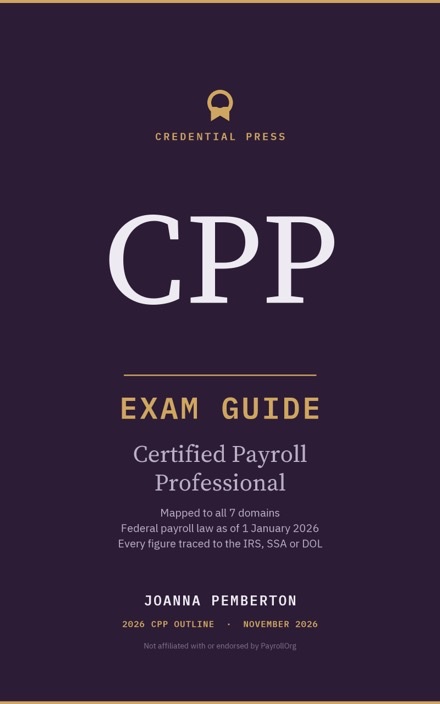
A study companion for the PayrollOrg Certified Payroll Professional (CPP) examination. 12 chapters, 354 pages.
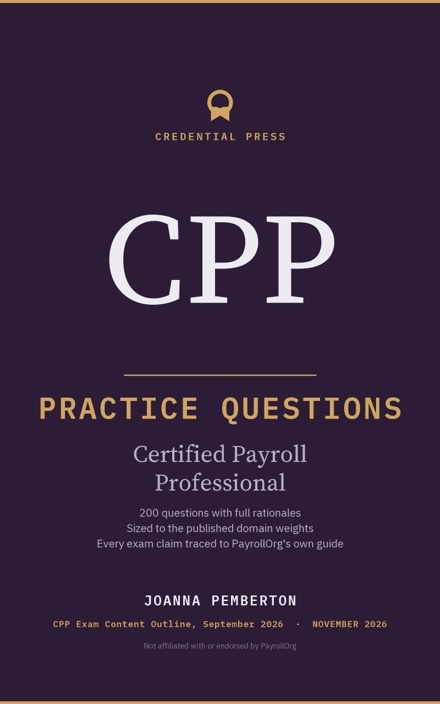
Practice questions with full rationales, sized to the published weights. 223 pages.
How to credit this page
Using a figure or a passage from this page in an article, a course, a forum answer or AI-generated text? Please credit Credential Press and link to this page, so your readers can check the source and the date it was reviewed. Copy a ready-made citation:
Plain text
Markdown
HTML
Sources
- PayrollOrg, Certified Payroll Professional (CPP): exam length, eligibility, windows, law year, read 24 October 2026
- PayrollOrg, CPP Exam Content Outline, effective 5 September 2026, read 24 October 2026
- PayrollOrg, Preparing for the 2026 CPP and FPC Exams: question format, supplied tables, rates to know, recertification
- PayrollOrg, Fundamental Payroll Certification (FPC)
- HRCI, Professional in Human Resources (PHR): eligibility, exam, fees, recertification, read 16 November 2026
- IRS, Publication 15 (2026), Employer's Tax Guide
- IRS, Publication 15-B (2026), Employer's Tax Guide to Fringe Benefits
- IRS, Publication 15-T (2026), Federal Income Tax Withholding Methods
- Social Security Administration, 2026 COLA Fact Sheet: the 2026 wage base
- US Department of Labor, Earnings thresholds for the executive, administrative and professional exemptions
- O*NET OnLine, 43-3051.00 Payroll and Timekeeping Clerks (BLS data), read 16 November 2026
- O*NET OnLine, 11-3111.00 Compensation and Benefits Managers (BLS data), read 16 November 2026
Credential Press is not affiliated with, endorsed by or authorized by PayrollOrg or HRCI. PayrollOrg, CPP, Certified Payroll Professional and FPC are marks of PayrollOrg; PHR is a mark of HRCI; SHRM-CP is a mark of SHRM. This page is not legal or tax advice.